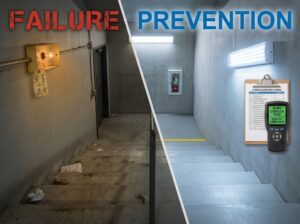
Equipment installed. Systems functional. Fire protection present. But equipment misused creates violations as serious as equipment absence. Fire doors propped open defeat compartmentalization. Emergency lighting units covered obstruct illumination. Fire extinguishers blocked prevent access. Sprinkler clearances violated compromise effectiveness.
Generic fire safety training teaches concepts: “Fire doors must remain closed.” “Emergency lighting provides safe evacuation.” “Fire extinguishers must be accessible.” Concepts understood abstractly. Behavior unchanged practically.
48Fire Protection observed pattern: Facilities receiving generic training continued equipment misuse. Facilities receiving customized fire safety training addressing specific operational behaviors eliminated misuse. Difference wasn’t information quantity. Difference was information specificity—training customized to actual facility behaviors, actual equipment locations, actual operational conflicts creating misuse.
Four equipment misuse problems. Four root causes. Four customized training solutions. Four behavioral changes documented.
—
MISUSE PROBLEM #1: Fire Doors Propped Open with Improvised Wedges
The Observable Problem:
Distribution facility, 180,000 sq ft, 240 employees. Eight fire-rated doors throughout facility. Annual inspection: Six of eight doors found propped open using door wedges, blocks, or furniture. Violation cited: “Fire doors compromised—compartmentalization defeated.”
The Surface Explanation:
“Doors inconvenient. Employees move materials between areas frequently. Stopping to open doors each time slows workflow. Doors propped open for operational efficiency.”
The Root Cause Analysis (48Fire Protection Investigation):
Why truly propped open?
Root Cause 1: Operational Conflict Not Addressed
Material flow requires passage through fire doors 40-60 times daily per door. Self-closing doors create bottleneck. No alternative passage exists. Operational need real—but fire safety requirement also real. Conflict unresolved creates behavior: prop door, eliminate bottleneck.
Root Cause 2: Fire Door Function Unknown
Interviews with employees: “Why must doors remain closed?” Responses: “Fire code requires it” (48%), “Don’t know” (32%), “Prevents drafts” (12%), “Company policy” (8%). Virtually no employees understood actual function: 90-minute fire/smoke barrier containing fire to origin area, protecting evacuation routes, buying time for safe evacuation.
Without understanding WHY, rule seems arbitrary. Arbitrary rules broken when inconvenient.
Root Cause 3: Belief That “Quick” Propping Harmless
“Only propped for 20 minutes.” “Just while we move this shipment.” “We close them at end of day.” Belief: Temporary propping doesn’t create serious risk. Reality: Fire doesn’t schedule itself around shipping schedules. Door propped during fire = door useless.
Root Cause 4: Alternative Solutions Unknown
Magnetic hold-open devices exist (releasing during alarm). Employees unaware. Facility management unaware. Everyone assumed: Either doors closed (inconvenient) or doors propped (violation). Third option never considered.
Generic Training Response:
“Fire doors must remain closed. Never prop doors open. Propping doors violates fire code.”
Employees: “We understand. We’ll try to remember.” (But operational conflict unaddressed, behavior continues)
Customized Training Solution (48Fire Protection):
Component 1: Function Education at Actual Doors
Walk employees to actual fire doors. Point to door label: “See this? 90-minute rated fire door. This door contains fire for 90 minutes—but only if closed. Watch.” Close door. “When closed, this creates barrier. Smoke can’t pass. Fire can’t spread. Evacuation routes protected.” Open door. “Now what happens? Barrier gone. Smoke passes freely. Fire spreads. People evacuating breathe smoke. This door isn’t arbitrary rule—it’s life safety barrier.”
Employees now understand FUNCTION, not just rule.
Component 2: Operational Conflict Acknowledgment
“We know you move materials through here 50 times daily. We know self-closing doors slow work. This creates real operational challenge. Propping doors understandable response—but creates life safety risk. Let’s solve operational problem differently.”
Acknowledging operational reality creates employee buy-in.
Component 3: Alternative Solution Implementation
“Magnetic hold-open devices can hold doors open during normal operations. During fire alarm, magnets release automatically. Doors close. Barrier restored. Operational convenience maintained. Fire safety maintained.” Demonstrate device. Show automatic release during alarm test.
Providing solution eliminates conflict driving behavior.
Component 4: Temporary Passage Protocol
“When moving materials, door can be held open during active passage—but person must remain present holding door. When passage complete, door closes. Never wedge, never walk away leaving propped.”
Practical protocol balancing safety and operations.
Behavioral Change Measured:
Pre-customized training:
- 6 of 8 doors propped (75%)
- Employees aware propping violates code but continued behavior
- No understanding of door function
- No alternative solutions implemented
Post-customized training:
- Magnetic hold-open devices installed at 6 high-traffic doors
- 0 of 8 doors propped open (0%)
- Follow-up inspection (12 months later): 0 violations
- Employee interviews: 92% could explain fire door function accurately
Result: Problem eliminated through customized training addressing operational conflict, building understanding, and providing alternatives—not just repeating prohibition.
—
MISUSE PROBLEM #2: Emergency Lighting Units Covered or Obstructed
The Observable Problem:
Manufacturing facility, 95,000 sq ft, 160 employees. 48 emergency lighting units throughout facility. Quarterly inspection: 14 units covered with cardboard, plastic sheeting, or accumulated dust/debris. Violation cited: “Emergency lighting obstructed—illumination compromised.”
The Surface Explanation:
“Units get dusty in manufacturing environment. Cardboard prevents dust accumulation. Plastic sheeting protects units.”
The Root Cause Analysis:
Root Cause 1: Emergency Lighting Function Misunderstood
Employees believed emergency lighting functioned like regular lighting—turned on when needed, could be cleaned/maintained as regular fixtures. Didn’t understand emergency lights must activate INSTANTLY during power failure. Covering prevents immediate illumination. Dust accumulation blocks light output (reducing 1.2 foot-candles to 0.6-0.8, below NFPA 101 minimum 1.0 foot-candles).
Root Cause 2: Maintenance Responsibility Unclear
Who maintains emergency lighting? “Facilities department” (28% of responses). “Don’t know” (52%). “Not my job” (20%). Unclear ownership created orphaned equipment. Nobody felt responsible for keeping units clean.
Root Cause 3: Illumination Requirements Unknown
Interviews: “How much light must emergency lighting provide?” “Enough to see” (38%), “Don’t know” (48%), “Same as regular lights” (14%). Zero employees knew NFPA 101 requirement: 1.0 foot-candles minimum. Can’t maintain standard you don’t know exists.
Root Cause 4: Testing Procedures Unknown
“When were emergency lights last tested?” “Don’t know” (82%). “Recently” (18%). Annual 90-minute load testing requirement unknown. Monthly 30-second functional testing unknown. Testing creates accountability for maintenance. No testing = no accountability.
Generic Training Response:
“Emergency lighting provides illumination during power failures. Don’t block emergency lights.”
Employees: “Okay.” (But underlying knowledge gaps unaddressed)
Customized Training Solution:
Component 1: Immediate Illumination Demonstration
Facility-wide training: Dim regular lights. “Watch emergency lighting.” Activate emergency system. Lights illuminate instantly. “Measure illumination.” Use light meter at floor level: 1.2 foot-candles. “NFPA 101 requires minimum 1.0 foot-candles. We measure 1.2—good. Now watch what happens when units covered.” Place cardboard over one unit. Measure again: 0.4 foot-candles. “Below minimum. Can’t see exit route safely. This is why covering units dangerous.”
Visual demonstration creates understanding generic lecture cannot.
Component 2: Backup Battery Education
Open emergency lighting unit (demonstration unit). Show backup battery. “This battery provides power when main power fails. Battery maintains illumination 90+ minutes minimum—long enough for safe evacuation and emergency response. Annual testing verifies 90-minute capability. This unit tested [date], verified 92 minutes. See test sticker.”
Making internal components visible creates equipment respect.
Component 3: Maintenance Responsibility Assignment
“Operations team: You’re responsible for monthly 30-second test—press test button, verify light activates, record on checklist. Facilities team: You’re responsible for annual 90-minute load test—full discharge test, verify duration, document results. All employees: You’re responsible for reporting covered, obstructed, or non-functional units immediately.”
Clear responsibility creates accountability.
Component 4: Cleaning Protocol
“Dusty environment requires regular cleaning. Clean units monthly using dry cloth—no cardboard covers, no plastic sheeting. If dust accumulation severe, notify facilities for cleaning. Never cover units attempting to ‘protect’ them—covering creates greater problem than dust.”
Practical solution to legitimate concern (dust) without compromising safety.
Behavioral Change Measured:
Pre-customized training:
- 14 of 48 units covered/obstructed (29%)
- Zero employees knew NFPA 101 illumination requirement
- No testing conducted (no 30-second monthly, no 90-minute annual)
- Maintenance responsibility unclear
Post-customized training:
- 0 of 48 units covered/obstructed (0%)
- 86% employees knew 1.0 foot-candles minimum requirement
- Monthly 30-second testing implemented (documented on facility checklist)
- Annual 90-minute load testing scheduled and completed
- Illumination measured quarterly: All units 1.1-1.3 foot-candles (maintained above minimum)
Result: Equipment misuse eliminated through understanding function, seeing demonstration, assigning responsibility, and providing proper maintenance protocol.
—
MISUSE PROBLEM #3: Fire Extinguishers Blocked by Storage
The Observable Problem:
Warehouse facility, 240,000 sq ft, 320 employees. 42 fire extinguishers wall-mounted throughout facility. Annual inspection: 18 extinguishers blocked by pallets, boxes, equipment, or merchandise. Violation cited: “Fire extinguisher access obstructed—emergency response delayed.”
The Surface Explanation:
“Storage space limited. Materials placed in available floor space. Didn’t realize extinguishers blocked.”
The Root Cause Analysis:
Root Cause 1: Extinguisher Locations Not Recognized
Employees moved materials without awareness extinguishers present. Red units on walls not registered as “equipment requiring access clearance.” Generic “don’t block fire extinguishers” training ineffective when employees don’t actively notice extinguishers daily.
Root Cause 2: Access Requirement Not Understood
“How much clearance required?” “Don’t know” (74%). “A foot?” (16%). “Arm’s reach?” (10%). No employees knew practical standard: Clear path, immediately visible, accessible within 3-5 seconds. Vague instruction “keep accessible” yielded vague compliance.
Root Cause 3: Emergency Response Scenario Not Visualized
“In fire emergency, how would you use extinguisher?” “Grab it and spray” (62%). “Don’t know, never trained” (28%). “Call 911 first” (10%). Employees couldn’t visualize emergency scenario requiring rapid extinguisher access. Abstract requirement (“keep clear”) doesn’t motivate behavior like concrete scenario visualization (“fire starts, you need extinguisher NOW, pallets blocking = delay = fire spreads”).
Root Cause 4: Storage Decision Framework Absent
Employees making storage decisions lacked framework: “Can I place materials here?” No decision tree. No clear “yes/no” guidance. Result: Materials placed anywhere convenient, extinguishers coincidentally blocked.
Generic Training Response:
“Fire extinguishers must remain accessible. Don’t place materials in front of extinguishers.”
Employees: “Understood.” (But extinguisher locations unknown, clearance undefined, behavior unchanged)
Customized Training Solution:
Component 1: Facility-Wide Extinguisher Walk
Walk entire facility. Stop at each extinguisher: “This is extinguisher location 1. Everyone look. Notice red unit. Notice wall mount. Notice location relative to work areas.” Repeat at all 42 locations. “Now you know where every extinguisher is. Not abstract—actual locations in your facility.”
Physical identification creates location awareness generic training cannot.
Component 2: Access Standard Demonstration
Stand at extinguisher. “Emergency happens. I need extinguisher.” Walk directly to unit, pull from wall: 3 seconds. “That’s accessible.” Place pallet in front. Attempt same access. Must move pallet first: 18 seconds. “That’s obstructed. 15-second delay. Fire spreads significantly in 15 seconds. This is why clearance matters.”
Timed demonstration creates urgency abstract instruction lacks.
Component 3: Emergency Scenario Training
“Small fire starts at workstation. Electrical equipment. You smell smoke. You see flames. What do you do?” Walk through decision tree: “Assess fire size—small, contained? Pull fire alarm first—always. Then: Can you safely extinguish? If yes, grab nearest extinguisher. Where is it? [Employee identifies location.] Can you reach it quickly? If blocked, fire grows while you move obstacles. If clear, extinguish immediately.”
Scenario visualization creates behavioral motivation.
Component 4: Storage Decision Framework
“Before placing materials anywhere, ask: Am I within 36 inches of fire extinguisher? YES = Find different location. NO = Acceptable. Simple decision rule.”
Provide measuring tape and 36-inch marker at common storage decision points. “If unsure, measure.”
Clear decision framework prevents unintentional blocking.
Behavioral Change Measured:
Pre-customized training:
- 18 of 42 extinguishers blocked (43%)
- Employees unable to identify extinguisher locations
- No understanding of access time impact
- No storage decision framework
Post-customized training:
- 1 of 42 extinguishers temporarily blocked (2%)—quickly corrected when identified
- 94% employees could identify nearest extinguisher to their work area
- Quarterly inspections: 0-1 blocked extinguishers (98% compliance sustained)
- Storage teams using 36-inch decision rule routinely
Result: Equipment misuse nearly eliminated through location identification, access demonstration, scenario training, and practical decision framework.
—
MISUSE PROBLEM #4: Sprinkler Clearance Violations from Vertical Storage
The Observable Problem:
Retail facility, 125,000 sq ft, 195 employees. Ceiling-mounted sprinkler system, 280 sprinkler heads. Annual inspection: 34 locations where merchandise stored within 18-inch clearance below sprinkler heads. Violation cited: “Sprinkler clearance violated—spray pattern obstructed.”
The Surface Explanation:
“Vertical storage maximizes space. Shelving reaches near ceiling. Merchandise stacked high.”
The Root Cause Analysis:
Root Cause 1: 18-Inch Requirement Unknown
“How much clearance required below sprinklers?” “Don’t know” (88%). “A foot?” (8%). “Don’t block them” (4%). 18-inch requirement unknown to 88% of employees making storage decisions.
Root Cause 2: Measurement Challenge
“How do you know if within 18 inches?” “Guess” (52%). “Looks okay” (38%). “Don’t measure” (10%). Without measurement tool or visual marker, employees couldn’t determine compliance even if requirement known.
Root Cause 3: Spray Pattern Function Not Understood
“Why 18 inches?” “Fire code” (44%). “Don’t know” (48%). “Safety reason” (8%). Virtually no employees understood: Sprinkler activates, sprays water in specific pattern downward and outward. Obstructions within 18 inches deflect spray, preventing water from reaching fire below. Understanding function creates compliance motivation.
Root Cause 4: Conflict Between Space Maximization and Clearance
Retail operation requires maximum merchandise display. Vertical space valuable. Storage maximization incentivized. Fire safety clearance requirements not incentivized. Competing priorities: Revenue (more merchandise displayed) vs. compliance (18-inch clearance maintained). Without understanding clearance importance, revenue priority wins.
Generic Training Response:
“Maintain 18-inch clearance below all sprinklers. Don’t store materials within clearance zone.”
Employees: “Okay.” (But requirement unknown, measurement method absent, function not understood, competing incentives unaddressed)
Customized Training Solution:
Component 1: Spray Pattern Demonstration
Facility training area: Activate demonstration sprinkler (water collection system). “Watch spray pattern.” Sprinkler activates, water sprays downward and outward in cone pattern. “Water reaches floor, covers approximately 12-foot radius.” Place obstruction 12 inches below sprinkler, activate again. “Water deflects. Floor coverage reduced 60%. Fire below obstruction doesn’t receive water. Sprinkler present but ineffective.”
Visual demonstration creates understanding words cannot convey.
Component 2: 18-Inch Standard Education with Measurement Tool
“NFPA 13 requires 18-inch clearance. Why 18? Spray pattern requires this vertical distance to develop properly.” Provide each department 18-inch measurement stick (painted bright orange). “Before stocking high shelves, measure. If stick fits vertically between merchandise and sprinkler, clearance adequate. If stick doesn’t fit, clearance violated. Simple tool, simple test.”
Measurement tool eliminates guessing, enables compliance.
Component 3: Ceiling Clearance Markers
Install visual markers (reflective tape) on walls at 18-inch-below-sprinkler height. “See orange line? That’s maximum storage height maintaining clearance. Merchandise above line = violation. Merchandise below line = compliant.”
Visual reference creates constant reminder generic training doesn’t provide.
Component 4: Revenue Protection Through Compliance
“Sprinkler clearance violations risk: Inspector closes sections until corrected. Merchandise inaccessible during correction. Sales lost. Compliance inspection allows continuous operations. Clearance compliance protects revenue by preventing forced closure.”
Reframing clearance as revenue protection aligns priorities.
Behavioral Change Measured:
Pre-customized training:
- 34 clearance violations (12% of 280 sprinkler heads)
- 88% employees unaware of 18-inch requirement
- No measurement tools provided
- No visual markers present
Post-customized training:
- 18-inch measurement sticks distributed (one per department)
- Visual ceiling markers installed facility-wide
- First inspection post-training: 3 clearance violations (1%)
- Second inspection (12 months later): 0 violations (0%)
- 91% employees knew 18-inch requirement
- 84% employees could explain spray pattern function
Result: Equipment misuse eliminated through function demonstration, measurement tools, visual markers, and priority reframing.
—
THE CUSTOMIZATION PRINCIPLE: WHY GENERIC TRAINING FAILS, CUSTOMIZED TRAINING SUCCEEDS
Generic Training Characteristics:
- Teaches universal concepts
- “Fire doors must be closed”
- “Emergency lighting must be unobstructed”
- “Fire extinguishers must be accessible”
- “Sprinkler clearance must be maintained”
Generic Training Limitation:
Concepts understood abstractly. Behavior unchanged practically. Why? Concepts don’t address:
- Specific operational conflicts creating misuse
- Actual equipment locations in specific facility
- Root causes driving specific behaviors
- Practical tools enabling compliance
Customized Training Characteristics:
- Addresses facility-specific operational realities
- Demonstrates function using actual facility equipment
- Provides practical tools (measurement sticks, visual markers)
- Acknowledges operational conflicts, provides alternatives
- Creates understanding at behavioral level, not just conceptual level
Customized Training Effectiveness:
Behavior changes because training addresses actual causes of actual behaviors at actual facility. Generic instruction: “Don’t do X.” Customized training: “Here’s why X happens at your facility, here’s why it’s problematic demonstrated with your equipment, here’s how to accomplish operational goals without X, here’s tool making compliance easy.”
—
48FIRE PROTECTION: CUSTOMIZED FIRE SAFETY TRAINING
48Fire Protection delivers customized fire safety training addressing facility-specific equipment misuse:
Facility Assessment:
- Equipment misuse identification (doors propped, lighting obstructed, extinguishers blocked, clearances violated)
- Root cause analysis (why misuse occurring)
- Operational conflict identification
Customized Training Development:
- Facility-specific demonstrations using actual equipment
- Emergency lighting function shown with facility units (NFPA 101: 1.0+ foot-candles, facility measurements typically 1.1-1.4 foot-candles, 90-minute backup battery)
- Operational alternatives provided (magnetic hold-opens, proper protocols)
- Practical compliance tools (measurement sticks, visual markers, decision frameworks)
Behavioral Change Verification:
- Follow-up inspections confirming misuse elimination
- Employee knowledge assessments
- Sustained compliance monitoring
—
Equipment misuse stems from knowledge gaps, operational conflicts, and lack of practical compliance tools—not employee malice. Generic training teaches concepts employees already know abstractly. Customized fire safety training addresses specific operational realities creating specific behaviors at specific facilities. Four misuse problems eliminated through customized training providing function understanding, acknowledging conflicts, offering alternatives, and supplying tools. Customization creates behavioral change generic training cannot achieve.
[Contact 48Fire Protection] to implement customized fire safety training eliminating equipment misuse at your facility. We’ll identify specific misuse patterns, analyze root causes, develop facility-specific training demonstrations, provide emergency lighting education (NFPA 101 standards, your facility measurements, backup battery systems), create practical compliance tools, and verify behavioral changes. Address actual problems with actual solutions. Eliminate violations through understanding.
Generic training teaches concepts. Customized training changes behavior.