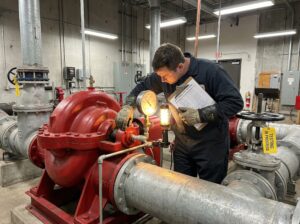
What Property Managers Should Know About Portable Extinguisher Service
—
QUICK REFERENCE GUIDE
Property Manager → Portable Fire Extinguisher Compliance
“`
YOUR ROLE = Tenant Safety + Owner Protection
TENANT SAFETY OWNER PROTECTION
↓ ↓
Equipment Works Liability Minimized
Compliance Current Insurance Satisfied
Service Professional Violations Prevented
Emergency Ready Asset Value Preserved
↓ ↓
BOTH REQUIRE: Proper Portable Fire Extinguisher Service
“`
This guide translates regulatory requirements into actionable property management strategies.
—
SECTION 1 → COMPLIANCE QUICK START
Your Three Regulatory Layers
LAYER 1: OSHA (If Commercial Tenants Have Employees)
29 CFR 1910.157 Compliance Checklist:
☐ Right equipment types for building hazards
☐ Monthly inspections documented
☐ Annual maintenance by qualified technician
☐ Hydrostatic testing on schedule
Non-negotiable. Federal requirement. Up to $16,131 penalty per serious violation.
—
LAYER 2: NFPA 10 (Technical Standard)
Your service blueprint:
| What | When | Who | Records |
|---|---|---|---|
| Monthly inspection | 30 days | Staff or 48Fire | Required |
| Annual maintenance | 12 months | Certified tech | Required |
| 6-year examination | 6 years | Certified tech | Required |
| Hydrostatic testing | 5-12 years | Testing facility | Required |
Think: NFPA = Your technical playbook. OSHA enforces it.
—
LAYER 3: Local Fire Code
Action items:
1. Call local fire marshal office
2. Ask: “Special requirements for [your property type]?”
3. Document conversation
4. Add to compliance calendar
48Fire knows your local requirements. One call covers all three layers.
—
SECTION 2 → LIABILITY REALITY CHECK
When Things Go Wrong
Fire occurs → Tenant uses extinguisher → Equipment fails
Questions you’ll face:
Q: “When was it last serviced?”
Q: “Who performed the service?”
Q: “Can you produce records?”
Q: “Were they certified?”
With records: Defensible position
Without records: Exposed position
—
Your Three Exposure Points
EXPOSURE 1: Direct Negligence
“`
Duty (you’re responsible)
+
Breach (service inadequate)
+
Causation (failure contributed)
+
Damages (injury/loss)
=
LIABILITY
“`
Protection: Professional service + complete documentation
—
EXPOSURE 2: Contract Breach
Your management agreement probably says:
- “Maintain fire safety equipment”
- “Ensure regulatory compliance”
- “Coordinate inspections”
- “Document all service”
Miss these = breach of contract with owner
Quick check:
□ Re-read your management agreement fire safety section
□ List your specific obligations
□ Verify current program satisfies each
□ Document compliance for owner
—
EXPOSURE 3: Insurance Non-Compliance
Policy language to find:
- “Fire protection equipment maintained per NFPA”
- “Professional service annually”
- “Documentation available for audit”
- “Deficiencies corrected within [X] days”
Non-compliance consequences:
→ Claim denial
→ Coverage reduction
→ Premium increase
→ Policy cancellation
Protection strategy: Treat insurance requirements as minimum baseline.
—
SECTION 3 → SERVICE PROGRAM DESIGN
START HERE: Equipment Inventory
What you need to know about every unit:
“`
UNIT ID: [Building-Floor-Number]
├─ Type: [ABC/BC/K/CO2]
├─ Size: [5lb/10lb/20lb]
├─ Location: [Specific room/hallway]
├─ Manufactured: [Year]
├─ Last Service: [Date]
├─ Next Service Due: [Date]
├─ Next Testing Due: [Date]
└─ Status: [Active/Service/Replace]
“`
Digital inventory = game changer
48Fire system shows:
- Every unit across all properties
- Service status real-time
- Upcoming deadlines
- Budget forecasting
Property managers with 5+ buildings: Manual tracking impossible. Digital required.
—
DECISION POINT: Monthly Inspections
Two approaches:
—
APPROACH A: Internal Staff
What staff must do:
1. Check 8 NFPA criteria every unit monthly
2. Document on approved form
3. Take photos of issues
4. Report deficiencies immediately
5. Track corrections
Requirements:
- Training on NFPA criteria
- Backup inspector (vacations, turnover)
- Quality control process
- Documentation system
Best for: Single property, stable staff, tight budget
Risk: Staff turnover = lost knowledge, inconsistent quality
—
APPROACH B: Professional Service (48Fire)
What happens:
- Certified inspector monthly
- All 8 criteria examined systematically
- Digital documentation automatic
- Photos captured
- Deficiencies flagged to you instantly
- Management dashboard access
Best for: Multiple properties, compliance priority, documentation quality
Benefit: Consistent execution regardless of property staff changes
—
Cost comparison (100-unit building):
Internal: $800-1,200/year (staff time)
Professional: $1,200-2,000/year
Difference: $400-800
Value difference: Professional documentation, liability transfer, consistency, no training burden
Most property managers choose: Professional service for documentation quality and consistency.
—
NON-NEGOTIABLE: Annual Maintenance
Cannot be done internally. Requires certified technician.
Why qualified technician matters:
Maintenance includes:
- Internal component examination
- Seal/gasket replacement
- Agent condition verification
- Mechanical operation testing
- Recharge when needed
- Service tag application per NFPA 10 Section 7.3.4
Unqualified service = OSHA violation + liability exposure
48Fire technicians:
☑ NFPA certified
☑ Manufacturer trained
☑ Professionally insured
☑ Documented credentials
—
Your annual maintenance workflow:
“`
11 months after last service
↓
48Fire sends notification
↓
You approve scheduling
↓
Service coordinated
↓
Completion report received
↓
Documentation filed
↓
Calendar updated (next service in 12 months)
“`
Set it and forget it: Automated reminders prevent missed deadlines.
—
PLANNING AHEAD: Testing Cycles
Hydrostatic testing timeline:
| Equipment Type | First Test | Interval | Your Action |
|---|---|---|---|
| CO2, Water, Wet Chem | 5 years | Every 5 years | Track age, budget accordingly |
| Dry Chemical ABC | 12 years | Every 12 years | Long interval, don’t forget |
Reality check: 20-40% fail testing (equipment 10+ years old)
Budget planning example (100 units):
Year 12 testing:
- Testing service: $8,000
- Expected failures (30%): 30 units
- Replacements: $7,350 (30 × $245)
- Year 12 total: $15,350
Pro tip: Start replacement fund Year 8-10. Avoid budget shock.
—
SECTION 4 → MULTI-TENANT COORDINATION
Model 1: You Handle Everything
Common in: Office buildings, retail centers
You provide:
□ All equipment
□ All service
□ All compliance
□ All documentation
You charge: Through CAM (Common Area Maintenance)
Advantage: Total control, consistent compliance
48Fire multi-property coordination:
- Single point of contact
- Portfolio-wide scheduling
- Consolidated billing
- Management reporting across all buildings
—
Model 2: Tenant Responsibility (You Verify)
Common in: Triple-net leases, industrial
Lease must specify:
- Tenant provides all portable fire extinguishers
- Professional monthly inspections required
- Annual maintenance by certified technician
- Testing per NFPA intervals
- Documentation submitted to landlord quarterly
- Landlord audit rights
- Remediation if non-compliant
Your verification process:
“`
Quarter End
↓
Collect tenant documentation
↓
Review for completeness
↓
Verify service provider credentials
↓
Check against NFPA requirements
↓
Issue deficiency notice if gaps
↓
Follow up correction within 30 days
“`
Challenge: Tenant quality varies widely
Risk management: Maintain right to hire 48Fire and back-charge tenant if non-compliant
—
Fire Marshal Inspection Prep
72 hours before inspection:
STEP 1: Documentation Check
□ 12+ months inspection records printed
□ Annual maintenance current
□ Testing documentation if due
□ Service provider certifications
STEP 2: Physical Walkthrough
□ Clear all obstructions
□ Verify signage visible
□ Check all service tags current
□ Ensure mounting secure
□ Confirm no units missing
STEP 3: Digital Access Ready
□ 48Fire system login available
□ Complete records accessible
□ Photos viewable if questions
During inspection:
- Be present
- Answer questions directly
- Note any concerns
- Get specific citation details
- Don’t argue, document instead
If violations cited:
1. Call 48Fire immediately
2. Coordinate correction within 24-48 hours
3. Document correction with photos
4. Submit to fire marshal
5. Attend re-inspection
6. Update procedures to prevent recurrence
—
SECTION 5 → BUDGET PLANNING
Annual Cost Calculator
Formula:
“`
Property Units × Service Rate = Annual Base Cost
Then add:
+ Six-year examination (1/6 of cost annually)
+ Testing cycle reserve (1/12 or 1/5 of cost annually)
+ Emergency/recharge incidents (estimate)
= Total Annual Budget
“`
Example: 100-unit property
“`
Monthly inspections: $1,600/year
Annual maintenance: $5,000/year
Six-year exam reserve: $ 583/year ($3,500 ÷ 6)
Testing reserve (12-year): $1,279/year ($15,350 ÷ 12)
Emergency contingency: $1,500/year
────────────────────────────────────────
TOTAL ANNUAL BUDGET: $9,962
“`
Budget per unit: ~$100/year
—
Capital Planning Chart
“`
YEAR EVENT BUDGET IMPACT
────────────────────────────────────────────────
1-5 Routine service only $8,000-10,000/year
6 Six-year examinations $11,500-15,000
7-11 Routine service only $8,000-10,000/year
12 Hydrostatic testing $15,000-25,000
(includes 20-40% replacements)
13-17 Routine service only $8,000-10,000/year
18 Second testing cycle $18,000-30,000
(higher failure rate)
“`
Property manager strategy:
- Budget routine annually: $8,000-10,000
- Reserve fund for major cycles: $5,000-10,000 annually
- Avoid surprise capital requests to owner
—
SECTION 6 → DOCUMENTATION ESSENTIALS
The Five Files You Need
FILE 1: EQUIPMENT MASTER LIST
Spreadsheet columns:
- Unit ID | Type | Size | Location | Serial
| Mfg Date | Install Date
FILE 2: INSPECTION RECORDS
Keep minimum 12 months (recommend permanent):
- Monthly inspection forms/digital records
- Photos of equipment
- Deficiency reports
- Correction documentation
FILE 3: SERVICE HISTORY
Every maintenance event:
- Service date
- Technician name & cert#
- Work performed
- Components replaced
- Service tag copy
- Invoice
FILE 4: TESTING RECORDS
Permanent retention required (NFPA 10 Section 8.3.3):
- Test date
- Test pressure
- Pass/fail result
- Testing facility
- Technician signature
- Next test due
FILE 5: VENDOR CREDENTIALS
Current on file:
- Technician certifications
- Insurance certificates
- Business licenses
- Service agreements
- Contact information
—
Digital vs. Paper
Paper reality:
- Filing cabinets full
- Search = frustrating
- Audit = scramble
- Multi-property = impossible
48Fire digital reality:
- Cloud access 24/7
- Search = instant
- Audit = 3 clicks
- Multi-property = dashboard view
Time savings estimate:
- Fire marshal requests records: Paper (30-60 min) vs. Digital (2 min)
- Owner audit prep: Paper (4-8 hours) vs. Digital (15 min)
- Portfolio compliance review: Paper (impossible) vs. Digital (instant)
—
SECTION 7 → COMMON MISTAKES
What Goes Wrong & How to Prevent
MISTAKE #1: “We’re too small to need professional service”
Reality: Size doesn’t matter. OSHA applies to any commercial property with employees. NFPA applies to any portable fire extinguisher installed.
Fix: Professional service is compliance requirement, not luxury.
—
MISTAKE #2: “Monthly inspections aren’t that important”
Reality: OSHA specifically requires monthly inspections (29 CFR 1910.157(e)(2)). Fire marshals check for gaps. Missing months = violation.
Fix: Automated reminders. Never miss a month.
—
MISTAKE #3: “We’ll handle testing when equipment is older”
Reality: Testing intervals are mandatory regardless of apparent condition. Equipment looks fine externally but may have internal corrosion.
Fix: Age tracking with automated alerts 12 months before testing due.
—
MISTAKE #4: “Tenant handles their own equipment”
Reality: Even with tenant responsibility, property manager often liable for overall building compliance during fire marshal inspections.
Fix: Verification process. Collect and review tenant documentation quarterly.
—
MISTAKE #5: “Documentation isn’t necessary if service is done”
Reality: Service without documentation = no proof service occurred. Fire marshals reject verbal claims.
Fix: Digital documentation automatic with every service event.
—
SECTION 8 → EMERGENCY PROTOCOLS
What To Do When…
SCENARIO 1: Extinguisher Used/Discharged
“`
IMMEDIATE (Within 24 hours):
├─ Remove extinguisher from service
├─ Tag “OUT OF SERVICE”
├─ Install temporary replacement
├─ Contact 48Fire for recharge
└─ Document incident
FOLLOW-UP:
├─ Recharge completed (24-48 hours)
├─ Equipment returned to service
├─ Documentation filed
└─ Incident report to owner
“`
—
SCENARIO 2: Fire Marshal Issues Citation
“`
DAY 1:
├─ Document citation details
├─ Call 48Fire immediately
└─ Schedule correction service
DAY 2-3:
├─ Correction completed
├─ Photo documentation
└─ Prepare submission package
DAY 4-7:
├─ Submit correction evidence
├─ Request re-inspection
└─ Attend with documentation
POST-CORRECTION:
└─ Update procedures to prevent recurrence
“`
—
SCENARIO 3: Equipment Missing/Stolen
“`
IMMEDIATE:
├─ File police report
├─ Document theft
├─ Order replacement
└─ Temporary unit if critical location
FOLLOW-UP:
├─ Installation within 48-72 hours
├─ Update inventory
├─ Notify insurance
└─ Consider security improvements
“`
—
IMPLEMENTATION CHECKLIST
Your 30-Day Action Plan
WEEK 1: Assessment
□ Review current service arrangement
□ Collect all existing documentation
□ Audit equipment inventory
□ Check compliance status
□ Identify gaps
WEEK 2: Planning
□ Contact 48Fire for proposal
□ Review budget requirements
□ Determine service model (full or support)
□ Get owner approval if needed
□ Set implementation timeline
WEEK 3: Setup
□ Sign service agreement
□ Complete equipment inventory
□ Schedule any overdue service
□ Set up digital access
□ Train staff on new procedures
WEEK 4: Launch
□ First professional service completed
□ Documentation system active
□ Calendar reminders set
□ Tenant notifications (if applicable)
□ Baseline established
—
FINAL TAKEAWAYS
Three Things You Cannot Delegate
1. KNOWING YOUR OBLIGATIONS
- Read OSHA 29 CFR 1910.157
- Understand NFPA 10 basics
- Know your local requirements
2. MAINTAINING DOCUMENTATION
- Collect all service records
- Organize systematically
- Make accessible for audits
- Preserve permanently
3. VERIFICATION & OVERSIGHT
- Confirm service completed
- Review documentation quality
- Monitor compliance status
- Address gaps immediately
—
What 48Fire Handles
Monthly:
- Systematic inspections
- Digital documentation
- Deficiency alerts
Annually:
- Certified maintenance
- Component replacement
- Compliance reporting
Periodically:
- Six-year examinations
- Hydrostatic testing coordination
- Equipment replacement
Continuously:
- Schedule management
- Compliance tracking
- Emergency response
- Fire marshal support
—
The Bottom Line
Property manager success formula:
“`
Professional Service
+
Complete Documentation
+
Systematic Tracking
+
Immediate Response
=
Tenant Safety Protected
Owner Liability Minimized
Compliance Verified
Career Protected
“`
48Fire provides property managers: Complete portable fire extinguisher service programs including monthly inspections, certified annual maintenance, testing coordination, digital documentation platforms, multi-property management, emergency response, fire marshal support, and budget planning tools—delivering comprehensive compliance with minimal property manager burden.
[Start Professional Property Management Program](/contact-us)
—
48Fire
Property Manager Specialists
Complete Service • Digital Platform • Portfolio Management
Contact: [/contact-us](/contact-us)