The Simple Inspection Step That Avoids $10K Fines
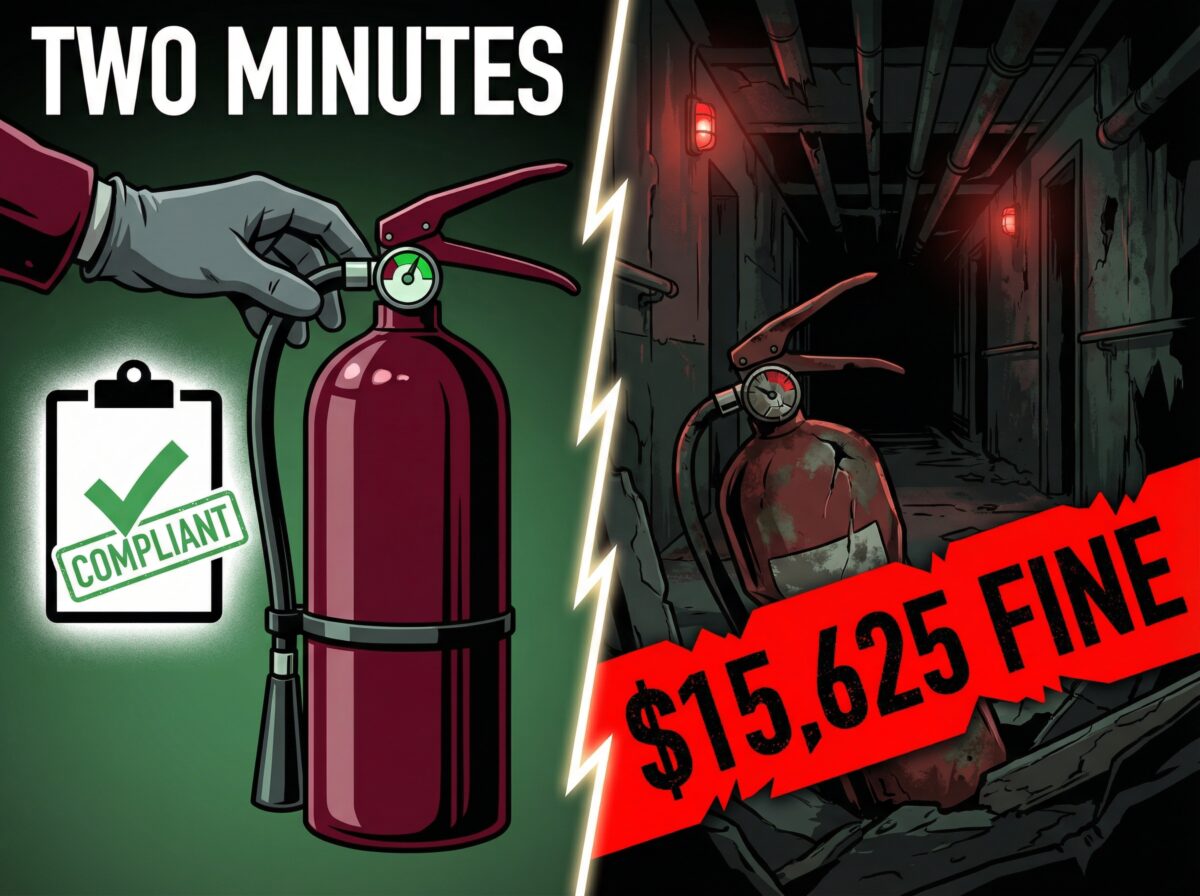
Monthly fire extinguisher inspections take less than two minutes per unit—yet skipping this simple step costs facilities an average of $15,625 in OSHA penalties per violation.
Most property managers don’t realize they’re non-compliant until an inspector arrives. The equipment hangs on the wall, looking fine from a distance. But OSHA regulation 1910.157 and NFPA 10 don’t care about appearances—they require documented monthly visual inspections at 30-day intervals.
What makes monthly inspections mandatory:
NFPA 10 established monthly fire extinguisher inspections as the minimum acceptable interval for verifying equipment remains operational. The requirement isn’t arbitrary—fire extinguishers can lose pressure, develop damage, or get tampered with between annual service appointments. Monthly checks catch these problems before they become life-safety failures or compliance violations.
The inspection takes minutes. The fine takes thousands.
Here’s what facilities need to know about the fire extinguisher inspection requirement that keeps properties compliant and protected.
—
Why Monthly Inspections Exist
Fire extinguishers aren’t passive safety devices. They require ongoing verification to ensure operational readiness.
NFPA research demonstrates fire extinguishers lose pressure over time through normal seal degradation. Pressure loss doesn’t always indicate defects—it’s a natural phenomenon that occurs even in properly manufactured units stored in ideal conditions.
Additionally, extinguishers in active facilities face environmental factors that accelerate deterioration:
Physical impact. Equipment carts, forklifts, cleaning equipment, and general facility activity can bump or knock extinguishers, causing unnoticed damage to valves, hoses, or pressure vessels.
Tampering. Curious employees, contractors, or visitors sometimes handle extinguishers, breaking seals or partially discharging units. Without monthly inspections, these incidents go undetected.
Environmental exposure. Moisture causes corrosion. Extreme temperatures affect seals and pressure. Dust and debris can obstruct nozzles or damage gauges.
Unauthorized use. Small fires get extinguished by building occupants who don’t report the incident. The partially discharged extinguisher goes back on the wall, appearing operational but actually useless.
Monthly fire extinguisher inspections identify these issues before they matter—before the fire, before the OSHA inspection, before the liability event.
48Fire performs systematic monthly inspections that document every checkpoint, creating the compliance trail OSHA inspectors verify.
—
What Monthly Inspections Actually Check
The monthly fire extinguisher inspection isn’t complicated. NFPA 10 specifies exactly what must be verified.
Location and Accessibility
Extinguishers must be in their designated locations. Someone didn’t move it for a project and forget to return it. Nothing blocks access—no pallets, equipment, furniture, or temporary storage.
The mounting bracket remains secure. The unit hangs properly at the correct height, not leaning or loose.
Signage remains visible and properly positioned above or near the extinguisher location.
Pressure Gauge Reading
The needle sits firmly in the green zone—the operable range marked on the gauge. Needles in the red zones (overcharged or undercharged) indicate units requiring immediate professional service.
For extinguishers without gauges (CO2 units, for example), weight verification ensures proper charge. The actual weight should match the weight marked on the nameplate.
Tamper Seals and Safety Pins
The tamper seal remains intact and unbroken. Any broken seal indicates the extinguisher has been handled or used, requiring immediate inspection and potential recharge.
The safety pin sits properly in place, preventing accidental discharge.
Physical Condition
The shell shows no dents, rust, corrosion, or damage. Paint remains intact without excessive chipping that might hide corrosion.
The nozzle or hose shows no cracks, blockages, or deterioration. For units with hoses, the hose remains pliable, not brittle or cracked.
The operating instructions remain legible. Faded or damaged instruction labels need replacement—occupants must be able to read how to use the equipment during emergencies.
Documentation
Each monthly fire extinguisher inspection must be documented with the date and the person who performed the inspection. Electronic or paper records work equally well, but the documentation must exist and be available for inspector review.
48Fire uses digital inspection systems that automatically timestamp each inspection, photograph equipment condition, and store records in cloud-based compliance databases accessible during audits.
—
The OSHA Requirement Everyone Misses
Here’s what trips up most facilities: OSHA doesn’t just require monthly inspections—it requires monthly documented inspections.
Maintenance staff walking past extinguishers and visually checking them doesn’t satisfy OSHA 1910.157. The regulation explicitly requires employers to maintain records showing inspections occurred.
During OSHA inspections, compliance officers request fire extinguisher inspection documentation. Facilities that cannot produce records of monthly inspections for the past year face citations—even if the extinguishers are perfectly functional.
The citation doesn’t say “your extinguisher is broken.” It says “you failed to conduct and document required inspections.”
The penalty: $15,625 for a serious violation.
Multiply that by the number of extinguishers lacking documentation, and a simple recordkeeping failure becomes a five-figure problem.
48Fire solves this documentation challenge through systematic monthly fire extinguisher inspection services that create permanent, auditable records automatically.
—
What Happens When Inspections Get Skipped
Real consequences follow when facilities defer or skip monthly fire extinguisher inspections.
Compliance Violations Accumulate
Every 30-day period without a documented inspection represents a potential OSHA violation. A facility that skips six months of inspections doesn’t face one violation—it faces six months of non-compliance that inspectors can cite.
OSHA considers repeated violations more seriously than first-time issues. Facilities with patterns of skipped fire extinguisher inspections face higher penalties and increased scrutiny.
Equipment Failures Go Undetected
The primary purpose of monthly fire extinguisher inspections isn’t bureaucratic compliance—it’s equipment verification.
Without monthly checks, pressure loss goes unnoticed. Employees attempting to use depressurized extinguishers during fires discover equipment failure at the worst possible moment.
Damaged extinguishers remain in place. Corrosion weakens pressure vessels. Blocked nozzles prevent discharge. These conditions create false confidence—occupants see equipment and assume it works.
Insurance Complications Develop
Commercial property insurance policies require documented fire safety compliance. Insurers audit fire extinguisher inspection records during underwriting and claims investigations.
Facilities without proper monthly fire extinguisher inspection documentation may face:
- Premium increases reflecting higher risk
- Coverage limitations for fire-related claims
- Claim denials if inspection gaps contributed to losses
- Mandatory third-party safety audits
48Fire provides the comprehensive fire extinguisher inspection documentation insurers require to verify systematic compliance.
Liability Exposure Increases
Property owners and employers have legal duties to provide functional fire safety equipment. When inadequate fire extinguisher inspections lead to equipment failures during fires, liability follows.
If employees or occupants suffer injuries because extinguishers weren’t properly inspected and maintained, facilities face workers’ compensation claims, premises liability lawsuits, and potential OSHA citations for failing to provide safe conditions.
—
The Cost Breakdown: Inspection vs. Violation
Let’s examine the actual numbers.
Monthly fire extinguisher inspection cost per unit: $5-10
Annual cost for monthly inspections (12 inspections): $60-120 per extinguisher
OSHA serious violation penalty: $15,625 per citation
OSHA willful violation penalty: $156,259 per citation
A facility with 30 extinguishers investing in proper monthly fire extinguisher inspections spends approximately $1,800-3,600 annually.
The same facility facing a single serious OSHA violation for inadequate inspection documentation pays $15,625—four to eight times the cost of annual compliance.
That calculation assumes only one violation. Inspectors can issue multiple citations affecting different equipment or time periods.
The financial case for systematic monthly fire extinguisher inspections through 48Fire becomes overwhelmingly clear when compared against violation penalties.
—
How to Implement Compliant Monthly Inspections
Facilities have two options for meeting monthly fire extinguisher inspection requirements: internal programs or professional services.
Internal Inspection Programs
Organizations can train facility staff to perform monthly fire extinguisher inspections. This approach requires:
Proper training. Staff must understand what to check, how to identify problems, and when to call for professional service. Training should cover all extinguisher types present in the facility.
Consistent scheduling. Inspections must occur at genuine 30-day intervals, not randomly when someone remembers. Calendar reminders or facility management software helps maintain schedules.
Thorough documentation. Each inspection needs recorded date, inspector name, findings, and corrective actions. Paper logs or digital systems both work if consistently maintained.
Accountability systems. Someone must verify inspections actually happen and documentation gets completed. Without oversight, internal programs often deteriorate.
Professional backup. When inspections identify problems—low pressure, damage, corrosion—facilities need immediate access to certified technicians for recharging or replacement.
Internal programs work well for facilities with dedicated safety staff and robust safety cultures. They require ongoing management attention to maintain effectiveness.
Professional Inspection Services
48Fire provides systematic monthly fire extinguisher inspection services that eliminate internal program management burdens.
Scheduled arrivals. Technicians arrive on predetermined dates each month, performing inspections without facility staff involvement.
Certified expertise. Inspectors know exactly what to check and can identify subtle issues untrained staff might miss.
Automatic documentation. Digital inspection systems create permanent records instantly, with photographs, timestamps, and technician certification.
Immediate service. Problems discovered during inspections get addressed immediately—recharging, replacement, or repair happens on the spot.
Compliance guarantee. Facilities know with certainty that monthly fire extinguisher inspections meet all NFPA 10 and OSHA requirements.
Professional services typically cost more per inspection than internal programs, but they eliminate compliance risk and management overhead.
—
The Monthly Inspection Checklist
Whether performed internally or professionally, every monthly fire extinguisher inspection should verify these points:
☐ Extinguisher is in designated location
Not moved, not missing, exactly where the facility plan indicates it should be.
☐ Access is unobstructed
No equipment, materials, or furniture blocks the extinguisher. Clear path for emergency access.
☐ Pressure gauge reads in the green zone
For units with gauges, needle sits firmly in the operable range. Units without gauges have correct weight.
☐ Tamper seal is intact
Seal unbroken, safety pin in place. Any broken seal requires immediate investigation and service.
☐ No visible physical damage
Shell shows no dents, corrosion, or damage. Hose and nozzle appear intact without cracks or deterioration.
☐ Operating instructions are legible
Labels remain readable. Faded or damaged labels need replacement.
☐ Inspection tag shows current annual service
The dated tag from last professional maintenance is present and shows service within the past year.
☐ Inspection is documented
Date, inspector name, and findings are recorded in inspection logs or digital system.
48Fire technicians complete this checklist digitally during every monthly fire extinguisher inspection, with results instantly available in client compliance portals.
—
Common Monthly Inspection Mistakes
Facilities attempting internal monthly fire extinguisher inspection programs often make these errors:
Mistake 1: Inconsistent Timing
Inspections happen “monthly” but not at true 30-day intervals. Someone inspects on the 15th one month, the 8th the next month, then skips a month entirely.
NFPA 10 specifies minimum 30-day intervals. Inconsistent timing creates compliance gaps that inspectors identify when reviewing documentation dates.
48Fire maintains rigid 30-day schedules, ensuring inspections never slip beyond required intervals.
Mistake 2: Inadequate Documentation
Inspection logs show checkmarks without detail. When OSHA inspectors or fire marshals review records, they see marks but no actual verification of specific checkpoints.
Proper fire extinguisher inspection documentation records what was checked, what was found, and what action (if any) was taken.
Mistake 3: Ignoring Discovered Problems
Staff note low pressure or broken seals during inspections but don’t immediately address issues. The extinguisher stays in place with a note to “fix later.”
Problems discovered during monthly fire extinguisher inspections require immediate correction. Equipment showing deficiencies must be serviced immediately or replaced with functional units.
Mistake 4: Skipping Difficult Locations
Inspectors check easily accessible ground-floor extinguishers but skip units in mechanical rooms, rooftops, or areas requiring ladder access.
Every extinguisher requires monthly inspection—no exceptions for inconvenient locations. OSHA citations don’t distinguish between accessible and difficult-to-reach equipment.
Mistake 5: Relying on Visual Checks Without Records
Facility managers walk the building regularly and look at extinguishers but never formally document inspections.
OSHA requires documented inspections. Undocumented visual checks don’t satisfy compliance requirements.
—
Monthly Inspections vs. Annual Maintenance
Monthly fire extinguisher inspections differ fundamentally from annual maintenance. Understanding this distinction prevents compliance gaps.
Monthly Inspections
Who performs them: Trained facility staff or professional inspection services
What they involve: Visual verification of equipment condition and accessibility
Tools required: Visual observation, possibly weight scale for CO2 units
Time required: 1-2 minutes per extinguisher
Documentation: Inspection date, inspector, findings
Frequency: Minimum 30-day intervals
Monthly inspections catch obvious problems—low pressure, damage, missing equipment, obstructed access.
Annual Maintenance
Who performs it: Certified technicians with appropriate tools and training
What it involves: Detailed mechanical inspection, internal examination where applicable, testing
Tools required: Specialized equipment, manufacturer service manuals, replacement parts
Time required: 15-30 minutes per extinguisher depending on type
Documentation: Service tag with date, technician certification, detailed service records
Frequency: Annually
Annual maintenance verifies internal components, mechanical function, and agent condition that visual inspections cannot assess.
Both are required. Monthly fire extinguisher inspections don’t replace annual maintenance. Annual maintenance doesn’t eliminate monthly inspection requirements.
48Fire provides both services in coordinated programs that ensure complete compliance without gaps or overlaps.
—
How Digital Systems Improve Compliance
Modern fire extinguisher inspection programs use digital tools that improve compliance and reduce administrative burden.
Mobile Inspection Applications
Technicians use tablets or smartphones to perform inspections. Digital forms ensure every checkpoint gets addressed—the system won’t allow incomplete inspections.
Photos document equipment condition at each inspection. Visual records prove compliance and show condition trends over time.
GPS verification confirms inspections occurred at correct locations. Time stamps prove 30-day intervals.
Cloud-Based Record Storage
Inspection records upload instantly to secure cloud databases. No paper logs to lose, no filing cabinets to maintain.
Records remain accessible indefinitely. When OSHA inspectors arrive, facilities produce complete inspection histories instantly.
Multiple stakeholders can access records—facility managers, corporate safety directors, insurance auditors—without physical document transfers.
Automated Scheduling and Alerts
Systems automatically schedule next inspections based on completion dates, ensuring 30-day intervals never get missed.
Alerts notify facility managers if inspections don’t occur on schedule. Problems discovered during inspections trigger immediate notifications to appropriate personnel.
Annual maintenance dates are tracked automatically. Facilities receive advance notice before annual service deadlines.
Analytics and Reporting
Digital systems generate compliance reports instantly. Facilities can demonstrate inspection completion rates, identify equipment requiring frequent service, and track compliance trends.
Management dashboards show compliance status across multiple locations for organizations with distributed properties.
48Fire uses advanced digital inspection platforms that provide clients with real-time compliance visibility and permanent documentation.
—
Monthly Inspections for Different Property Types
Fire extinguisher inspection requirements apply universally, but implementation varies by property type.
Manufacturing and Industrial Facilities
High equipment density and harsh environments require robust monthly fire extinguisher inspection programs.
Challenges include difficult access (equipment mounted high or in confined spaces), environmental factors (dust, moisture, chemicals), and large quantities of extinguishers.
48Fire provides industrial-focused fire extinguisher inspection services with technicians trained to work safely in manufacturing environments and access challenging locations.
Commercial Office Buildings
Multiple tenants create coordination challenges for monthly fire extinguisher inspections.
Building management must ensure inspections occur in tenant spaces without disrupting operations. Clear communication and scheduling prevent conflicts.
48Fire works with property managers to establish inspection schedules that minimize tenant impact while maintaining compliance.
Healthcare Facilities
Hospitals, clinics, and medical facilities require uninterrupted operations during monthly fire extinguisher inspections.
Critical areas like operating rooms, patient care units, and emergency departments need inspection scheduling that doesn’t interfere with medical services.
48Fire provides healthcare-experienced technicians who understand medical facility protocols and can perform inspections without operational disruption.
Educational Institutions
Schools, colleges, and universities have seasonal occupancy patterns affecting inspection scheduling.
Summer periods offer opportunities for comprehensive fire extinguisher inspection programs when buildings have fewer occupants. Academic year inspections require careful scheduling around classes and activities.
48Fire develops education-sector inspection programs that work within academic calendars.
Retail and Hospitality
Customer-facing businesses need fire extinguisher inspections that don’t impact guest experience or retail operations.
Inspections during off-peak hours or planned maintenance windows minimize visibility to customers.
48Fire offers flexible scheduling including evening and weekend fire extinguisher inspection services for retail and hospitality clients.
—
The Inspection That Catches Everything Else
Monthly fire extinguisher inspections create unexpected benefits beyond fire equipment compliance.
Facility Condition Monitoring
Technicians walking through facilities monthly to inspect extinguishers notice other fire safety issues—blocked exits, damaged exit signs, improperly stored materials.
These observations, documented during fire extinguisher inspections, help facilities maintain broader fire safety compliance.
Emergency Preparedness Verification
Monthly inspections verify that employees can actually reach extinguishers during emergencies. Obstructed access discovered during inspections gets corrected immediately.
Regular inspection routines keep fire safety visible to employees, reinforcing safety culture.
Asset Management
Monthly fire extinguisher inspection records document equipment condition over time. Facilities can predict replacement needs and budget accordingly rather than facing surprise failures.
Digital inspection systems track extinguisher age, service history, and condition trends, supporting informed asset management decisions.
—
What Happens During OSHA Inspections
Understanding how OSHA inspectors verify monthly fire extinguisher inspection compliance helps facilities prepare.
Document Review
Inspectors request fire extinguisher inspection records covering the past 12 months. They verify inspections occurred at proper 30-day intervals and include required information.
Missing months or irregular intervals trigger violations. Inspectors calculate days between inspections—anything exceeding 30 days without documented inspection constitutes non-compliance.
Physical Verification
Inspectors examine actual extinguishers, checking pressure gauges, seals, physical condition, and accessibility.
They compare physical findings to inspection records. If records show “passed” but extinguishers show low pressure or damage, inspectors cite both the equipment deficiency and documentation accuracy problems.
Staff Interviews
Inspectors may ask facility staff about fire extinguisher inspection procedures. Employees who don’t know inspection requirements exist or can’t describe the process create compliance concerns.
Citation Process
When inspectors identify monthly fire extinguisher inspection violations, they issue citations specifying:
- The regulation violated (typically 1910.157)
- Specific deficiencies found
- Number of affected extinguishers
- Required corrections
- Penalty amounts
- Correction deadline
Facilities must correct violations by specified deadlines and provide proof of correction to close citations.
48Fire helps facilities prepare for OSHA inspections by conducting pre-inspection audits that identify and correct deficiencies before official inspections occur.
—
Building Long-Term Compliance
Successful monthly fire extinguisher inspection programs require consistent execution over years, not just temporary compliance efforts before scheduled inspections.
Establishing Routines
Whether using internal staff or professional services, inspections must become routine operational activities—as automatic as opening doors or turning on lights.
Calendar integration helps. Schedule inspections the same day each month. Use the same inspection teams when possible to build familiarity and efficiency.
Maintaining Documentation Discipline
Records must be complete, accessible, and permanent. Establish clear procedures for storing inspection documentation—physical files in designated locations or digital records in specified systems.
Regular audits of inspection records identify missing documentation before inspectors do.
Addressing Problems Immediately
When monthly fire extinguisher inspections discover deficiencies, correction happens immediately—not next week, not when convenient.
Facilities with immediate correction protocols maintain compliance. Those that defer discovered problems face violations even though inspections occurred.
Continuous Improvement
Review inspection programs annually. Are all locations getting inspected? Is documentation complete? Do staff need refresher training?
48Fire includes program reviews in annual fire extinguisher maintenance appointments, ensuring inspection programs remain effective long-term.
—
The Simple Step That Actually Works
Monthly fire extinguisher inspections aren’t complicated. They don’t require advanced degrees or specialized equipment. The process takes minutes per unit.
Yet this simple step—consistently performed, properly documented, immediately acted upon—prevents the majority of fire extinguisher compliance violations facilities face.
The choice is straightforward: invest two minutes monthly per extinguisher, or risk $15,625 per violation when OSHA arrives.
48Fire makes the choice even simpler by handling the entire monthly fire extinguisher inspection process—scheduling, execution, documentation, and immediate problem resolution—so facilities can focus on their actual operations with confidence that fire safety compliance is systematically maintained.
—
Get Compliant, Stay Compliant
Facilities don’t need to wait for an OSHA inspection to discover compliance gaps. 48Fire provides comprehensive fire extinguisher inspection services that establish and maintain complete compliance from day one.
Monthly inspections at proper 30-day intervals. Digital documentation accessible instantly during audits. Immediate correction of discovered problems. Professional expertise ensuring every checkpoint meets NFPA 10 and OSHA requirements.
48Fire serves commercial properties, manufacturing facilities, healthcare institutions, educational campuses, and retail operations across the United States. Local certified technicians understand regional fire code requirements and provide responsive service.
Talk to an Expert! Contact 48Fire at [/contact-us](/contact-us) to schedule a fire extinguisher inspection assessment. Our certified technicians will evaluate your current inspection program, identify gaps, and implement systematic monthly inspections that keep your facility compliant while protecting occupants with verified fire safety equipment.
—
Frequently Asked Questions
How often must fire extinguishers be inspected monthly?
NFPA 10 requires fire extinguisher inspections at minimum 30-day intervals. This means inspections must occur at least every 30 days—not “once per month” which could stretch to 60+ days between January 15 and March 15 inspections, for example.
Can facility staff perform monthly fire extinguisher inspections?
Yes. Trained facility employees can perform monthly visual inspections. However, annual maintenance must be performed by certified technicians. 48Fire provides both professional monthly inspection services and staff training for facilities preferring internal programs.
What documentation do monthly fire extinguisher inspections require?
Each inspection must be documented with the date, name or initials of the person performing inspection, and notation of any deficiencies discovered. Records must be maintained and available for inspector review.
What happens if a monthly inspection discovers a problem?
Problems discovered during fire extinguisher inspections require immediate correction. Low pressure units need recharging, damaged extinguishers need replacement, obstructed access needs clearing. Equipment cannot remain in deficient condition.
Do monthly inspections replace annual maintenance?
No. Monthly fire extinguisher inspections are separate requirements from annual maintenance by certified technicians. Both are mandatory under NFPA 10 and OSHA 1910.157. Monthly inspections catch obvious problems; annual maintenance verifies internal components and mechanical function.
How much do professional monthly fire extinguisher inspections cost?
Professional monthly inspection services typically cost $5-10 per extinguisher per inspection, or $60-120 annually per unit. This investment prevents OSHA violations with penalties starting at $15,625. Contact 48Fire at [/contact-us](/contact-us) for facility-specific pricing.
What OSHA penalties apply for missing monthly fire extinguisher inspections?
Facilities without documented monthly inspections face serious violations under OSHA 1910.157, with penalties of $15,625 per citation. Willful or repeated violations increase to $156,259. Multiple extinguishers lacking inspections can result in multiple citations.
Can digital systems replace paper inspection logs?
Yes. OSHA accepts digital fire extinguisher inspection records as long as they contain required information and remain accessible during inspections. 48Fire uses digital systems that create permanent cloud-based records with photographs and timestamps.
—