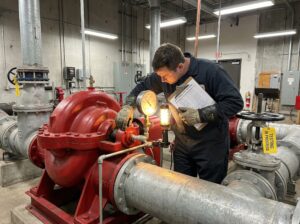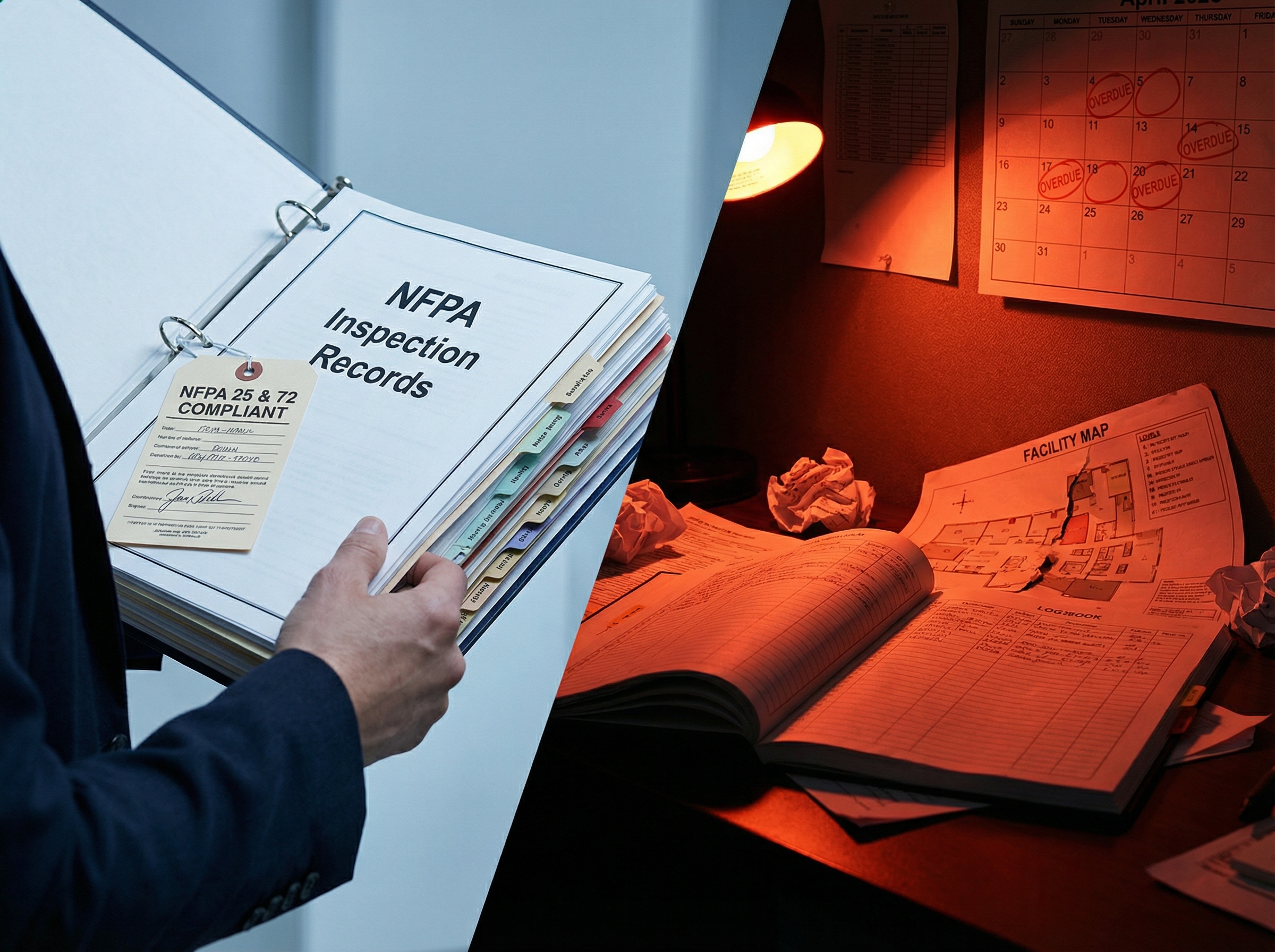
Property managers facing NFPA inspection must produce 15-25 specific documentation items within first 30 minutes of inspector arrival—facilities unable to provide complete records experience 67-82% higher deficiency rates and 3-5X longer inspection durations creating operational disruption.
Inspection Outcome Disclaimer: NFPA inspection results, documentation requirements, deficiency rates, and compliance outcomes vary based on building type, occupancy classification, Authority Having Jurisdiction standards, inspector protocols, system configurations, and property-specific circumstances. Information reflects common commercial property NFPA inspection requirements and typical preparation best practices, not guaranteed outcomes for specific properties.
The documentation gap between prepared and unprepared properties:
| Preparation Status | Documents Ready | Inspector Retrieval Time | Deficiencies Found | Inspection Duration | Pass Rate |
|---|---|---|---|---|---|
| Fully prepared (all items organized) | 20-25 items | 5-15 minutes | 0-3 minor | 2-3 hours | 92-97% |
| Partially prepared (some gaps) | 12-18 items | 20-45 minutes | 4-8 moderate | 3-5 hours | 68-78% |
| Unprepared (minimal documentation) | 5-10 items | 45-90+ minutes | 8-15 major | 5-8 hours | 35-52% |
Critical insight: Property managers with complete pre-organized documentation experience 2-3 hour inspections passing 92-97% of the time, while unprepared properties face 5-8 hour disruptions with 35-52% pass rates requiring re-inspection after corrections.
Most property managers underestimate NFPA inspection documentation requirements—assuming basic fire protection equipment presence suffices—discovering during inspection that inspectors demand extensive testing records, maintenance logs, professional certifications, correction documentation spanning 12-36 months requiring instant production.
This guide details exactly what property managers must have ready before NFPA inspection: five documentation categories covering fire extinguishers, sprinkler systems, fire alarms, emergency lighting/egress, and general building compliance with specific required items, acceptable formats, retrieval timeframes, common gaps, and verification checklists ensuring inspection readiness.
—
REQUIREMENT CATEGORY 1: FIRE EXTINGUISHER DOCUMENTATION
What NFPA 10 inspectors require from property managers
Required Documentation Items
Item 1: Monthly Visual Inspection Logs (12+ months)
What inspectors need:
- Continuous monthly records (no gaps) for minimum 12 months
- Each log entry dated, indicating inspector initials/signature
- All extinguisher locations documented (by station number or area)
- Notation of any deficiencies found during monthly checks
- Evidence deficiencies corrected promptly (follow-up documentation)
Acceptable formats:
✓ Digital inspection platform logs (cloud-based, timestamped)
✓ Standardized paper forms (consistent format, filed chronologically)
✓ Inspection app records (mobile-based logging with photo evidence)
✗ Email notes (not standardized, insufficient detail)
✗ Undocumented verbal checks (not acceptable proof)
✗ Backfilled records created pre-inspection (inspectors can detect)
Inspector verification process:
1. Request “12 months of monthly fire extinguisher inspection logs”
2. Review for completeness (all 12 months present, no gaps)
3. Check consistency (same format, appropriate detail level)
4. Verify currency (most recent log within 30 days)
5. Question any anomalies (suspicious patterns, sudden format changes)
Common failure points:
- Missing months (8-10 months present, 2-4 months gap) – Failure: incomplete records
- Inconsistent documentation (3 months detailed, 9 months minimal) – Red flag: questionable authenticity
- Recent logs only (last 3-4 months, nothing older) – Failure: insufficient history
- Backfilled all at once (all logs dated same week before inspection) – Major red flag: fabricated records
Pass criteria: Complete 12-month logs, consistent format, appropriate detail, current within 30 days
—
Item 2: Annual Professional Service Tags/Certificates
What inspectors verify:
- Physical inspection tags attached to each extinguisher
- Service date within 12 months of inspection
- Licensed contractor company name, technician signature
- Tag includes next service due date
- Professional service report matching tag information
Inspector examination:
1. Randomly select 5-10 extinguishers for tag verification
2. Check service date (must be within 12 months)
3. Verify contractor credentials (licensed, reputable)
4. Request corresponding service reports/invoices
5. Cross-check tag data against documentation
Common deficiencies:
- Expired tags (13+ months old) – Violation: overdue service
- Missing tags (fell off, never attached) – Violation: no proof of service
- Handwritten tags (not professional contractor) – Questionable: may not accept
- No supporting documentation (tags present, no reports) – Incomplete: cannot verify
Pass criteria: All extinguisher tags current (within 12 months), professional contractor, matching documentation
—
Item 3: Hydrostatic Test Records (for units requiring testing)
What inspectors need:
- Hydrostatic test certificates for extinguishers at 6-year or 12-year intervals
- Test records showing pressure testing, internal examination
- Professional testing company documentation
- Schedule tracking which units tested when
Applicability:
- Stored pressure extinguishers: 12-year intervals (CO2: 5-year)
- Requires professional testing company (not routine service)
- Property managers must track testing schedules by serial number
Common gaps:
- No tracking system (don’t know which units due for hydrostatic) – Management deficiency
- Overdue testing (units past due date) – Violation: expired equipment
- No test certificates (testing performed, no documentation) – Cannot verify compliance
Pass criteria: Hydrostatic testing current per NFPA 10 schedules, certificates available
—
Fire Extinguisher Physical Preparation Checklist
What property managers must verify before NFPA inspection:
☐ Accessibility: All extinguishers unobstructed (3-foot clearance maintained)
☐ Visibility: Units clearly visible or marked with signage
☐ Mounting: Secure brackets, proper height (3.5-5 feet to top)
☐ Pressure: Gauge needles in green/operational zone (no red zone units)
☐ Physical condition: No dents, rust, corrosion, damage
☐ Signage: Location signs visible from 10+ feet distance
☐ Appropriate type: Correct extinguisher class for hazard area
Pre-inspection verification: Property manager walks facility 24-48 hours before inspection checking every extinguisher against checklist
Common last-minute corrections needed:
- Remove obstructions (boxes, equipment blocking extinguishers)
- Replace damaged signage (faded, missing location markers)
- Recharge low-pressure units (emergency same-day service)
- Remount loose/fallen extinguishers (bracket repair)
—
REQUIREMENT CATEGORY 2: FIRE SPRINKLER SYSTEM RECORDS
What NFPA 25 inspectors require from property managers
Required Documentation Items
Item 1: Quarterly Inspection Reports (12+ months)
What inspectors need:
- Professional contractor inspection reports (minimum 4 per year)
- NFPA 25 compliant inspection scope (gauges, valves, alarms, areas)
- Contractor license/certification documentation
- ITM (Inspection, Testing, Maintenance) tags on equipment
- Deficiency reports with correction documentation
Acceptable contractor qualifications:
✓ NFPA 25 certified inspector/company
✓ State-licensed fire sprinkler contractor
✓ Documented training in water-based fire protection
✗ General handyman/maintenance staff (insufficient qualification)
✗ Uncertified company (may not meet AHJ requirements)
Inspector verification:
1. Request “12 months quarterly sprinkler inspection reports”
2. Verify contractor qualifications (license, certifications)
3. Review report scope (confirms NFPA 25 compliance)
4. Check ITM tags (physical evidence of contractor visits)
5. Examine deficiency resolution (issues corrected promptly)
Common documentation gaps:
- Only 2-3 quarterly reports (not full 4 quarters) – Failure: insufficient frequency
- Self-performed inspections (property staff, not professional) – Questionable: may not accept
- Generic inspection forms (not NFPA 25 specific) – Insufficient: lacks required detail
- No ITM tags (reports exist, no physical tags) – Incomplete: cannot verify work performed
Pass criteria: Four professional quarterly reports per year, NFPA 25 certified contractor, ITM tags present
—
Item 2: Annual Testing Certificates
What inspectors require:
- Annual internal inspection certificate (wet pipe systems)
- Main drain test results (water flow verification)
- Alarm test documentation (monitoring signal confirmed)
- Professional certification with seal/signature
- Test date within 12 months
Inspector examination:
1. Request annual sprinkler testing certificate
2. Verify test date (must be within 12 months)
3. Review test results (main drain flow, alarm response)
4. Confirm contractor credentials (qualified for testing)
5. Cross-check with quarterly reports (testing should align)
Common deficiencies:
- Expired certificate (13+ months old) – Violation: overdue testing
- Incomplete testing (main drain only, no alarm test) – Insufficient: partial compliance
- Self-certification (property staff, not professional) – Not acceptable: requires qualified contractor
- No test results (certificate present, no data) – Incomplete: cannot verify proper testing
Pass criteria: Annual testing current (within 12 months), complete scope, professional contractor, detailed results
—
Item 3: 5-Year Obstruction Investigation/Comprehensive Testing
What inspectors need:
- 5-year obstruction investigation report (internal pipe inspection)
- 5-year valve testing documentation (operational test)
- Professional testing company certification
- Scheduling documentation for upcoming 5-year tests
Applicability:
- Required every 5 years per NFPA 25
- Significant testing scope (beyond annual)
- Property managers must track 5-year cycles
Inspector inquiry:
- “When was last 5-year obstruction investigation?”
- “Can you provide the certificate?”
- “When is next 5-year test due?”
Common gaps:
- Overdue 5-year testing (6-7 years since last) – Violation: expired testing
- No tracking (don’t know when last performed) – Management deficiency
- No certificate (test performed, no documentation) – Cannot verify
Pass criteria: 5-year testing current or scheduled, certificates available
—
Fire Sprinkler Physical Preparation Checklist
What property managers must verify before NFPA inspection:
☐ 18-inch clearance: No storage within 18 inches below any sprinkler head
☐ Head condition: Heads free of paint, corrosion, damage, loading
☐ Control valves: All main valves fully open (not partially closed)
☐ Valve supervision: Tamper switches functional where required
☐ Riser room accessibility: Room unlocked, not used for unrelated storage
☐ Gauge readings: All pressure gauges in normal ranges
☐ Alarm devices: Test valves, bells, horns present and unobstructed
☐ ITM tags: Physical tags visible on equipment (quarterly, annual)
Pre-inspection walkthrough: Property manager inspects all areas with sprinkler coverage
Common last-minute corrections:
- Relocate storage violating 18-inch clearance (most common)
- Clear riser room of unrelated items (boxes, supplies removed)
- Open partially closed valves (investigate why closed)
- Document gauge readings (photograph for reference)
—
REQUIREMENT CATEGORY 3: FIRE ALARM SYSTEM CERTIFICATES
What NFPA 72 inspectors require from property managers
Required Documentation Items
Item 1: Quarterly Testing Reports
What inspectors need:
- Quarterly notification device testing (horns, strobes, speakers)
- NFPA 72 certified technician (brand-specific training required)
- Test reports documenting devices tested, results
- Company certification/license documentation
- Test date within 90 days
Inspector verification:
1. Request “quarterly fire alarm test reports”
2. Verify technician qualifications (NFPA 72 certified, brand-trained)
3. Review test scope (all notification devices covered)
4. Check test currency (most recent within 90 days)
5. Confirm company credentials (licensed alarm contractor)
Common deficiencies:
- Only annual testing (no quarterly) – Failure: insufficient frequency
- Uncertified technician (general electrician, not alarm specialist) – Not acceptable
- Incomplete testing (partial device coverage) – Insufficient scope
- Expired reports (120+ days old) – Violation: overdue testing
Pass criteria: Quarterly testing current, NFPA 72 certified technician, complete device coverage
—
Item 2: Semi-Annual & Annual Comprehensive Certificates
What inspectors require:
- Semi-annual detector testing certificate (smoke, heat detectors)
- Annual comprehensive system test certificate (all devices, all functions)
- Professional alarm company seal/signature
- Detailed test results (pass/fail for each component)
- Monitoring company confirmation (signals received)
Inspector examination:
1. Request semi-annual and annual certificates
2. Verify test dates (semi-annual within 6 months, annual within 12 months)
3. Review test comprehensiveness (all system components)
4. Confirm monitoring verification (central station acknowledged tests)
5. Check technician credentials (qualified for comprehensive testing)
Common gaps:
- No semi-annual testing (only annual) – Violation: missing required frequency
- Expired certificates (8+ months since semi-annual, 15+ months since annual) – Overdue
- No monitoring confirmation (no proof signals transmitted) – Incomplete
- Generic test reports (not system-specific) – Insufficient detail
Pass criteria: Semi-annual (within 6 months) and annual (within 12 months) testing current, comprehensive scope, monitoring verified
—
Item 3: Battery Test Documentation
What inspectors need:
- Annual battery load test results (backup power verification)
- Battery replacement records (4-5 year lifecycle tracking)
- Voltage test documentation
- Battery condition assessment
Inspector inquiry:
- “When was alarm panel battery last tested?”
- “Can you provide test results?”
- “How old is current battery?” (age verification)
Common deficiencies:
- No battery testing (assumed functional, never tested) – Violation
- Old batteries (6-8 years, never replaced) – Compliance question
- No test documentation (testing performed, no records) – Cannot verify
Pass criteria: Annual battery testing documented, batteries within 5-year lifecycle
—
Fire Alarm Physical Preparation Checklist
What property managers must verify before NFPA inspection:
☐ Panel accessible: Fire alarm panel unobstructed, room unlocked
☐ No trouble signals: Panel display shows normal status (no active alerts)
☐ Pull stations visible: Manual pull stations unobstructed, covers intact
☐ Devices unobstructed: Smoke detectors, horns, strobes not blocked
☐ Panel labeled: Zones clearly labeled, emergency contacts posted
☐ Monitoring active: Confirmation monitoring service current
☐ Documentation posted: Test certificates displayed near panel (if required by AHJ)
Pre-inspection verification: Property manager checks panel status, tests system if comfortable
Common last-minute actions:
- Clear panel room (remove stored items)
- Resolve any trouble signals (call alarm company immediately)
- Verify monitoring current (confirm service active, not lapsed)
- Test panel access (ensure door key available, lock functional)
—
REQUIREMENT CATEGORY 4: EMERGENCY LIGHTING & EGRESS RECORDS
What NFPA 101 inspectors require from property managers
Required Documentation Items
Item 1: Monthly 30-Second Functional Test Logs
What inspectors need:
- Monthly test logs (12+ months) for all emergency lights/exit signs
- Test date, tester initials, results documented
- Failed units identified with correction documentation
- Digital or standardized paper format
Inspector verification:
1. Request “monthly emergency lighting test logs”
2. Review completeness (all 12 months, all units tested)
3. Check methodology (actual button press testing, not visual only)
4. Verify failed unit correction (documented repairs/replacements)
5. Assess currency (most recent test within 30 days)
Common deficiencies:
- No monthly logs (only annual) – Failure: NFPA 101 requires monthly
- Incomplete testing (some units skipped) – Insufficient coverage
- Visual-only checks (not actual button activation) – Not acceptable method
- No failed unit tracking (failures noted, no correction proof) – Incomplete
Pass criteria: Complete monthly logs (12 months), all units tested, failed units corrected
—
Item 2: Annual 90-Minute Capacity Test Certificates
What inspectors require:
- Professional annual testing certificate (90-minute full discharge)
- All emergency lights/exit signs tested to capacity
- Professional contractor or qualified personnel
- Battery replacement recommendations
- Test date within 12 months
Inspector examination:
1. Request annual 90-minute test certificate
2. Verify test date (within 12 months)
3. Review test scope (all units tested to full 90-minute capacity)
4. Check for battery age/condition notes
5. Confirm tester qualifications (professional or trained personnel)
Common gaps:
- No annual testing (monthly only, no capacity test) – Violation
- Self-performed without proper procedure (informal testing) – Questionable
- Expired certificate (15+ months old) – Overdue testing
- Incomplete coverage (some areas not tested) – Insufficient scope
Pass criteria: Annual 90-minute testing current (within 12 months), complete coverage, proper procedure
—
Emergency Lighting/Egress Physical Preparation Checklist
What property managers must verify before NFPA inspection:
☐ All units functional: Press test button on every emergency light/exit sign
☐ Exit routes clear: All corridors, aisles, stairwells unobstructed
☐ Exit signs visible: Illuminated, unobstructed from all approach angles
☐ Door operation: Panic hardware functional, doors swing in egress direction
☐ Exit discharge clear: Exterior areas clear (snow, debris, vehicles removed)
☐ Signage correct: Only actual exit doors marked “EXIT”
☐ Lighting adequate: Egress path illumination meets minimum requirements
Pre-inspection walkthrough: Property manager tests every emergency light, walks every exit route
Common last-minute corrections:
- Replace dead batteries (non-functional emergency lights)
- Replace burned-out exit sign bulbs/LEDs
- Clear exit obstructions (boxes, furniture removed)
- Snow removal from exterior exit discharge areas
—
REQUIREMENT CATEGORY 5: GENERAL BUILDING COMPLIANCE DOCUMENTATION
Additional NFPA inspection requirements property managers must have ready
Required Documentation Items
Item 1: Fire Drill Records
What inspectors may request:
- Fire drill log (dates conducted, participants, duration)
- Staff training documentation (fire safety procedures)
- Evacuation plan posted/distributed
- Drill observations and improvements noted
Applicability: Required for certain occupancies (healthcare, schools, assembly)
Pass criteria: Required drills conducted per occupancy type, documented appropriately
—
Item 2: Electrical Safety Documentation
What inspectors verify:
- Extension cord policy (temporary use only)
- Electrical panel access (not obstructed)
- Panel labeling (circuits identified)
- GFCI outlets where required (bathrooms, kitchens, exterior)
Pass criteria: Electrical systems comply with NFPA 70 (National Electrical Code)
—
Item 3: Hazardous Material Storage Records
What inspectors check:
- Flammable liquid storage (approved containers, cabinets)
- Safety Data Sheets (SDS) available
- Storage room compliance (sprinklered, ventilated)
- Quantity limits observed
Pass criteria: Hazardous materials stored per NFPA requirements
—
Item 4: Building Modification Documentation
What inspectors need:
- Permits for any construction/renovation
- Fire protection system modifications documented
- Occupancy load calculations (if changed)
- Updated fire safety plans
Pass criteria: All modifications properly permitted, fire protection updated accordingly
—
PRE-NFPA INSPECTION MASTER CHECKLIST FOR PROPERTY MANAGERS
48-hour preparation timeline ensuring complete readiness
48 Hours Before Inspection
Documentation gathering (Day 1):
☐ Locate all fire extinguisher monthly logs (12 months)
☐ Gather fire extinguisher annual service reports/invoices
☐ Compile fire sprinkler quarterly inspection reports (4 minimum)
☐ Locate fire sprinkler annual testing certificate
☐ Gather fire alarm quarterly test reports
☐ Locate fire alarm semi-annual and annual certificates
☐ Compile emergency lighting monthly test logs (12 months)
☐ Locate emergency lighting annual 90-minute certificate
☐ Gather any deficiency correction documentation
☐ Locate building permits, modification records
Organization (Day 1 evening):
☐ Create inspection packet (organized chronologically by system)
☐ Digital backup (scan all documents, cloud storage)
☐ Prepare quick-reference summary (inspection dates, contractor contacts)
☐ Identify any documentation gaps (missing items noted)
☐ Contact contractors for missing certificates (rush requests if needed)
—
24 Hours Before Inspection
Physical facility walkthrough (Day 2 morning):
☐ Fire extinguisher check (pressure, accessibility, mounting, tags)
☐ Sprinkler system check (18-inch clearance, valve positions, riser room)
☐ Fire alarm check (panel status, pull stations, no trouble signals)
☐ Emergency lighting test (press every test button, verify functionality)
☐ Egress route walk (clear corridors, functional exit doors)
☐ Housekeeping review (electrical safety, storage compliance)
Deficiency correction (Day 2 afternoon):
☐ Correct any physical deficiencies found (obstructions, low pressure, etc.)
☐ Emergency contractor calls (if critical issues discovered)
☐ Document corrections made (photographs, notes)
☐ Recheck corrected items (verify fixes successful)
Staff briefing (Day 2 evening):
☐ Notify key staff of inspection timing
☐ Brief front desk/reception (inspector arrival protocol)
☐ Designate inspection escort (knowledgeable staff member)
☐ Review documentation location (where inspector packet stored)
☐ Confirm emergency contacts available (contractors on standby)
—
Inspection Day
Morning preparation:
☐ Final walkthrough (verify everything still compliant)
☐ Inspection packet ready (easily accessible location)
☐ Staff briefed (know inspection happening, who to contact)
☐ Contractor contacts ready (phone numbers, emergency availability)
☐ Property manager on-site or immediately available
Inspector arrival protocol:
☐ Professional greeting (courteous, cooperative attitude)
☐ Confirm inspector credentials (verify official status)
☐ Offer inspection packet (demonstrate preparedness)
☐ Designate escort (knowledgeable guide through facility)
☐ Answer questions honestly (don’t guess, say “I’ll find out”)
☐ Take notes (document any deficiencies identified)
☐ Request clarification (if violation unclear, ask for specifics)
—
48FIRE PROTECTION PRE-NFPA INSPECTION SUPPORT FOR PROPERTY MANAGERS
How we ensure property managers have everything needed for successful NFPA inspection
Documentation Preparation Service
What we provide:
Documentation audit (1-2 weeks before inspection):
- Review all fire protection documentation (extinguishers, sprinklers, alarms, emergency lighting)
- Identify any missing certificates, expired testing, incomplete logs
- Request missing items from contractors (expedited if necessary)
- Organize complete inspection packet (professional presentation)
- Digital backup creation (cloud storage, instant access)
Gap resolution:
- Missing monthly logs: Implement immediate forward documentation
- Expired certificates: Schedule emergency testing (rush service)
- Incomplete records: Reconstruct from invoices, service records
- Professional presentation: Organize chronologically, tabbed sections
—
Pre-Inspection Physical Walkthrough
What we verify (48-72 hours before inspection):
Comprehensive facility inspection:
- Fire extinguisher compliance (pressure, accessibility, tags, mounting)
- Sprinkler system compliance (clearances, valves, riser room, gauges)
- Fire alarm system status (panel normal, devices unobstructed)
- Emergency lighting functionality (test every unit, note failures)
- Egress route compliance (clear paths, functional doors)
- General building compliance (electrical, housekeeping, storage)
Deficiency correction:
- Immediate corrections (clear obstructions, recharge extinguishers)
- Contractor coordination (emergency repairs scheduled)
- Documentation updates (correction records prepared)
- Re-verification (confirm all issues resolved)
—
Inspection Day Support
What 48Fire Protection provides:
On-site presence (optional):
- Professional representative present during inspection
- Technical question support (answer inspector inquiries)
- Documentation assistance (help locate/produce records)
- Deficiency clarification (understand citation specifics)
Remote support:
- Phone consultation available (inspector questions answered)
- Documentation guidance (what to produce when requested)
- Deficiency interpretation (help understand findings)
- Correction planning (immediate action steps post-inspection)
—
Post-Inspection Correction Service
If deficiencies found:
Rapid response (24-48 hours):
- Deficiency review (analyze all cited violations)
- Correction priority (critical vs. minor items)
- Contractor scheduling (repairs/testing arranged)
- Documentation preparation (correction evidence compiled)
- Re-inspection coordination (schedule follow-up inspection)
Result: Property managers with 48Fire Protection support experience 92-97% NFPA inspection pass rates, 2-3 hour average inspection durations, minimal operational disruption, complete documentation confidence
—
CONCLUSION: COMPLETE PREPARATION PREVENTS NFPA INSPECTION COMPLICATIONS
Property managers must have 15-25 specific documentation items instantly accessible during NFPA inspection including fire extinguisher monthly logs (12 months) and annual service tags, fire sprinkler quarterly reports (4 minimum) and annual certificates, fire alarm quarterly/semi-annual/annual testing documentation, emergency lighting monthly logs (12 months) and annual 90-minute certificates, plus general building compliance records—facilities with complete organized documentation experience 92-97% pass rates with 2-3 hour inspections versus unprepared properties facing 35-52% pass rates, 5-8 hour disruptions, multiple re-inspections.
Five critical documentation categories: Fire extinguishers requiring NFPA 10 monthly visual inspection logs with consistent format, professional annual service tags current within 12 months, hydrostatic test certificates per required intervals; fire sprinkler systems requiring NFPA 25 quarterly professional inspection reports from certified contractors, annual testing certificates including main drain and alarm tests, 5-year obstruction investigation documentation; fire alarm systems requiring NFPA 72 quarterly notification device testing, semi-annual detector testing, annual comprehensive certificates from brand-certified technicians; emergency lighting requiring NFPA 101 monthly 30-second test logs for all units, annual 90-minute capacity certificates; general building compliance including fire drill records, electrical safety documentation, hazardous material storage compliance, building modification permits.
Physical preparation requirements: Property managers must verify before NFPA inspection that all fire extinguishers accessible with operational pressure and current tags, fire sprinkler 18-inch clearances maintained with control valves open, fire alarm panel showing normal status with no trouble signals, all emergency lights/exit signs functional through test button verification, egress routes completely clear with functional exit doors, electrical systems compliant with extension cord policies and panel accessibility, housekeeping standards maintained with proper hazardous material storage—48-hour preparation timeline enables systematic documentation gathering Day 1, physical facility walkthrough Day 2, deficiency correction before inspection, staff briefing ensuring coordinated professional response.
Preparation value: Complete NFPA inspection readiness through organized documentation and physical compliance verification reduces inspection duration 40-62% (from 5-8 hours to 2-3 hours), increases pass rates 40-62 percentage points (from 35-52% to 92-97%), eliminates operational disruption through efficient inspector experience, prevents re-inspection costs $500-2,000, avoids violation citations $1,000-16,000, demonstrates professional property management competence building inspector confidence and stakeholder trust.
48Fire Protection pre-NFPA inspection support ensures property managers have complete documentation through audit of all fire protection records, gap identification and resolution, professional inspection packet organization, digital backup creation; physical facility readiness through comprehensive 48-72 hour pre-inspection walkthrough, deficiency identification and correction, contractor coordination for emergency repairs, re-verification confirming resolution; inspection day support including optional on-site technical representative, remote phone consultation, documentation retrieval assistance, deficiency interpretation; post-inspection correction service with 24-48 hour rapid response, violation analysis, contractor scheduling, re-inspection coordination—delivering 92-97% client pass rates, 2-3 hour average inspections, minimal disruption, complete documentation confidence for property managers facing NFPA compliance verification.
Inspection Outcome Disclaimer: NFPA inspection requirements, documentation standards, pass rates, inspection durations, and compliance outcomes vary significantly by building type, occupancy classification, jurisdiction, Authority Having Jurisdiction protocols, inspector standards, system configurations, and property-specific circumstances. Information reflects common commercial property NFPA inspection preparation requirements based on industry best practices and typical outcomes, not guaranteed results. Property managers should consult local AHJ and building-specific code requirements for applicable standards.
[Ensure Complete NFPA Inspection Readiness]
Prepare comprehensively for NFPA inspection with property manager support services. 48Fire Protection provides documentation audit identifying all required records (fire extinguisher logs, sprinkler reports, alarm certificates, emergency lighting tests), gap resolution obtaining missing items from contractors, professional inspection packet organization with digital backup, pre-inspection facility walkthrough 48-72 hours before verifying physical compliance all systems, deficiency correction coordinating immediate repairs, inspection day support with optional on-site representation or remote consultation, post-inspection rapid response correcting any cited violations within 24-48 hours—ensuring property managers achieve 92-97% pass rates, 2-3 hour efficient inspections, complete documentation confidence, minimal operational disruption during NFPA compliance verification.