30 Days to Save 250 Jobs
Day 1: Insurance carrier delivers ultimatum—correct critical fire protection deficiencies within 30 days or coverage terminates.
The reality: Without insurance, the manufacturing plant can’t operate. Lending covenants require continuous coverage. Plant closure means 250 employees lose jobs, $18M in annual production stops, and potential permanent shutdown.
What went wrong: 35 years of “adequate” fire protection. Annual inspections signed off as passed. Nobody knew the systems were failing—until comprehensive testing revealed the truth.
—
How Did It Get This Bad?
The Plant
- Operation: Automotive component manufacturing
- Size: 180,000 square feet, single story
- Built: 1988
- Fire protection: Wet pipe sprinkler system, addressable fire alarm
- Annual inspections: Local contractor, visual only, minimal functional testing
The Assumption
Plant manager’s perspective: “We paid for annual inspections. Contractor gave us signed forms saying systems passed. We assumed everything worked.”
The Reality
Visual inspections without functional testing miss hidden failures.
What visual inspections show:
- Sprinkler heads exist
- Fire alarm panel has power
- Pipes appear intact
- Valves are present
What visual inspections don’t show:
- Whether sprinkler heads will actually activate
- If fire alarm signals transmit correctly
- Whether pipes can deliver adequate water flow
- If integrated systems coordinate properly
—
What NFPA 25 Actually Requires
The standard distinguishes three levels of ITM (Inspection, Testing, and Maintenance):
Inspection = Visual examination ensuring system appears intact
Testing = Operating components to verify they function per specifications
Maintenance = Work performed to keep systems operational or repair deficiencies
The problem: Most contractors perform inspections. Few perform complete testing. Almost none perform comprehensive maintenance addressing discovered deficiencies.
48Fire’s approach: Full ITM compliance per NFPA 25—not just visual inspections.
—
The 8 Critical Deficiencies
When 48Fire conducted comprehensive testing, the findings were severe enough to justify insurance cancellation.
—
Deficiency #1: Fire Pump Operating at 45% Capacity
What the test found:
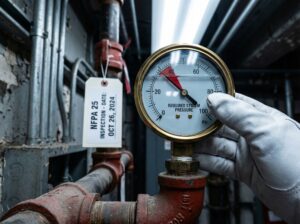
Fire pump rated for 750 GPM at 85 PSI. Actual delivery: 410 GPM at 65 PSI. Impeller wear, bearing failure, shaft misalignment, motor problems.
Why it matters:
Sprinkler system designed assuming 750 GPM available. Most hydraulically demanding area requires 520 GPM. System cannot meet design requirements.
What happens during a fire:
Sprinklers activate but deliver insufficient water. Fire growth exceeds control capacity. Small fire becomes catastrophic loss.
The fix:
- Pump rebuild: new impeller, bearings, seals, packing
- Shaft alignment correction
- Motor testing and repair
- Retest verifying rated performance
Emergency cost: $28,000 | Timeline: 6 days
If discovered during fire: $15M-$45M facility loss plus 250 jobs
—
Deficiency #2: Pipe Interior Reduced 20-35% by Corrosion
What the test found:
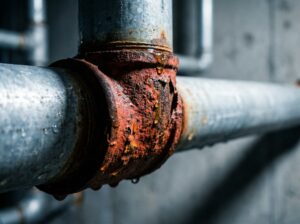
Removed 15 pipe samples throughout facility. Tuberculation (rust scale buildup) reducing diameter. Interior corrosion creating rough surfaces. Pipe thickness reduced from 0.154″ to 0.095-0.110″ (38% loss).
Why it matters:
Friction loss calculations assumed smooth pipe (C-factor 120). Actual C-factor: 60-80. Friction loss 80-150% higher than design.
Areas designed for 0.20 GPM/SF would receive only 0.08-0.12 GPM/SF during fires.
What happens during a fire:
Water can’t reach remote areas adequately. Fire spreads before suppression achieves control.
The fix:
- Emergency phase: Replace worst 15% (2,200 linear feet)
- Long-term: Replace remaining 85% (10,300 linear feet)
- New material: CPVC (superior corrosion resistance)
- Recalculate hydraulics, verify adequacy
Emergency cost: $185,000 | Timeline: 21 days
Total program: $840,000 over 4 months
If pipe fails during operation: $8M-$12M (flooding, equipment damage, weeks of downtime)
—
Deficiency #3: 127 Inoperable Sprinkler Heads (7% of System)
What the inspection found:
| Problem | Count | Impact |
|---|---|---|
| Painted heads | 62 | Paint delays/prevents activation |
| Corroded heads | 38 | Heat-sensitive elements degraded |
| Damaged heads | 18 | Won’t distribute water properly |
| Obstructed heads | 9 | Water distribution blocked |
| Total | 127 | 7% system failure rate |
Why it matters:
Failures clustered in high-risk production areas—machining with flammable oils, paint operations, materials storage.
Statistical risk:
With 7% heads inoperable overall, seems like 93% reliability. But clustering in high-risk areas means fires starting in production zones have 15-20% probability of being near inoperable heads.
What happens during a fire:
Fire starts in machining area. Nearest head is painted—delayed activation. Fire spreads to three adjacent heads: two corroded, one functional. Only one of four operates properly. Fire growth exceeds single head control capacity.
The fix:
- Replace all painted heads (can’t be cleaned per NFPA 25)
- Replace all corroded heads
- Replace all damaged heads
- Remove obstructions or relocate heads
Emergency cost: $12,800 | Timeline: 4 days (off-shift work)
If heads fail during fire: Uncontrolled spread, $15M-$45M potential loss
—
Deficiency #4: Fire Alarm Integration Failed
What the test found:
Flow switch failures: 3 of 8 flow switches don’t trigger fire alarm. Sprinkler activation doesn’t notify monitoring station. Fire department not automatically called.
HVAC failure: Air handlers continue during alarms. Smoke distributed throughout facility. Occupants in non-fire areas exposed unnecessarily.
Detector contamination: 23% of smoke detectors non-responsive. Fires wouldn’t trigger detection until flames reach detectors—defeating early warning.
Why it matters:
Code violation: NFPA 72 requires supervision of sprinkler systems.
Insurance violation: Policy requires monitored fire protection. Non-functional monitoring potentially voids coverage.
What happens during a fire:
Sprinklers might activate but nobody’s notified. Fire department response delayed until someone manually calls 911. HVAC spreads smoke. Remote occupants don’t receive early warning.
The fix:
- Repair flow switch wiring, verify signal transmission
- Program HVAC shutdown sequence, test functionality
- Clean/replace contaminated detectors
- Retest all integration points
Emergency cost: $8,400 | Timeline: 3 days
If system fails during fire: 35% larger fire before suppression, increased damage, potential casualties
—
Deficiency #5: Control Valves Inaccessible
What we found: 11 of 14 valves in locked rooms or above ceiling tiles. Emergency shutoff impossible without keys or ladders.
Risk: Can’t stop water during pipe breaks or head damage. Extended water damage.
Fix: Relocate 4 valves, add signage and access panels for 7 others.
Cost: $6,200 | Timeline: 2 days
—
Deficiency #6: Emergency Generator Undersized
What we found: Generator overloads during fire events requiring simultaneous fire pump and building load operation.
Risk: Fire pump stops during power outages when most needed.
Fix: Load shed programming prioritizing fire pump. Verification testing under load.
Cost: $3,100 | Timeline: 1 day
—
Deficiency #7: Expired Fire Extinguishers
What we found: 34 of 87 extinguishers exceeded 12-year hydrostatic test interval. Eight exceeded 25-year service life.
Risk: Extinguishers may fail during use—pressure loss, discharge valve failure, structural weakness.
Fix: Replace 8 expired units, hydrostatically test 34 others, recharge 12 with low pressure.
Cost: $4,700 | Timeline: 1 day
—
Deficiency #8: No Maintenance Records
What we found: No documented ITM records for previous 8 years.
Risk: Can’t prove code compliance or insurance requirements. Insurance may deny future claims. Code violations during inspections.
Fix: Establish record-keeping system. Document current condition as baseline.
Cost: $0 (administrative) | Timeline: Immediate
—
The 28-Day Emergency Response
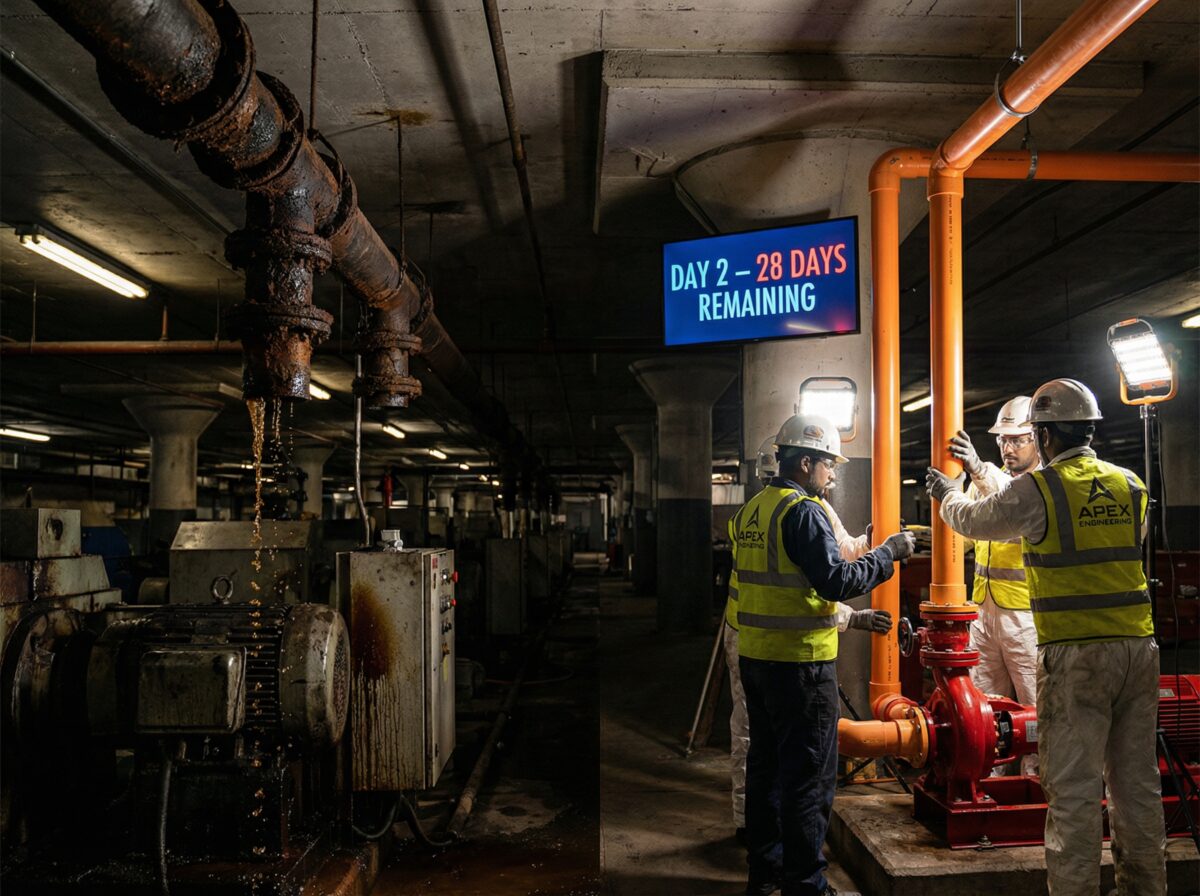
48Fire mobilized to complete all critical corrections within the 30-day deadline.
Week 1: Stop the Bleeding
Days 1-2: Fire pump rebuild (off-site with temporary rental pump on-site)
Days 3-4: Control valve relocation and accessibility improvements
Days 5-6: Fire alarm integration repairs and testing
Day 7: Generator load shed programming and testing
Week 1 outcome: Life safety issues corrected. Facility has functional fire protection meeting code minimums.
Weeks 2-3: Fix the Sprinkler Heads
Days 8-21: Replace all 127 painted, corroded, and damaged heads
Work schedule: 7:00 PM – 5:00 AM (avoid production disruption)
Strategy: One production area per night, coordinated with scheduled maintenance
Timeline: 14 days continuous work
Weeks 3-4: Emergency Pipe Replacement
Days 15-28: Replace worst 15% of corroded pipe (2,200 linear feet)
Work schedule: Off-shifts and weekends
Strategy: One zone per weekend, five zones over three weekends plus weeknights. Maintain protection in non-affected areas.
Day 28: Final Verification
Complete system functional testing. Document all work with photos, test reports, certifications. Submit comprehensive report to insurance company.
Day 29: Insurance Decision
Insurance carrier reviews documentation. Confirms critical deficiencies corrected. Reinstates full coverage. Establishes ongoing monitoring program.
Total emergency cost: $248,200
Timeline: 28 days (2 days under deadline)
Avoided loss: Facility closure, 250 job losses, $18M annual production
[Talk to an Expert!](/contact-us)
—
The Aftermath: Long-Term Corrections
Emergency program addressed immediate threats. Comprehensive correction program phased over 12 months addressed remaining issues.
Months 2-5: Complete Pipe Replacement
Remaining 85% of system (10,300 linear feet)
Cost: $655,000 | Impact: Minimal (night/weekend work)
Month 3: Fire Pump Upgrade
Larger pump meeting future expansion needs
Cost: $42,000 | Impact: None (planned shutdown)
Month 4: Fire Alarm System Upgrade
Replace 35-year-old panel with modern addressable system
Cost: $38,000 | Impact: Minimal (existing system operational during upgrade)
Months 6-12: Ongoing ITM Program
Comprehensive testing and maintenance program
Cost: $18,000 annually | Value: Prevents future deficiencies
The Financial Picture
Total long-term program: $753,000 over 12 months
Financing: Equipment loan amortized over 7 years
Annual payment: $118,000
Insurance savings: $52,000 annually (premium reduction for upgraded systems)
Net annual cost: $66,000
—
What Comprehensive Testing Actually Looks Like
The manufacturing plant’s failures resulted from 35 years of inadequate testing. Here’s what NFPA 25 compliance actually requires:
Weekly (Facility Staff)
✓ Visual check: control valves in open position
✓ Fire pump running indicator verification
✓ Fire alarm panel power and normal status
Quarterly (Qualified Contractor)
✓ Sprinkler head visual inspection (damage, corrosion, obstruction)
✓ Fire alarm functional test (detectors, pull stations, notification devices)
✓ Pressure test (verify system maintains proper pressure)
Semi-Annually (Qualified Contractor)
✓ Complete fire alarm system test (all devices, all circuits)
✓ Alarm transmission to monitoring station verification
✓ Integration testing (HVAC, access control, emergency lighting)
Annually (Licensed Contractor)
✓ Flow testing (verify adequate water delivery)
✓ Fire pump full-load test
✓ Backflow preventer test
✓ Fire extinguisher maintenance
✓ Detection device sensitivity testing
Every 5 Years (Specialized Testing)
✓ Internal pipe obstruction investigation
✓ Fire pump comprehensive maintenance
✓ Hydrostatic testing (pressure vessels, extinguishers)
✓ System capacity verification
The difference: Documented testing reports with photographs and measured data—not just “passed inspection” checkboxes.
—
The True Cost of Cutting Corners
Plant Manager’s Original Math
Annual visual inspection: $2,800
Comprehensive testing quote: $8,500
Annual “savings”: $5,700
10-year “savings”: $57,000
The Reality
Emergency corrections: $248,200
Stress of near-shutdown: Immeasurable
Risk of facility closure: 250 jobs, $18M production
What comprehensive testing would have cost: $120,000-$160,000 over 10 years (gradual corrections as problems developed)
Actual cost of “savings”: Additional $80,000-$120,000 plus existential business risk
Plant Manager’s New Perspective
“Comprehensive testing is cheap insurance. The $8,500 annual cost prevents problems costing 10-30x more to fix in emergencies.”
—
The Warning Signs (That Got Ignored)
Looking back, warning signs existed for years:
Fire pump noise increasing – Bearing wear progressing
Water pressure complaints – Corroded pipes restricting flow
Painted ceilings near sprinklers – Heads getting covered during maintenance
Intermittent fire alarm issues – Detector contamination building up
Rusty water during testing – Interior pipe corrosion progressing
The problem: Nobody connected the dots. Visual inspections didn’t catch functional failures. Comprehensive testing would have identified developing problems enabling gradual corrections.
—
Why This Happens More Than You Think
This manufacturing plant isn’t unique. Similar scenarios play out nationwide:
The competitive bid trap: Lowest-price contractor skips comprehensive testing to reduce costs
The “it’s worked for years” assumption: Systems seem fine until they’re needed
The documentation gap: No records proving maintenance was performed
The integration oversight: Systems installed decades apart never tested together
The specialized equipment excuse: “Testing would disrupt operations”
The consequences: Critical failures discovered during emergencies—or actual fires
—
What 48Fire Does Differently
Full NFPA 25 Compliance
We perform actual testing—not just visual inspections.
Fire pump testing: Full-flow testing at churn, rated flow, and 150% rated flow with pressure, power, and bearing measurements
Pipe inspection: Internal obstruction investigation every 5 years with sample removal and analysis
Head inspection: Individual examination for painting, corrosion, damage, and obstruction
Integration testing: Activate every detector, flow switch, and device verifying proper system coordination
Comprehensive Documentation
Every test includes:
- Photographs of conditions
- Measured data (not just pass/fail)
- Equipment certifications and calibration
- Deficiency lists with corrective action recommendations
- Reports formatted for insurance and code compliance
Preventive Maintenance Programs
We identify developing problems before they become failures:
- Trending data showing gradual degradation
- Proactive component replacement schedules
- Corrosion monitoring in vulnerable systems
- Predictive failure analysis
Emergency Response Capability
When testing reveals critical deficiencies:
- Immediate mobilization (not “we’ll schedule it”)
- 24/7 availability for urgent corrections
- Temporary protection measures while repairs progress
- Expedited parts sourcing and installation
—
The Questions You Should Ask Your Testing Contractor
1. Do you perform full-flow fire pump testing or just visual inspection?
Visual inspection misses 90% of pump problems. Full-flow testing reveals actual capacity.
2. Do you remove pipe samples for internal inspection?
You can’t see internal corrosion from outside. Sample removal is required every 5 years.
3. Do you test integration between fire alarm and sprinkler systems?
Visual inspection doesn’t verify signals transmit correctly. Integration testing catches wiring and programming errors.
4. Do you provide documented test reports with measured data?
“Passed inspection” forms don’t prove anything. Measured data shows actual system performance.
5. What happens if you find critical deficiencies?
Some contractors identify problems and disappear. Others provide emergency correction capability.
—
How to Avoid This Crisis
Annual Comprehensive Testing
Invest in proper testing following full NFPA 25 protocols. The $8,500 annual cost prevents $248,200 emergency corrections.
Documentation Management
Maintain complete testing records proving code compliance and insurance requirements. Missing documentation creates liability and coverage issues.
Proactive Corrections
Address deficiencies when discovered—not when insurance demands it. Gradual corrections cost 60-80% less than emergency programs.
Professional Partnership
Work with fire protection contractors specializing in comprehensive ITM—not general contractors treating testing as add-on service.
System Monitoring
Track system performance over time. Trending data identifies developing problems enabling preventive maintenance.
—
What This Manufacturing Plant Learned
Before the crisis:
- Visual inspections seemed adequate
- Saving money on testing felt smart
- Systems appeared functional
- No documentation was concerning
- Emergency preparedness was theoretical
After the crisis:
- Comprehensive testing is essential
- Cheap inspections cost more long-term
- Visual inspection misses critical failures
- Documentation prevents insurance issues
- Emergency preparedness became reality
Current status:
- Full NFPA 25 compliance testing program
- Comprehensive ITM documentation
- Proactive correction of developing issues
- Insurance premiums reduced 22%
- 250 jobs secured, $18M production protected
—
Ready to Test Your Systems Properly?
Don’t wait for an insurance ultimatum. Comprehensive testing following NFPA 25 protocols identifies problems before they become crises.
48Fire delivers:
- Full ITM compliance (inspection, testing, maintenance)
- Comprehensive documentation proving code compliance
- Emergency correction capability when needed
- Preventive maintenance preventing future failures
- Professional partnership protecting your operations
The manufacturing plant’s lesson: Cutting corners on testing created $248,200 emergency corrections and risked 250 jobs. Proper testing costs $8,500 annually and prevents catastrophic failures.
[Talk to an Expert!](/contact-us)