The Fire That Could Have Destroyed Everything
A hydraulic line ruptures near a CNC machine.
Hot hydraulic fluid sprays onto a 900°F surface. Ignition is immediate. Within 90 seconds, flames reach adjacent workstations containing flammable cutting oils and plastic components.
The fire should have spread to the entire 75,000 square foot manufacturing floor. Total estimated loss: $5.2 million in equipment, inventory, and building damage, plus 8-12 weeks of production downtime.
Actual loss: $187,000. The difference? A fire protection layout designed specifically for manufacturing hazards rather than generic code compliance.
—
Generic Design vs. Hazard-Specific Design
Most fire sprinkler systems follow prescriptive code requirements. NFPA 13 provides minimum standards for sprinkler spacing, pipe sizing, and water supply based on broad occupancy classifications.
The problem: Minimum standards don’t account for specific hazards unique to each facility.
A manufacturing floor with CNC machines, flammable liquids, and high-value equipment needs more than code minimum protection. It needs design that addresses actual fire scenarios.
Standard code approach for ordinary hazard (Group 2) classification:
- Sprinkler spacing: 130 square feet per head maximum
- Water density: 0.20 gallons per minute per square foot
- Design area: 1,500 square feet
- Head activation temperature: 155-165°F
Hazard-specific design for this facility added:
- Reduced spacing near high-risk equipment (100 sq ft per head)
- Increased water density in machine tool areas (0.30 gpm/sq ft)
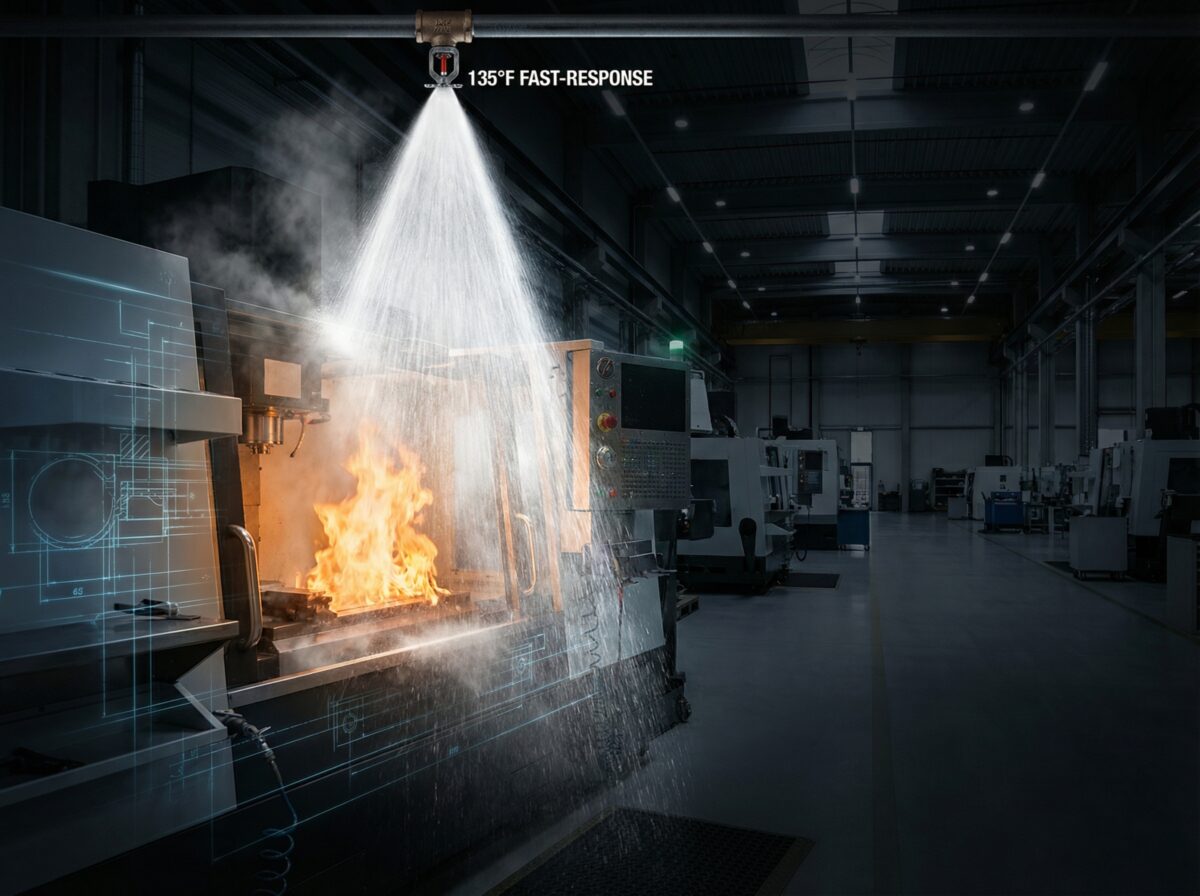
- Fast-response heads (135°F) near ignition sources
- Supplemental protection for flammable liquid storage
The additional design cost: $18,000 in engineering analysis and $42,000 in enhanced system components. The return: $5+ million in prevented losses.
—
Critical Design Elements That Made the Difference
Hazard Analysis Before Layout Design
Fire protection engineers walked the facility during operational hours. They identified specific fire risks:
Hydraulic systems under pressure: Potential for spray fires creating rapid flame spread.
Flammable cutting fluids: Oil-based coolants stored in 55-gallon drums near machining centers.
Plastic raw materials: Injection molding plastics with low ignition temperatures.
High-value CNC equipment: Individual machines valued at $250,000-$800,000.
Electrical panels: 480V distribution equipment with arc flash potential.
Each hazard got mapped with specific sprinkler coverage addressing its characteristics. This isn’t standard practice—most designs use uniform spacing across entire areas.
Strategic Head Placement
The hydraulic line fire started between two sprinkler heads positioned for code compliance but not optimized for actual risk locations.
Standard spacing would have placed heads on 10-foot centers throughout the space. Fire would have spread 8-12 feet before activating the nearest head—enough distance to ignite adjacent workstations.
The enhanced design placed heads directly above each CNC machine at 8-foot spacing. When the hydraulic fire started, a sprinkler head 4 feet away activated within 90 seconds.
Activation time matters. Fire doubles in size approximately every minute during growth phase. A 90-second response versus a 4-minute response means containing a 10-square-foot fire versus a 160-square-foot fire.
Increased Water Density in High-Risk Zones
NFPA 13 requires 0.20 gpm per square foot for ordinary hazard Group 2 spaces. The enhanced design increased density to 0.30 gpm per square foot in machining areas.
Why it matters: Standard density (0.20 gpm/sq ft) delivers approximately 300 gallons per minute over the 1,500 square foot design area. Enhanced density (0.30 gpm/sq ft) delivers 450 gallons per minute.
That additional 150 gallons per minute provided enough cooling capacity to control the hydraulic fluid fire despite its intensity. Standard density would have slowed fire growth but might not have prevented spread to adjacent equipment.
Fast-Response Head Selection
Standard sprinkler heads use 155-165°F activation temperatures. The facility installed 135°F fast-response heads near identified ignition sources.
The temperature difference seems small but creates significant response time improvements. In the hydraulic fire scenario, heat accumulated faster at lower elevations where the fast-response heads were positioned.
Fast-response heads use smaller thermal elements that react quicker to heat. They’re specifically designed for areas where rapid fire growth is expected—exactly the scenario with pressurized flammable liquids.
—
System Performance During the Actual Fire
Timeline of Events
3:47 AM: Hydraulic line failure. Fluid sprays onto hot surface.
3:48 AM: Fire reaches adjacent plastic components. Flames spread to 15 square feet.
3:49 AM: First sprinkler head activates (135°F fast-response head directly above machine).
3:49:30 AM: Water flow switch triggers fire alarm. Monitoring company notified.
3:50 AM: Second sprinkler head activates as fire reaches edge of coverage zone.
3:51 AM: Fire growth stops. Flames controlled to approximately 40 square feet total affected area.
3:54 AM: Fire department arrives. Fire already contained and cooling.
4:12 AM: Fire completely extinguished. Only two sprinkler heads activated.
Damage Assessment
Fire damage: One CNC machine with heat damage to controls ($45,000 repair). Two adjacent workstations with smoke and minor heat damage ($8,000 cleaning and repainting). Plastic inventory near fire origin destroyed ($12,000 material cost).
Water damage: Minimal. Two sprinkler heads discharging 75 liters per minute each = 150 liters/min total. Twenty-three minutes of flow = 3,450 liters (910 gallons). Floor drains and containment berms prevented water from spreading to other areas. Water damage to affected equipment and materials: $22,000.
Business interruption: Two days. Affected area cleaned, repaired, and returned to service. Unaffected production areas continued operation throughout.
Total actual loss: $187,000.
—
What Generic Design Would Have Cost
The fire protection engineering firm modeled the same fire scenario with standard code-minimum sprinkler design.
Projected timeline with standard design:
- 4-5 minutes before first head activation (165°F standard-response head farther from ignition source)
- Fire spreads to 4-6 adjacent machines before control
- 6-8 sprinkler heads activate
- Water flows 30+ minutes before fire department arrival and shutdown
Projected damage:
- Equipment loss: 3-4 CNC machines = $1,200,000-$2,400,000
- Building damage: Structural steel heat damage requiring repairs = $300,000-$500,000
- Inventory loss: Raw materials and work-in-progress = $400,000-$600,000
- Water damage: 6-8 heads flowing 30 minutes = extensive damage to electrical systems and additional equipment = $800,000-$1,200,000
- Business interruption: 8-12 weeks = $2,500,000-$3,000,000 in lost production
Total projected loss with standard design: $5,200,000-$7,700,000.
The enhanced fire protection design cost an additional $60,000. It prevented $5,013,000 in losses (using conservative estimates).
Return on investment: 8,355%.
—
Design Principles for Factory Fire Protection
Match System to Actual Hazards
Fire protection layout design should address specific operations, not generic occupancy classifications. Manufacturing facilities need analysis of:
- Chemical and flammable liquid storage locations
- Hot work and ignition source mapping
- High-value equipment protection requirements
- Process-specific fire risks
A facility producing electronics has different fire risks than one manufacturing automotive parts. The sprinkler design should reflect those differences.
Layer Protection Strategies
Effective factory fire protection combines multiple approaches:
Active protection: Sprinkler systems with appropriate density and coverage, fire detection systems with early warning capability, fire alarm integration for rapid notification, portable extinguishers for immediate response.
Passive protection: Fire-resistant walls separating high-hazard areas, fire doors preventing spread between zones, proper ventilation preventing smoke accumulation.
The manufacturing facility case study used both. Fire-rated walls limited the maximum fire size even if sprinklers failed. The sprinklers prevented fire from reaching the walls.
Calculate Real Water Demand
NFPA 13 requires using only 90% of available water supply for system design. Many facilities design to exactly that limit—leaving no safety margin.
The enhanced facility design used 75% of available supply at maximum demand. The extra 15% margin ensured adequate performance even if water pressure fluctuated or additional heads activated.
For factories with fire pumps: Size pumps for actual demand plus margin, not code minimum. Pumps must undergo annual flow testing by licensed contractors to verify performance.
Plan for Business Continuity
Fire protection design affects more than fire control—it determines how quickly operations resume after incidents.
Considerations include:
- Zone design allowing partial facility shutdown during repairs
- Water drainage systems preventing damage to unaffected areas
- Redundant systems for critical production equipment
- Documentation supporting insurance claims and compliance
The manufacturing facility installed floor drains and containment berms as part of fire protection design. During the hydraulic fire, 3,450 liters of water drained away from unaffected equipment. Without drainage planning, that water would have damaged electrical systems throughout the facility.
[Talk to an Expert!](/contact-us)
—
Beyond Installation: Maintaining Design Intent
Proper design means nothing if systems aren’t maintained.
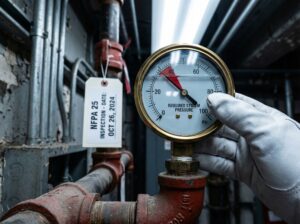
NFPA 25 requires specific inspection, testing, and maintenance activities:
- Quarterly inspections: Verify sprinkler heads aren’t obstructed, damaged, or painted
- Annual flow testing: Confirm water pressure and flow rate meet design requirements
- Five-year internal inspections: Check for pipe corrosion affecting water delivery
The manufacturing facility maintains detailed ITM records. They discovered corroded pipe sections during a five-year inspection—allowing repairs before they caused system failure.
Common maintenance failures:
Control valves left closed after maintenance (62% of sprinkler system failures). Items hanging from sprinkler heads blocking water distribution. Painted sprinkler heads delaying activation. Obstructed access to control valves preventing emergency shutoffs.
These failures negate even the best design. A $5 million fire protection system is worthless if the control valve is closed during a fire.
—
The Engineering Investment That Pays Back
Fire protection engineering costs money upfront. A comprehensive hazard analysis and custom system design runs $15,000-$50,000 depending on facility size and complexity.
What you get:
- Sprinkler layouts optimized for actual fire scenarios
- Water supply calculations with adequate safety margins
- System type selection matching environmental conditions
- Integration with building systems and passive protection
- Documentation supporting insurance and compliance requirements
The alternative: Install minimum code-compliant systems and hope fires never happen. When they do, pay the full cost of inadequate protection.
The manufacturing facility case study demonstrates reality: Fires happen. Equipment fails. People make mistakes. When fire starts, your protection system either works as designed or it doesn’t.
The difference between $187,000 in containable damage and $5.2 million in catastrophic loss was $60,000 in enhanced design and engineering. The facility owners consider it the best investment they made during construction.
—
Key Takeaways
Proper fire protection layout design addresses specific facility hazards rather than generic code requirements. The difference in performance—and cost—is dramatic.
Hazard analysis identifies actual fire risks unique to operations. Strategic sprinkler placement puts protection where fires are most likely to start. Increased water density in high-risk zones provides adequate cooling capacity for intense fires. Fast-response heads reduce activation time when seconds matter.
Fire protection engineering costs 1-2% of total system value but can prevent 90%+ of potential fire losses. The investment pays back the first time you need it—and you only need it once for the math to work.
Manufacturing facilities face unique fire risks from flammable materials, hot processes, and high-value equipment. Generic sprinkler designs might meet code but won’t prevent catastrophic losses when fires match your specific hazards.
The $5 million loss that didn’t happen wasn’t luck. It was engineering.