You’re Not Alone in This
A facility manager sits at her desk reviewing fire safety documentation. She’s asking questions that probably sound familiar if you work in building operations:
“Are our smoke detectors in the right places? How do I know?”
“What about the emergency lighting? When was it last tested?”
“Is our fire alarm system actually going to work if there’s a fire?”
“What am I missing?”
These aren’t theoretical questions. They’re the questions that keep facility managers awake at night because they know that somewhere in their building, there’s fire safety infrastructure they’re responsible for—and they don’t have total visibility into all of it.
This is where a structured approach stops being optional and becomes absolutely necessary.
—
The Reality of Commercial Fire Safety
Walk through most commercial buildings and here’s what you’ll find:
Smoke detectors exist. Usually in the right places. Sometimes not measured to verify.
Fire alarms are installed. They work. Probably. But when was the last time they were actually tested?
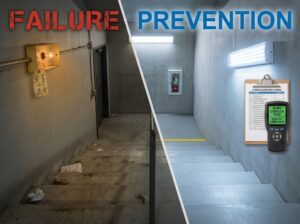
Emergency lighting is present. It’s there in hallways and stairwells. But nobody’s actually measured if it provides enough light to see in darkness.
Fire extinguishers hang on walls. They’ve been serviced. Mostly. But is the documentation organized anywhere?
Exit signs are posted. Routes are established. Procedures exist.
But is there one comprehensive system that ties all of this together? That verifies every element? That documents everything?
Usually… no.
—
What a Systematic Checklist Actually Does
A fire safety management checklist isn’t bureaucratic paperwork. It’s a visibility tool.
It answers the question: “Do I actually know what’s in my building and whether it’s working?”
Here’s what happens when a facility implements structured verification:
First: Things get measured. Not assumed. Not hoped. Measured.
Smoke detector spacing gets checked against actual square footage. Emergency lighting illumination gets measured in foot-candles. Alarm audibility gets tested in actual areas where employees work. Battery ages get documented. Load testing gets performed.
Suddenly you’re not operating on assumptions anymore. You’re operating on data.
Second: Problems surface that nobody knew existed.
A facility discovers emergency lighting is below code minimum in two stairwells. Another finds that alarm audibility drops below acceptable levels in the mechanical room. A third realizes backup batteries are seven years old when the manufacturer specs for six-year replacement.
These aren’t violations. They’re discoveries. And they matter because once you know about them, you can fix them.
Third: Everything gets organized.
Instead of fire safety documentation scattered across multiple cabinets, emails, and people’s memories, it’s systematically collected and accessible. Testing records. Maintenance schedules. Training documentation. Evacuation drill results. Everything in one place.
Fourth: Management becomes possible.
Once you have visibility into what you have, systematic management becomes achievable. Monthly inspections happen. Annual testing gets scheduled. Batteries get replaced on schedule. Documentation gets updated.
—
One Building’s Journey Through Systematic Verification
A 45,000 square foot commercial office facility decided to stop guessing.
They implemented systematic verification using a structured checklist. Here’s what the process actually looked like.
Week One: Reality Check
The facility manager and operations team walked through the building with a checklist in hand. Not to find problems (though problems emerged). To establish baseline understanding of what actually existed.
Fire detection systems: Checked placement, spacing, operational status. Found smoke detector spacing exceeded recommended maximum in two areas.
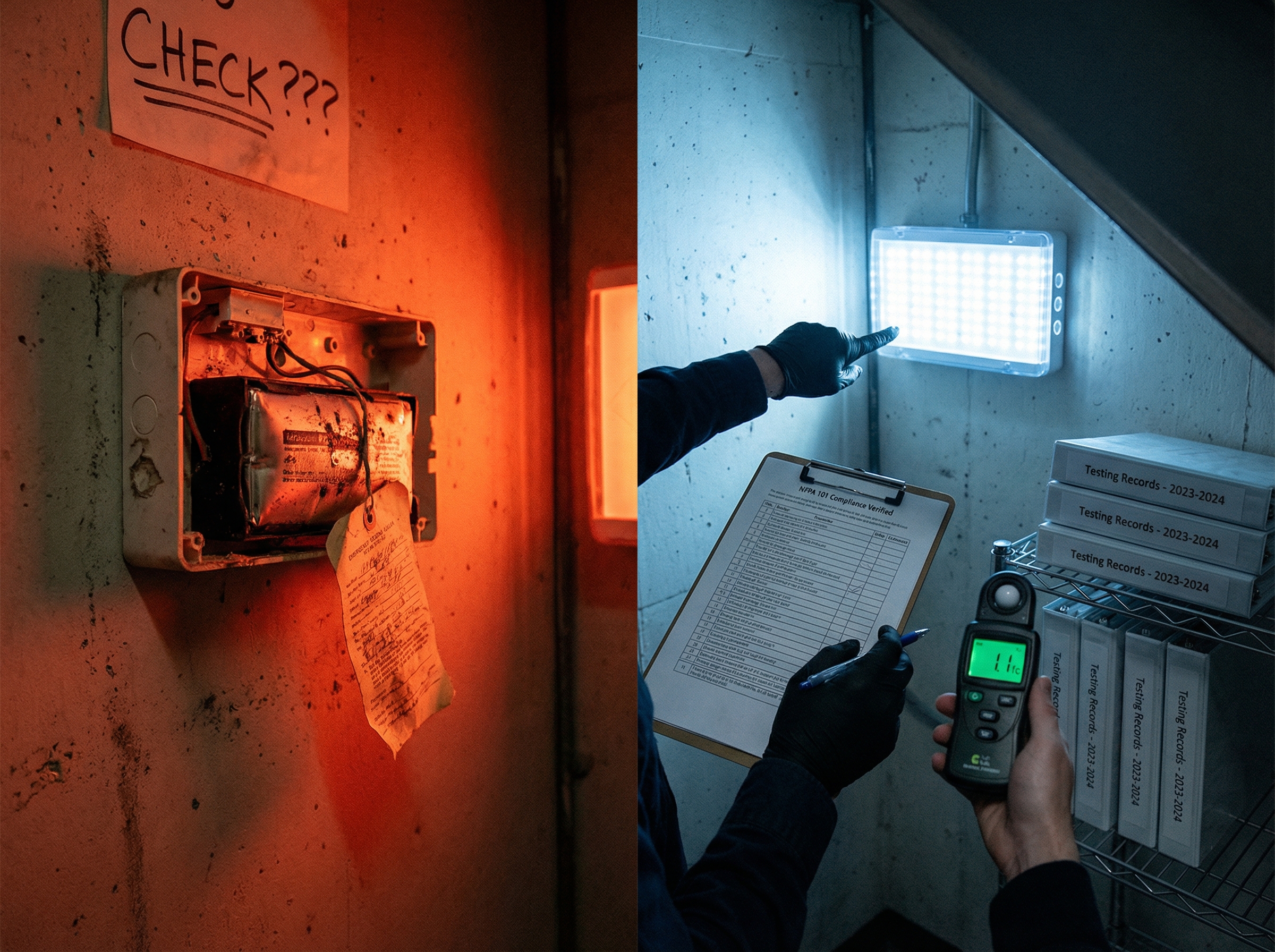
Emergency lighting: Measured illumination levels in stairwells and exit routes using a light meter. Found multiple areas below the 1 foot-candle minimum specified in NFPA 101.
Fire alarm system: Tested responsiveness. Measured alarm audibility in various locations. Discovered alarm was inaudible during operating hours in areas with high background noise.
Exit routes: Verified signage visibility, route clarity, accessibility. Found one exit route partially obstructed by equipment.
Battery systems: Documented ages of all backup batteries. Discovered emergency lighting backup batteries ranged from 5-7 years old, with several beyond manufacturer lifespan recommendations.
Week Two Through Four: Corrections
Rather than panic-fixing, the facility prioritized corrections by impact.
Critical: Emergency lighting battery replacement (if these fail, evacuation becomes dangerous). All backup batteries replaced. Load testing performed to verify 90-minute duration. Integrated testing confirmed fire alarm system triggers emergency lighting activation.
High: Emergency lighting illumination gaps. Fixtures replaced in areas below code minimum. Illumination re-measured to verify compliance.
High: Smoke detector spacing. Two additional detectors installed, spacing verified.
High: Alarm audibility. Speakers relocated and tested. Measurements confirmed 90+ dB audibility in all areas.
Medium: Exit route obstruction cleared. Equipment repositioned.
Month Two: Documentation and Ongoing Systems
All corrective actions got documented. But more importantly, ongoing systems got established.
Monthly: Visual inspection of fire safety systems with checklist verification documented.
Quarterly: Exit route inspection (spacing, signage, obstruction).
Annually: Fire alarm system professional testing and service.
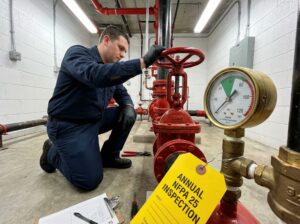
Annually: Sprinkler system professional testing and maintenance.
Annually: Load testing of emergency lighting backup batteries.
Every 3 years: Emergency lighting battery replacement (established schedule).
Documentation: All testing, maintenance, and inspection results organized in accessible files.
Result: Transition From Unknown to Verified
Before systematic verification: “I think our fire safety systems are fine.”
After systematic verification: “Here are the measurements. Here are the test results. Here’s the maintenance schedule. Here’s what we’ve corrected. Here’s the documentation proving compliance.”
That’s not a small difference. That’s the difference between operating on hope and operating on certainty.
—
What a Comprehensive Checklist Covers
A full fire safety management checklist for commercial buildings typically spans nine major areas:
Fire Detection: Smoke detector spacing, placement, operability, testing.
Alarm Systems: Fire alarm control panel, responsiveness, audibility, testing records.
Notification: Audible alarm volume verification, visual strobe visibility, integration testing.
Emergency Lighting: Installation in all required areas, illumination measurement, battery age and condition, load testing, integration with detection systems.
Fire Suppression: Sprinkler system pressure verification, head obstruction check, backflow prevention testing, portable extinguisher placement and maintenance.
Exit Routes: Door operability, signage visibility, route clearance, accessibility, handrail installation.
Fire Separations: Fire-rated door functionality, labeling, frame integrity, wall penetration sealing.
Emergency Procedures: Documentation, employee training, evacuation drills, fire warden designation.
Documentation: Testing records, maintenance records, training records, inspection results, compliance documentation.
Plus facility-specific items that vary based on building type and occupancy.
—
Why This Matters Right Now
Commercial buildings face changing fire codes. Insurance companies scrutinize compliance more carefully. Regulatory inspections are becoming more frequent.
But more than that: the people inside the buildings—employees, visitors, tenants—deserve to know that someone is paying attention to systems designed to protect them.
A facility manager implementing systematic verification isn’t just checking boxes. They’re answering a fundamental question: “If a fire started right now, would the systems designed to protect people actually work?”
That question deserves an answer based on measurement and testing—not assumptions.
—
The Starting Point
Most facilities that move to systematic verification start the same way:
One person gets frustrated with the uncertainty. They decide to actually know what they have.
They walk through the building with a checklist. They measure things. They test things. They document things.
They discover problems they didn’t know existed. They fix them. They establish ongoing processes.
Six months later, they have something they didn’t have before: actual visibility into their fire safety infrastructure.
That visibility changes everything about how they operate.
Maybe you’re that person right now. Maybe you’re the facility manager or building operations professional who’s tired of guessing about fire safety systems.
If so: the tools exist. The checklists exist. The processes exist. The only missing piece is starting.
And starting is simpler than most people think. It’s just systematic verification of what you have, documentation of what you find, and correction of what needs fixing.
That’s it. That’s how buildings move from “probably compliant” to “verified and documented.”
It doesn’t require consultants or special expertise in the first phase. It requires attention to detail, a structured checklist, and willingness to measure things instead of assuming about them.
Everything after that—the corrective actions, the ongoing management, the sophisticated compliance systems—flows naturally from that initial decision to actually know what you have.
The question isn’t whether your building needs systematic fire safety verification. The question is whether you’re going to take the first step to make it happen.
—
Ready to Know What You Actually Have?
Start with the measurement. That’s the first step. Walk through your building with a light meter, measuring emergency lighting illumination. Document smoke detector spacing. Test fire alarm audibility. Record backup battery ages.
You’ll learn more in that one walkthrough than you’ve known in years of operation.
If you want guidance on that measurement phase—if you want someone experienced to help identify what to measure and what the standards actually require—[get in touch]. 48Fire Protection helps facilities like yours move from uncertainty to certainty through systematic measurement and verification.
But honestly? You can start today. Right now. With a checklist and a willingness to measure.
That’s where every compliant facility starts.