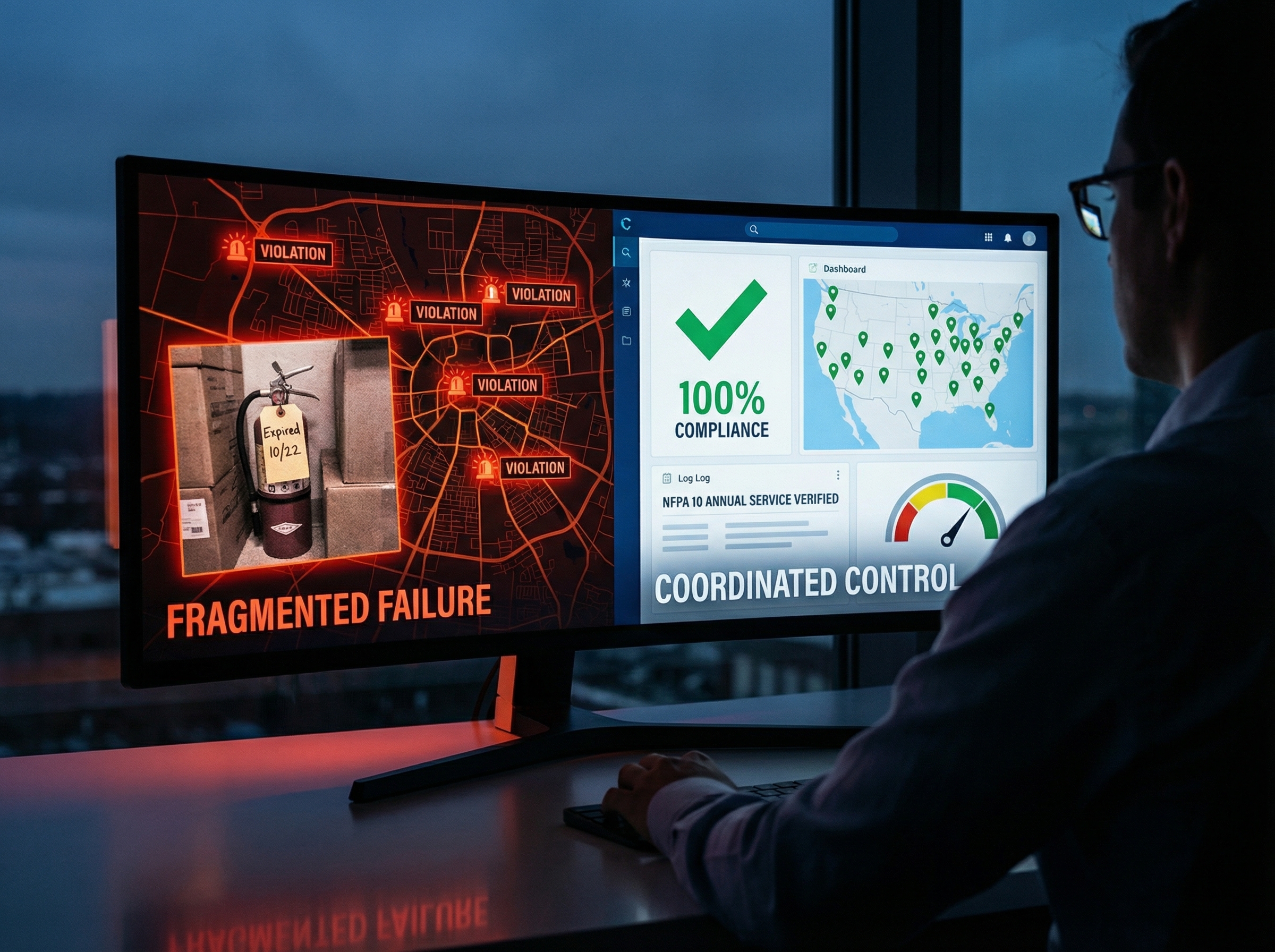
The situation appeared manageable on paper. A mid-sized retail chain operating 23 store locations across four states had been managing fire safety independently for years. Each store had fire extinguishers. Each store had emergency lighting. Each store supposedly met fire code requirements.
But when regional fire marshals conducted surprise inspections across all 23 locations in a single month, the results revealed operational reality: 18 of 23 stores had fire code violations. Only 5 stores passed inspection.
The violations ranged across issues: missing fire extinguishers, expired equipment, improperly pressurized extinguishers, emergency lighting not functional, accessibility problems, and documentation gaps. None were catastrophic individually, but collectively they revealed a compliance system in disrepair.
This wasn’t a facilities management failure. The stores were maintaining equipment—but without coordinated oversight across locations, compliance gaps accumulated. Purchasing managers bought extinguishers independently. Store managers tracked maintenance differently. Documentation was scattered across locations and vendors. When fire marshal inspections came, the organization discovered it had 18 stores failing compliance from problems that were fixable.
Within 12 months, 48Fire Protection helped transform this retail chain from 22% compliance (5 of 23 stores passing) to 100% compliance (all 23 stores passing). Here’s how.
—
The Multi-Location Compliance Challenge
Retail chains face compliance complexity that single-location businesses don’t encounter. When fire safety relies on individual store managers making independent decisions, coordination breaks down.
The Compliance Breakdown Across Locations
Store 1 (Location A): Fire extinguishers present but three hadn’t been recharged since 2022. Last inspection tag showed service from different vendor 14 months ago. No documentation of monthly pressure checks.
Store 2 (Location B): Emergency lighting functional but backup batteries hadn’t been replaced in 4 years. Illumination measurement showed 0.4 foot-candles (code requires minimum 1 foot-candle). Last test log was dated 18 months ago.
Store 3 (Location C): Fire extinguisher mounting accessible but 36-inch clearance radius blocked by merchandise display (code violation—extinguishers must be immediately accessible).
Store 4 (Location D): Documentation existed but was paper-based, incomplete, and scattered across filing systems. Fire marshal couldn’t verify last inspection date or service history in 30-minute window.
Store 5 (Location E): One type K fire extinguisher present in kitchen area but two adjacent type A extinguishers missing entirely. NFPA 10 requires specific extinguisher types for each hazard area.
This pattern repeated across locations. The organization had safety equipment, but without coordinated oversight, compliance was inconsistent.
Why Single-Vendor Coordination Failed
Before implementing coordinated fire extinguisher service, the chain used fragmented approach:
- Three different vendors servicing various locations
- Different service schedules (some quarterly, some annually)
- Inconsistent documentation (some electronic, some paper)
- No central tracking of compliance status
- Delayed corrective actions (stores waiting for local vendor availability)
- Budget inefficiency (multiple vendors, no volume pricing, inconsistent pricing)
When compliance problems were discovered, the organization couldn’t quickly identify which stores needed corrective action because there was no unified view of compliance status across locations.
—
The Coordinated Fire Extinguisher Service Strategy
48Fire Protection implemented a unified fire extinguisher service model across all 23 locations addressing three core problems: Equipment Management, Documentation Integration, and Preventive Maintenance Scheduling.
Component 1: Standardized Equipment Inventory
Rather than each store maintaining independent extinguisher inventories, 48Fire Protection created unified standards:
All 23 stores received identical inventory configuration:
- Type A extinguishers: 2 per 2,500 square feet of retail floor
- Type B extinguishers: Positioned near electrical/machinery areas
- Type K extinguishers: Kitchen areas (all 23 stores had food service)
- ABC multi-purpose extinguishers: Backup in main sales areas
Standardization ensured: Every store had the right extinguisher types for its specific hazards. No location had “missing” equipment because central inventory planning verified each location’s equipment against fire code requirements.
Cost benefit: Standardized purchasing for 23 locations reduced per-unit cost versus individual store purchases. The chain achieved 23% cost reduction on fire extinguisher inventory through volume pricing negotiated by single provider.
Component 2: Unified Documentation and Tracking System
Rather than each store maintaining paper logs or independent records, 48Fire Protection implemented centralized digital documentation:
Every service documented in unified system:
- Technician name, inspection date, time
- Pressure readings (before/after recharge)
- Physical inspection findings (corrosion, hose integrity, pin security)
- Corrective actions taken
- Next service date
Unified access meant:
- Corporate compliance office could view status of all 23 stores in real-time
- Regional managers could see which stores had pending maintenance
- Fire marshals could access complete documentation during inspections
- Corrective actions were tracked from identification through completion
Documentation transformation:
- Week 1: 18 stores with missing/incomplete documentation
- Month 2: 100% of locations with documented baseline inspection
- Month 3: All fire extinguisher service activity tracked centrally
- Month 6: Complete 12-month service history for all locations
This unified documentation became the foundation of compliance verification. When fire marshals arrived unannounced, the organization could produce complete records for any location within minutes.
Component 3: Preventive Maintenance Schedule Coordination
Rather than reactive maintenance (fix when broken), 48Fire Protection established proactive scheduling:
Quarterly service rotation:
- Month 1: Locations A, B, C, D (first tier)
- Month 2: Locations E, F, G, H (second tier)
- Month 3: Locations I, J, K, L (third tier)
- Month 4: Locations M, N, O, P, Q, R, S, T, U, V, W, X (remaining stores + returns)
Rotation benefits:
- Every extinguisher inspected minimum 4 times annually (exceeds code requirement)
- Consistent availability (no store waiting weeks for service)
- Predictable maintenance windows (stores knew service date in advance)
- Technician efficiency (same technician servicing multiple locations in geographic cluster)
Emergency lighting coordination:
Running parallel to extinguisher service, 48Fire Protection established emergency lighting service schedule, ensuring illumination levels met NFPA 101 requirement of minimum 1 foot-candle. Emergency lighting backup batteries were replaced on annual cycle, preventing degradation that led to failed inspections.
Component 4: Regional Compliance Reporting
Rather than each store reporting separately, 48Fire Protection provided unified monthly compliance report to corporate office:
Monthly Compliance Report Contents:
- All 23 locations status (compliant/non-compliant)
- Extinguisher equipment status by location
- Emergency lighting functionality verification
- Corrective actions completed
- Corrective actions pending (with timeline)
- Compliance percentage (total locations compliant/total locations)
- Cost summary and budget tracking
This reporting enabled management visibility:
- Week 1 of inspection month: Corporate knew exactly which stores had pending issues
- Week 2: Store managers received specific corrective action lists
- Week 3: Compliance office tracked completion of corrections
- Week 4: Fire marshal inspection occurred with confidence knowing compliance status
—
The Transformation: From 22% to 100% Compliance
Month 1: Baseline Assessment
- 5 of 23 stores compliant (22%)
- 18 stores with violations identified
- Violations categorized by severity and corrective action timeline
Month 2-3: Critical Corrections
- Expired extinguishers replaced across all locations
- Emergency lighting backup batteries replaced where degraded
- Documentation compiled and digitized
Month 4-6: Systematic Remediation
- Recurring service schedule established
- Staff trained on equipment accessibility requirements
- Documentation system live and operational
- Corrective actions tracked to completion
Month 9-12: Sustained Compliance
- Monthly compliance reports showing 100% store compliance
- Fire marshal re-inspections showing zero violations
- Equipment maintained on preventive schedule
- Staff trained on fire safety and equipment location
Final Result (Month 12): All 23 stores passed fire marshal inspection with zero violations. The chain achieved 100% compliance.
—
The Role of Fire Extinguisher Service in Compliance
Fire extinguisher service appears as a routine maintenance item, but proper coordinated service is foundational to fire code compliance.
NFPA 10 requires:
- Monthly visual inspections by trained personnel (pressure gauge check, hose integrity, pin security)
- Annual service by certified technician (internal inspection, recharge if needed)
- Documentation of all inspections and service
The retail chain’s transformation depended on fire extinguisher service coordination because:
1. Equipment Accountability: Centralized service meant every extinguisher was accounted for, preventing “missing equipment” violations.
2. Pressure Integrity: Monthly checks ensured extinguishers remained pressurized and ready, preventing “non-functional equipment” violations.
3. Accessibility: Service included verification that 36-inch clearance radius was maintained, preventing “blocked extinguisher” violations.
4. Documentation: Unified service documentation provided proof of compliance for fire marshal verification.
5. Corrective Action: When service identified problems (expired extinguisher, low pressure, accessibility issues), unified system tracked corrections to completion.
—
Emergency Lighting Integration in Retail Compliance
Throughout the retail chain’s compliance transformation, emergency lighting received consistent attention as critical life safety component.
Pre-compliance baseline:
- Emergency lighting functional in 20 of 23 stores (87%)
- Backup battery age inconsistent (some 2 years old, some 5+ years)
- Illumination levels not measured (couldn’t verify NFPA 101 compliance)
- Battery replacement not tracked or scheduled
Post-compliance implementation:
- 100% emergency lighting functional across all 23 stores
- Backup batteries replaced annually on scheduled cycle
- Illumination levels measured quarterly (verified minimum 1 foot-candle)
- Emergency lighting status integrated into monthly compliance reporting
Emergency lighting deficiencies had caused 8 of 18 violations during initial fire marshal inspections. By integrating emergency lighting into coordinated service schedule and verification process, the retail chain eliminated this violation category.
—
The ROI of Coordinated Fire Extinguisher Service
The retail chain’s compliance transformation delivered measurable business benefits:
Compliance Achievement: 100% pass rate on fire marshal inspections (previously 22%)
Cost Reduction:
- 23% reduction in fire extinguisher costs through volume pricing
- Eliminated emergency corrective actions (which cost premium for expedited service)
- Single vendor coordination reduced administrative overhead
Operational Benefit:
- Compliance status visible to management in real-time
- Store managers knew compliance status and corrective action requirements
- Fire marshal inspections became predictable events rather than stressful surprises
Risk Reduction:
- Zero violations across 23 locations versus 18 locations with violations
- Complete documentation demonstrating compliance due diligence
- Proactive maintenance prevented emergency situations
Insurance Benefit:
- Multi-location retail chains with documented compliance programs receive lower premiums
- Complete documentation supports insurance claims if fire incident occurs
- Demonstrated risk management improves insurance partnership
—
How 48Fire Protection Implements Retail Compliance Coordination
48Fire Protection approaches multi-location retail compliance as integrated system rather than collection of independent locations:
Step 1: Portfolio Assessment
- Map all locations
- Document current compliance status
- Identify violations and root causes
- Assess equipment inventory needs
Step 2: Standardized Strategy Development
- Determine appropriate extinguisher inventory for each location type
- Establish service schedule across locations
- Design documentation system
- Create compliance reporting structure
Step 3: Unified Implementation
- Deploy standardized equipment across locations
- Launch digital documentation system
- Train staff on new procedures
- Establish communication channels
Step 4: Ongoing Coordination
- Execute quarterly service rotation
- Track all maintenance and service activity
- Monitor compliance status monthly
- Report findings to corporate office
- Respond to issues with unified approach
Step 5: Compliance Verification
- Prepare documentation for fire marshal inspections
- Verify equipment accessibility and functionality
- Confirm emergency lighting meets standards
- Support fire marshal questions with complete records
—
Moving Forward: From Compliance Gaps to Coordinated Fire Safety
If your retail chain operates multiple locations and manages fire safety independently at each store, compliance gaps are accumulating behind the scenes. Fragmented systems create documentation problems, equipment inconsistencies, and compliance vulnerabilities that fire marshals will eventually discover.
[Talk to an Expert!] at 48Fire Protection about implementing unified fire extinguisher service coordination across all your retail locations. We’ll standardize equipment inventory, establish predictive service schedules, integrate documentation systems, and provide monthly compliance reporting ensuring all locations pass fire code inspections consistently.
Your retail chain doesn’t need to manage fire safety separately at each store. One coordinated fire extinguisher service strategy, properly implemented, transforms compliance from reactive problem-solving to proactive assurance—keeping all locations compliant and your organization focused on operations rather than violations.