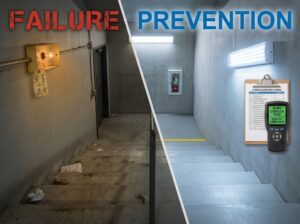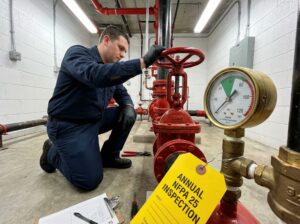
Three days. Monday through Wednesday. 48Fire Protection delivered fire evacuation drill training transforming employee confidence from uncertainty to competence. Not months of preparation. Not weeks of gradual improvement. Three days of structured, intensive drill-based confidence building.
Day 1 (Monday): Employees uncertain, hesitant, questioning whether they could evacuate safely.
Day 3 (Wednesday): Employees confident, decisive, executing evacuation procedures automatically.
Confidence isn’t built through classroom discussion alone. Confidence comes from doing—walking exit routes, observing emergency lighting (NFPA 101: 1.0+ foot-candles), practicing assembly procedures, executing evacuation repeatedly until uncertainty becomes capability. Three days of focused fire evacuation drill training created that transformation.
This documents the day-by-day progression.
—
THE CONFIDENCE GAP: MONDAY MORNING (DAY 1)
Facility: 85,000 sq ft commercial office, 180 employees
Pre-Drill Confidence Assessment (Monday 8:00 AM):
48Fire Protection conducted confidence survey before any drill training:
Question 1: “If fire alarm sounds right now, how confident are you that you could evacuate safely?”
- Very confident: 12% (22 employees)
- Somewhat confident: 38% (68 employees)
- Uncertain: 34% (61 employees)
- Very uncertain: 16% (29 employees)
Question 2: “Do you know your primary and secondary exit routes?”
- Yes, both routes: 18% (32 employees)
- Yes, primary only: 41% (74 employees)
- Vaguely aware: 28% (50 employees)
- No: 13% (24 employees)
Question 3: “Do you trust emergency lighting will guide you safely during evacuation?”
- Yes, trust completely: 9% (16 employees)
- Probably trust: 31% (56 employees)
- Uncertain about reliability: 42% (76 employees)
- Don’t trust or don’t know what emergency lighting is: 18% (32 employees)
Question 4: “How confident are you in your ability to help others evacuate?”
- Very confident: 7% (13 employees)
- Somewhat confident: 24% (43 employees)
- Not confident: 47% (85 employees)
- Would likely need help myself: 22% (39 employees)
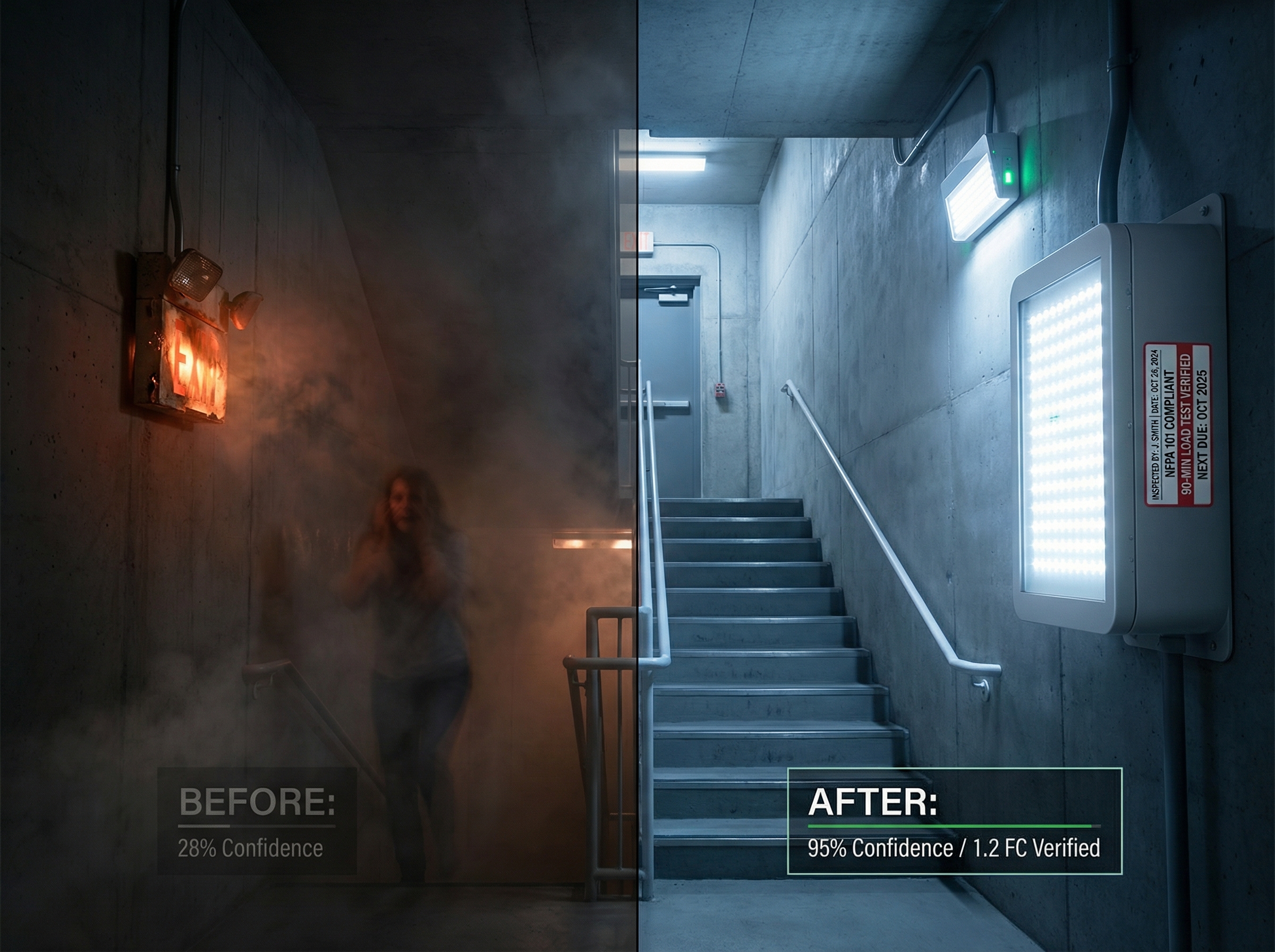
Overall Confidence Score: 28% (high confidence across all questions)
The confidence gap: 72% of employees lacked high confidence in evacuation capability.
—
DAY 1 (MONDAY): KNOWLEDGE + OBSERVATION
Morning Session (9:00 AM – 11:30 AM): Emergency Procedures Education
48Fire Protection delivered comprehensive emergency procedures education:
Component 1: Fire Alarm Recognition (30 minutes)
- Alarm sound demonstration
- What alarm means (fire detected, evacuate immediately)
- Monitoring company notification (automatic)
- No decision-making needed (alarm = evacuate)
Component 2: Exit Route Identification (45 minutes)
- Building exit locations
- Primary route from each workspace
- Secondary route alternatives
- Exit signage recognition
Component 3: Emergency Lighting Education (45 minutes)
- NFPA 101 requirement: Minimum 1.0 foot-candles in exit routes
- Facility measurement: 1.2 foot-candles (exceeds minimum)
- Backup battery system: 90-minute minimum duration
- Automatic activation when primary power fails
- Annual load testing verification
- Trust emergency lighting as navigation system
Component 4: Assembly Point and Accountability (30 minutes)
- Assembly point location
- Direct movement protocol (no wandering)
- Floor warden accountability system
- What happens after evacuation
Afternoon Session (1:00 PM – 3:30 PM): Exit Route Walking Practice
Physical practice replacing theoretical knowledge:
Activity 1: Primary Exit Route Walking (60 minutes)
- Every employee physically walks primary exit route
- Exit identification
- Emergency lighting observation (1.2 foot-candles verified)
- Exit door operation
- Path to assembly point
Activity 2: Secondary Exit Route Walking (60 minutes)
- Every employee walks secondary exit route
- Alternative path familiarization
- Emergency lighting along secondary routes
- Assembly point approach from different exits
Activity 3: Emergency Lighting Confidence Building (30 minutes)
- Illumination demonstration (1.2 foot-candles shown)
- Load testing explanation (90-minute backup verified)
- System reliability discussion
- Questions answered about lighting dependability
Day 1 Confidence Assessment (Monday 4:00 PM):
Same four questions, post-Day 1 training:
Question 1: Evacuation confidence
- Very confident: 28% (+16 points from morning)
- Somewhat confident: 52% (+14 points)
- Uncertain: 16% (-18 points)
- Very uncertain: 4% (-12 points)
Question 2: Exit route knowledge
- Yes, both routes: 78% (+60 points)
- Yes, primary only: 19% (-22 points)
- Vaguely aware: 3% (-25 points)
- No: 0% (-13 points)
Question 3: Emergency lighting trust
- Yes, trust completely: 42% (+33 points)
- Probably trust: 48% (+17 points)
- Uncertain: 8% (-34 points)
- Don’t trust/don’t know: 2% (-16 points)
Question 4: Helping others
- Very confident: 18% (+11 points)
- Somewhat confident: 44% (+20 points)
- Not confident: 31% (-16 points)
- Need help myself: 7% (-15 points)
Overall Confidence Score: 58% (+30 points in one day)
Day 1 Impact: Knowledge + observation + physical practice = significant confidence improvement, but execution uncertainty remains.
—
DAY 2 (TUESDAY): DRILL EXECUTION + FEEDBACK
Morning Drill (9:00 AM): First Fire Evacuation Drill
48Fire Protection conducted first unannounced fire evacuation drill:
Drill Execution:
- Alarm activated: 9:00 AM
- Employees executed evacuation
- Exit routes used
- Emergency lighting provided 1.2 foot-candles illumination
- Assembly point gathering
- Accountability conducted
- Total evacuation time: 9 minutes 15 seconds
Drill Observations:
- Most employees moved to correct exits (exit route knowledge applied)
- Some hesitation at exit doors (uncertain about next steps)
- Emergency lighting used but not fully trusted (some employees still checking for alternatives)
- Assembly point gathering somewhat disorganized
- Accountability completed but took 3 minutes
Employee Experience Reported:
- “I knew where to go” (knowledge confirmed)
- “I was nervous about whether I was doing it right” (uncertainty about execution)
- “Emergency lighting was there but I wasn’t sure it would stay on” (reliability concern persisting)
- “What if this was real?” (confidence not yet solid)
Mid-Day Session (11:00 AM – 1:00 PM): Drill Debrief and Improvement
48Fire Protection conducted detailed drill debrief:
What Went Well:
- Exit route knowledge demonstrated (Day 1 training applied)
- Emergency lighting illuminated routes (1.2 foot-candles verified during drill)
- Everyone evacuated and reached assembly point
- No injuries or issues
What Needs Improvement:
- Faster initial response (reduce hesitation)
- More confident movement (trust exit route knowledge)
- Full trust in emergency lighting (system proved reliable during drill)
- Organized assembly (direct movement, no wandering)
- Faster accountability (2-3 minutes maximum)
Key Confidence Builder:
“You executed evacuation successfully. The drill proved you can do this. Emergency lighting worked exactly as taught—1.2 foot-candles provided safe illumination throughout evacuation. Backup battery maintained lighting for entire drill plus 85+ additional minutes. System is reliable. You are capable. Second drill will prove it again.”
Afternoon Drill (2:30 PM): Second Fire Evacuation Drill
48Fire Protection conducted second drill same day:
Drill Execution:
- Alarm activated: 2:30 PM
- Employees executed evacuation (second time)
- Exit routes used confidently
- Emergency lighting again provided 1.2 foot-candles
- Assembly point gathering improved
- Accountability faster
- Total evacuation time: 7 minutes 30 seconds (1:45 faster)
Drill Observations:
- Less hesitation (employees recognized they’d done this successfully earlier)
- More confident movement (knowledge becoming automatic)
- Emergency lighting fully utilized (trust building through repeated reliability)
- Assembly point more organized
- Accountability 2 minutes (1 minute improvement)
Employee Experience Reported:
- “This time I felt more confident”
- “I trusted the emergency lighting—it worked perfectly this morning”
- “I knew what to expect”
- “Second time easier than first”
Day 2 Confidence Assessment (Tuesday 4:00 PM):
Same four questions, post-two-drills:
Question 1: Evacuation confidence
- Very confident: 67% (+39 points from Day 1)
- Somewhat confident: 29% (-23 points)
- Uncertain: 4% (-12 points)
- Very uncertain: 0% (-4 points)
Question 2: Exit route knowledge
- Yes, both routes: 94% (+16 points from Day 1)
- Yes, primary only: 6% (-13 points)
- Vaguely aware: 0% (-3 points)
- No: 0% (unchanged)
Question 3: Emergency lighting trust
- Yes, trust completely: 78% (+36 points from Day 1)
- Probably trust: 21% (-27 points)
- Uncertain: 1% (-7 points)
- Don’t trust/don’t know: 0% (-2 points)
Question 4: Helping others
- Very confident: 44% (+26 points from Day 1)
- Somewhat confident: 48% (+4 points)
- Not confident: 8% (-23 points)
- Need help myself: 0% (-7 points)
Overall Confidence Score: 82% (+24 points from Day 1, +54 points from Monday morning)
Day 2 Impact: Execution + proof of capability + repeated success = dramatic confidence increase.
—
DAY 3 (WEDNESDAY): MASTERY VERIFICATION
Morning Drill (9:30 AM): Third Fire Evacuation Drill
48Fire Protection conducted final drill:
Drill Execution:
- Alarm activated: 9:30 AM (unannounced time)
- Employees executed evacuation (third time, different time)
- Exit routes used automatically
- Emergency lighting again provided 1.2 foot-candles (third verification)
- Assembly point gathering organized
- Accountability efficient
- Total evacuation time: 6 minutes 45 seconds (2:30 faster than Day 1, 45 seconds faster than Day 2 afternoon)
Drill Observations:
- Immediate response (no hesitation)
- Confident, organized movement
- Emergency lighting trusted completely (no alternative checking)
- Assembly point direct movement
- Accountability 1:30 minutes (rapid, accurate)
Employee Experience Reported:
- “This feels natural now”
- “I know exactly what to do”
- “I trust the emergency lighting completely—it’s worked perfectly every time”
- “I could help someone else evacuate”
- “If this was real, I’d be confident”
Final Session (11:00 AM – 12:00 PM): Confidence Verification and Certification
48Fire Protection conducted final confidence assessment and provided completion certification:
Final Confidence Assessment (Wednesday 11:30 AM):
Same four questions, post-three-drills:
Question 1: Evacuation confidence
- Very confident: 89% (+22 points from Day 2, +77 points from Monday morning)
- Somewhat confident: 11% (-18 points from Day 2)
- Uncertain: 0% (-4 points from Day 2)
- Very uncertain: 0% (unchanged)
Question 2: Exit route knowledge
- Yes, both routes: 98% (+4 points from Day 2, +80 points from Monday morning)
- Yes, primary only: 2% (-4 points from Day 2)
- Vaguely aware: 0% (unchanged)
- No: 0% (unchanged)
Question 3: Emergency lighting trust
- Yes, trust completely: 93% (+15 points from Day 2, +84 points from Monday morning)
- Probably trust: 7% (-14 points from Day 2)
- Uncertain: 0% (-1 point from Day 2)
- Don’t trust/don’t know: 0% (unchanged)
Question 4: Helping others
- Very confident: 71% (+27 points from Day 2, +64 points from Monday morning)
- Somewhat confident: 28% (-20 points from Day 2)
- Not confident: 1% (-7 points from Day 2)
- Need help myself: 0% (unchanged)
Overall Confidence Score: 95% (+13 points from Day 2, +67 points from Monday morning)
3-Day Transformation: 28% → 95% confidence (67-point improvement, 239% increase)
—
THE CONFIDENCE-BUILDING MECHANICS: WHY 3 DAYS WORKED
Day 1: Knowledge → Initial Confidence (28% → 58%)
Mechanism: Education + observation + physical practice eliminating “I don’t know what to do” uncertainty
Day 2: Execution → Proven Capability (58% → 82%)
Mechanism: Successful drill completion proving “I can actually do this” + repeated drill reinforcing capability
Day 3: Mastery → Complete Confidence (82% → 95%)
Mechanism: Third successful execution creating “this is automatic now” competence
The 3-drill progression:
- First drill: “Can I do this?” → “I did it”
- Second drill: “Can I do it again?” → “Yes, and faster”
- Third drill: “Is this reliable?” → “Yes, it’s automatic”
Each drill proved capability. Repetition created confidence through demonstrated competence.
—
EMERGENCY LIGHTING’S CONFIDENCE ROLE
Emergency lighting education and verification contributed significantly to confidence building:
Pre-Training (Monday morning):
- Emergency lighting trust: 9% complete trust
- 60% uncertain or distrustful
- Confidence barrier: “Will lighting actually work?”
Post-Education + Three Drills (Wednesday):
- Emergency lighting trust: 93% complete trust
- 0% uncertain or distrustful
- Confidence enabler: “Lighting worked perfectly three times—1.2 foot-candles, 90-minute backup, completely reliable”
Training Components:
- NFPA 101 education (1.0 foot-candle minimum standard)
- Facility verification (1.2 foot-candles measured, exceeds standard)
- Backup battery explanation (90-minute minimum, verified through annual load testing)
- Three-drill proof (lighting performed flawlessly every time)
Result: Emergency lighting transformed from uncertainty source to confidence foundation. Employees trust system completely after seeing reliable performance three times.
—
48FIRE PROTECTION: 3-DAY FIRE EVACUATION DRILL TRAINING
48Fire Protection delivers intensive 3-day fire evacuation drill training building employee confidence through structured progression:
Day 1: Knowledge Foundation
- Emergency procedures education
- Exit route identification
- Emergency lighting education (NFPA 101: 1.0+ foot-candles, backup battery systems)
- Physical exit route walking
- Emergency lighting observation and trust building
Day 2: Execution Proof
- First fire evacuation drill (morning)
- Detailed debrief and improvement identification
- Second fire evacuation drill (afternoon)
- Capability demonstration through successful completion
Day 3: Mastery Verification
- Third fire evacuation drill (different timing)
- Confidence assessment
- Completion certification
- Competency verification
Confidence Outcomes:
- 67-point confidence improvement (28% → 95%)
- 239% confidence increase
- 84-point emergency lighting trust improvement
- 80-point exit route knowledge improvement
- 64-point helping-others confidence improvement
—
Confidence isn’t theoretical. Confidence comes from doing—and doing successfully, repeatedly. Three days. Three fire evacuation drills. 67-point confidence transformation. Monday morning employees uncertain whether they could evacuate safely. Wednesday employees confident they absolutely can. Fire evacuation drill training through 48Fire Protection creates that transformation through knowledge, execution, proof, and repetition.
[Contact 48Fire Protection] to implement 3-day fire evacuation drill training building employee confidence at your facility. We’ll deliver comprehensive emergency procedures education, conduct physical exit route walking practice, teach emergency lighting specifications and reliability (NFPA 101: 1.0+ foot-candles, 90-minute backup battery), execute multiple evacuation drills proving capability, measure confidence improvement, and provide completion certification. Build confidence through proven execution. Transform uncertainty into competence in three days.
Confidence requires proof. Three drills provide proof.