Why NFPA Standards Are Non-Negotiable for Businesses
—
OPENING: THE $47,000 LESSON
Conference call. Tuesday morning. Eight executives on the line.
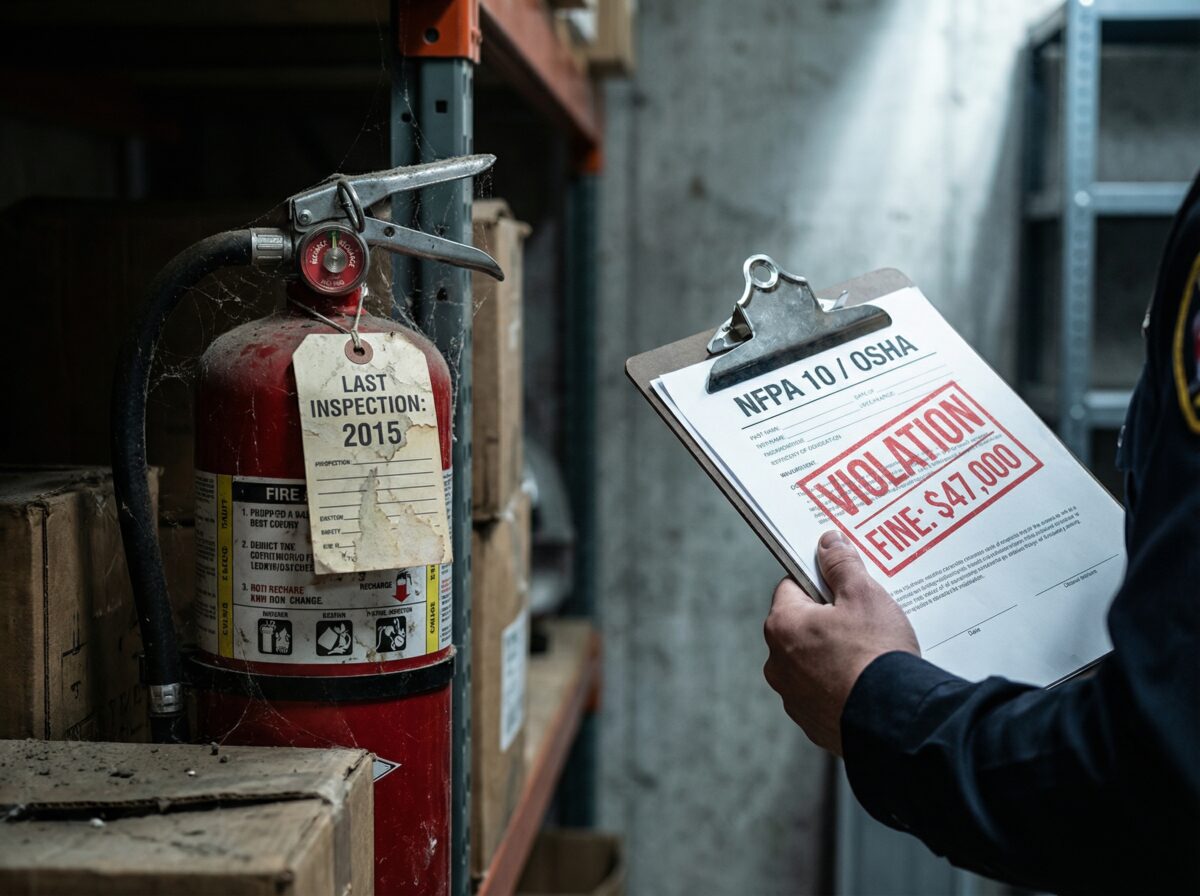
The safety director was explaining why the manufacturing plant in Ohio just got hit with three OSHA citations totaling $47,000.
The violations? Fire extinguisher non-compliance. Specifically, failure to maintain equipment per NFPA 10 standards.
“But we have fire extinguishers,” one executive interrupted. “They’re on every floor. We bought them three years ago.”
The safety director’s response:
“Buying them isn’t compliance. NFPA 10 requires monthly inspections, annual maintenance, six-year examinations, and hydrostatic testing. We haven’t done any professional maintenance since installation. The fire marshal’s report says 40% of our extinguishers are non-functional or improperly maintained.”
Silence on the line.
Then the CFO: “So we’re paying $47,000 in fines because we didn’t follow standards nobody told us existed?”
Not exactly. The standards exist, they’re legally binding through OSHA, and “we didn’t know” isn’t a defense.
—
WHAT NFPA ACTUALLY IS
The Organization Behind the Standards
NFPA = National Fire Protection Association
Founded 1896. Non-profit organization. Develops and publishes fire safety codes and standards used worldwide.
Not a government agency. NFPA creates standards through consensus process involving fire safety professionals, engineers, manufacturers, insurance companies, and enforcement authorities.
Why it matters: When OSHA, insurance companies, and fire marshals reference “fire extinguisher requirements,” they’re citing NFPA standards—specifically NFPA 10.
NFPA 10: The Fire Extinguisher Standard
Full title: Standard for Portable Fire Extinguishers
What it covers:
- Selection and installation of fire extinguishers
- Inspection, testing, and maintenance requirements
- Training and education
- Hydrostatic testing
- Recharging and repair
- Obsolete extinguisher identification
Current edition: Updated every three years (most recent major update 2022)
Scope: Applies to selection, installation, inspection, testing, maintenance, and recharging of portable fire extinguishers and extinguisher systems
Does not cover: Fixed fire suppression systems, fire hoses, fire pumps (those have separate NFPA standards)
How NFPA Standards Become Legally Binding
The enforcement chain:
NFPA creates standard → Technical committee drafts requirements → Public comment period → Consensus approval → Published standard
OSHA adopts by reference → OSHA regulation 1910.157 references NFPA standards → Becomes federal law for workplaces
State/local codes adopt → Building codes incorporate NFPA standards → Becomes local enforcement requirement
Insurance requires → Property insurance policies reference NFPA compliance → Becomes contractual obligation
Result: NFPA 10 has legal force even though NFPA itself has no enforcement authority.
48Fire operates specifically to NFPA 10 standards because that’s what OSHA inspectors, fire marshals, and insurance carriers will verify during compliance checks.
—
THE SPECIFIC REQUIREMENTS BUSINESSES MISS
Monthly Inspection (NFPA 10 Section 7.2)
Requirement: Fire extinguishers shall be inspected at least monthly or more frequently if circumstances require.
What “inspection” means per NFPA:
✓ Extinguisher located in designated place
✓ No obstruction to access or visibility
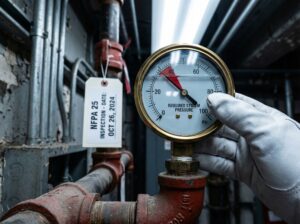
✓ Pressure gauge reading shows operable range
✓ Fullness determined by weighing or hefting (for self-expelling types)
✓ Condition of hose and nozzle
✓ Indicator for non-rechargeable extinguisher shows serviceability
✓ Operating instructions on nameplate legible and facing outward
✓ Safety seals and tamper indicators not broken or missing
✓ Examination for obvious physical damage, corrosion, leakage, clogged nozzle
Who can perform: Trained facility personnel (doesn’t require certification)
Documentation required: Date, person conducting inspection, notation of defects found
Common business mistake: Assuming “we walk by them regularly” satisfies this requirement. NFPA requires systematic examination with documentation, not casual observation.
48Fire note: While businesses can perform monthly inspections internally, many choose professional monthly service ensuring consistent documentation and immediate identification of issues requiring technical service.
—
Annual Maintenance (NFPA 10 Section 7.3)
Requirement: Fire extinguishers shall be subjected to maintenance at intervals of not more than 1 year, at the time of hydrostatic test, or when specifically indicated by an inspection.
What “maintenance” means per NFPA:
This is comprehensive examination by trained, certified person including:
✓ Mechanical parts examination
✓ Extinguishing agent examination
✓ Expelling means examination
✓ Physical condition examination
✓ All maintenance procedures must be per manufacturer’s manual
✓ Nameplate or suitable label affixed showing maintenance performed
✓ Date of maintenance
✓ Name of person performing service
✓ Name of agency performing service
Who can perform: Certified fire extinguisher service technician only
Documentation required: Service tag/label showing date, service performed, technician/agency identification
Common business mistake: Treating monthly inspection as annual maintenance. These are distinct activities with different qualification requirements.
What 48Fire explains to clients: Annual maintenance involves disassembly, internal examination, component testing, and professional equipment that facilities don’t possess. This isn’t DIY-able compliance activity.
—
Six-Year Internal Examination (NFPA 10 Section 7.3.1)
Requirement: Every 6 years, stored pressure type extinguishers that require a 12-year hydrostatic test shall be emptied and subjected to maintenance procedures detailed in manufacturer’s service manual.
What this involves per NFPA:
✓ Complete removal of extinguishing agent
✓ Internal examination for damage, corrosion, or other defects
✓ Replacement of all seals, gaskets, and valve components per manufacturer
✓ Mechanical testing of all components
✓ Recharge with proper agent
Who can perform: Certified technician with proper equipment and training
Documentation required: Service tag showing internal examination performed, date, technician/agency
Common business mistake: Not tracking equipment age, missing six-year deadlines entirely
48Fire tracking system: Automatically monitors equipment ages and flags units approaching six-year examination deadlines, scheduling service before NFPA intervals expire.
—
Hydrostatic Testing (NFPA 10 Section 8)
Requirement: Pressure vessels require periodic pressure testing to verify structural integrity.
Test intervals per NFPA 10 Table 8.3.1:
| Extinguisher Type | Test Interval |
|---|---|
| Stored pressure water/foam/dry chemical | 12 years |
| Carbon dioxide (CO2) | 5 years |
| Wet chemical | 5 years |
| Dry chemical (cartridge/cylinder operated) | 12 years |
| Halogenated agent | 12 years |
| Clean agent | 12 years |
What testing involves per NFPA:
✓ Complete discharge of extinguisher
✓ Removal of valve assembly and internal examination
✓ Vessel filled with water (or approved fluid)
✓ Pressurization to test pressure (typically 1.5-3x normal operating pressure)
✓ Hold time to verify no leakage or deformation
✓ Visual inspection for damage or expansion
✓ Drying and proper reassembly
✓ Recharge with correct agent
✓ Test results recorded with date, technician, test facility
Who can perform: Certified testing facility with proper equipment
NFPA requirement for failed tests: Extinguisher must be removed from service and destroyed (cannot be repaired)
Common business mistake: Complete unawareness this requirement exists
48Fire finds: 80%+ of businesses we audit for the first time have overdue hydrostatic testing because nobody knew NFPA required it.
—
WHY “CLOSE ENOUGH” DOESN’T WORK
OSHA Enforces NFPA Standards
OSHA 1910.157(e)(3): “The employer shall assure that portable fire extinguishers are subjected to an annual maintenance check.”
How OSHA defines “maintenance check”: By reference to NFPA standards
OSHA 1910.157(e)(4): “The employer shall assure that stored pressure dry chemical extinguishers that require a 12-year hydrostatic test are emptied and subjected to the applicable maintenance procedures as detailed in the manufacturer’s service manual every 6 years.”
Direct NFPA language incorporated into federal law.
OSHA inspection reality:
Fire marshals and OSHA inspectors carry copies of NFPA 10. They verify compliance against specific sections. “We do it differently” or “close enough” doesn’t satisfy regulatory requirements.
Current OSHA penalties (2025):
- Serious violation: Up to $16,131 per violation
- Repeat violation: Up to $161,323 per violation
- Willful violation: Up to $161,323 per violation
Multiple extinguishers with same deficiency = multiple violations = compounding penalties.
That’s how a facility with 30 non-compliant extinguishers gets $47,000 in citations. Three violation categories × multiple units.
—
Insurance Policies Reference NFPA Standards
Standard commercial property insurance policy language:
“Insured shall maintain all fire protection equipment in accordance with applicable NFPA standards…”
What this means practically:
Claims adjusters investigating fire damage review fire protection maintenance records. Equipment maintained below NFPA standards creates policy compliance questions.
Potential insurance consequences:
- Claim denial for policy non-compliance
- Coverage reduction based on inadequate fire protection
- Premium increases after discovering substandard maintenance
- Required corrective action as policy renewal condition
48Fire client experience: One facility had fire claim initially questioned because maintenance records showed annual service hadn’t occurred in 18 months. Insurance eventually paid but required NFPA-compliant program implementation before policy renewal.
—
Fire Marshals Verify NFPA Compliance
Authority Having Jurisdiction (AHJ) = local fire marshal or fire prevention bureau
Fire marshal inspection protocol:
Random sampling of fire extinguishers checking:
- Monthly inspection documentation (per NFPA 7.2)
- Annual maintenance within 12 months (per NFPA 7.3)
- Service tags with proper information (per NFPA 7.3.4)
- Hydrostatic testing current (per NFPA 8)
- Proper selection for hazards (per NFPA 6)
- Correct mounting and accessibility (per NFPA 6.1.3)
Fire marshals enforce local fire codes that incorporate NFPA standards.
Inspection outcomes:
- Violations for NFPA non-compliance
- Re-inspection requirements
- Correction deadlines with follow-up
- Potential operational restrictions for serious violations
Pattern 48Fire observes: Facilities confident in their compliance often receive fire marshal violations because internal understanding doesn’t match NFPA technical requirements.
—
THE BUSINESS CONSEQUENCES OF NON-COMPLIANCE
Regulatory Penalties (Quantifiable)
OSHA serious violations: $16,131 each
Typical multi-violation scenario:
- Annual maintenance overdue: $16,131
- Hydrostatic testing not performed: $16,131
- Inadequate documentation: $16,131
- Total: $48,393
Plus:
- Re-inspection fees
- Corrective action requirements
- Follow-up verification
- Potential reputation impact (OSHA violations are public record)
—
Insurance Complications (Variable but Significant)
Premium impact:
Fire protection deficiencies discovered during underwriting or claim investigations can increase premiums 15-30% on property coverage.
Claim complications:
Fire damage claim with inadequate fire extinguisher maintenance creates scrutiny. Even if claim pays, questions about policy compliance emerge.
Coverage requirements:
Post-claim or renewal, insurers may mandate:
- Professional NFPA-compliant service programs
- Quarterly or semi-annual audits
- Enhanced documentation systems
- Independent verification reports
—
Liability Exposure (Potentially Catastrophic)
Scenario: Fire occurs. Employee attempts to use fire extinguisher. Equipment fails due to lack of maintenance. Fire spreads. Employee injured. Property damaged.
Legal questions:
- Did employer maintain required fire protection equipment?
- Were NFPA standards followed?
- Is negligence apparent?
Liability exposure:
- Employee injury claims
- Property damage beyond insurance coverage
- Third-party claims (neighboring properties, tenant businesses)
- Punitive damages if negligence demonstrated
NFPA compliance documentation provides liability defense. Non-compliance removes that protection.
—
Operational Disruption (Often Underestimated)
Fire marshal violations can require:
- Immediate correction within 24-72 hours
- Operations suspension until compliance demonstrated
- Emergency service at premium rates
- Management time redirected to crisis response
- Reputational impact with tenants, customers, partners
48Fire emergency response experience: Facilities discovering violations day-before-deadline frantically seeking immediate service. Emergency corrections cost 2-3x normal service rates plus operational chaos.
Prevention through NFPA compliance costs fraction of emergency correction.
—
WHAT ACTUAL COMPLIANCE LOOKS LIKE
The NFPA-Compliant Fire Extinguisher Program
Month 1-12: Systematic inspection cycle
Monthly: Professional or trained internal staff perform NFPA 7.2 visual inspections. Document findings. Address any issues immediately.
At Month 11: Schedule annual maintenance before 12-month deadline
Month 12: Certified technician performs NFPA 7.3 annual maintenance including:
- Complete external examination
- Mechanical parts inspection
- Pressure verification with calibrated equipment
- Seal replacement
- Documentation with proper service tags
Ongoing: Monitor for any inspections revealing need for immediate service (damage, pressure loss, tampering)
Year 6: Units reaching six-year anniversary receive NFPA 7.3.1 internal examination including complete disassembly, internal inspection, component replacement, recharge
Years 5/12: Units reaching hydrostatic test intervals receive NFPA Section 8 pressure testing at certified facility
Continuous: Digital or physical tracking ensuring no deadlines missed, all documentation organized, audit-ready compliance maintained
48Fire programs include all these components with automated scheduling preventing deadline violations and maintaining continuous NFPA compliance.
—
Documentation That Satisfies NFPA Requirements
Monthly inspection records must show per NFPA 7.2.2:
- Date of inspection
- Person conducting inspection
- Any defects found
- Remedial action taken
Annual maintenance tags must show per NFPA 7.3.4:
- Month and year maintenance performed
- Person or agency performing maintenance
- Can be on hang tag or adhesive label
- Must be durable and legible
Hydrostatic test documentation must show per NFPA 8.3.3:
- Month and year test performed
- Name of person or agency performing test
- Test results
What NFPA requires businesses maintain:
Permanent records of maintenance, recharging, and hydrostatic testing for each extinguisher. Records retained per applicable regulations (OSHA, local codes) typically 1-5 years minimum.
48Fire documentation approach: Physical service tags meeting NFPA requirements plus digital records with photographic evidence accessible 24/7 through client portal, creating redundant audit-ready documentation.
—
Professional Service vs. Internal Management
What businesses can handle internally per NFPA:
✓ Monthly visual inspections (after proper training)
✓ Basic accessibility maintenance (keeping areas clear)
✓ Immediate removal of damaged equipment from service
What NFPA requires professional certified service:
✓ Annual maintenance (Section 7.3)
✓ Six-year internal examination (Section 7.3.1)
✓ Hydrostatic testing (Section 8)
✓ Recharging (Section 7.4)
✓ Any internal work on extinguisher components
Most businesses lack:
- Certified fire extinguisher technicians on staff
- Calibrated testing equipment
- Hydrostatic testing facilities
- Proper recharging equipment and agents
- Technical knowledge of NFPA procedures
Practical approach: Internal monthly inspections coordinated with professional service for annual maintenance and testing requirements.
48Fire serves businesses recognizing fire extinguisher compliance requires specialized expertise they don’t possess internally and don’t want to develop for non-core business activity.
—
THE COST-BENEFIT ANALYSIS
Investment in NFPA Compliance
Typical commercial facility (50 extinguishers):
Monthly professional inspection service: $100-150/month = $1,200-1,800 annually
Annual maintenance: $1,000-1,500 once yearly
Six-year internal examinations: $200-300 amortized annually
Hydrostatic testing: $150-300 amortized annually
Total annual NFPA-compliant program: $2,550-3,900
Alternative: Internal monthly inspections + professional annual service:
Internal inspection labor: 2 hours monthly × $30/hour = $720 annually
Professional annual maintenance: $1,000-1,500 once yearly
Six-year and hydrostatic testing: $350-600 amortized
Total annual cost: $2,070-2,820
Per extinguisher annual cost: $41-78 for complete NFPA compliance
—
Cost of Non-Compliance
Single OSHA serious violation: $16,131
Three-violation scenario: $48,393
Insurance premium increase: 15-30% of property coverage (varies significantly by property value, could be $2,000-20,000+ annually)
Fire marshal emergency correction: $2,000-5,000 for rushed compliance
Operational disruption: Variable, potentially $10,000-50,000+ in lost productivity/revenue
Fire damage with inadequate equipment: Potentially hundreds of thousands to millions
—
ROI Calculation
Scenario: Prevent single OSHA violation
Compliance investment: $2,500-4,000 annually
Avoided violation cost: $16,000-48,000
ROI: 400-1,900%
Scenario: Prevent insurance complications
Compliance investment: $2,500-4,000 annually
Avoided premium increase: $2,000-20,000+ annually
ROI: Positive to substantial depending on coverage levels
Scenario: Equipment functions during actual fire
Compliance investment: $2,500-4,000 annually
Value of properly functioning fire protection during early fire suppression: Potentially prevents $100,000-$1,000,000+ in fire damage
ROI: Immeasurable but substantial
The numbers justify NFPA compliance as risk management investment, not just regulatory checkbox.
—
IMPLEMENTING NFPA COMPLIANCE
Step 1: Assess Current Status
Inventory all fire extinguisher equipment:
- Locations throughout facility
- Types and ratings
- Manufacturing dates
- Last service dates (if any)
Review current practices:
- Monthly inspection procedures and documentation
- Annual maintenance history
- Hydrostatic testing records
- Service provider qualifications
Identify gaps against NFPA requirements:
- Equipment overdue for service
- Missing documentation
- Procedures not meeting NFPA standards
- Testing never performed
48Fire provides complimentary compliance assessments comparing current programs against NFPA requirements and identifying specific gaps requiring correction.
—
Step 2: Establish Professional Service
Select qualified service provider:
Verify provider qualifications:
- Technician NFPA certification
- Hydrostatic testing facility access
- Insurance coverage
- References from similar facilities
- Documentation systems meeting NFPA requirements
Define service scope:
- Monthly inspection (professional or internal with oversight)
- Annual maintenance timing and procedures
- Six-year examination tracking
- Hydrostatic testing coordination
- Emergency response availability
Establish service agreement:
- Clear service scope and schedule
- Documentation deliverables
- Pricing structure
- Response times for issues
- Compliance tracking systems
48Fire service agreements include all NFPA-required maintenance with automated scheduling, comprehensive documentation, and dedicated client support ensuring continuous compliance.
—
Step 3: Correct Existing Deficiencies
Prioritize by urgency:
Immediate (safety issues):
- Non-functional equipment (remove from service, provide temporary coverage)
- Blocked or inaccessible units (clear access or relocate)
- Wrong types for hazards (replace with appropriate equipment)
Short-term (30 days):
- Overdue annual maintenance (schedule comprehensive service)
- Missing or inadequate documentation (complete service and proper tagging)
- Equipment requiring hydrostatic testing (schedule testing)
Ongoing:
- Establish systematic inspection program
- Implement tracking for future deadlines
- Train staff on monthly inspection procedures
48Fire correction programs address all identified deficiencies with prioritized timelines ensuring critical issues resolve immediately while systematic improvements implement progressively.
—
Step 4: Maintain Continuous Compliance
Automated systems prevent future gaps:
- Digital tracking of all equipment with service deadlines
- Automatic scheduling before NFPA intervals expire
- Alert systems flagging approaching deadlines
- Centralized documentation accessible for audits
- Regular compliance reporting to management
Periodic verification:
- Quarterly or semi-annual compliance reviews
- Annual comprehensive program audits
- Equipment inventory updates as facility changes
- Service provider performance verification
Documentation organization:
- All NFPA-required records maintained per regulations
- Organized for rapid inspector access
- Digital and physical redundancy
- Historical records preserved
48Fire clients receive digital compliance dashboards showing real-time status across all equipment, upcoming deadlines, complete service history, and instant audit-ready reporting.
—
BEYOND COMPLIANCE: THE BUSINESS VALUE
Risk Management Benefit
NFPA-compliant fire extinguisher programs provide genuine risk reduction beyond regulatory compliance.
Properly maintained equipment actually works during fires. Seems obvious, but consider:
- Equipment with proper pressure discharges fully for rated duration
- Components tested regularly function reliably under stress
- Agents maintained properly suppress fires effectively
- Employees trained through systematic programs respond appropriately
Non-compliant equipment may look fine but fail when needed most.
48Fire perspective: Compliance isn’t about satisfying inspectors—it’s about ensuring fire protection equipment protects when fires occur.
—
Insurance Optimization
Proactive compliance documentation supports:
- Favorable underwriting (demonstrated risk management)
- Smoother claims processing (no compliance questions)
- Potential premium discounts (varies by carrier, some offer 5-15% for certified programs)
- Enhanced coverage options (better terms for well-maintained facilities)
Insurance carriers increasingly verify fire protection maintenance during underwriting and claims. NFPA-compliant programs create documentation supporting facility’s risk profile.
—
Operational Excellence Signal
Fire extinguisher compliance reflects broader facility management quality.
Facilities maintaining rigorous NFPA compliance typically also demonstrate:
- Systematic approach to safety programs
- Attention to regulatory requirements across domains
- Investment in proper facility maintenance
- Professional management practices
Correlation works both ways: Facilities sloppy about fire extinguisher compliance often show similar patterns in other safety and maintenance areas.
For multi-location operations, standardized NFPA-compliant programs create consistency across properties, simplifying corporate oversight and demonstrating systematic risk management to stakeholders.
—
COMMON NFPA COMPLIANCE QUESTIONS
Q: Can businesses use non-NFPA-compliant extinguishers if they prefer different standards?
No. OSHA 1910.157 specifically requires compliance with NFPA standards for workplaces. Insurance policies reference NFPA. Fire codes adopt NFPA. Choosing “different standards” doesn’t satisfy legal requirements.
Q: What if NFPA standards conflict with manufacturer recommendations?
NFPA 10 frequently references manufacturer instructions, requiring procedures be performed per manufacturer manuals. Generally, follow whichever is more stringent. When genuine conflicts arise, consult certified service provider and AHJ for interpretation.
Q: Do NFPA standards apply to residential properties?
NFPA 10 primarily covers commercial, industrial, and institutional settings. Residential requirements vary by local jurisdiction. However, NFPA 10 provides best practices regardless of legal requirements—proper maintenance ensures equipment works whether legally required or not.
Q: Are older extinguishers “grandfathered” from new NFPA requirements?
Generally no. Current NFPA editions apply to all equipment regardless of installation date. However, specific requirements sometimes include phase-in periods for existing equipment. Consult current NFPA 10 edition or qualified service provider for specific situations.
Q: Can facilities perform NFPA-compliant service with internal staff?
Monthly inspections yes (with proper training). Annual maintenance, six-year examinations, hydrostatic testing, and recharging require certified technicians with specialized equipment most facilities don’t possess. Few businesses employ NFPA-certified fire extinguisher technicians making professional service practical necessity.
Q: How often does NFPA 10 update?
NFPA 10 updates on three-year cycle. Most recent significant update was 2022 edition. Updates typically involve refinements rather than wholesale changes. Service providers like 48Fire track edition changes ensuring service procedures remain current with latest NFPA requirements.
Q: What happens if NFPA compliance is impossible due to extinguisher age or condition?
NFPA provides obsolescence criteria requiring equipment removal from service. Very old extinguishers, units with unavailable parts, or equipment using obsolete agents must be replaced—cannot be maintained to standards. Professional assessment determines when replacement becomes necessary.
Q: Do NFPA standards cover fire extinguisher training?
NFPA 10 Section 7.1 addresses training, requiring education on hazards, equipment location, and proper use. However, OSHA 1910.157(g) provides more detailed training requirements including hands-on practice. Both sets of requirements apply to workplaces.
—
TAKING ACTION ON NFPA COMPLIANCE
Three starting points for businesses:
Option 1: Compliance Assessment
For businesses unsure of current NFPA status:
Professional evaluation comparing existing fire extinguisher program against NFPA 10 requirements, identifying specific gaps, providing prioritized correction recommendations.
Assessment includes:
- Complete equipment inventory
- Documentation review
- Physical inspection sampling
- NFPA requirement comparison
- Written findings report
- Correction cost estimates
Investment: $500-1,200 depending on facility size
Outcome: Clear understanding of NFPA compliance status and correction pathway
[Request NFPA Compliance Assessment](/contact-us)
—
Option 2: Program Implementation
For businesses ready to establish NFPA-compliant programs:
Complete service program addressing all NFPA 10 requirements including monthly inspections, annual maintenance, six-year examinations, hydrostatic testing, and comprehensive documentation.
Implementation includes:
- Current deficiency correction
- Systematic service schedule establishment
- Documentation system setup
- Ongoing compliance maintenance
- Training and support
Investment: Variable based on equipment quantity and current status, typically $2,500-5,000 annually for medium facilities
Outcome: Full NFPA compliance with automated maintenance and audit-ready documentation
[Implement NFPA Program](/contact-us)
—
Option 3: Emergency Correction
For businesses facing immediate inspections or known violations:
Rapid response addressing critical NFPA deficiencies, bringing equipment and documentation to compliant status within days.
Emergency service includes:
- 24-48 hour assessment
- Immediate critical issue correction
- Expedited comprehensive service
- Inspector-ready documentation
- Ongoing program establishment
Investment: Premium rates for emergency response, $3,000-8,000+ depending on urgency and scope
Outcome: Rapid NFPA compliance preventing or addressing violations
[Request Emergency NFPA Service](/contact-us)
—
CONCLUSION: COMPLIANCE ISN’T OPTIONAL
NFPA standards carry legal force through OSHA adoption, local fire code incorporation, and insurance policy requirements.
“Non-negotiable” isn’t rhetorical emphasis—it’s regulatory reality.
Businesses have two choices:
Choice 1: Maintain fire extinguishers to NFPA standards through systematic professional programs. Cost: $40-80 per extinguisher annually. Outcome: Regulatory compliance, insurance alignment, functional equipment, risk mitigation.
Choice 2: Ignore NFPA requirements hoping inspectors never arrive. Cost: $0 until violations discovered. Outcome: $16,000+ penalties per serious violation, insurance complications, equipment that may fail during fires, liability exposure.
The math isn’t complicated. The risk isn’t theoretical. The consequences aren’t trivial.
NFPA compliance represents basic risk management for businesses with fire extinguishers—which means essentially all businesses with physical facilities.
48Fire exists specifically because NFPA requirements are technical, specific, and require professional expertise most businesses don’t possess and don’t want to develop internally.
Fire extinguisher compliance isn’t your core business. It’s ours.
[Establish Your NFPA-Compliant Program Today](/contact-us)
—
48Fire
NFPA-Certified Fire Extinguisher Service
Nationwide Professional Compliance Programs
Contact: [/contact-us](/contact-us)
Specialization: Complete NFPA 10 compliance for commercial facilities
Commitment: Technical expertise, systematic service, audit-ready documentation
—
NFPA standards exist because fire extinguishers save lives and property—when properly maintained.
Compliance ensures your equipment delivers that protection when seconds matter and alternatives don’t exist.
That’s why NFPA standards are non-negotiable.
[Begin NFPA Compliance Now](/contact-us)
—