What to Expect During a Professional Fire Extinguisher Service
—
YOUR SERVICE APPOINTMENT: WHAT ACTUALLY HAPPENS
Technician scheduled for Tuesday. What occurs during the visit?
Most facility managers never observe professional fire extinguisher service directly. Equipment gets serviced during normal operations. Technician arrives, works on extinguishers, leaves documentation. The process remains unclear.
Understanding professional fire extinguisher service helps facilities:
- Recognize quality service vs. inadequate work
- Prepare facilities appropriately
- Verify NFPA requirements satisfied
- Understand service value
- Identify substandard service
This article details actual professional fire extinguisher service from arrival through completion—procedures, timing, documentation, and NFPA 10 compliance elements.
—
BEFORE THE TECHNICIAN ARRIVES
Pre-Service Preparation
What professional fire extinguisher service providers request:
Facility information:
- Floor plans showing extinguisher locations
- Equipment inventory (types, quantities, ages)
- Access instructions (codes, keys, after-hours procedures)
Service history:
- Previous provider documentation
- Last service dates
- Recent issues or concerns
Scheduling details:
- Preferred days/times
- On-site contact person
- Special access requirements
Why advance information matters:
Preparation enables technicians to:
- Bring appropriate parts and supplies
- Allocate sufficient time
- Minimize operational disruption
- Avoid return visits for parts
—
Facility Preparation Checklist
Before service visit:
□ Unlock areas containing fire extinguishers
□ Provide keys/codes for restricted areas
□ Notify security of appointment
□ Clear pathways to equipment
□ Designate available contact person
□ Note recent equipment issues
What not to do:
✗ Block equipment with deliveries
✗ Schedule during major facility events
✗ Assume unrestricted building access
✗ Expect service without contact available
—
ARRIVAL AND SETUP
First 15 Minutes
Technician arrival procedure:
Check-in:
- Report to contact person
- Present credentials
- Confirm service scope
- Review facility requirements
Equipment setup:
- Service tools and supplies
- Documentation devices (tablets, forms)
- Parts and materials
- Mobile workstation if needed
Initial assessment:
- Verify equipment locations
- Identify access challenges
- Note obvious issues
- Confirm service can proceed
Time investment: 10-15 minutes
—
Professional Equipment Required
Standard professional fire extinguisher service tools:
Testing equipment:
- Calibrated pressure gauges
- Precision scales (weight verification)
- Flashlights (internal examination)
- Inspection mirrors (difficult viewing areas)
Service tools:
- Wrenches and valve tools
- Pin pullers and seal applicators
- Pressure relief equipment
- Recharging equipment
Parts and supplies:
- Replacement seals and pins
- O-rings and gaskets
- Service tags and labels
- Cleaning materials
Documentation equipment:
- Digital tablets with software
- Cameras for photos
- Barcode scanners
- Portable printers
48Fire technicians arrive fully equipped for comprehensive NFPA-compliant service.
—
VISUAL INSPECTION PROCESS
Systematic Examination
Per NFPA 10 Section 7.2 requirements:
Location verification:
- Confirm designated position
- Check mounting security
- Verify accessibility (36-inch clearance)
- Assess signage visibility
External condition:
- Shell inspection (corrosion, dents, damage)
- Paint and finish condition
- Physical abuse indicators
- Environmental factor effects
Component examination:
- Hose condition (cracks, deterioration)
- Nozzle condition (damage, blockage)
- Valve assembly condition
- Handle and trigger mechanism
Operating instructions:
- Nameplate legible
- Instructions facing outward
- Critical information readable
Time per unit: 2-3 minutes
What technicians identify:
- Corrosion patterns (green brass, rust steel, white aluminum)
- Stress indicators (dents, scratches, wear)
- Environmental exposure (fading, dirt, moisture)
- Tampering evidence (broken seals, missing pins)
—
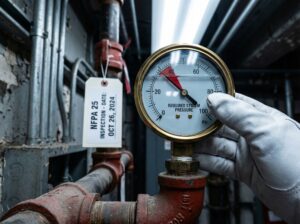
Pressure Verification
Critical measurement per NFPA:
For stored pressure types:
Visual gauge assessment:
- Read directly with proper lighting
- Document zone (green/yellow/red)
- Photograph for records
Function verification:
- Tap gauge detecting stuck needles
- Observe needle response
- Document mechanical issues
Range verification:
- Confirm manufacturer specifications
- Green zone = operable range
- Yellow/red = immediate service needed
For CO2 types:
Weight verification required:
- Remove and weigh on calibrated scale
- Compare to specification weight
- Calculate acceptable range (±10% typical)
- Document actual vs. specification
Why verification matters:
Green gauge doesn’t definitively prove adequate pressure. Technicians verify:
- Gauge accuracy through calibrated equipment
- Gauge mechanical function (not stuck)
- Actual pressure/weight meets specifications
Common findings:
- Gauges stuck in green zone
- Faded gauges (unclear boundaries)
- Slow pressure loss beginning
- CO2 weight loss indicating leaks
Time per unit: 1-2 minutes
—
Seal and Tamper Indicator Check
NFPA 10 requires intact seals:
Safety pin verification:
- Present and intact
- Proper size and type
- Not bent or damaged
- Secured correctly
Tamper seal verification:
- Unbroken and intact
- Properly attached
- Appropriate type
- No manipulation evidence
Why this matters:
Broken seals indicate:
- Possible discharge
- Tampering
- Immediate service need
- Equipment compromise
Broken seal response:
- Immediate service flagging
- Unit removed from service
- Full inspection required
- Recharge and seal replacement
—
Real-Time Documentation
Digital recording during inspection:
Per unit entry includes:
- Location (building, floor, room, position)
- Serial number and manufacturing date
- Type, size, rating
- Pressure reading with photo
- Physical condition notes
- Pass/fail status
- Deficiencies requiring service
- Photographic evidence
Why immediate documentation:
- Memory unreliable across many units
- Photos capture exact conditions
- Digital timestamps prove timing
- GPS confirms physical presence
- Real-time manager notifications
Time investment: 1-2 minutes per unit for documentation
—
ANNUAL MAINTENANCE SERVICE
Beyond Visual Inspection
NFPA 10 Section 7.3 requires annual maintenance—comprehensive examination.
When annual maintenance occurs:
- 12 months since last professional maintenance
- Inspection reveals issues needing detailed examination
- Scheduled annual maintenance date reached
- Equipment age suggests comprehensive service
Time requirement: 15-30 minutes per unit
—
Internal Examination
Per NFPA 10 Section 7.3.2:
Pressure relief and agent removal:
- Safely depressurize stored pressure types
- Remove agent for internal access
- Document agent condition
Valve assembly removal:
- Remove valve from cylinder
- Inspect threads for damage
- Examine valve seat
- Check stem for corrosion
Internal cylinder examination:
- Inspect walls for corrosion
- Check for rust, pitting, deterioration
- Look for foreign materials
- Assess overall condition
Component inspection:
- Siphon tube examination
- Internal hose condition
- Dip tube integrity
- Component security
External component examination:
- Discharge hose thorough inspection
- Nozzle internal/external examination
- Valve mechanism testing
- Gauge calibration verification
What internal examination reveals:
- Internal corrosion (exterior perfect, interior rusted)
- Agent contamination (moisture, foreign materials)
- Component wear (valve seats, O-rings, springs)
- Siphon tube issues (detachment, cracks, blockages)
—
Component Replacement
NFPA requires replacing components per manufacturer specifications:
Standard annual maintenance replacements:
Seals and O-rings:
- Valve stem O-rings
- Discharge valve seals
- Siphon tube gaskets
- Deteriorated sealing components
Why replacement required:
Rubber components degrade over time:
- Hardening from age/temperature
- Compression set (permanent deformation)
- Chemical degradation
- Environmental exposure
NFPA requires replacement during annual maintenance even if appearing functional.
Safety pins and tamper seals:
- New pin installed
- New tamper seal applied
- Proper installation verified
- Replacement documented
Other components as needed:
- Pressure gauges if damaged
- Discharge hoses if deteriorated
- Nozzles if damaged
- Valve components if worn
Parts quality:
48Fire uses:
- Manufacturer-approved parts
- NFPA specification compliance
- New (not refurbished) components
- Model-specific appropriate parts
—
Recharging Procedure
NFPA 10 Section 7.4 recharge requirements:
Agent verification:
- Correct agent type
- Proper quantity per specifications
- Quality meeting standards
- Expiration verification
Recharge process:
- Clean internal components
- Reassemble with new seals
- Install correct agent quantity
- Pressurize to specifications
- Verify pressure reading
- Test for leaks
Quality checks:
- Weight verification correct
- Pressure stability over time
- No leaks detected
- Components properly secured
Time for complete recharge: 20-40 minutes depending on type
—
Service Tag Application
NFPA 10 Section 7.3.4 requires:
“Maintenance shall be indicated by attachment of service tag or label including: (1) Month and year maintenance performed, (2) Name of person or agency performing service, (3) Name of agency.”
Professional fire extinguisher service tag includes:
Required information:
- Service date (month/year)
- Service provider name (48Fire)
- Technician name or certification number
- Service type performed
- Next service due date
Additional information:
- Provider contact information
- Technician certification credentials
- Barcode/QR code for digital records
- Serial number reference
Tag characteristics:
- Securely attached
- Visible without moving unit
- Durable material for environment
- Previous tags remain or replaced
Why proper tags matter:
Inspectors verify:
- Service actually occurred (date proves timing)
- Qualified provider (company identification)
- Service frequency meets requirements (date progression)
- Accountability established (technician identification)
48Fire service tags meet all NFPA 10 Section 7.3.4 requirements with enhanced digital record linkage.
—
HYDROSTATIC TESTING COORDINATION
Testing Requirements
NFPA 10 Table 8.3.1 test intervals:
| Extinguisher Type | Test Interval |
|---|---|
| CO2, water, foam, wet chemical | 5 years |
| Dry chemical (stored pressure) | 12 years |
| Clean agent | 12 years |
How professional fire extinguisher service identifies testing needs:
- Manufacturing date (establishes schedule)
- Last test date (determines interval status)
- Equipment age (flags approaching deadlines)
- Service history (verifies compliance)
When testing overdue:
Immediate actions:
- Flag unit in system
- Notify facility management
- Provide cost estimate
- Recommend timeline
- Offer temporary replacement
—
Testing Process
Hydrostatic testing requires specialized facility:
Step 1: Equipment removal
- Remove units requiring testing
- Document serial numbers and locations
- Photograph before removal
- Install temporary replacements
Step 2: Certified facility transport
- Secure transport to 48Fire testing facility
- Proper handling preventing damage
- Chain of custody documentation
Step 3: Testing
- Complete discharge and disassembly
- Internal vessel examination
- Pressure testing per NFPA
- Pass/fail determination
Step 4: Post-test processing
If passed:
- Complete drying
- Reassemble with new components
- Recharge with proper agent
- Apply test documentation
- Return to facility
If failed:
- Unit destroyed per NFPA 10 Section 8.3.5
- Failure documentation
- Replacement unit provided
- Disposal certified
Step 5: Reinstallation
- Return tested/replacement units
- Install in original locations
- Remove temporary units
- Update documentation
Timeline: 5-10 business days
Costs:
- Testing: $50-75 per unit
- Recharge (passed): $35-50 per unit
- Replacement (failed): $180-350 per unit
—
HANDLING DEFICIENT EQUIPMENT
Common Deficiencies
Issues found during professional fire extinguisher service:
Pressure problems:
- Gauge outside acceptable range
- Rapid pressure loss (leaks)
- CO2 weight below specification
Physical damage:
- Shell dents or corrosion
- Hose cracks or deterioration
- Nozzle damage or blockage
- Valve damage or malfunction
Maintenance issues:
- Service significantly overdue
- Missing/illegible service tags
- Broken seals or missing pins
- Internal corrosion/contamination
Compliance issues:
- Wrong type for location
- Improper mounting height
- Missing signage
- Overdue testing
—
Response Protocol
Critical safety issues (non-functional):
Immediate actions:
- Remove from service
- Tag “OUT OF SERVICE”
- Install temporary replacement
- Notify management immediately
- Document with photos
Service options:
- On-site repair if parts available
- Transport for facility repair
- Replacement if beyond economical repair
- Emergency service available
Non-critical issues (compliance deficiencies):
Immediate actions:
- Document deficiency clearly
- Provide correction recommendations
- Estimate costs
- Establish timeline
- Unit may remain in service pending correction
—
Temporary Equipment
48Fire policy during equipment service:
When equipment removed:
- Temporary replacement installed immediately
- Same type and rating
- Fully charged and functional
- Maintains continuous fire protection
When awaiting parts:
- Temporary unit until repair complete
- No fire protection gap
- No additional charge
When replacement needed:
- Temporary unit until permanent arrives
- Never without required protection
- Smooth transition when permanent installed
Why this matters: NFPA requires maintained fire protection. Facilities cannot operate without proper coverage.
—
SERVICE DOCUMENTATION
Completion Documentation
What facilities receive:
Service summary:
- Total units serviced
- Units passing inspection
- Units requiring service/repair
- Units removed for testing
- Temporary units installed
Equipment-specific reports:
- Individual unit findings
- Photographic evidence
- Service performed per unit
- Parts replaced
- Current status
Compliance reporting:
- Percentage meeting NFPA requirements
- Units overdue for service
- Upcoming testing requirements
- Correction recommendations
Cost documentation:
- Services performed with costs
- Parts and materials used
- Additional work required
- Invoice and payment terms
—
Digital Records Access
Modern professional fire extinguisher service (48Fire provides):
Cloud platform features:
- Login credentials for management
- 24/7 access to service history
- Real-time equipment status
- Upcoming deadline tracking
- Photographic documentation archive
Mobile accessibility:
- Smartphone app access
- Tablet compatibility
- View records anywhere
- Download reports on demand
Report generation:
- Custom reports for specific needs
- Fire marshal preparation
- Insurance documentation
- Management summaries
- Compliance verification
—
Audit-Ready Documentation
For OSHA inspections:
- Service dates within required intervals
- Certified technician identification
- Service type documentation
- 1910.157 compliance verification
For fire marshal inspections:
- Complete service history
- NFPA 10 requirement satisfaction
- Testing compliance documentation
- Equipment selection verification
For insurance requirements:
- Professional provider identification
- Regular service intervals
- Equipment condition reports
- Compliance certification
48Fire documentation specifically designed for regulatory and insurance audit requirements.
—
ONGOING SERVICE AND FOLLOW-UP
Automatic Scheduling
Professional fire extinguisher service providers schedule future service automatically:
Annual maintenance tracking:
- System calculates 12-month due dates
- Automatic 30-60 day advance notifications
- Facility coordination for scheduling
- Service before NFPA deadlines
Testing reminders:
- Equipment age monitoring
- 6-12 month advance notice
- Budget planning assistance
- Testing coordination
Inspection schedules:
- Monthly visits if contracted
- Consistent dates (e.g., first Tuesday)
- Automatic calendar integration
- Service confirmations
—
Quality Assurance
How professional fire extinguisher service ensures quality:
Technician certification:
- NFPA training and certification
- Continuing education
- Manufacturer-specific training
- Quality standards compliance
Service verification:
- Management review of work
- Customer satisfaction follow-up
- Issue resolution protocols
- Continuous improvement
Documentation accuracy:
- Digital validation checks
- Photographic evidence requirements
- Location verification (GPS)
- Time stamp authentication
48Fire quality assurance includes independent verification sampling and customer satisfaction surveys.
—
COST TRANSPARENCY
Service Pricing
Typical professional fire extinguisher service costs:
Monthly inspection:
- Small facilities (10-25 units): $100-150/month
- Medium facilities (25-75 units): $150-250/month
- Large facilities (75+ units): $250-400+/month
Annual maintenance:
- Per unit: $40-70 depending on type
- Includes inspection, maintenance, parts, documentation
- Recharge additional $30-50 if needed
Six-year examination:
- Per unit: $60-90
- Complete disassembly and examination
- More comprehensive than annual
Hydrostatic testing:
- Testing: $50-75 per unit
- Recharge (passed): $35-50 per unit
- Replacement (failed): $150-350 per unit
Cost factors:
- Extinguisher types
- Equipment ages
- Facility access
- Equipment quantities
- Service frequency
- Geographic location
—
Service Value
Professional fire extinguisher service value includes:
Technical expertise:
- NFPA-certified technicians
- Proper training and equipment
- Manufacturer knowledge
- Regulatory compliance understanding
Quality assurance:
- Correct procedures
- Appropriate parts
- Thorough documentation
- Compliance verification
Liability protection:
- Due diligence demonstration
- Regulatory defense documentation
- Insurance requirement satisfaction
- Reduced violation risk
Peace of mind:
- Equipment functionality verified
- Compliance requirements satisfied
- Professional accountability
- Expert recommendations
Time savings:
- No facility staff time required
- Automated scheduling
- Minimal coordination needed
- Comprehensive reporting
—
RECOGNIZING QUALITY SERVICE
Red Flags
Warning signs service doesn’t meet NFPA standards:
Procedural shortcuts:
- No individual unit examination
- No pressure verification
- No internal examination during annual maintenance
- Service completed too quickly
- Visual inspection only when maintenance due
Documentation deficiencies:
- Generic tags without specific dates
- No technician identification
- Missing service reports
- No photographic evidence
- Inaccessible digital records
Technical concerns:
- Lacks proper tools/equipment
- Uses generic parts
- Doesn’t verify specifications
- Can’t answer NFPA questions
- No certification shown
Professional issues:
- Poor communication
- No correction recommendations
- Defensive about questions
- Won’t explain procedures
- No follow-up support
—
Quality Indicators
Professional fire extinguisher service hallmarks:
Technical competency:
- NFPA-certified with credentials
- Proper calibrated equipment
- Systematic NFPA approach
- Manufacturer-approved parts
- Thorough documentation
Communication excellence:
- Clear work explanations
- Proactive issue identification
- Improvement recommendations
- Responsive to questions
- Professional demeanor
Documentation quality:
- Complete service tags
- Detailed reports
- Photographic evidence
- Accessible digital records
- Audit-ready documentation
Service value:
- Appropriate time per unit
- All NFPA requirements addressed
- Automatic follow-up scheduling
- Post-service support
- Continuous improvement
48Fire professional fire extinguisher service incorporates all quality indicators as standard practice.
—
CONCLUSION
Professional fire extinguisher service involves:
Visual inspection: Location, accessibility, condition, pressure verification (2-3 minutes/unit)
Annual maintenance: Disassembly, internal examination, component replacement, recharging, documentation (15-30 minutes/unit)
Testing coordination: Hydrostatic testing per NFPA intervals with temporary equipment provision
Deficiency resolution: Immediate response ensuring continuous fire protection
Comprehensive documentation: Audit-ready compliance records with digital access
Ongoing support: Automated scheduling, issue tracking, quality assurance
Complete facility service: 2-6 hours depending on equipment quantity and service needs
Facilities should expect:
- NFPA-certified technicians with proper equipment
- Systematic approach following standards
- Complete regulatory documentation
- Clear communication about findings
- Continuous compliance maintenance
48Fire professional fire extinguisher service provides all NFPA 10 requirements with transparent processes, comprehensive documentation, and continuous quality assurance ensuring facilities understand exactly what occurs during every service visit.
[Schedule Professional Fire Extinguisher Service](/contact-us)
—
48Fire
Professional Fire Extinguisher Service
NFPA-Certified • Complete Documentation • Nationwide
Contact: [/contact-us](/contact-us)