What Most Property Managers Miss in Tag Inspections
—
THE REALITY CHECK
You manage a 12-story office building. Forty-three fire extinguishers scattered across hallways, mechanical rooms, elevator lobbies, and tenant spaces.
Monthly, you walk the property checking various items. Fire extinguishers? They’re on the list. You glance at them. Still mounted. Still have those little tags. Check. Move on.
Annual fire safety inspection happens. Service company sends someone. They spend a few hours. Invoice arrives. You pay it. Everything’s handled, right?
Then the fire marshal shows up.
Not for a scheduled inspection—those you prepare for. This is the random compliance check. The kind where they walk floors, pull extinguishers, examine tags closely, and write citations for things you genuinely didn’t know were problems.
Three violations written in 20 minutes:
1. Five extinguishers with annual maintenance exceeding 12 months
2. Monthly inspection tags showing 2-3 month gaps on multiple units
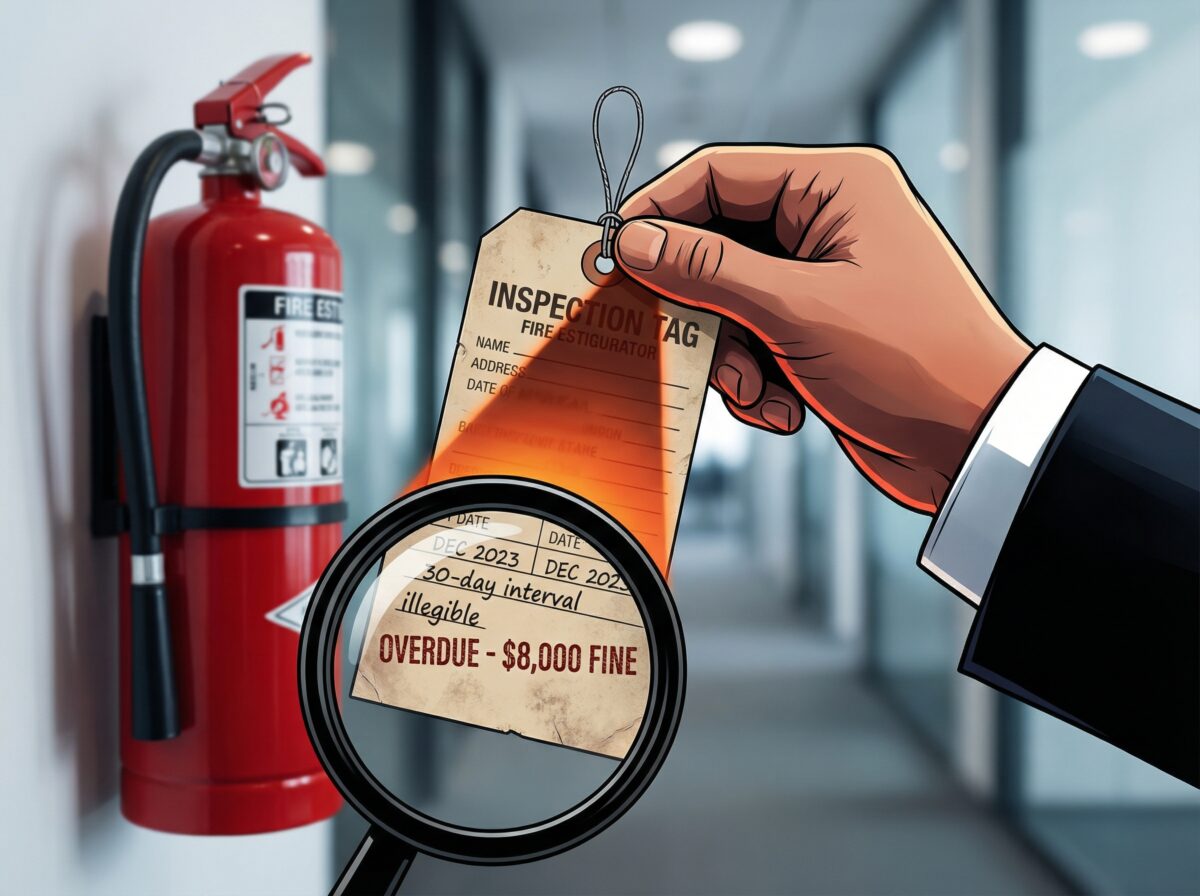
3. Two extinguishers with tags so faded the information is unreadable
You thought everything was current. The tags looked… fine? You paid for service regularly.
The disconnect: You didn’t know what “current” actually means, what constitutes proper documentation, or how to verify service quality between professional inspections.
This happens more often than property managers admit.
—
WHAT THE TAGS ACTUALLY ARE
Legal Documentation, Not Maintenance Reminders
Fire extinguisher service tags serve one primary purpose: proving compliance during inspections.
NFPA 10 (the national standard for portable fire extinguishers) requires specific maintenance at defined intervals. OSHA 1910.157 enforces these requirements for most commercial properties. Compliance documentation isn’t optional—it’s regulatory requirement.
The tags document:
- Monthly visual inspections occurred within 30-day intervals
- Annual maintenance performed by certified technicians within 12-month intervals
- Six-year internal examinations happened on schedule
- Hydrostatic testing completed per required timelines
- Specific dates, technician identity, service provider information
Why documentation matters legally:
Without documentation, you can’t prove service occurred. Fire marshals don’t accept “we definitely had it serviced” or “I remember the truck was here.” If the tag doesn’t show it, it didn’t happen from a compliance perspective.
48Fire service includes comprehensive tag documentation meeting all NFPA 10 and OSHA requirements because we understand tags aren’t administrative details—they’re legal proof of compliance.
—
What Different Tags Mean
Monthly Inspection Tags:
Small cards (typically 3×3 inches) with spaces for 12 months. Technician initials or punches each month after inspection. Should show consecutive months without gaps.
Purpose: Proves 30-day inspection intervals maintained.
What’s checked monthly: Accessibility, pressure gauge in green zone, physical damage, seal intact, proper mounting.
Annual Maintenance Tags:
Larger tags (typically 4×6 inches) with detailed information. Applied once yearly during comprehensive maintenance.
Purpose: Documents certified technician performed complete maintenance including internal examination of accessible components, pressure verification, hose/nozzle inspection, component replacement if needed.
Six-Year Maintenance Notation:
Same format as annual tag but specifically notes “6-Year Maintenance” or “Internal Examination Completed.”
Purpose: Documents that stored pressure extinguishers were completely disassembled, internally inspected, components replaced, recharged—required every six years.
Hydrostatic Test Documentation:
Often stamped directly on extinguisher collar rather than hanging tag.
Purpose: Proves pressure vessel tested at required intervals (5 or 12 years depending on type) and passed integrity testing.
—
COMMON TAG PROBLEMS PROPERTY MANAGERS ACTUALLY FACE
Problem #1: Not Recognizing Overdue Service
Real scenario from property manager:
“I looked at the tag. It said ‘Next Service Due: 03/2024.’ It was April 2024. I figured we had scheduled it and it would happen soon. Didn’t realize that meant it was already overdue.”
The issue:
Annual maintenance must occur within 12 months of last service. Once you pass that 12-month mark—even by one day—you’re in violation. “Next service due” means deadline, not suggestion.
Why property managers miss this:
- Focusing on other urgent issues, fire extinguishers seem low priority
- Assuming service company will automatically schedule (many don’t)
- Not understanding “annual” means strict 12-month maximum
- Believing a few weeks delay doesn’t really matter (it does to inspectors)
How to catch it:
Set calendar reminder at 11 months from last service date. Schedule next service before the 12-month deadline.
48Fire approach: Our system automatically tracks service intervals and contacts property managers at 10 months to schedule annual maintenance, preventing accidental deadline violations.
—
Problem #2: Monthly Inspection Gaps
Real scenario:
Monthly tag shows: `Jan ✓ Feb ✓ Mar ✓ Apr __ May __ Jun ✓ Jul ✓ Aug ✓`
Property manager sees recent months marked and assumes current compliance.
The issue:
NFPA 10 requires inspections at approximately 30-day intervals. April-May gap represents 60+ days without inspection—double the maximum allowed period. This violates the standard regardless of current months being marked.
Why it happens:
- Service provider scheduling inconsistencies
- Site access issues certain months
- Technician turnover creating service gaps
- Contract disputes temporarily halting service
- Property manager not monitoring monthly—only checking once or twice yearly
How to catch it:
Actually look at the sequence of monthly marks. Consecutive months should be marked. Any blank months between marked months indicate missed inspections.
48Fire solution: Monthly inspection scheduling occurs consistently same week each month. Digital tracking flags any location approaching 30-day window without completed inspection.
—
Problem #3: Wrong Year Tags
Real scenario:
Current year: 2025. Multiple extinguishers still showing 2024 monthly inspection tags with nothing marked.
Property manager assumption: “We must be switching to 2025 tags soon.”
The reality:
January 2025 passed without monthly inspection. February passed. Now it’s March and no 2025 tags applied because no service occurred yet this year.
Why it happens:
- Service lapsed, new contract not established
- Budget issues delaying service approval
- Service company dropped property, replacement not arranged
- Property manager changed, new manager unaware service needed
- Simply forgotten in day-to-day property management chaos
How to catch it:
January 1st each year, verify all monthly tags show current year. If still showing last year, service hasn’t occurred.
What to do:
Contact service provider immediately or arrange service if provider relationship ended.
—
Problem #4: Illegible Tags
Real scenario:
Property manager preparing for tenant tour. Glances at fire extinguisher in lobby. Tag present. Closer examination: completely faded. Can barely make out any information.
Fire marshal won’t accept unreadable tags as documentation.
Why tags become illegible:
- Sun exposure through windows (fades ink)
- Humidity in coastal climates (deteriorates paper)
- Chemical exposure in certain areas (damages materials)
- Physical wear from people brushing past equipment
- Poor quality tag materials degrading over time
- Age—tags from 5+ years ago often deteriorate
How to catch it:
Actually read tags during walkthroughs, not just verify presence. If you have to squint or can’t clearly read the information, it needs replacement.
48Fire tags: We use weather-resistant materials and replace deteriorated tags at no charge during routine service visits.
—
Problem #5: Missing Service Company Information
Real scenario:
Tag shows dates and checkmarks but no company name, phone number, or technician identification.
Why this matters:
Fire marshals need to verify qualified service provider performed work. Generic tags without company identification raise questions about service legitimacy.
How this happens:
- Building maintenance staff performed “inspections” using blank tags purchased online (not qualified to do so)
- Service company uses generic tags to save money
- Old tags from previous provider not replaced
- DIY attempts at compliance documentation
Red flag for property managers:
If you can’t identify who performed service from the tag alone, inspectors will question whether certified service occurred.
Proper tags include:
- Service company business name
- Contact phone number
- Technician name or certification number
- Often company logo or branding
48Fire tags: Every tag includes our company name, contact information, and specific technician certification number.
—
WHAT INSPECTORS ACTUALLY CHECK
The Fire Marshal’s Tag Review Process
Having spoken with fire marshals about their inspection approach, here’s what they actually do:
Step 1: Random sampling
They don’t check every extinguisher in large buildings. They select representative samples:
- Common areas (lobbies, hallways)
- Critical locations (near exits, mechanical rooms)
- Random tenant spaces if accessible
- Different floor levels
Typically 10-20 units in medium building, looking for patterns.
Step 2: Tag examination
For each sampled unit:
- Verify tag physically present and attached
- Check legibility of information
- Confirm service date within required interval
- Look for service provider identification
- Note any inconsistencies
Step 3: Pattern assessment
Finding one overdue extinguisher might get warning. Finding six suggests systematic problem—that gets citations.
Step 4: Documentation request
May ask for:
- Service contracts proving professional service arrangement
- Invoices matching tag dates
- Service company licensing/certification
- Equipment inventory list
What triggers violations:
- Missing tags
- Service exceeding required intervals (annual >12 months)
- Gaps in monthly inspection sequences
- Illegible documentation
- Patterns suggesting no systematic service program
- Inability to verify service provider qualifications
What doesn’t typically trigger violations:
- One extinguisher slightly overdue if clear it’s being addressed
- Minor tag damage if information still readable
- Different tag formats if all show compliant service
- Older equipment if properly maintained and documented
—
Real Violation Examples
Violation Example #1:
“Fifteen fire extinguishers sampled. Twelve showing annual maintenance tag dated more than 12 months prior. Violation of NFPA 10 annual maintenance requirement.”
Citation: OSHA 1910.157(e)(3)
Penalty: $8,000 (negotiated from $15,625 serious violation)
Required correction: All extinguishers must receive current annual maintenance within 30 days. Reinspection fee: $350.
Total cost: $8,350 + service costs
—
Violation Example #2:
“Fire extinguishers located in Building C lack proper monthly inspection documentation. Tags show gaps of 2-3 months between inspections, violating 30-day interval requirement.”
Citation: NFPA 10 Section 7.2.1
Penalty: Warning with 60-day correction requirement
Required correction: Establish monthly inspection program with documented 30-day intervals. Submit proof of compliance.
Cost: No fine this time, but future violations will incur penalties. Service setup: $150/month ongoing.
—
Violation Example #3:
“Multiple fire extinguishers throughout property have service tags that are illegible due to weathering and age. Cannot verify compliance with maintenance requirements.”
Citation: Inadequate fire safety documentation
Penalty: $2,500
Required correction: Replace all illegible tags with current service documentation. Reinspection required.
Cost: $2,500 + $250 reinspection + emergency service call to replace tags
—
PRACTICAL TAG VERIFICATION FOR PROPERTY MANAGERS
The 5-Minute Monthly Check
Realistic approach for busy property managers:
You don’t need to inspect every tag monthly. You need to verify your service program is working.
Quick monthly verification (5-10 minutes):
1. Select 5 random extinguishers in different locations
2. Check the monthly tag for current month marking
3. Verify tag condition (readable, attached securely)
4. Note any issues (missing mark, damaged tag, etc.)
What you’re looking for:
✓ Current month is marked on at least most units checked
✓ Tags are legible and in reasonable condition
✓ Consistent service provider across units
What triggers follow-up:
✗ Current month not marked (service may not be occurring)
✗ Multiple tags with gaps in monthly sequence
✗ Different providers or inconsistent tag formats
✗ Tags showing signs of deterioration
If problems found:
Contact your service provider same day. “I checked tags today. Current month isn’t marked on several units. Can you verify service is occurring as scheduled?”
—
The Annual Deep Check
Once yearly, more thorough review (30-45 minutes):
Preparation:
- Get list of all fire extinguisher locations (from building plans or service contract)
- Set aside time to actually walk the property
- Bring clipboard with checklist
- Take photos of sample tags
Walk-through process:
Check every extinguisher (or representative sampling if property is very large):
□ Tag present? Note any missing tags
□ Annual maintenance current? Last service within 12 months?
□ Monthly inspections current? Current month marked, no major gaps?
□ Information legible? Can you clearly read dates and company info?
□ Service provider consistent? Same company across building or understood variation?
Documentation:
Create simple spreadsheet:
| Location | Tag Present? | Annual Current? | Monthly Current? | Issues |
|---|---|---|---|---|
| Lobby North | Yes | Yes (03/2024) | Yes | None |
| Floor 2 Hall | Yes | NO (01/2023) | No | OVERDUE |
| Floor 3 Break | Yes | Yes (11/2024) | Yes | Tag faded |
Follow-up actions:
- Any overdue units: Schedule immediate service
- Missing tags: Contact provider for documentation or service
- Deteriorated tags: Request replacement during next service
- Pattern problems: Meet with service provider to address systemic issues
48Fire clients receive: Annual compliance reports showing all equipment status, upcoming deadlines, and any issues requiring attention—eliminating manual property manager verification burden.
—
Pre-Inspection Preparation
When you know fire marshal inspection is coming (or could come soon):
30 days before expected inspection:
1. Complete annual deep check (above)
2. Address any identified problems immediately—don’t wait
3. Gather documentation:
- Service contracts
- Past 12 months invoices
- Service provider certifications
- Equipment inventory list
4. Verify service provider responsiveness:
- Contact them
- Confirm they can provide documentation if inspector requests
- Ensure they’re available for questions
Week of inspection:
1. Quick visual verification: Walk property, confirm tags still present and readable
2. Documentation ready: Keep files accessible, ideally in one binder or digital folder
3. Identify point person: Who will escort inspector and answer questions?
4. Review basics: Know how many extinguishers in building, when last serviced, who provides service
During inspection:
- Be professional and cooperative
- Provide requested documentation promptly
- Don’t volunteer information beyond what’s asked
- Don’t make excuses—if there’s a problem, acknowledge it
- Take notes on inspector’s findings
- Ask for clarification on anything unclear
After inspection:
- If violations cited: Understand exactly what’s required for correction
- Get timeline for corrections and reinspection
- Contact service provider immediately with violation notice
- Document all corrections with photos and invoices
- Request reinspection once corrections complete
—
THE SERVICE PROVIDER RELATIONSHIP
What Good Service Looks Like
Clear signs you have quality fire extinguisher service:
✓ Consistent scheduling: Service occurs predictably, same general timeframe monthly/annually
✓ Professional documentation: Clean, legible tags with complete information
✓ Proactive communication: Provider contacts you to schedule, confirms appointments
✓ Detailed reporting: You receive inspection reports, not just invoices
✓ Responsive: Questions answered promptly, issues addressed quickly
✓ Certified: Can provide technician certifications and company credentials
✓ Transparent pricing: Clear service costs, no surprise charges
Warning signs of problematic service:
✗ Irregular service—months pass between visits with no explanation
✗ Tags often missing, incomplete, or illegible
✗ Have to chase provider for scheduling
✗ Invoices arrive but no documentation of work performed
✗ Can’t get anyone on phone when you have questions
✗ Can’t verify technician certifications
✗ Prices seem too good to be true
—
Questions to Ask Your Service Provider
About documentation:
- “What information do your service tags include?”
- “How do you handle deteriorated or damaged tags?”
- “Do you provide digital documentation in addition to physical tags?”
- “Can I access service records online?”
About scheduling:
- “How do you ensure we stay within the 12-month annual maintenance window?”
- “What happens if you need to reschedule a monthly inspection?”
- “Do you track deadlines and alert us proactively?”
About compliance:
- “Are your technicians NFPA certified?”
- “Can you provide proof of insurance and licensing?”
- “What happens if a fire marshal identifies documentation issues?”
- “Do you offer pre-inspection audits?”
About service quality:
- “What’s included in monthly inspection vs. annual maintenance?”
- “How do you handle equipment that needs repair or replacement?”
- “What’s your response time if we need emergency service?”
- “Can you provide references from similar properties?”
Quality providers welcome these questions. Evasive answers or inability to provide clear information suggests problems.
48Fire responses: We provide detailed answers to all these questions, written service standards, sample documentation, and client references as standard practice.
—
When to Change Providers
Legitimate reasons to switch fire extinguisher service:
- Service consistently late or missed
- Documentation problems persist despite your feedback
- Cannot verify technician certifications or company credentials
- Unresponsive to questions or concerns
- Received violations due to provider’s inadequate service
- Better value available elsewhere for equivalent or better service
How to transition smoothly:
1. Don’t just stop current service: Ensure no gap in coverage
2. Research replacement providers: Get multiple quotes, check credentials
3. Overlap timing: Have new provider start before formally ending old contract
4. Document transition: Clear records of last service by old provider, first service by new provider
5. Verify documentation: Ensure new provider’s tags meet your standards from first service
48Fire transition support: We assist properties transitioning from inadequate service providers, conducting initial comprehensive inspection to establish baseline compliance and clear documentation.
—
DIGITAL DOCUMENTATION OPTIONS
QR Code Tags (Becoming Standard)
How they work:
Physical tag includes traditional information (dates, service type, company) PLUS QR code. Scanning code with smartphone reveals complete digital record.
What scanning shows:
- Complete service history for that specific extinguisher
- Photos from recent inspections
- Equipment specifications and manufacturing date
- Next service deadlines
- Technician certification information
Benefits for property managers:
- Verify service actually occurred (photos from inspection)
- Check compliance status in seconds
- Access documentation without filing cabinet searches
- Show fire marshals comprehensive records during inspections
Current limitations:
- Physical tag still required (QR supplements, doesn’t replace)
- Requires smartphone/device to scan
- Some older inspectors prefer physical documentation only
- Technology dependent (database access required)
48Fire implementation: All our tags include QR codes linking to secure cloud documentation. Property managers get 24/7 access. Physical tags show traditional information meeting all requirements even without scanning.
—
Property Management Platforms
Some modern service providers offer web/app access:
Typical features:
- Dashboard showing all extinguishers and status
- Upcoming service deadline alerts
- Digital inspection reports with photos
- Historical service records
- Service scheduling
- Compliance summary reports
Value for property managers:
Know compliance status before inspections without physical building walk-through. Prepare documentation instantly when fire marshal arrives.
What to verify:
- Platform actually maintained (some providers set them up then never update)
- Data accuracy (compare digital records to physical tags periodically)
- Access reliability (can you log in when you need it?)
- Export capability (can you get your data if you change providers?)
48Fire platform: Property managers receive login credentials. System updates in real-time as service occurs. Reports generate instantly for any timeframe or location.
—
THE REAL COSTS
What Violations Actually Cost
Actual OSHA penalty for fire extinguisher violations:
- Serious violation: Up to $16,131 per violation (2025 rate)
- Repeat violation: Up to $161,323
- Willful violation: Up to $161,323
Most common outcome: $5,000-$15,000 for serious violations with negotiated settlements.
Additional costs:
- Reinspection fees: $200-500
- Emergency service to correct: $500-2,000
- Administrative time responding: 10-20 hours
- Potential insurance implications: Variable
Total realistic violation cost: $6,000-$18,000 for first-time serious violation.
—
What Proper Service Costs
Typical commercial building (40 extinguishers):
- Monthly inspection service: $120-200/month = $1,440-2,400/year
- Annual maintenance (once yearly): $600-1,200
- Occasional recharge/repair: $200-500/year average
- Total annual cost: $2,240-4,100
Cost per extinguisher:
- $56-103 annually per unit for complete compliant service
Compare to violation:
Single violation ($6,000-18,000) pays for 2-8 years of proper service.
—
The ROI of Compliance
Beyond avoiding fines:
Equipment actually works when needed:
Properly maintained extinguishers function during fires. Neglected equipment may fail. Fire damage costs dwarf compliance costs.
Insurance benefits:
Documented maintenance supports claims, prevents coverage issues. Some insurers offer premium discounts for certified fire safety programs.
Liability protection:
If fire occurs and inadequate maintenance contributed to damage, liability exposure is significant. Proper documentation demonstrates reasonable care.
Professional property management:
Compliance reflects overall property management quality. Attracts quality tenants, supports property values, prevents regulatory issues.
Peace of mind:
Knowing you’re compliant eliminates worry about surprise inspections.
—
YOUR PRACTICAL ACTION PLAN
Start This Week
Day 1: Quick assessment (15 minutes)
- Walk your property
- Check 10 random fire extinguishers
- Look at the tags closely (don’t just glance)
- Note any obvious problems (missing tags, old dates, illegible information)
—
Day 2: Document what you found (10 minutes)
- List any extinguishers with problems
- Note when last service occurred (check tags or invoices)
- Calculate if you’re approaching annual maintenance deadline
- Identify if you even know who provides your service
—
Day 3: Take action on urgent issues (30 minutes)
If assessment revealed:
- Overdue annual maintenance: Call provider immediately, schedule service
- Missing tags: Verify service is actually occurring
- No service provider: Research options, get quotes
- Current provider concerns: Schedule meeting to discuss
—
This Month: Establish Baseline
Create your fire extinguisher inventory:
Simple spreadsheet with:
- Location of each extinguisher
- Type/size
- Last service date (from tags)
- Next service due date
- Any current issues
Verify your service arrangement:
- Have written contract or agreement?
- Know what’s included (monthly, annual, testing)?
- Have service provider contact information?
- Understand what you’re paying for?
Set up monitoring system:
- Calendar reminder 11 months after annual maintenance
- Monthly calendar reminder to spot-check few tags
- Annual calendar reminder for comprehensive review
- File folder (physical or digital) for all fire extinguisher documentation
—
This Quarter: Get Compliant and Stay Compliant
Address any identified gaps:
- Overdue service completed
- Missing tags replaced
- Service agreement established if needed
- Documentation organized
Prepare for future inspections:
- Know your compliance status
- Have documentation readily accessible
- Understand what inspectors check
- Establish process to maintain compliance ongoing
Consider improvements:
- Better service provider if current one inadequate
- Digital documentation access
- Staff training on what to look for
- Integration with overall building safety program
—
PARTNER WITH DOCUMENTATION EXPERTS
48Fire provides fire extinguisher service with documentation that survives inspector scrutiny because we understand tags aren’t just stickers—they’re legal proof of compliance.
Our service includes:
✓ Weather-resistant tags with complete NFPA 10 information
✓ Consistent monthly inspection on reliable schedule
✓ Certified technician service (not just anyone with a clipboard)
✓ QR codes providing instant digital record access
✓ Property manager dashboard showing real-time compliance status
✓ Automated deadline tracking (we remind you before service is due)
✓ Pre-inspection support (we help you prepare for fire marshal visits)
✓ Professional documentation that proves service legitimacy
—
GET STARTED WITH TAG AUDIT
Complimentary 30-minute documentation assessment:
We’ll review:
- Current tag documentation across your property
- Whether service is actually current and compliant
- Any immediate issues needing correction
- Comparison to NFPA 10 requirements
What you’ll receive:
- Written findings report
- Specific recommendations for any improvements needed
- No-obligation proposal if you want to improve service
- Peace of mind about your compliance status
No cost. No pressure.
[Schedule Tag Audit →](/contact-us)
—
EMERGENCY TAG CORRECTION
Fire marshal inspection approaching?
Discovered your service is overdue or documentation inadequate?
48Fire emergency response:
- Rapid scheduling (typically 24-48 hours)
- Comprehensive service bringing all equipment current
- Proper documentation application
- Inspector-ready compliance summary
Available when you need us.
[Request Emergency Service →](/contact-us)
—
ONGOING SERVICE PROGRAM
Want systematic compliance without constant oversight?
48Fire handles everything:
- Monthly inspections (consistent schedule, no gaps)
- Annual maintenance (scheduled proactively before deadlines)
- Six-year internal examinations (tracked automatically)
- Hydrostatic testing (scheduled per equipment age)
- Complete documentation (physical tags + digital records)
- Compliance monitoring (we track deadlines, you get alerts)
Custom proposals for any property size.
[Request Service Proposal →](/contact-us)
—
48Fire
Professional Fire Extinguisher Service
Nationwide Coverage
Contact: [/contact-us](/contact-us)
Specialization: Commercial property fire safety compliance
Service Standard: Documentation that survives fire marshal scrutiny
—
Fire extinguisher tags seem insignificant until fire marshals examine them and write citations.
The difference between compliance and violations often comes down to knowing what those tags should show and verifying service actually maintains proper documentation.
Most property managers discover these details the hard way—during inspections when it’s too late to correct problems easily.
Better approach: Learn what to look for now. Verify your service is adequate. Fix any gaps before inspectors find them.
[Begin Your Compliance Review →](/contact-us)
—
FREQUENTLY ASKED QUESTIONS
How often must fire extinguisher service tags be updated?
Monthly inspection tags should show current month marked (within 30 days). Annual maintenance tags must show service within past 12 months. If it’s June 2025 and your annual tag shows May 2024, you’re overdue regardless of it being “only” 13 months. Hydrostatic test documentation updates every 5 or 12 years depending on extinguisher type.
Can building maintenance staff perform inspections and apply tags?
Trained building staff can perform monthly visual inspections per NFPA 10, but tags should accurately reflect who performed the inspection (building staff, not suggest professional service occurred). Annual maintenance requires certified technicians—only qualified professionals should perform and document this service. DIY annual maintenance tags suggesting professional service when it didn’t occur constitutes fraudulent documentation.
What makes a service tag legitimate vs. potentially fraudulent?
Legitimate tags include: specific service company name and contact information, actual service dates, technician identification (name or certification number), and match paid invoices proving service occurred. Generic blank tags with handwritten dates, no company identification, or tags that don’t correspond to documented service raise red flags. If you can’t verify who performed service from the tag, inspectors will question its validity.
What should property managers do if service tags are faded or illegible?
Contact your service provider requesting tag replacement. Quality providers replace damaged or illegible tags at no charge during next service visit or sometimes upon request between visits. Don’t attempt to create or apply tags yourself—only the service provider who performed work should document their service. For urgent situations (inspection approaching), request immediate tag replacement.
Do digital records or QR codes replace physical service tags?
No under current regulations. Physical tags on equipment remain required by NFPA 10 and most jurisdictions. Digital documentation and QR codes supplement physical tags (providing comprehensive detail, photos, historical records) but don’t replace the requirement for visible physical documentation. Fire marshals can require physical tags even if digital records exist. Use hybrid approach: physical tags for basic compliance, digital for comprehensive documentation.
Who is responsible if service provider applies inadequate tags?
Property owner/manager is ultimately responsible for compliance regardless of service provider quality. Fire marshals cite the property for violations, not the service company. While you can hold providers accountable contractually, this doesn’t transfer compliance responsibility. This makes service provider selection critical—verify documentation standards before engaging, monitor quality periodically, address problems immediately.
What happens during fire marshal inspections if tags show service overdue?
Fire marshals issue violations for service exceeding required intervals. Annual maintenance over 12 months old triggers citation regardless of how recent monthly inspections are. Violations require correction within specified timeframe (typically 30-60 days) and reinspection to verify compliance. Serious violations can result in fines $5,000-$16,000 depending on jurisdiction and violation severity. Some jurisdictions can issue operational restrictions until compliance is demonstrated.
How long must property managers retain fire extinguisher service documentation?
Physical tags remain on equipment until replaced during subsequent service. Centralized documentation (service contracts, invoices, inspection reports) should be retained per local fire code and OSHA requirements—typically minimum 1-3 years, though longer retention is recommended. Digital documentation enables indefinite retention without storage burden. During property sales or insurance audits, comprehensive historical records demonstrate proper management and can affect valuations and premiums.