The Credibility Problem: Who Verifies Your Verification?
A facility has fire safety systems. The systems are maintained. The facility manager believes they work. But there’s a credibility question: who independently verifies that they actually work?
If the facility tests its own systems, the facility knows the results. But regulators, insurance companies, emergency responders, and occupants face a legitimate question: “You’re testing your own systems. How do we know the results are accurate and unbiased?”
Third-party fire system testing answers this credibility question. It transforms fire protection from “we say it works” to “an independent third party verified it works.”
—
The Trust Hierarchy: Why Independence Matters
Fire protection credibility operates on a trust hierarchy:
Level 1: Internal Trust
The facility tests its own systems.
- Benefit: Facility understands results immediately
- Limitation: Facility has incentive to report favorable results
- Trust level: Internal only. External parties question objectivity.
Level 2: Service Provider Trust
The equipment vendor/installer tests the system.
- Benefit: Professional verification
- Limitation: Service provider installed the system. They have incentive to report it works (they installed it)
- Trust level: Limited. “They’re testing their own work.”
Level 3: Third-Party Verification
An independent third party tests the system.
- Benefit: No incentive bias. Independent party has no stake in whether system works or fails
- Verification quality: Highest. Unbiased assessment
- Trust level: Highest. “An independent expert verified it.”
This hierarchy matters because different parties place trust at different levels:
- Facility management can operate on Level 1 (internal testing is sufficient for operations)
- Insurance companies require Level 2 minimum (professional verification)
- Regulators expect Level 3 (independent third-party verification for critical systems)
- Emergency responders depend on Level 3 (independent verification that systems actually work)
- Occupants rely on Level 3 confidence (independent verification that systems protect them)
—
What Third-Party Testing Reveals That Internal Testing Misses
Third-party fire system testing differs from internal maintenance because it operates with different methodology and objectivity.
Internal Maintenance Testing:
- Vendor maintains the system it installed
- Testing checks “is it working basically?”
- Results reported to facility (internal feedback)
- Bias: System installer has incentive to report functionality
Third-Party Fire System Testing:
- Independent professional tests the system
- Testing checks “does it meet all code requirements and manufacturer specifications?”
- Results certified and documented (external credibility)
- Bias: None. Independent party gains no benefit from favorable or unfavorable results
What Third-Party Testing Finds That Maintenance Misses:
Example 1: Fire Alarm Audibility
- Internal maintenance: “Alarm sounds when activated. Working.”
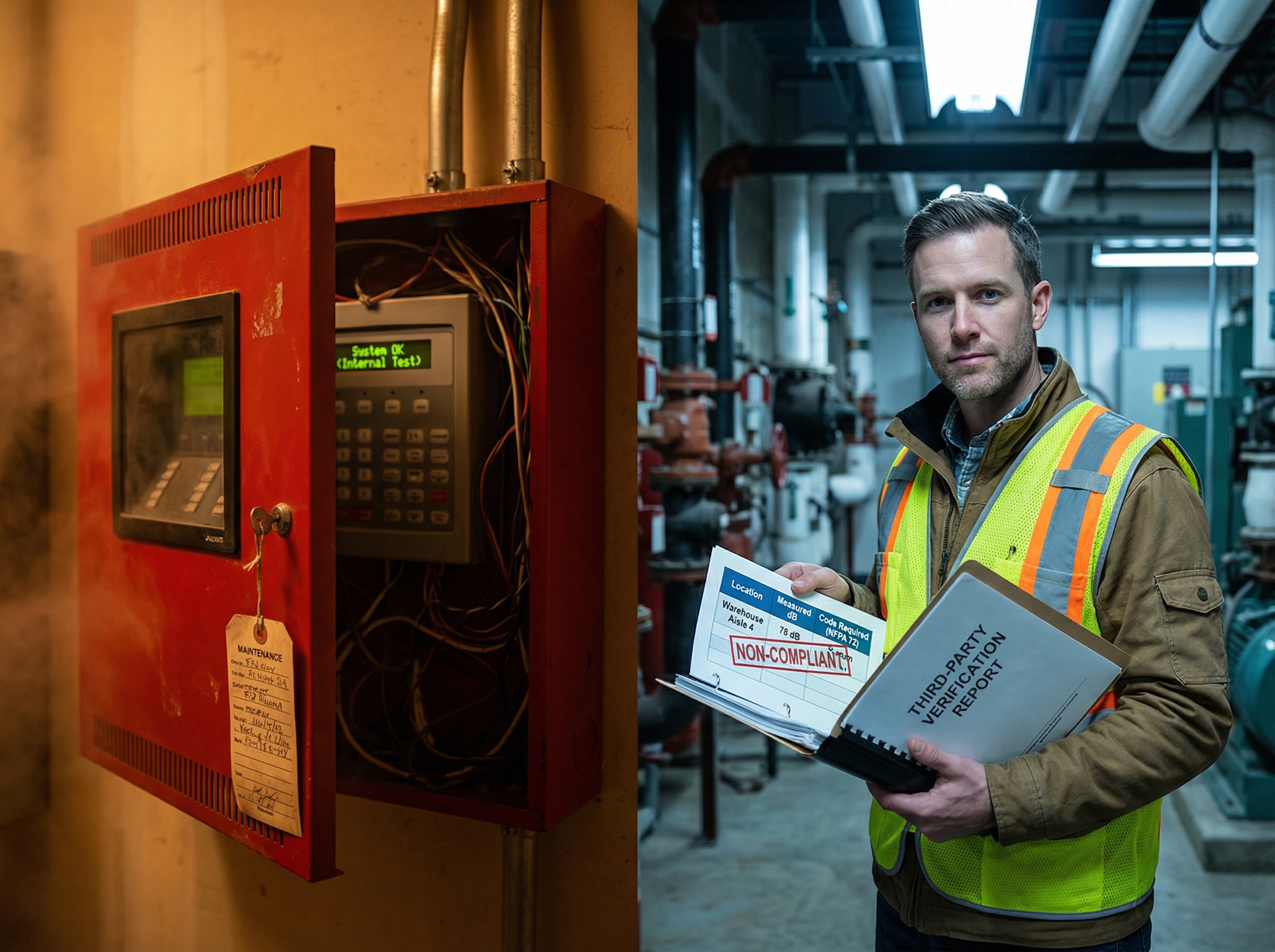
- Third-party testing: “Alarm sounds but measures 75 dB in mechanical areas. Code requires 90+ dB. Non-compliant in that area.”
Example 2: Sprinkler System Pressure
- Internal maintenance: “Pressure gauge shows adequate pressure. System appears functional.”
- Third-party testing: “Pressure measurement: 65 PSI. Code requirement: 60-80 PSI. You’re at minimum. Flow testing reveals coverage areas at north wing operate below optimal pressure. Recommend pressure regulator adjustment.”
Example 3: Emergency Lighting Load Testing
- Internal maintenance: “Backup battery appears to work. Lights come on when power off.”
- Third-party testing: “Load testing for 90-minute duration specified. Test result: 87 minutes until voltage drops below acceptable level. Specification: 90 minutes. Result: Non-compliant. Battery replacement recommended.”
Third-party testing applies professional rigor, precise measurement, and code-specific standards. It finds problems that internal maintenance, which focuses on basic functionality, misses.
—
The Credibility Document: Third-Party Testing Report
A third-party fire system testing report is a credibility document. It’s not just information—it’s externally verified, professionally documented evidence.
What Makes a Third-Party Report Credible:
Element 1: Third-Party Credentials
- Testing performed by certified professional (not facility staff or equipment vendor)
- Professional has credentials recognized by regulators and insurance
- Professional can be held accountable for accuracy of testing
Element 2: Specified Testing Standards
- Testing performed to NFPA standards specific to each system
- Testing methodology documented (here’s exactly what we tested and how)
- Results measured against specific code requirements (not vague functionality)
Element 3: Detailed Results
- Specific measurements (not “working” but “85 dB” or “0.9 foot-candles” or “92 PSI”)
- Comparison to code requirements (measured value vs. required value)
- Pass/fail determination against standards
- Detailed observations (not just results but what was observed)
Element 4: Professional Accountability
- Professional’s signature and credentials documented
- Professional’s license number and certification documented
- Professional can be contacted for clarification
- Professional’s reputation depends on accuracy
Element 5: External Recognition
- Report accepted by insurance companies as verification
- Report accepted by regulators as compliance documentation
- Report accepted by emergency responders as facility information
- Report accepted by legal system in case of incident
This is the credibility difference. An internal test result is facility information. A third-party testing report is externally verified evidence.
—
A Facility’s Credibility Problem: Resolved by Third-Party Testing
A 50,000 square foot commercial facility had fire safety systems and believed they were working. The facility performed regular maintenance and basic testing.
The Credibility Crisis:
Insurance company audit asked: “Can you provide independent verification that your fire safety systems meet code requirements?”
Facility response: “We maintain our systems regularly. Our vendor checks them annually.”
Insurance company response: “That’s maintenance. We need independent third-party verification that systems meet code requirements and function properly.”
Facility faced a decision: Continue with vendor maintenance only (internal credibility), or implement independent third-party testing (external credibility).
The Third-Party Testing Decision:
The facility contracted with 48Fire Protection for comprehensive third-party fire system testing.
Fire Alarm System Test Results:
- Audibility testing in 12 locations
- Finding: Three locations (mechanical areas, warehouse, stairwell) measured 75-82 dB. Code requires 90+ dB.
- Result: Non-compliant in those three areas
- Recommendation: Install additional notification devices to bring audibility to 90+ dB in those areas
Internal maintenance had never measured audibility. The facility’s vendor maintained the system but didn’t test against specific code requirements. Third-party testing revealed compliance gaps.
Sprinkler System Test Results:
- Flow testing at 12 locations across three zones
- Finding: Two locations in north wing operate at reduced pressure (55 PSI vs. 60 PSI minimum)
- Root cause identified: Pressure regulator setting misaligned
- Recommendation: Adjust pressure regulator, re-test to verify
- Result: Adjustment made, re-testing confirmed compliance
Internal maintenance assumed adequate pressure without detailed flow testing. Third-party testing identified specific pressure deficiency and root cause.
Emergency Lighting Load Testing:
- Load testing on 8 backup battery systems
- Finding: Three backup batteries fail to maintain voltage for full 90-minute duration
- Battery 1: 87 minutes (3 minutes short)
- Battery 3: 84 minutes (6 minutes short)
- Battery 6: 81 minutes (9 minutes short)
- Specification: 90 minutes minimum
- Result: Three batteries non-compliant
- Recommendation: Replace three batteries, repeat load testing on remaining batteries annually
Internal testing assumed batteries “work.” Third-party load testing revealed three batteries operating below specification.
The Credibility Outcome:
After third-party testing and corrections:
Insurance company: “Thank you. We have independent verification that your fire safety systems now meet code requirements. Your insurance classification improves accordingly.”
Regulators: “We have documented independent verification of compliance. Your facility is compliant.”
Emergency responders: “We have current independent verification of system functionality. We can depend on these systems in emergencies.”
Occupants: “Independent testing verified that fire safety systems work properly. We’re protected.”
Facility management: “We now have objective evidence of what’s actually working and what needs attention. We’re making decisions based on verified facts, not assumptions.”
—
Third-Party Testing vs. Vendor Maintenance: The Difference
Vendor Maintenance:
- Purpose: Keep systems operational
- Frequency: Annual or as-needed
- Testing scope: Basic functionality
- Bias: System installer has interest in reporting functionality
- Documentation: Maintenance reports (internal use)
- Code requirement verification: Limited
Third-Party Fire System Testing:
- Purpose: Verify code compliance and system reliability
- Frequency: Annual recommended, specific systems quarterly/semi-annual
- Testing scope: Comprehensive code-specified testing
- Bias: None. Independent party has no interest in results
- Documentation: Professional testing reports (external credibility)
- Code requirement verification: Comprehensive
Both are necessary. Maintenance keeps systems operational. Third-party testing verifies they meet requirements.
—
Why Credibility Matters: The Real-World Consequence
Imagine two facilities with similar fire safety systems:
Facility A: Maintains systems internally. Vendor performs annual maintenance. No independent testing. System believed to work.
Facility B: Maintains systems internally. Vendor performs annual maintenance. Independent third-party testing annually. System verified to work.
A fire occurs at each facility. Both facilities depend on fire safety systems to function.
In Facility A: Insurance company asks “Can you prove your systems worked as required?” Facility shows maintenance records. Insurance questions: “But was it independently verified?” Facility cannot answer definitively. Insurance investigation proceeds with uncertainty about system performance.
In Facility B: Insurance company asks “Can you prove your systems worked as required?” Facility shows third-party testing reports. Insurance confirms: “Yes. Independent testing verified performance to code requirements.” Insurance accepts facility’s fire protection verification.
In incident aftermath, credibility matters. Facilities with third-party testing documentation have clear evidence of system performance. Facilities without it have questions and uncertainty.
—
The Systems Requiring Third-Party Testing
Not all systems require equal testing rigor, but these warrant third-party verification:
Critical Systems (Annual Third-Party Testing):
- Fire alarm systems (requires audibility testing, notification verification)
- Sprinkler systems (requires flow testing, pressure verification)
- Emergency lighting (requires illumination measurement, load testing)
- Fire-rated door seals (requires seal integrity and closing verification)
Important Systems (Annual Testing, Third-Party Verification Recommended):
- Fire detection systems (smoke detectors, heat detectors)
- Backup power systems (battery load testing, generator operation)
- Fire suppression systems (function testing, chemical verification)
Documentation Systems (Third-Party Audit/Verification):
- Evacuation procedures
- Fire safety training records
- Maintenance documentation
- System specifications and drawings
—
Fire System Testing: The Credibility Investment
Third-party fire system testing costs money. A comprehensive third-party testing program for a commercial facility runs $3,000-$8,000 annually depending on facility size and system complexity.
But it creates value that far exceeds the cost:
Insurance benefit: Lower insurance classification, premium discounts
Regulatory benefit: Documented compliance proof, fewer citations
Operational benefit: Verified system performance, confidence in reliability
Liability benefit: Clear evidence of due diligence and compliance
Occupant benefit: Independent verification of protection systems
The cost of third-party testing ($3,000-$8,000/year) is minimal compared to the cost of a fire incident in an un-verified system ($millions in damages, liability, investigation).
—
48Fire Protection: Third-Party Fire System Testing
48Fire Protection provides independent third-party fire system testing that creates credibility for fire protection programs.
We test to specific code requirements:
- Fire alarm systems: Audibility, notification, response testing
- Sprinkler systems: Flow, pressure, coverage, activation testing
- Emergency lighting: Illumination measurement, backup battery load testing
- Fire doors: Seal integrity, closing function, hardware verification
- Backup power systems: Load testing, battery capacity verification
Each test produces a professional report documenting:
- What was tested
- Testing methodology
- Results measured against code requirements
- Pass/fail determination
- Professional certification and credentials
This report serves as independent verification for insurance companies, regulators, emergency responders, and occupants.
—
Your Facility Needs Third-Party Fire System Testing
Ask yourself:
- Do you have independent verification that your fire safety systems meet code requirements?
- Could you prove to an insurance company that systems work as required?
- Could you defend your fire protection in a regulatory investigation?
- Do emergency responders have certified documentation of system performance?
- Are occupants protected by independently verified systems?
If you answer “no” to any question, your facility needs third-party fire system testing.
48Fire Protection provides independent third-party fire system testing that transforms fire protection from “we believe it works” to “we have verified it works.”
[Contact 48Fire Protection] today to schedule third-party fire system testing. We’ll verify your fire safety systems meet code requirements, document performance in professional testing reports, and provide the independent verification your insurance company, regulators, emergency responders, and occupants need.
Your fire safety systems deserve independent verification. Let’s test them.