The Hidden Cost of Skipping Monthly Extinguisher Checks
—
REGULATORY REQUIREMENT: NOT OPTIONAL
NFPA 10 Section 7.2.1:
“Fire extinguishers shall be inspected when initially placed in service and thereafter at approximately 30-day intervals.”
OSHA 1910.157(e)(2):
“The employer shall assure that portable fire extinguishers are visually inspected monthly.”
Legal status: Mandatory federal workplace safety requirement with enforcement penalties.
Current OSHA serious violation penalty: $16,131 per violation (2025 rate)
Compliance is legally required. Skipping monthly inspections violates federal law regardless of justification.
—
WHAT MONTHLY INSPECTION MEANS
Defined Requirements Per NFPA 10 Section 7.2.1.1
Monthly inspection must verify each extinguisher has:
| Inspection Element | Requirement |
|---|---|
| Location | In designated place |
| Accessibility | Not obstructed, visible |
| Instructions | Legible, facing outward |
| Seals/Pins | Intact, not tampered with |
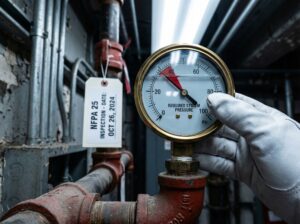
| Pressure Gauge | Needle in operable (green) zone |
| Physical Condition | No damage, corrosion, leakage |
| Hose/Nozzle | Present, not damaged, not clogged |
| Weight | Appropriate for CO2 types |
Time requirement: 2-3 minutes per extinguisher for proper examination
Documentation requirement (NFPA 10 Section 7.2.2): Manual or electronic records showing date, inspector, and any defects found
—
DIRECT FINANCIAL PENALTIES
OSHA Violations
Violation structure:
| Violation Type | Penalty Amount | Application |
|---|---|---|
| Serious | Up to $16,131 | Failure to conduct monthly inspections |
| Repeat | Up to $161,323 | Second offense within 5 years |
| Willful | Up to $161,323 | Intentional non-compliance |
| Failure to Abate | $16,131 per day | Not correcting cited violations |
Multiple violations possible: Each building, department, or pattern of non-compliance can generate separate citations.
Additional costs beyond penalties:
- Legal consultation: $5,000-15,000
- Third-party compliance audit: $2,000-5,000
- Re-inspection fees: $200-500
- Management time responding: 40-80 hours
- Emergency corrective service: $1,000-5,000
Total OSHA violation response cost: $24,000-50,000+ typical
—
State and Local Fire Marshal Citations
Enforcement authority: Local fire prevention bureaus enforce fire codes incorporating NFPA standards
Typical citation structure:
- Warning with correction deadline
- Monetary fines: $250-5,000 per violation depending on jurisdiction
- Re-inspection requirements
- Potential operational restrictions until compliance demonstrated
Correction costs:
- Emergency service provider engagement: $500-3,000
- Equipment replacement if deferred maintenance caused failures: $150-400 per unit
- Documentation reconstruction: 20-40 staff hours
Fire marshal violation total cost: $2,000-10,000 typical
—
Insurance Policy Complications
Standard commercial property insurance language:
“Insured shall maintain all fire protection equipment in accordance with applicable NFPA standards.”
Discovery of non-compliance triggers:
During underwriting/renewal:
- Premium increases: 15-30% typical for fire safety deficiencies
- Coverage limitations or exclusions
- Mandatory corrective action as policy condition
- Required independent verification
During claims:
- Enhanced scrutiny of fire damage claims
- Questions about policy compliance
- Potential coverage reductions
- Subrogation considerations
Annual cost impact: $3,000-20,000+ in premium increases depending on property value and coverage scope
—
OPERATIONAL CONSEQUENCES
Equipment Failure During Fires
Purpose of monthly inspections: Detect problems before fires occur
Common issues monthly inspections catch:
| Problem | Detection | Consequence if Undetected |
|---|---|---|
| Pressure loss | Gauge reading outside green zone | Non-functional extinguisher |
| Physical damage | Visible dents, corrosion | Structural failure risk |
| Broken seals | Visual inspection | Unknown use/tampering |
| Nozzle blockage | Visual examination | Discharge failure |
| Missing pins | Safety pin check | Accidental discharge risk |
Fire scenario without inspections:
1. Fire occurs
2. Employee attempts extinguisher use
3. Equipment fails (undetected problem)
4. Fire spreads beyond control
5. Property damage escalates
6. Evacuation required
7. Emergency response costs increase
Cost differential:
- Monthly inspection detecting pressure loss and prompting $40 recharge
- vs. $50,000-500,000 fire damage from non-functional equipment
Fire investigation reports frequently cite inadequate fire extinguisher maintenance as contributing factor in fire spread.
—
Liability Exposure
Legal liability framework:
Employers have duty to provide safe workplaces including functional fire protection equipment. Failure to maintain equipment per industry standards (NFPA 10) constitutes potential negligence.
Liability scenarios:
Employee injuries:
- Workers’ compensation claims (strict liability)
- Potential third-party lawsuits if gross negligence demonstrated
- OSHA citation amplifies liability exposure
Third-party injuries:
- Customer/visitor injuries from fires
- Neighboring property damage
- Business interruption claims from tenants
Legal defense costs: $50,000-200,000+ even when claims don’t succeed
Settlement/judgment exposure: Variable, potentially substantial in serious injury cases
Documentation protection value: Systematic monthly inspection records demonstrate reasonable care, provide defense against negligence claims
—
WHY FACILITIES SKIP INSPECTIONS
Factor #1: Responsibility Ambiguity
Common situation: Nobody specifically designated to perform monthly inspections
Result: Everyone assumes someone else handles it, nobody actually does it
Solution: Written assignment of responsibility to specific named individual with backup designee
—
Factor #2: Competing Priorities
Facility staff responsibilities:
- Emergency repairs
- Scheduled maintenance
- Work order management
- HVAC, plumbing, electrical
- Cleaning oversight
- Safety coordination
Fire extinguisher characteristics:
- Silent failures (don’t announce problems)
- Low visible urgency (equipment hangs quietly)
- Infrequent actual use (years between fires)
Result: Monthly inspections consistently deprioritized for seemingly urgent tasks
Solution: Scheduled recurring inspections with accountability verification or professional service eliminating staff burden
—
Factor #3: Training Deficiency
Untrained staff behaviors:
- Glances from distance: “Looks fine”
- Checks pressure gauge without approaching closely
- Inspects representative sample, not all units
- Assumes recent service tag means equipment functional
Proper inspection requirements:
- Direct approach to each unit
- Close examination with adequate lighting
- Systematic verification of all NFPA elements
- Immediate documentation of findings
Gap between untrained assumptions and NFPA requirements causes false compliance documentation
Solution: Formal training on NFPA inspection procedures or professional service with certified technicians
—
Factor #4: Documentation Without Verification
Paper systems enable falsification:
Staff can complete inspection forms without actually inspecting because nobody verifies form accuracy against equipment condition
Common pattern:
Month ends → Staff realizes inspection not performed → Form completed retroactively based on assumption equipment is fine → False documentation created
OSHA inspector pattern recognition:
Inspection logs show monthly completion but equipment has obvious deficiencies (low pressure, damage, etc.) proving inspections didn’t occur. Results in serious violations for falsified records.
Solution: Digital systems with photographic evidence, GPS verification, or professional service with accountability documentation
—
Factor #5: Cost Minimization
Calculation: “Save $2,000-4,000 annually by not paying for professional inspections”
Missing from calculation:
- Staff time performing inspections (2-4 hours monthly = $720-1,440 annually)
- Training requirements
- Oversight verification
- OSHA violation risk: $16,131
- Fire marshal citation risk: $2,000-10,000
- Insurance premium increase risk: $3,000-20,000+
- Equipment failure during fire risk: Substantial
Actual cost comparison:
| Approach | Annual Cost | Risk Exposure |
|---|---|---|
| No inspections | $0 | $21,000-200,000+ |
| Internal (unverified) | $720-1,440 | $16,000-50,000+ |
| Internal (properly supervised) | $1,500-2,500 | Minimal |
| Professional service | $2,400-4,800 | Minimal |
False economy: Attempting to save $2,000 creates $16,000-50,000+ exposure
—
PROPER INSPECTION PROCEDURES
Step-by-Step NFPA-Compliant Process
Equipment needed:
- Inspection checklist
- Flashlight (for poorly lit areas)
- Step stool (for high-mounted units)
- Scale (for CO2 weight verification)
- Documentation system (paper forms or digital device)
Inspection sequence per unit:
1. Approach extinguisher directly
Walk to each unit individually. Don’t inspect from distance.
2. Location verification
- Unit in designated mounting position
- Bracket secure
- Signage visible if required
3. Accessibility check
- No obstructions within 36-inch clearance
- Unit visible or signed
- Access path clear
4. Instruction verification
- Nameplate visible and legible
- Operating instructions facing outward
- No damage obscuring critical information
5. Pressure gauge examination
- Read gauge at close range with proper lighting
- Needle clearly within green operable zone
- For CO2: verify weight within specifications using scale
6. Physical condition assessment
- No corrosion on shell, valve, or hose
- No dents, damage, or deformation
- Hose and nozzle intact, not cracked
- Discharge assembly properly attached
7. Seal and tamper indicator check
- Safety pin present and intact
- Tamper seal unbroken
- If compromised: remove unit from service immediately
8. Documentation
- Record date immediately
- Note inspector name
- Document any deficiencies found
- Record remedial action taken
Time per extinguisher: 2-3 minutes
Facility with 50 extinguishers: 100-150 minutes (2-2.5 hours) monthly
—
Documentation Requirements
NFPA 10 Section 7.2.2 mandates records showing:
✓ Date of inspection
✓ Person conducting inspection
✓ Defects found
✓ Remedial action taken
Retention period: Per applicable regulations (OSHA and local fire codes), typically 1-3 years minimum
Format options:
- Paper inspection logs (must be organized and preserved)
- Digital systems (preferred for accessibility and verification)
- Service provider platforms (for professional inspections)
Audit accessibility: Records must be producible during OSHA or fire marshal inspections
—
PROFESSIONAL SERVICE ALTERNATIVES
When Professional Monthly Inspection Makes Sense
Professional service advantages:
| Benefit | Value |
|---|---|
| Consistency | Same certified technician, no variation from turnover |
| Expertise | Professionals recognize subtle problems staff miss |
| Documentation | Digital records with photographic evidence |
| Liability protection | Professional service demonstrates systematic compliance |
| Time savings | Eliminates 2-4 staff hours monthly |
| Issue resolution | Problems identified often resolvable during visit |
Professional service appropriate when:
✓ Staff time limited by competing priorities
✓ Facility lacks dedicated safety coordinator
✓ Compliance assurance critical (high liability environment)
✓ Management wants verification inspections actually occur
✓ Staff turnover creates training challenges
✓ Previous internal programs failed consistency
—
48Fire Professional Monthly Inspection
Service structure:
- Certified technician visits monthly on consistent schedule
- Systematic inspection of all equipment per NFPA 10 requirements
- Digital documentation with photographic evidence
- Pressure gauge readings recorded and photographed
- Issues flagged immediately with notification to facility management
- Equipment requiring service identified and scheduled
Digital platform access:
- Real-time inspection status visibility
- Photographic evidence from each inspection
- Historical records for all equipment
- Automated deadline tracking
- Instant compliance reporting for audits
Cost structure:
Based on equipment quantity and facility size:
- Small facilities (10-25 units): $100-150/month
- Medium facilities (25-75 units): $150-250/month
- Large facilities (75+ units): $250-400+/month
Includes: Inspection service, digital documentation, management reporting, issue identification
Does not include: Equipment repair, recharge, or replacement (quoted separately when needed)
—
Hybrid Approach Option
Structure:
- Facility staff perform monthly inspections (maintaining internal engagement)
- Professional service conducts quarterly verification (ensuring quality)
- Annual comprehensive professional maintenance (NFPA requirement)
Benefits:
- Lower cost than full professional monthly service
- Higher reliability than unverified internal program
- Staff involvement in fire safety maintained
- Professional verification provides compliance assurance
48Fire hybrid program:
- Initial training for facility staff
- Quarterly professional verification inspections
- Annual comprehensive maintenance
- Digital platform tracking both internal and professional inspections
Cost: $1,200-2,400 annually depending on facility size
—
INTERNAL INSPECTION PROGRAM REQUIREMENTS
Essential Components for Compliant Internal Program
1. Clear responsibility assignment
Written designation of specific person(s) responsible for performing monthly inspections with named backup for absences
2. Comprehensive training
Initial training covering:
- NFPA 10 inspection requirements
- Proper pressure gauge reading
- Physical damage recognition
- Documentation procedures
- When to flag equipment for professional service
Annual refresher training maintaining competency
3. Adequate time allocation
Realistic time blocks scheduled for inspection performance:
- 2-3 minutes per extinguisher
- Travel time between locations
- Documentation completion
- Follow-up on identified issues
4. Proper tools and equipment
- Current facility floor plans showing all extinguisher locations
- Inspection checklists matching NFPA requirements
- Flashlight for poorly lit areas
- Step stool for high-mounted units
- Scale for CO2 weight verification
- Documentation system (forms or digital)
5. Accountability verification
Management oversight ensuring inspections actually occur:
- Monthly review of inspection documentation
- Quarterly random physical verification (manager checks equipment against documentation)
- Annual third-party audit confirming program effectiveness
6. Corrective action procedures
Clear protocols for:
- Removing deficient equipment from service immediately
- Notifying management of problems
- Scheduling professional service for repairs
- Installing temporary equipment during service
- Documenting resolution
Without these components, internal inspection programs typically fail to maintain consistent NFPA compliance.
—
48Fire Internal Program Support
Services for facilities choosing internal inspection approach:
Initial setup:
- Staff training on proper NFPA inspection procedures
- Inspection checklist development
- Documentation system establishment
- Equipment inventory and baseline assessment
Ongoing support:
- Annual refresher training
- Quarterly verification inspections
- Corrective action when deficiencies found
- Backup professional inspection during staff absences
- Digital platform for documentation tracking
Investment: $1,500-2,500 annually
Ensures: Internal program operates to NFPA standards with professional verification preventing compliance gaps
—
COST-BENEFIT ANALYSIS
Investment Comparison
Annual cost options:
| Approach | Annual Investment | Compliance Reliability | Risk Level |
|---|---|---|---|
| No inspections | $0 | 0% | Extreme |
| Unsupervised internal | $720-1,440 | 30-50% | High |
| Supervised internal program | $1,500-2,500 | 80-95% | Low |
| Hybrid (internal + professional verification) | $1,200-2,400 | 90-98% | Minimal |
| Full professional monthly service | $2,400-4,800 | 99%+ | Minimal |
—
Risk Exposure Comparison
Annual violation exposure without compliant inspections:
| Risk Category | Probability | Potential Cost |
|---|---|---|
| OSHA inspection finding violations | 5-15% annually | $16,000-50,000 |
| Fire marshal citations | 10-25% annually | $2,000-10,000 |
| Insurance premium increase | 20-40% over 3 years | $3,000-20,000/year |
| Equipment failure during fire | 1-3% annually | $50,000-500,000+ |
Risk-adjusted cost calculation:
Expected annual loss from no inspections:
- OSHA: 10% × $30,000 = $3,000
- Fire marshal: 15% × $5,000 = $750
- Insurance: 30% × $10,000 = $3,000
- Equipment failure: 2% × $100,000 = $2,000
Total expected annual loss: $8,750
vs. Investment in professional inspection: $3,600
Net benefit: $5,150 annually plus unmeasured liability protection and genuine fire safety
—
Return on Investment Calculation
Scenario: Facility with 50 extinguishers
Professional monthly inspection investment: $2,400 annually
Avoided costs:
Direct violations avoided:
- OSHA serious violation: $16,131 (prevented)
- Fire marshal citation: $3,000 average (prevented)
Operational costs avoided:
- Emergency correction services: $2,000
- Management crisis response time: $3,000
- Third-party audit requirements: $3,000
Total first-year avoided costs: $27,131
ROI: 1,130% first year
Ongoing annual benefit: Risk protection + compliance assurance + staff time savings
Financial justification is unambiguous: Professional inspection investment pays for itself many times over through risk reduction alone, before considering actual fire protection value.
—
IMPLEMENTATION PATHWAYS
Option A: Establish Internal Program with Professional Support
Best for: Facilities with adequate staff capacity, desire for internal involvement, management committed to oversight
Setup:
1. Contact 48Fire for assessment and training setup
2. Designate responsible personnel with written assignment
3. Receive comprehensive training on NFPA inspection procedures
4. Establish documentation system with provided templates
5. Implement accountability verification through management oversight
6. Schedule quarterly professional verification ensuring program effectiveness
Investment: $1,500-2,500 annually
[Request Internal Program Setup](/contact-us)
—
Option B: Professional Monthly Inspection Service
Best for: Facilities prioritizing compliance assurance, lacking adequate staff time, or with history of failed internal programs
Setup:
1. Contact 48Fire for facility assessment and service proposal
2. Review equipment inventory and establish service schedule
3. Receive digital platform access for real-time compliance visibility
4. Begin monthly professional inspections on consistent schedule
5. Receive automated reporting confirming inspection completion
Investment: $2,400-4,800 annually depending on facility size
[Request Professional Service Quote](/contact-us)
—
Option C: Hybrid Program
Best for: Facilities wanting cost-effective approach with professional verification ensuring quality
Setup:
1. Contact 48Fire for hybrid program consultation
2. Receive staff training on proper monthly inspection
3. Perform internal monthly inspections with provided checklists and digital tracking
4. Receive quarterly professional verification confirming program effectiveness
5. Schedule annual comprehensive maintenance meeting all NFPA requirements
Investment: $1,200-2,400 annually
[Request Hybrid Program Consultation](/contact-us)
—
IMMEDIATE ACTION STEPS
For Facilities Currently Skipping Inspections
Urgency level: High – Violations possible during any inspection
Immediate actions:
Day 1-3:
- Contact professional service provider for emergency assessment
- Conduct rapid internal review documenting current equipment status
- Identify any obvious deficiencies requiring immediate attention
- Remove any clearly deficient equipment from service
Week 1-2:
- Complete professional assessment of all equipment
- Establish baseline documentation
- Address critical safety issues
- Implement temporary inspection program pending systematic solution
Month 1:
- Establish compliant inspection program (internal, professional, or hybrid)
- Complete initial comprehensive inspection of all equipment
- Set up accountability and tracking systems
- Train responsible personnel
Ongoing:
- Maintain consistent monthly inspection schedule
- Verify inspections actually occurring through oversight
- Address any identified deficiencies promptly
- Maintain audit-ready documentation
—
For Facilities with Uncertain Compliance
Signs internal program may not be working:
- Can’t produce complete inspection records for past 12 months
- Different personnel documenting inspections inconsistently
- Inspection logs show consistent “all satisfactory” findings (unusual pattern suggesting cursory review)
- Management uncertain whether inspections actually occurring
- Recent inspection documentation but obviously deficient equipment
Verification approach:
1. Request professional assessment comparing documentation against actual equipment condition
2. Random physical verification by management checking equipment against logs
3. Staff interviews to understand actual practices vs. documented procedures
If gaps identified:
- Acknowledge current situation honestly
- Implement corrective measures immediately
- Establish verification mechanisms preventing future gaps
- Consider professional service if internal program unreliable
—
CONTACT 48FIRE
Three service pathways available:
Assessment and Consultation
Understanding current compliance status and determining best approach
[Request Assessment](/contact-us)
—
Professional Monthly Inspection
Complete service ensuring consistent NFPA-compliant inspections
[Request Service Quote](/contact-us)
—
Internal Program Support
Training, verification, and oversight for facility-managed inspections
[Request Training and Support](/contact-us)
—
48Fire
Professional Fire Extinguisher Services
NFPA-Certified • Nationwide Coverage
Contact: [/contact-us](/contact-us)
Specialization: Monthly inspection programs ensuring genuine compliance
Commitment: Actual inspections, accurate documentation, regulatory compliance
—
CONCLUSION
Monthly fire extinguisher inspections are federal legal requirements under OSHA 1910.157(e)(2) and NFPA 10 Section 7.2.
Skipping inspections violates law and creates:
- $16,131+ OSHA violation exposure
- $2,000-10,000 fire marshal citation risk
- $3,000-20,000+ insurance premium increase potential
- $50,000-500,000+ property loss risk from equipment failure during fires
- Substantial legal liability exposure
Proper monthly inspections cost:
- $1,500-2,500 annually (supervised internal program)
- $2,400-4,800 annually (professional service)
ROI calculation: Investment prevents 5-20x costs in violations and risk exposure.
The choice: Pay $2,000-5,000 annually for compliant inspections or accept $16,000-500,000+ violation and failure risk.
Financially and legally, proper inspections are non-negotiable.
[Implement Compliant Monthly Inspections Now](/contact-us)