Fire alarm technology hasn’t stood still—and the next decade brings changes that will fundamentally improve how commercial buildings detect and respond to fires.
Think about what’s already changed in the last 20 years:
2005 fire alarms:
- Conventional panels showing only zone information
- Manual programming requiring on-site technicians
- Limited integration with other building systems
- Standalone operation with no remote access
2025 fire alarms:
- Addressable systems pinpointing exact device locations
- Remote programming and diagnostics
- Integration with HVAC, access control, and elevators
- Cloud connectivity for 24/7 monitoring
What’s Coming Next:
The next generation of commercial fire alarm systems will bring:
Artificial Intelligence: Detectors that learn building patterns and distinguish real fires from false alarms with 90%+ accuracy
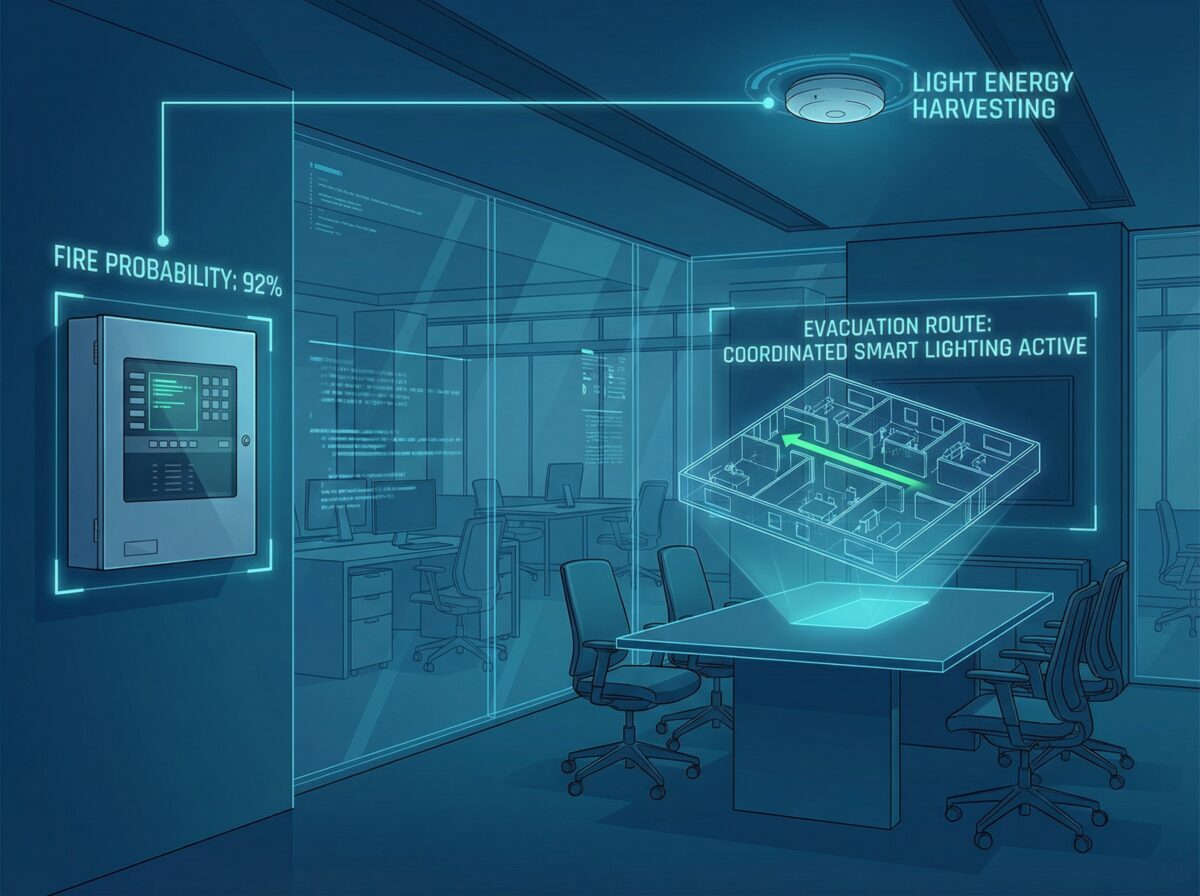
Wireless Technology: Battery-free devices powered by energy harvesting, eliminating installation wiring costs
Voice Integration: Natural language interaction—”Alexa, what’s the fire alarm status at our Main Street building?”
Predictive Analytics: Systems that predict detector failures 60-90 days before they happen
Smart Integration: Seamless coordination with every building system from lighting to security to HVAC
This isn’t science fiction—these technologies exist today in pilot programs and early deployments. Within 5-10 years, they’ll become standard features in commercial fire protection.
—
AI and Machine Learning in Fire Detection
Artificial intelligence is solving the oldest problem in fire alarms: distinguishing real fires from nuisance conditions.
How AI Detection Works
Traditional fire detectors use simple threshold logic:
- Smoke density exceeds 50% → Alarm
- Temperature reaches 135°F → Alarm
- No consideration of context or patterns
AI-enabled detectors analyze multiple data streams simultaneously:
Data Inputs:
- Smoke particle size and distribution
- Temperature and rate of temperature change
- Carbon monoxide levels
- Time of day and occupancy patterns
- Historical alarm data from that location
- Current HVAC status
- Humidity and air pressure
AI Processing:
The system compares current conditions against millions of data points from real fires and false alarms, calculating probability scores:
- Real fire probability: 87%
- Steam/moisture: 8%
- Dust/contamination: 5%
Decision Making:
Systems can be programmed for different response thresholds:
- 90%+ confidence → Immediate full alarm
- 70-89% confidence → Pre-alarm with verification request
- Below 70% → Monitor closely but no alarm
False Alarm Reduction Results
Early deployments show dramatic improvements:
Hospital System (Pennsylvania):
- Before AI: 32 false alarms annually
- After AI: 4 false alarms annually
- Reduction: 87.5%
- Result: $42,000 saved in false alarm response costs
University Campus (California):
- Before AI: 156 nuisance alarms across 12 buildings
- After AI: 18 nuisance alarms
- Reduction: 88.5%
- Benefit: Maintained occupant confidence in system
The technology isn’t perfect—AI systems still miss 2-3% of actual fires in testing. But this accuracy rate matches or exceeds human verification while responding faster.
Pattern Learning Capabilities
AI systems improve through continuous learning:
Building-Specific Training:
- System observes normal conditions for 30-90 days
- Learns typical HVAC cycles, occupancy patterns, environmental fluctuations
- Builds baseline profile unique to that building
- Adjusts detection algorithms to local conditions
Example Pattern Recognition:
Office building detector consistently shows elevated readings between 6:00-6:30 AM. AI analysis reveals:
- Pattern occurs Monday-Friday only
- Correlates with HVAC startup sequence
- Coincides with humidity spike from system condensation
- Never accompanied by temperature increase or CO detection
AI conclusion: Not fire risk—adjust sensitivity during this period or recommend detector relocation.
Current Limitations
AI fire detection faces real constraints:
Computational Requirements:
- Advanced AI requires more processing power than traditional detectors
- Increases device cost by $50-150 per detector
- May require more frequent battery replacement in wireless systems
Training Data Needs:
- AI accuracy depends on quality training data
- Limited real-world fire data available (actual fires are rare)
- Most training uses simulated fire conditions
Regulatory Approval:
- NFPA codes currently specify traditional detection methods
- AI systems need supplemental approval processes
- Some jurisdictions don’t yet accept AI as sole detection method
Liability Concerns:
- Who’s responsible if AI makes wrong decision?
- Insurance implications still being evaluated
- Legal frameworks still developing
Despite limitations, AI detection is expanding rapidly. Expect broader adoption as costs decrease and regulatory frameworks catch up.
—
Wireless and Battery-Free Technology
Wiring costs represent 40-60% of fire alarm installation expenses. Wireless technology eliminates these costs while improving system flexibility.
Current Wireless Fire Alarm Systems
Today’s wireless systems use:
Radio Frequency (RF) Communication:
- Secure, license-free frequency bands
- Encrypted signal transmission
- Mesh networking for extended range
- Battery-powered devices (typically 5-10 year battery life)
Applications:
- Historic buildings where wiring damages architecture
- Retrofit installations in occupied buildings
- Temporary installations during construction
- Facilities where running conduit is impractical
Limitations:
- Battery replacement requirements
- Initial device costs 30-50% higher than wired
- Signal interference potential
- Range limitations requiring repeaters
Energy Harvesting Technology
Next-generation wireless devices eliminate batteries entirely:
How Energy Harvesting Works:
Devices capture ambient energy from:
Temperature Differentials: Thermoelectric generators convert temperature differences between ceiling and detector into electricity
Light Energy: Photovoltaic cells harvest energy from indoor lighting (fluorescent or LED)
Vibration: Piezoelectric materials generate electricity from building vibrations (footsteps, HVAC, equipment)
Radio Frequency: Antennas capture RF energy from WiFi, cellular, and other wireless signals
Power Requirements:
Fire alarm detectors need minimal power:
- Smoke sensor: 10-50 microwatts
- Communication transmitter: 1-5 milliwatts (brief pulses)
- Total daily consumption: 0.1-0.5 watt-hours
Energy harvesting can provide this power in most commercial building environments.
Real-World Deployments
Office Building (Germany):
- 85 energy-harvesting smoke detectors installed
- Light-based harvesting (fluorescent ceiling fixtures)
- Zero battery replacements in 3 years of operation
- Installation cost: 45% less than wired system
Warehouse Facility (Netherlands):
- Thermoelectric detectors using ceiling temperature differential
- 120 devices across 200,000 square feet
- Operating successfully for 4 years
- Eliminated $12,000 in battery replacement costs
Current Limitations:
Energy harvesting faces challenges:
- Dark environments: Insufficient light for photovoltaic harvesting
- Stable temperatures: Minimal temperature differential reduces thermoelectric generation
- Low vibration areas: Some spaces lack sufficient vibration energy
- Startup power: Devices need initial charge to begin harvesting
Hybrid approaches use small capacitors or rechargeable batteries to bridge gaps when harvesting energy isn’t sufficient.
Installation Cost Comparison
Traditional Wired System (10,000 sq ft office):
- Devices: $3,500
- Conduit and wiring: $6,000
- Installation labor: $8,500
- Total: $18,000
Battery-Powered Wireless System:
- Devices: $5,000
- Installation labor: $2,500
- Total: $7,500
- Ongoing battery replacement: $800/year
Energy Harvesting Wireless System:
- Devices: $6,500
- Installation labor: $2,500
- Total: $9,000
- Ongoing costs: $0 (no batteries)
Energy harvesting costs more initially but eliminates ongoing battery expenses and reduces installation time by 60-70%.
—
Smart Building Integration and IoT
Fire alarm systems are becoming nodes in larger building intelligence networks rather than standalone safety systems.
Beyond Simple Integration
Traditional fire alarm integration means:
- HVAC shutdown when alarm activates
- Elevator recall to ground floor
- Door unlock for evacuation
Future integration means:
Bidirectional Communication:
- Fire alarm system receives data from other building systems
- Adjusts sensitivity based on occupancy sensors
- Coordinates with lighting for evacuation guidance
- Receives weather data affecting detection thresholds
Predictive Coordination:
- Building management system predicts high dust conditions during construction
- Automatically adjusts fire alarm sensitivity in affected zones
- Returns to normal sensitivity when construction complete
Occupancy-Aware Detection
Modern buildings know exactly how many people are present and where they’re located:
Data Sources:
- Access control badge readers
- Network device detection (WiFi, Bluetooth)
- Security camera analytics
- HVAC occupancy sensors
- Desk booking systems
Fire Alarm Applications:
During Normal Operation:
- Reduce testing disruption by scheduling during low occupancy
- Adjust voice evacuation messages based on occupancy levels
- Optimize notification device activation patterns
During Fire Events:
- Provide emergency responders with occupant count and locations
- Identify areas requiring search and rescue priority
- Verify evacuation completion through occupancy data
Example Scenario:
Fire alarm activates in third-floor conference room. Building intelligence shows:
- 45 people currently on third floor
- 12 people in conference room where alarm originated
- 8 people with mobility restrictions in building
- Elevator at second floor
System response:
- Voice evacuation directs mobile occupants to nearest stairs
- Sends mobility-restricted occupant locations to responding fire department
- Holds elevator at second floor for firefighter use
- Updates responder dashboard as people evacuate (badge readers track exit)
Lighting Integration for Evacuation
Smart lighting becomes part of fire protection:
Normal Lighting:
Standard operation during occupied hours
Pre-Alarm Condition:
- Lights in affected zone flash amber
- Directs occupants to investigate without full evacuation
- Maintains calm while verifying condition
Full Alarm:
- Emergency lighting activates throughout building
- Lights along primary evacuation routes brighten to maximum
- Colored lighting indicates exit directions (green toward exits, red away from fire)
- Strobes synchronize with fire alarm notification devices
Post-Evacuation:
- Lighting remains active for emergency responder operations
- Different zones can be illuminated based on fire department needs
- Lights help responders navigate unfamiliar buildings
Digital Twin Technology
Some large facilities create virtual building models continuously updated with real-time data:
What Digital Twins Provide:
3D Building Model:
- Accurate floor plans and room layouts
- Equipment locations and specifications
- HVAC ductwork and smoke barrier locations
- Fire protection system device locations
Real-Time Data Overlay:
- Current fire alarm device status
- Occupancy information
- Environmental conditions (temperature, humidity)
- Door positions (open/closed)
- HVAC operation status
Emergency Response Tool:
- Fire department accesses digital twin during response
- Sees exact fire location in 3D building model
- Views occupancy data and potential rescue locations
- Identifies best access routes and equipment staging areas
Training and Planning:
- Run fire scenarios in digital environment
- Test evacuation strategies virtually
- Train building occupants using interactive model
- Optimize detector placement through simulation
Digital twins currently cost $50,000-500,000 depending on building complexity. As costs decrease, medium-sized commercial buildings (50,000+ sq ft) will increasingly adopt this technology.
—
Voice Control and Natural Language Processing
Fire alarm system interaction is becoming conversational rather than technical.
Current Interface Challenges
Traditional fire alarm panels require:
- Understanding complex LED indicators
- Interpreting numerical codes
- Navigating menu systems
- Technical training for basic operations
This creates problems:
- Building managers can’t quickly assess system status
- Emergency responders waste time decoding panel information
- Maintenance technicians need manufacturer-specific training
- Non-technical staff avoid interacting with system
Voice-Enabled Fire Alarm Systems
Emerging systems support natural language queries:
Basic Status Checks:
- “What’s the current status?” → “All systems normal, no alarms or troubles”
- “Any trouble conditions?” → “Detector 142 showing high contamination warning”
- “When was the last test?” → “Annual inspection completed March 15, 2025”
Device-Specific Information:
- “Check detector in Conference Room B” → “Device 264 normal, last tested January 10”
- “Why is the second floor showing trouble?” → “Pull station 208 has low battery”
Troubleshooting Assistance:
- “How do I silence the alarm?” → “Press the yellow Acknowledge button, then press Signal Silence”
- “How do I reset after a drill?” → “Press System Reset button. All pull stations must be manually reset first”
System Management:
- “Schedule test for next Tuesday at 6 AM” → “Test scheduled, building occupants will receive notification”
- “Show me last month’s alarm history” → Displays chronological alarm log
Integration With Building Voice Assistants
For buildings already using Alexa, Google Assistant, or similar platforms:
Multi-Building Portfolios:
- “Show fire alarm status for all buildings” → Dashboard with all property statuses
- “Which buildings need inspection this month?” → Lists properties with upcoming due dates
- “Any active alarms?” → Immediate notification of alarm conditions
Mobile Access:
- Building managers check system status from anywhere
- Receive voice notifications for critical conditions
- Give voice commands remotely for system management
Language Support:
- Multi-language support for diverse building populations
- Automatic language detection based on user profile
- Real-time translation of system messages
Privacy and Security Considerations
Voice-enabled systems raise concerns:
Who Can Access?
- Voice authentication required for system commands
- Read-only access vs. control permissions separated
- Audit logs track all voice interactions
What Gets Recorded?
- Voice queries logged but not stored as audio
- Text transcripts maintained for record keeping
- Sensitive commands require additional authentication
Network Security:
- Voice communication encrypted
- Commands processed locally when possible
- Cloud connectivity optional, not required for operation
Voice control won’t replace traditional panel interfaces—Fire Alarm Control Panels (FACP) will maintain conventional controls as required by code. Voice serves as supplemental access method for convenience.
—
Preparing for Next-Generation Systems
Understanding future technology helps make smart decisions today about fire alarm investments.
Upgrade Timing Considerations
When to Upgrade Now:
Replace existing systems immediately if:
- Equipment exceeds 15-20 years old
- Frequent service calls indicate declining reliability
- Difficult to find replacement parts
- System lacks required code compliance features
- Renovation project requires system modifications
When to Wait:
Keep current systems if:
- Equipment less than 10 years old and operating reliably
- Technology meets current needs adequately
- Budget constraints limit investment
- Building occupancy or use may change soon
Timing Sweet Spot:
Best upgrade timing is typically:
- 10-15 years after original installation
- During major building renovations
- When expanding building occupancy or use
- After change in building ownership or management
Future-Proofing Strategies
Make decisions today that accommodate tomorrow’s technology:
Infrastructure Decisions:
Conduit Sizing:
Install oversized conduit (25-50% larger than current needs) allowing future cable additions without re-running conduit.
Spare Capacity:
Select Fire Alarm Control Panels with 30-40% unused zone or device capacity for future expansion.
Power Provisions:
Ensure adequate power supply capacity for additional devices and features.
Network Infrastructure:
Include Ethernet connections to fire alarm panel locations even if not currently needed.
System Selection:
Open Protocols:
Choose systems supporting industry-standard communication protocols rather than proprietary-only systems.
Manufacturer Stability:
Select established manufacturers with long-term support commitments and strong parts availability.
Software Upgradability:
Verify panel firmware can be updated remotely without hardware replacement.
Modular Architecture:
Systems with modular design allow component upgrades without complete replacement.
Technology Investment Guidelines
Core System (FACP and Critical Devices):
Invest in quality addressable panels from established manufacturers. This 15-20 year investment forms your system foundation.
Detection Devices:
Standard smoke and heat detectors are mature technology. Advanced features (AI detection, multi-criteria sensing) can be added selectively where false alarms are problematic.
Notification Devices:
Voice evacuation systems provide flexibility for future use changes. Initial cost premium ($20,000-50,000 for medium building) justified by long-term adaptability.
Communication and Monitoring:
Cloud connectivity and remote access become more valuable over time. Factor $40-100 monthly into long-term operating budgets.
Integration Capabilities:
Building Management System integration costs vary widely ($5,000-50,000) but provides operational benefits throughout system life.
Working With Fire Protection Professionals
Technology complexity makes professional expertise increasingly valuable:
Design Phase:
Hire qualified fire protection engineers for systems in buildings over 25,000 square feet or with complex occupancies.
Installation:
Use licensed fire alarm contractors with manufacturer certifications for equipment being installed.
Commissioning:
Insist on thorough testing and documentation before accepting system as complete.
Maintenance:
Establish service relationships with companies experienced in your specific system type.
Upgrades:
Consult with fire protection professionals before major technology investments to understand compatibility and integration requirements.
Planning major fire alarm upgrades or new installations? [Talk to an expert](/contact-us) at 48fire who stays current with emerging fire protection technology and can design systems ready for future advancements.
—
Conclusion
Commercial fire alarm systems are evolving from reactive emergency response tools into intelligent building safety networks.
Key Technology Trends:
Artificial Intelligence: Dramatically reduces false alarms while maintaining sensitivity to actual fires. Expect AI features to become standard in 5-10 years as costs decrease and regulatory frameworks adapt.
Wireless Technology: Energy harvesting eliminates installation wiring costs and battery maintenance. Currently suitable for retrofit applications, wireless will increasingly compete with wired systems for new construction.
Smart Integration: Fire alarms become participants in building-wide intelligence networks, coordinating with lighting, HVAC, security, and occupancy systems for enhanced safety and operational efficiency.
Voice Control: Natural language interfaces make fire alarm systems accessible to non-technical users while maintaining professional-grade capabilities.
What This Means for Building Owners:
The technology exists today to significantly improve fire protection beyond what current codes require. Buildings making intelligent technology investments now will see benefits in:
- Lower false alarm rates (reducing fines and occupant disruption)
- Reduced installation and maintenance costs (wireless systems)
- Better emergency response (integrated building intelligence)
- Easier system management (voice control and remote access)
- Future flexibility (systems that adapt as technology evolves)
Making Smart Decisions:
Not every building needs cutting-edge technology. Simple, well-maintained addressable fire alarm systems provide excellent protection for most commercial properties. Advanced features make most sense for:
- Buildings with chronic false alarm problems
- Facilities where wiring installation is difficult or expensive
- Properties requiring sophisticated emergency response coordination
- Organizations managing multiple buildings needing centralized oversight
The Bottom Line:
Fire alarm technology continues advancing rapidly. While current systems effectively protect building occupants, next-generation technology offers improvements in cost, reliability, and operational efficiency.
The question isn’t whether to adopt new technology—it’s when adoption makes sense for your specific building and budget. Work with knowledgeable fire protection professionals who understand both current requirements and emerging capabilities to make informed decisions.
The future of commercial fire protection is intelligent, wireless, and integrated. That future is arriving faster than most people realize.