The Fire Protection Role of a Rechargeable Extinguisher Program
—
RECHARGEABILITY AS STRATEGIC ASSET
Commercial fire protection systems require two fundamental characteristics:
1. Immediate response capability when fire occurs
2. Sustained readiness over extended lifecycle
Rechargeable extinguishers deliver both.
Disposable extinguishers provide immediate response capability once. After discharge—partial or complete—equipment becomes waste requiring replacement.
Note: Industry commonly refers to non-rechargeable extinguishers as “disposable” extinguishers. These units are designed for single-use lifecycle and are not intended for recharge or internal maintenance.
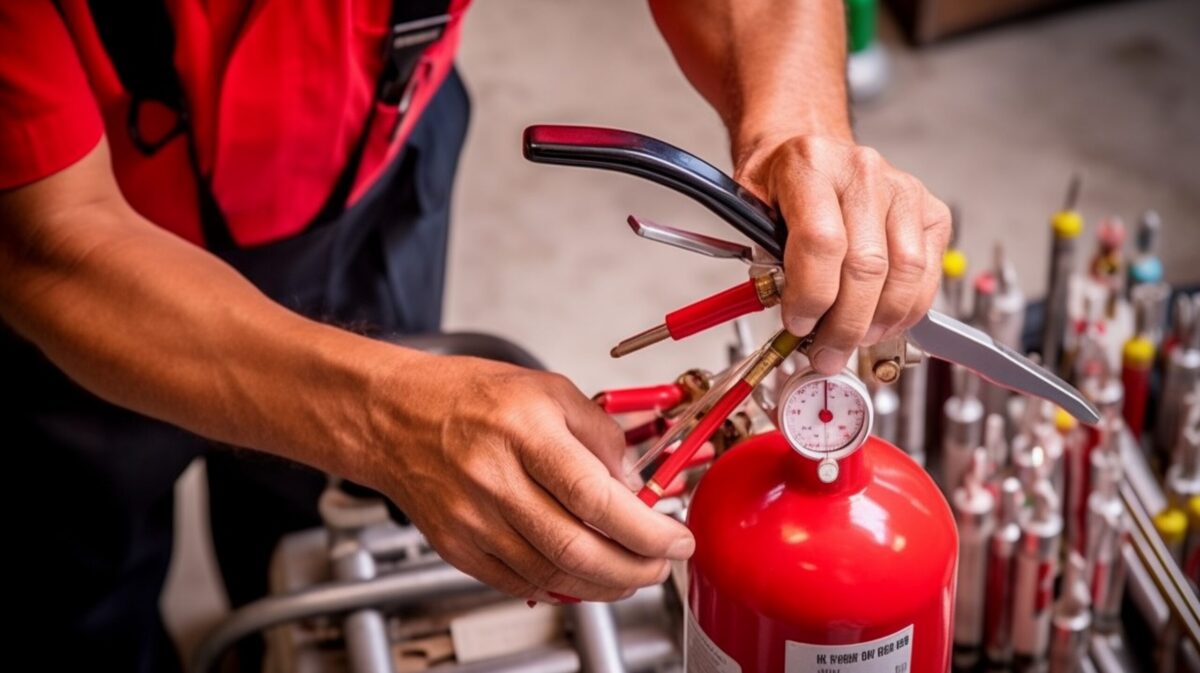
Rechargeable extinguishers restore response capability repeatedly. After discharge, equipment receives agent refill and returns to service. Same vessel. Same mounting location. Restored functionality.
This rechargeability transforms fire extinguishers from single-use devices into long-term commercial fire protection assets.
Understanding the fire protection role of rechargeable extinguisher programs requires examining how rechargeability impacts:
- Asset lifecycle management
- Emergency response reliability
- Maintenance economics
- Environmental sustainability
- Regulatory compliance
This article analyzes rechargeable extinguisher programs through commercial fire protection lens, documenting how rechargeability enhances protection effectiveness.
—
ROLE 1 → ASSET LIFECYCLE OPTIMIZATION
The Long-Term Investment Model
Commercial fire protection benefits from equipment serving 12-20 year lifecycles when properly maintained.
—
Rechargeable vs. Disposable Comparison
DISPOSABLE EXTINGUISHERS
“`
Lifecycle Pattern:
Purchase → Mount → Monitor → Discharge/Expire → Replace
↓
Asset becomes waste
New purchase required
“`
Typical lifecycle:
- Use duration: Until discharge or expiration (6-12 years typical)
- Post-discharge: Complete replacement required
- Testing: Not performed (non-rechargeable construction)
- Investment recovery: None after disposal
—
RECHARGEABLE EXTINGUISHERS
“`
Lifecycle Pattern:
Purchase → Mount → Monitor → Discharge → Recharge → Return to service
↓
Asset remains productive
Investment preserved
↓
Maintenance cycle continues
↓
Testing performed periodically
↓
12-20 year service life typical
“`
Extended lifecycle:
- Use duration: 12-20 years with proper maintenance
- Post-discharge: Recharge restores function
- Testing: Hydrostatic testing per NFPA 10 Table 8.3.1
- Investment recovery: Full asset value preserved over lifecycle
—
Commercial Fire Protection Asset Value
Financial analysis of rechargeability:
100-unit facility equipment investment:
| Factor | Disposable Program | Rechargeable Program |
|---|---|---|
| Initial unit cost | $45 each | $245 each |
| Initial investment | $4,500 | $24,500 |
| Expected lifecycle | 6-10 years | 15-20 years |
| Recharge capability | No | Yes (unlimited) |
| Testing performed | No | Yes per NFPA |
| 20-year replacement cycles | 2-3 cycles | 0-1 cycles |
| 20-year total cost | $9,000-13,500 | $24,500-30,000 |
| Annual cost average | $450-675 | $1,225-1,500 |
Note: While disposable extinguishers have lower initial cost, commercial fire protection programs must factor in complete lifecycle costs including replacements, testing capabilities, and environmental disposal. Cost figures represent typical estimates for comparison purposes. Actual costs vary by geographic location, service provider, equipment brand, and facility-specific requirements. Contact 48Fire for detailed pricing based on your facility’s needs.
—
Maintenance Investment Protection
Rechargeable extinguishers preserve commercial fire protection maintenance investments:
Annual maintenance value preservation:
When 48Fire performs annual maintenance on rechargeable equipment:
- Internal component inspection possible
- Seals and gaskets replaceable
- Agent condition verifiable
- Equipment serviceable to manufacturer specifications
- Investment in maintenance extends asset life
Maintenance cycle:
“`
Year 1-5: Monthly inspections + Annual maintenance
Year 6: Six-year internal examination
Year 7-11: Monthly inspections + Annual maintenance
Year 12: Hydrostatic testing (dry chemical types)
Year 13-15+: Continued service cycles
“`
Each maintenance investment extends productive asset life, maximizing commercial fire protection equipment value.
—
ROLE 2 → EMERGENCY RESPONSE CONTINUITY
The Restoration Capability
Commercial fire protection requires rapid restoration after fire incidents.
—
Post-Incident Equipment Status
Scenario: Small fire controlled using extinguisher
With disposable extinguishers:
“`
Fire Event → Discharge → Equipment disposal required
↓
Fire protection gap created
↓
New equipment procurement needed
↓
Days to weeks until replacement
↓
Temporary reduced protection
“`
Timeline to restored protection:
- Procurement: 2-5 days minimum
- Delivery: 1-3 days
- Installation: Same day
- Total restoration time: 3-8 days typical
—
With rechargeable extinguishers:
“`
Fire Event → Discharge → Recharge service scheduled
↓
48Fire recharge within 24-48 hours
↓
Same equipment returned to service
↓
Same location, restored function
↓
Fire protection continuity maintained
“`
Timeline to restored protection:
- Service scheduling: Same day
- Recharge service: 24-48 hours typical
- Reinstallation: Immediate
- Total restoration time: 1-2 days typical
Commercial fire protection continuity advantage: Approximately 60-75% faster restoration with rechargeable program.
—
Partial Discharge Recovery
Rechargeable extinguishers restore protection after partial discharge:
Common partial discharge scenarios:
- Accidental activation (bumped, tested)
- Small fire attempt (seconds of discharge)
- Training use (controlled demonstration)
- Malicious tampering (broken seal, brief discharge)
NFPA 10 requirement: Any discharge—regardless of amount—requires equipment removal from service until recharged.
Disposable response:
- Partially discharged unit replaced completely
- Remaining agent wasted
- Full replacement cost incurred
- Equipment becomes waste
Rechargeable response:
- Partially discharged unit serviced by 48Fire
- Complete recharge performed
- Standard service cost only
- Equipment returned to full function
Commercial fire protection economics: Rechargeability prevents full replacement costs for partial discharge incidents, which occur more frequently than complete fire events.
—
ROLE 3 → MAINTENANCE PROGRAM ENABLEMENT
The Serviceability Foundation
Commercial fire protection maintenance programs require serviceable equipment.
—
NFPA 10 Maintenance Requirements
Annual maintenance per Section 7.3 includes:
□ Complete external examination
□ Internal examination where accessible
□ Mechanical parts inspection
□ Agent condition assessment
□ Component replacement as needed
□ Recharge when indicated
Rechargeable extinguisher construction enables:
- Valve disassembly for inspection
- Internal vessel access
- Component examination and replacement
- Agent removal and testing
- Complete recharge capability
Disposable extinguisher construction prevents:
- Internal access (sealed, non-serviceable)
- Component replacement (not designed for service)
- Agent testing (inaccessible)
- Recharge (no service valve)
Commercial fire protection maintenance programs achieve full NFPA 10 compliance through rechargeable equipment serviceability.
—
Six-Year Internal Examination
NFPA 10 Section 7.3.1 requires six-year internal examination for stored-pressure extinguishers with 12-year hydrostatic test intervals.
Procedure requirements:
1. Complete agent discharge
2. Disassembly of valve assembly
3. Internal vessel examination
4. Corrosion assessment
5. Component replacement
6. Reassembly and recharge
Rechargeable extinguishers:
✓ Designed for complete disassembly
✓ Internal examination fully achievable
✓ Corrosion visible and assessable
✓ Recharge restores service
✓ NFPA 10 Section 7.3.1 compliant
Disposable extinguishers:
✗ Not designed for disassembly
✗ Internal examination impossible without destruction
✗ Section 7.3.1 not applicable (no 12-year test interval)
✗ Replacement rather than examination required
Commercial fire protection programs using rechargeable equipment achieve complete NFPA maintenance compliance including internal examinations.
—
Hydrostatic Testing Program
NFPA 10 Section 8 requires periodic hydrostatic testing verifying pressure vessel structural integrity.
NFPA 10 Table 8.3.1 test intervals:
- Dry chemical stored-pressure: 12 years
- Water stored-pressure: 5 years
- CO2: 5 years
- Wet chemical: 5 years
Testing process:
1. Complete discharge and disassembly
2. Internal cleaning and examination
3. Hydrostatic pressure testing
4. Pass/fail determination
5. Reassembly and recharge (passed units)
6. Destruction (failed units per Section 8.3.5)
Rechargeable extinguishers:
✓ Testable per NFPA procedures
✓ Passed units receive recharge
✓ Return to full service
✓ Testing extends verified safe service life
✓ Commercial fire protection reliability confirmed
Disposable extinguishers:
✗ Not tested (non-rechargeable construction)
✗ Vessel integrity unverified over lifecycle
✗ Replacement before structural issues develop
Commercial fire protection programs benefit from verified vessel integrity through testing rather than assuming continued safety.
—
ROLE 4 → COST MANAGEMENT OPTIMIZATION
The Economic Efficiency Model
Commercial fire protection budgets benefit from predictable, optimized costs.
—
Service vs. Replacement Economics
Cost comparison: 100-unit facility over 15 years
DISPOSABLE PROGRAM
“`
Initial Purchase (100 units @ $45): $4,500
Replacement Cycle 1 (Year 8, 100 units): $4,500
Replacement Cycle 2 (Year 15, 100 units): $4,500
Disposal fees (200 units @ $5): $1,000
Testing: N/A $0
Annual inspections (15 years @ $600): $9,000
─────────────────────────────────────────────────
15-YEAR TOTAL: $23,500
“`
—
RECHARGEABLE PROGRAM
“`
Initial Purchase (100 units @ $245): $24,500
Annual maintenance (15 years @ $4,000): $60,000
Six-year examinations (2 cycles @ $3,500): $7,000
Hydrostatic testing (Year 12, @ $8,000): $8,000
Recharge incidents (est. 15 @ $75): $1,125
Equipment replacements (20% fail test): $4,900
Annual inspections (15 years @ $1,200): $18,000
─────────────────────────────────────────────────
15-YEAR TOTAL: $123,525
“`
Cost Analysis Note: These figures represent typical estimates for comparison purposes demonstrating the different cost structures of each approach. Actual costs vary significantly by geographic location, service provider, equipment brand and quality, facility size and complexity, and specific service contract terms. The analysis demonstrates that rechargeable programs have higher total investment but provide substantially enhanced commercial fire protection value through complete NFPA maintenance compliance, verified equipment reliability through testing, professional service throughout lifecycle, environmental responsibility, and extended asset longevity of 15-20 years versus 6-10 years for disposable types. Contact 48Fire for facility-specific pricing and detailed cost analysis based on your commercial fire protection requirements.
—
Predictable Budget Allocation
Commercial fire protection benefits from cost predictability:
Disposable program unpredictability:
- Replacement timing uncertain (after discharge or expiration)
- Emergency replacements required (unpredictable)
- Disposal costs variable
- No scheduled service costs
Rechargeable program predictability:
- Annual maintenance: Scheduled, budgeted
- Six-year examination: Known timing, planned budget
- Hydrostatic testing: Scheduled per NFPA intervals
- Recharge incidents: Known costs, predictable frequency
- Emergency response: Recharge cost known
Budget planning advantage: 48Fire rechargeable program provides commercial fire protection with predictable annual costs enabling accurate budget forecasting.
—
ROLE 5 → ENVIRONMENTAL RESPONSIBILITY
The Sustainability Contribution
Commercial fire protection programs increasingly prioritize environmental impact.
—
Waste Reduction
Disposable extinguisher lifecycle waste:
Per unit over 15 years:
- 2-3 complete units disposed
- Steel vessel: 10-15 pounds per unit
- Plastic components: 1-2 pounds per unit
- Agent disposal (if not discharged): Specialized handling required
- Total waste per unit: 25-50 pounds over 15 years
100-unit facility: 2,500-5,000 pounds waste over 15 years
—
Rechargeable extinguisher lifecycle waste:
Per unit over 15 years:
- 0-1 units disposed (if pass hydrostatic testing)
- Steel vessel: 0-15 pounds (only if failed testing)
- Replaceable components: Seals, gaskets (ounces, not pounds)
- Agent: Reused or properly recycled
- Total waste per unit: 0-15 pounds over 15 years
100-unit facility: 0-1,500 pounds waste over 15 years
Environmental impact reduction: Approximately 40-70% less waste with rechargeable commercial fire protection program.
Note: Environmental benefits assume proper disposal and recycling procedures are followed. Actual waste reduction varies based on equipment failure rates during hydrostatic testing and specific facility conditions.
—
Resource Conservation
Manufacturing impact reduction:
Disposable lifecycle (100 units, 15 years):
- Units manufactured: 200-300 total
- Raw materials: Steel, plastics, chemicals (×2-3)
- Manufacturing energy: ×2-3 facility production runs
- Transportation: ×2-3 shipping cycles
Rechargeable lifecycle (100 units, 15 years):
- Units manufactured: 100-120 total
- Raw materials: Single production + replacement parts
- Manufacturing energy: Single facility run + component production
- Transportation: Initial + service recharge agents
Resource conservation: Rechargeable commercial fire protection programs reduce raw material consumption and manufacturing energy through extended equipment lifecycles.
—
ROLE 6 → REGULATORY COMPLIANCE SUPPORT
The Standards Alignment
Commercial fire protection regulatory compliance facilitated through rechargeable equipment capabilities.
—
NFPA 10 Compliance Enablement
Rechargeable extinguisher design enables complete NFPA 10 compliance:
Section 7.2 (Monthly Inspections):
✓ All criteria examinable on rechargeable equipment
✓ Pressure gauge accessible and verifiable
✓ Equipment remains serviceable when issues detected
Section 7.3 (Annual Maintenance):
✓ Complete maintenance scope achievable
✓ Internal examination accessible
✓ Components replaceable
✓ Recharge capability enables restoration
Section 7.3.1 (Six-Year Examination):
✓ Complete disassembly possible
✓ Internal vessel inspection achievable
✓ Recharge restores equipment to service
✓ Commercial fire protection maintained continuously
Section 8 (Hydrostatic Testing):
✓ Testing procedures applicable
✓ Passed units return to service via recharge
✓ Structural integrity verified
Commercial fire protection programs achieve full NFPA 10 compliance spectrum through rechargeable equipment serviceability.
—
OSHA Requirements Support
OSHA 29 CFR 1910.157 requirements:
1910.157(e)(3) Annual Maintenance:
“Stored pressure extinguishers do not require an internal examination.”
However, NFPA 10 (incorporated by reference into OSHA regulations) requires six-year internal examination for rechargeable stored-pressure types with 12-year hydrostatic test intervals. Rechargeable equipment construction enables this examination when required.
1910.157(g)(1) Hydrostatic Testing:
“The employer shall assure that hydrostatic testing is performed by trained persons with suitable testing equipment.”
Rechargeable extinguisher design enables hydrostatic testing compliance. Disposable types not designed for testing.
Commercial fire protection compliance: Rechargeable programs support complete OSHA requirement satisfaction including testing mandates.
—
ROLE 7 → PROFESSIONAL SERVICE PARTNERSHIP
The Maintenance Relationship Model
Commercial fire protection programs benefit from ongoing service provider relationships.
—
Service Continuity
Rechargeable programs create continuous service relationship with 48Fire:
Ongoing service touchpoints:
- Monthly inspection support (training, digital systems)
- Annual maintenance service
- Six-year internal examinations
- Hydrostatic testing coordination
- Recharge service after discharge incidents
- Component replacement and updates
- Regulatory compliance verification
Professional partnership advantages:
- Equipment history knowledge (service provider knows each unit)
- Proactive issue identification (patterns visible over time)
- Optimized maintenance scheduling (provider manages timelines)
- Regulatory guidance (compliance expertise applied continuously)
- Emergency response familiarity (provider knows facility layout)
Disposable programs lack service continuity:
- Limited service touchpoints (inspections only, no maintenance)
- No equipment history development
- Transactional replacement relationship
- No ongoing professional partnership
Commercial fire protection enhanced through sustained professional service relationships enabled by rechargeable equipment serviceability.
—
Technical Expertise Access
Rechargeable program provides continuous access to certified technician expertise:
Technical support includes:
- NFPA 10 compliance guidance
- Maintenance procedure optimization
- Testing program coordination
- Recharge quality assurance
- Component specification verification
- Service scheduling optimization
- Documentation system management
48Fire certified technicians provide commercial fire protection programs with professional fire protection expertise through ongoing service relationships rather than transactional equipment sales.
—
IMPLEMENTING RECHARGEABLE EXTINGUISHER PROGRAMS
Strategic Deployment for Commercial Fire Protection
—
Equipment Selection
Rechargeable extinguisher types for commercial fire protection:
Dry Chemical (ABC or BC):
- Most common commercial application
- 12-year hydrostatic test interval
- Versatile hazard coverage
- Cost-effective rechargeability
Water or Foam:
- Class A hazard specialization
- 5-year hydrostatic test interval
- Environmentally friendly agents
- Effective recharge economics
CO2:
- Electrical and Class B hazards
- 5-year hydrostatic test interval
- No agent cleanup required
- Recharge fully restores function
Clean Agent (Halotron):
- Sensitive equipment protection
- 12-year hydrostatic test interval
- No residue discharge
- Premium rechargeability value
Class K (Wet Chemical):
- Commercial kitchen requirement
- 5-year hydrostatic test interval
- Specialized agent recharge
- Essential commercial kitchen fire protection
—
Program Implementation
48Fire rechargeable program deployment:
PHASE 1: Assessment
□ Current equipment inventory
□ Replacement timeline analysis
□ Budget planning for transition
□ Facility hazard assessment
□ Equipment specification determination
PHASE 2: Equipment Installation
□ Rechargeable units installed
□ Proper mounting per NFPA 10
□ Initial commissioning service
□ Documentation system established
PHASE 3: Service Program Launch
□ Monthly inspection training
□ Annual maintenance scheduling
□ Six-year examination planning
□ Testing program timeline established
□ Recharge protocols documented
PHASE 4: Continuous Management
□ Automated service reminders
□ Digital documentation maintenance
□ Performance monitoring
□ Budget optimization
□ Compliance verification continuous
—
CONCLUSION
The Rechargeable Advantage for Commercial Fire Protection
Rechargeable extinguisher programs enhance commercial fire protection through seven distinct roles:
ROLE 1: Asset Lifecycle Optimization
- 15-20 year service life vs. 6-10 years
- Investment preservation through rechargeability
- Maintenance value retained over lifecycle
ROLE 2: Emergency Response Continuity
- Rapid restoration after discharge (1-2 days vs. 3-8 days)
- Partial discharge recovery capability
- Protection continuity maintained
ROLE 3: Maintenance Program Enablement
- Full NFPA 10 compliance achievable
- Six-year internal examination possible
- Hydrostatic testing supported
ROLE 4: Cost Management Optimization
- Predictable budget allocation
- Service economics vs. replacement costs
- Long-term value maximization
ROLE 5: Environmental Responsibility
- Approximately 40-70% waste reduction
- Resource conservation through extended lifecycles
- Sustainability alignment
ROLE 6: Regulatory Compliance Support
- Complete NFPA 10 compliance enabled
- OSHA requirement satisfaction
- Verified safety through testing
ROLE 7: Professional Service Partnership
- Continuous service relationship
- Technical expertise access
- Equipment history development
48Fire rechargeable extinguisher programs provide commercial fire protection with serviceable equipment, complete NFPA 10 maintenance compliance, predictable cost management, environmental sustainability, verified safety through testing, and ongoing professional service relationships—delivering comprehensive fire protection value through rechargeability.
[Implement Rechargeable Extinguisher Program](/contact-us)
—
48Fire
Commercial Fire Protection Through Rechargeable Programs
Complete Serviceability • NFPA Compliance • Lifecycle Value
Contact: [/contact-us](/contact-us)