The Fire Extinguisher Inspection That Helped a Business Meet NFPA 10
—
COMPLIANCE REALITY CHECK
Self-Assessment: ✓ Compliant
Professional Inspection: ✗ Non-Compliant (83% failure rate)
Commercial facility believed fire protection met NFPA 10 standards. Equipment appeared maintained. Service tags visible. Internal monthly checks performed.
Pre-audit professional fire extinguisher inspection service engagement with 48Fire revealed different reality.
—
THE COMPLIANCE SCORECARD
Before Professional Fire Extinguisher Inspection Service
| NFPA 10 Section | Facility Belief | Actual Status |
|---|---|---|
| 6.1 Selection & Distribution | ✓ | ✗ |
| 6.2 Marking & Identification | ✓ | ⚠ |
| 7.2 Monthly Inspections | ✓ | ⚠ |
| 7.3 Annual Maintenance | ✓ | ✗ |
| 7.3.1 Six-Year Examination | ✓ | ✗ |
| 8 Hydrostatic Testing | ✓ | ✗ |
Reality: 1 of 6 requirements actually satisfied
This article documents systematic compliance achievement through professional fire extinguisher inspection service.
—
SECTION 6.1 → EQUIPMENT SELECTION
NFPA 10 Requirement
“Fire extinguishers shall be selected on the basis of the character and extent of the hazards to be protected.”
—
The Problem
❌ KITCHEN AREA
- Hazard Class: K (commercial cooking)
- Equipment Present: 10 lb BC dry chemical
- Required: Class K wet chemical
- Issue: Wrong extinguisher type creates safety hazard
❌ ELECTRICAL ROOM
- Hazard Class: C (energized electrical)
- Equipment Present: Water extinguisher
- Required: CO2 or clean agent
- Issue: Water presents electrical shock hazard
❌ LOADING DOCK
- Travel Distance: 92 feet to nearest extinguisher
- NFPA Maximum: 75 feet for Class A
- Issue: Exceeds coverage requirements
—
The Solution
✓ Kitchen Correction
- Installed: 6-liter Class K wet chemical
- Relocated: BC unit to appropriate area
- Verified: Proper equipment for hazard
✓ Electrical Room Correction
- Installed: 10 lb CO2 extinguisher
- Relocated: Water unit to general area
- Verified: Electrical safety maintained
✓ Loading Dock Correction
- Installed: Additional 10 lb ABC unit
- New Location: 68 feet from furthest point
- Verified: Complete area coverage
SECTION 6.1: COMPLIANCE ACHIEVED ✓
—
SECTION 7.2 → MONTHLY INSPECTIONS
NFPA 10 Requirement
“Fire extinguishers shall be inspected at approximately 30-day intervals.”
Section 7.2.1.1 mandates eight specific criteria examination:
1. Located in designated place
2. Access not obstructed
3. Operating instructions legible
4. Pressure gauge in operable range
5. Fullness determined
6. No physical damage/corrosion/leakage
7. Hose and nozzle clear
8. Seals/tamper indicators intact
—
The Problem
❌ INCOMPLETE CRITERIA EXAMINATION
Facility checked: Gauge pressure only
NFPA requires: All eight criteria
Missing examinations:
- ✗ Location/accessibility verification
- ✗ Operating instructions legibility check
- ✗ Fullness verification (weighing/hefting)
- ✗ Physical damage assessment
- ✗ Hose/nozzle condition inspection
- ✗ Seal/tamper indicator verification
—
❌ INADEQUATE DOCUMENTATION
Facility documentation:
- Generic checklist with “OK” marking
- No specific findings recorded
- No deficiency identification
- No photographic evidence
- Cannot prove NFPA criteria examined
NFPA 10 Section 7.2.2 requires:
“Records shall be maintained to provide evidence that the required inspections have been performed.”
—
The Solution
✓ Fire Extinguisher Inspection Service Implementation
48Fire systematic program:
Complete Criteria Examination:
□ Digital system with all eight NFPA criteria
□ Each criterion verified per unit
□ Pass/fail status recorded
□ Deficiencies documented specifically
Proper Documentation:
□ Photographic evidence captured
□ Inspector identification recorded
□ Date/time stamps automatic
□ Searchable digital records
□ Audit-ready reports instant
Automated Management:
□ Monthly reminders prevent gaps
□ Management dashboard visibility
□ Real-time deficiency alerts
□ Compliance status continuous
—
✓ First Professional Inspection Findings
Issues internal process missed:
- 3 units: Slow pressure loss (gauges marginally acceptable but declining)
- 2 units: Early corrosion (surface rust beginning)
- 1 unit: Deteriorating hose (cracking from age)
- 4 units: Faded instructions (legibility compromised)
All corrected before audit.
SECTION 7.2: COMPLIANCE ACHIEVED ✓
—
SECTION 7.3 → ANNUAL MAINTENANCE
NFPA 10 Requirement
“Fire extinguishers shall be subjected to maintenance at intervals of not more than 1 year.”
Critical qualifier – Section 7.3.2:
“Maintenance shall be performed by persons trained in maintenance procedures.”
—
The Problem
❌ UNQUALIFIED SERVICE PROVIDER
Facility used: Local handyman service
Qualification level: No NFPA certification
Training documentation: None available
Service tags: Generic, no technician identification
NFPA requires: Certified trained personnel
—
❌ INCOMPLETE MAINTENANCE SCOPE
Service performed:
- External cleaning
- Pressure check only
NFPA 10 Section 7.3.2 requires:
- ✗ Internal component examination
- ✗ Seal/O-ring replacement
- ✗ Agent condition verification
- ✗ Mechanical parts testing
- ✗ Proper service documentation
—
❌ IMPROPER SERVICE TAGS
NFPA 10 Section 7.3.4 requires service tags include:
1. Month and year maintenance performed
2. Name of person/agency performing service
3. Name of agency
Facility tags: Generic stickers, missing required information
—
The Solution
✓ Professional Fire Extinguisher Inspection Service
48Fire certified technician program:
Qualified Personnel:
□ NFPA-certified technicians only
□ Training documentation available
□ Certification credentials verified
□ Professional accountability established
Complete Maintenance Scope:
□ Internal component examination performed
□ All seals/O-rings replaced per schedule
□ Agent condition verified, recharged if needed
□ Mechanical parts tested functionally
□ Manufacturer specifications followed
Proper Service Tags:
□ Month and year documented
□ Technician name and certification number
□ 48Fire agency identification
□ Next service due date included
□ All NFPA 10 Section 7.3.4 requirements met
—
✓ Comprehensive Maintenance Results
118 units: Complete annual maintenance
8 units: Enhanced service (internal issues detected)
3 units: Replacement recommended (corrosion beyond service)
SECTION 7.3: COMPLIANCE ACHIEVED ✓
—
SECTION 7.3.1 → SIX-YEAR EXAMINATION
NFPA 10 Requirement
“Every 6 years, stored pressure type extinguishers that require a 12-year hydrostatic test shall be emptied and subjected to maintenance procedures.”
—
The Problem
❌ EXAMINATIONS NEVER PERFORMED
Equipment analysis:
- Units 6-12 years old: 47 units
- NFPA requirement: Six-year examination mandatory
- Actual examinations performed: ZERO
- Overdue units: 47 (100% non-compliance)
Internal condition status: UNKNOWN
- Corrosion presence unverified
- Component condition unassessed
- Contamination unchecked
- Vessel integrity unconfirmed
—
The Solution
✓ Fire Extinguisher Inspection Service Program
48Fire six-year examination process:
Complete Examination:
□ All 47 overdue units scheduled
□ Complete agent discharge and removal
□ Internal vessel inspection performed
□ Corrosion/damage assessment documented
□ Photographic evidence captured
Component Replacement:
□ All seals and gaskets replaced
□ O-rings renewed per specifications
□ Worn components identified and replaced
□ Complete reassembly per manufacturer
□ Proper recharge with correct agent
—
✓ Examination Results
| Finding | Units | Action |
|---|---|---|
| Good Condition | 39 | Returned to service |
| Early Corrosion | 5 | Enhanced treatment, returned |
| Severe Corrosion | 3 | Replacement required |
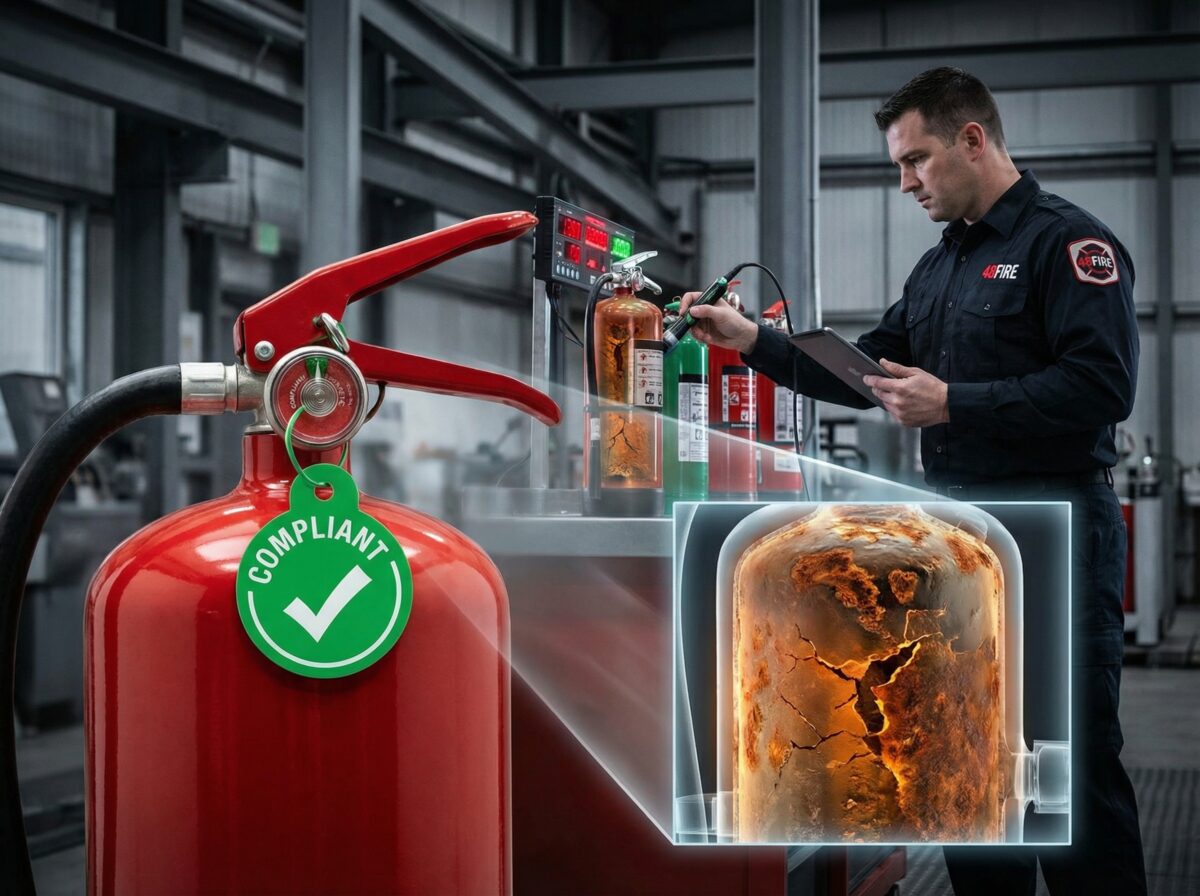
Critical Discovery: Three units appeared perfect externally but had severe internal corrosion. Six-year examination prevented potential failures.
SECTION 7.3.1: COMPLIANCE ACHIEVED ✓
—
SECTION 8 → HYDROSTATIC TESTING
NFPA 10 Requirement
“Hydrostatic testing is a means to periodically determine that a fire extinguisher’s pressure vessel is safe for continued use.”
NFPA 10 Table 8.3.1 Test Intervals:
| Type | Interval |
|---|---|
| CO2 | 5 years |
| Water/Foam/Wet Chemical | 5 years |
| Dry Chemical | 12 years |
| Clean Agent | 12 years |
—
The Problem
❌ TESTING NEVER PERFORMED
Equipment requiring testing:
- CO2 units (ages 7-14 years): 12 units overdue
- Dry chemical units (ages 13-16 years): 28 units overdue
- Total overdue: 40 units (100% non-compliance)
Testing documentation: NONE
- No permanent records exist
- Cannot verify any unit ever tested
- No testing facility relationship
- Complete program absence
—
The Solution
✓ Professional Fire Extinguisher Inspection Service Testing
48Fire hydrostatic testing program:
Systematic Testing:
□ All 40 overdue units scheduled
□ Transport to certified testing facility
□ Complete discharge and disassembly
□ Internal visual examination
□ Pressure testing per NFPA procedures
□ Pass/fail determination documented
Permanent Records:
□ Testing certificates for passed units
□ Destruction certificates for failed units
□ Testing facility credentials documented
□ Digital records maintained per Section 8.3.3
□ Next testing due dates calculated
—
✓ Testing Results
| Outcome | Units | Percentage | Action |
|---|---|---|---|
| PASSED | 24 | 60% | Recharged, returned |
| FAILED | 16 | 40% | Destroyed per NFPA, replaced |
Critical Findings:
- 40% of equipment appeared functional but failed structural testing
- Internal corrosion invisible externally compromised vessel integrity
- Units would have remained in service indefinitely without testing
- Potential safety hazards eliminated
SECTION 8: COMPLIANCE ACHIEVED ✓
—
TRANSFORMATION SUMMARY
Before vs. After
“`
BEFORE Fire Extinguisher Inspection Service
═══════════════════════════════════════════
Section 6.1 ✗ Wrong equipment types
Section 6.2 ⚠ Incomplete markings
Section 7.2 ⚠ Partial inspections
Section 7.3 ✗ Unqualified service
Section 7.3.1 ✗ Zero examinations
Section 8 ✗ No testing program
───────────────────────────────────────────
COMPLIANCE: 1 of 6 (17%)
AFTER Fire Extinguisher Inspection Service
═══════════════════════════════════════════
Section 6.1 ✓ Proper selection verified
Section 6.2 ✓ Complete markings
Section 7.2 ✓ Systematic inspections
Section 7.3 ✓ Certified technicians
Section 7.3.1 ✓ All examinations current
Section 8 ✓ Testing program active
───────────────────────────────────────────
COMPLIANCE: 6 of 6 (100%)
“`
—
AUDIT OUTCOME
Insurance Verification Results
Documentation Presented:
✓ Complete equipment inventory
✓ Six months systematic inspection records
✓ Certified technician credentials
✓ Six-year examination certificates
✓ Hydrostatic testing records
✓ Proper service tags (Section 7.3.4 compliant)
✓ Photographic evidence
✓ 48Fire systematic program documentation
Audit Result: ✓ Full NFPA 10 compliance verified
Deficiencies Cited: ZERO
Insurance Impact: 6% premium reduction
Annual Savings: $2,400
—
VALUE DELIVERED
Professional Fire Extinguisher Inspection Service ROI
Compliance Achievement:
- 17% → 100% NFPA 10 compliance
- 5 major gaps corrected
- Complete transformation: 45 days
Safety Improvement:
- Wrong equipment types corrected
- 40% of tested units structurally unsafe
- Internal corrosion discovered before failures
- Equipment reliability verified
Risk Mitigation:
- Audit failure prevented
- Regulatory violations avoided
- Insurance complications eliminated
- Liability exposure reduced
Financial Benefit:
- Premium reduced: $2,400 annually
- Violation penalties avoided: $5,000-15,000
- Audit corrections prevented: $8,000-20,000
- Equipment failure liability eliminated
—
ONGOING COMPLIANCE
Systematic Fire Extinguisher Inspection Service
48Fire continuous program maintains:
Monthly (Section 7.2):
→ Digital inspection, all eight criteria
→ Photographic documentation
→ Automated scheduling
→ Real-time deficiency alerts
Annually (Section 7.3):
→ NFPA-certified technicians
→ Complete maintenance scope
→ Proper service tags
→ Compliance verification
Six-Year (Section 7.3.1):
→ Automated tracking
→ Scheduled examinations
→ Complete internal inspection
→ Component replacement
Testing (Section 8):
→ Equipment age monitoring
→ Proactive scheduling
→ Certified facility utilization
→ Permanent records
Result: Continuous NFPA 10 compliance maintained
—
CONCLUSION
The Professional Difference
Self-assessment indicated compliance.
Professional fire extinguisher inspection service revealed 83% non-compliance.
Systematic correction achieved:
- ✓ Equipment selection verified
- ✓ Monthly inspections systematized
- ✓ Certified technicians performing maintenance
- ✓ Six-year examinations completed
- ✓ Hydrostatic testing program established
- ✓ Complete NFPA 10 compliance verified
Value delivered:
- Audit success guaranteed
- Insurance optimized
- Safety assured
- Liability minimized
48Fire professional fire extinguisher inspection service provides comprehensive NFPA 10 compliance assessment, gap identification, systematic correction, certified service, complete documentation, and continuous compliance maintenance.
[Schedule Professional Fire Extinguisher Inspection Service](/contact-us)
—
48Fire
Professional Fire Extinguisher Inspection Service
Complete NFPA 10 Compliance • Certified Technicians • Systematic Programs
Contact: [/contact-us](/contact-us)