The Fire Alarm Setup That Passed Every Code Audit
NFPA 72 Testing Requirements Explained
Fire alarm systems must follow specific testing schedules mandated by NFPA 72 (National Fire Alarm and Signaling Code). Understanding these requirements helps prevent violations during inspections.
Visual Inspection Schedule
Monthly visual inspections verify fire alarm equipment remains accessible and undamaged.
NFPA 72 Table 14.3.1 specifies inspection frequencies:
Fire Alarm Control Panel (FACP):
- Check AC power indicator shows normal operation
- Verify no alarm or trouble conditions present
- Confirm panel enclosure closes properly
- Inspect for physical damage or tampering
Notification Appliances:
- Verify horns, strobes, and speakers physically intact
- Check for missing covers or visible damage
- Ensure proper mounting (not loose or hanging)
- Confirm no paint covering devices
Initiating Devices:
- Visual check of smoke and heat detectors
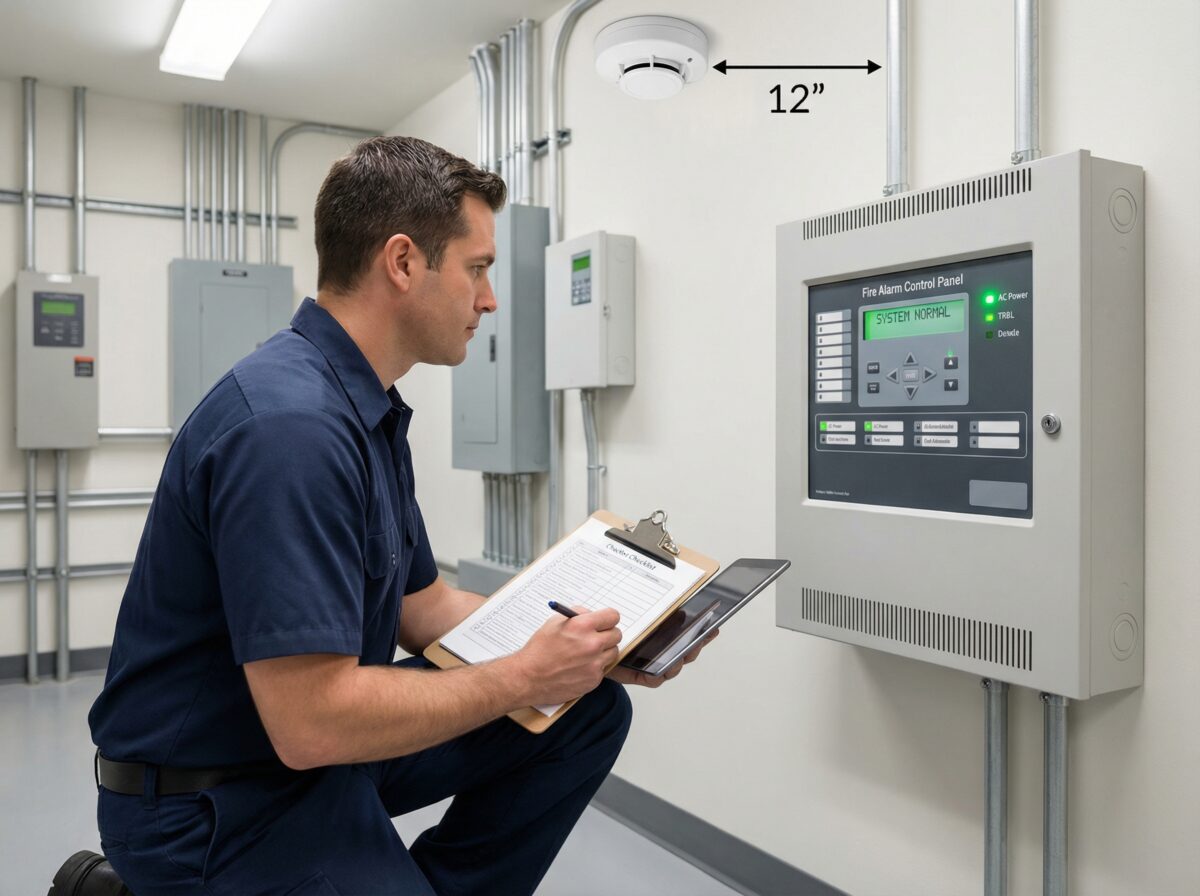
- Verify 12-inch clearance from obstructions
- Check manual pull stations for damage
- Ensure duct detectors remain accessible
Required documentation: Monthly inspection records must include date, inspector name, items checked, and any deficiencies noted.
Semi-Annual Testing
Every 6 months requires functional testing of specific components per NFPA 72 Section 14.4.3.2:
Battery Testing:
- Measure battery voltage with voltmeter
- Test under simulated alarm load
- Verify automatic switchover from AC to battery power
- Confirm batteries maintain proper charge
Notification Appliances:
- Activate all horns, strobes, and speakers
- Verify audibility throughout protected areas
- Check synchronization of visual devices
- Test speaker voice intelligibility
Testing can occur during regular maintenance visits. Results must be documented with voltage readings, sound pressure measurements, and any equipment replaced.
Annual Comprehensive Inspection
Once per year, NFPA 72 requires testing of every fire alarm system component by qualified technicians.
Smoke Detector Testing (Section 14.4.5.3):
Each smoke detector must respond to test aerosol, magnet test, or calibrated test equipment within manufacturer specifications. For addressable systems, sensitivity measurements verify detectors operate within listed sensitivity range (typically 0.5% to 4.0% obscuration per foot).
Detectors 10+ years old: NFPA 72 Section 14.4.5.3.5 requires sensitivity testing. If sensitivity drifts beyond listed range, detector must be cleaned or replaced.
Heat Detector Testing (Section 14.4.5.4):
Heat detectors tested with heat source or removed for bench testing. Fixed-temperature detectors must activate within rated temperature range ±3%. Rate-of-rise detectors verified to respond at 15°F per minute temperature increase.
Manual Pull Station Testing (Section 14.4.6.2):
Every manual fire alarm box operated at least once annually. Test verifies:
- Alarm signal transmits to control panel
- Notification appliances activate
- Signal reaches monitoring station
- Manual reset required (per device type)
Notification Appliance Testing (Section 14.4.3.2):
Sound pressure measurements taken in areas served by audible appliances. NFPA 72 requires:
- Minimum 75 dBA measured at pillow level in sleeping areas
- Minimum 15 dBA above average ambient sound in other areas
- Visual devices produce minimum 15 candela in rooms under 500 square feet
Control Panel Testing (Section 14.4.2.2):
Complete functional test including:
- Primary power removal (AC disconnect)
- Secondary power operation verification
- Alarm and trouble signal testing
- Ground fault detection testing
- System reset function verification
Documentation requirements: Annual inspection report must include device test results, sound pressure measurements, sensitivity readings, photos of deficiencies, and engineer certification of code compliance.
Special Testing Requirements
Duct Smoke Detectors (Section 14.4.5.7):
Tested annually using calibrated test instrument or smoke source introduced into duct. Must verify:
- Detector response within 60 seconds
- HVAC system shuts down as programmed
- Fire dampers close if so equipped
- Signal transmits to control panel
Air Sampling (Aspirating) Detectors (Section 14.4.5.6):
Tested annually by introducing smoke or test aerosol at farthest sampling port. Verify alarm within manufacturer-specified time and all sampling ports functional.
Emergency Voice/Alarm Communication Systems (Section 14.4.3.3):
Annual testing includes:
- Voice message clarity (intelligibility)
- All speaker zones functional
- Paging override capabilities
- Amplifier capacity adequate for system load
Documentation Standards
NFPA 72 Section 7.7 requires specific records maintained:
Required retention periods:
- Testing and inspection records: Minimum 5 years
- Service records: Until next test or inspection
- As-built drawings: Life of system
- Certificates of completion: Permanent
Record contents must include:
- Date and time of test
- Person performing test (name and affiliation)
- Equipment tested (location and device address)
- Test methods used
- Results obtained
- Deficiencies found
- Corrective actions taken
Electronic records acceptable if protected against unauthorized modification and backed up regularly.
—
Building Fire Alarm System Types and Code Implications
Different fire alarm system architectures have distinct code compliance considerations.
Conventional Fire Alarm Systems
Conventional panels group initiating devices into zones rather than identifying individual devices.
How conventional systems work:
Devices wired in parallel on zone circuits. When any device activates, panel indicates which zone but not which specific device. Typical commercial building might have:
- Zone 1: First floor east
- Zone 2: First floor west
- Zone 3: Second floor east
- Zone 4: Second floor west
Code compliance considerations:
NFPA 72 Section 23.5.3.3 requires zone identification clearly indicate approximate alarm location. Zone must not exceed 22,500 square feet and cannot cover more than one floor.
Testing implications:
During annual inspection, technician must test devices sequentially and verify correct zone activates on panel. Cannot identify individual device performance through panel—requires physical inspection and testing at device location.
Documentation challenges:
Conventional systems don’t provide device-level data. Inspection records must manually cross-reference device locations to zone numbers using as-built drawings.
Addressable Fire Alarm Systems
Addressable systems assign unique address to each device, providing device-level identification and status information.
How addressable systems work:
Devices connected via Signaling Line Circuit (SLC) using communication protocol. Each device reports:
- Individual device address (e.g., Device 142)
- Exact location (programmed description)
- Current status (normal, alarm, trouble)
- Analog values (smoke density, temperature)
- Maintenance data (contamination levels, sensitivity)
Code compliance advantages:
NFPA 72 Section 23.8.5.4 allows addressable systems to provide detailed device information. During inspections, can demonstrate:
- Exact location of every device
- Last test date for specific devices
- Historical alarm data with timestamps
- Contamination tracking for maintenance scheduling
Testing efficiency:
Walk-test mode allows technician to activate devices sequentially while panel announces each device address and automatically resets. Significantly reduces annual inspection time compared to conventional systems.
Maintenance benefits:
Addressable detectors report when contamination approaches alarm threshold (typically 70-80% of alarm point). Allows scheduled cleaning before false alarms occur or sensitivity drifts beyond code-allowed range.
Wireless Fire Alarm Systems
Wireless systems use radio frequency communication between devices and control panel, eliminating physical wiring.
NFPA 72 requirements for wireless (Section 23.16.3):
- Encrypted communication required
- Supervised transmission (devices check in regularly)
- Battery monitoring with low battery indication
- Signal interference detection
- Minimum 200-hour standby battery capacity per device
Code compliance considerations:
Wireless devices must meet same performance standards as wired devices. NFPA 72 Section 14.4.6.3 requires annual radio frequency testing verifying:
- Communication signal strength adequate
- No interference affecting transmission
- Battery voltage above minimum threshold
- Device response time within specifications
Installation requirements:
Must follow manufacturer specifications for:
- Maximum distance between devices and receivers
- Wall/ceiling materials affecting signal penetration
- Frequency coordination with other wireless systems
- Battery replacement schedules (typically 5-10 years)
Inspection focus:
Fire marshals verify wireless system maintains UL 2572 listing and all devices show adequate signal strength. Dead batteries or communication failures are common violation sources.
Voice Evacuation Systems
Voice evacuation systems use speakers to provide emergency instructions rather than simple horn tones.
NFPA 72 requirements (Chapter 24):
Voice systems must meet intelligibility standards measured by:
- Speech Transmission Index (STI) of 0.5 minimum
- Common Intelligibility Scale (CIS) score of 0.7 minimum
- Sound pressure level adequate for ambient noise conditions
Testing requirements (Section 14.4.3.3):
Annual testing includes:
- Voice message audibility in all areas
- Speaker functionality in every zone
- Emergency microphone operation
- Paging and override features
- Backup tone signal capability
Code compliance benefit:
Voice systems often exceed minimum code requirements. NFPA 72 Section 24.4.1.9 allows voice systems to provide phased evacuation instructions in high-rise buildings where simultaneous evacuation impractical.
ADA considerations:
Voice messages must coordinate with visual notification (strobes) providing equivalent alarm notification for hearing-impaired occupants per NFPA 72 Section 18.4.
—
Common Code Violations and Prevention
Understanding typical inspection failures helps avoid them.
Documentation Violations
Missing inspection records represent most common violation category.
Fire marshals require proof of:
- Monthly visual inspections (12 months minimum)
- Semi-annual battery testing results
- Annual comprehensive inspection report
- Monitoring company verification
Prevention strategy:
Maintain organized filing system with:
- Current year records immediately accessible
- Historical records (5 years minimum) in labeled storage
- Digital backup of all documentation
- Inspection checklist templates pre-printed
Create simple spreadsheet tracking:
- Last inspection date
- Next due date
- Responsible person
- Status (completed/pending)
- Document location
Set calendar reminders two weeks before inspections due ensuring adequate scheduling time with contractors.
Equipment Maintenance Violations
Dirty or damaged devices frequently cited during inspections.
Common issues:
- Smoke detectors covered with paint or dust
- Missing notification device covers
- Damaged manual pull stations
- Panel showing active trouble conditions
Prevention strategy:
Establish quarterly cleaning schedule for:
- High-contamination areas (kitchens, manufacturing): Every 3 months
- Moderate environments (offices, corridors): Every 6 months
- Low-contamination areas (storage, mechanical rooms): Annually
Use manufacturer-approved cleaning methods:
- Vacuum with soft brush attachment
- Compressed air for inaccessible areas
- Never use water or chemical cleaners
- Replace damaged devices immediately
Address trouble conditions within 48 hours of notification. Most panels have battery backup supporting 24-48 hour operation with troubles, but NFPA 72 Section 10.15.1 requires prompt repair.
Testing Deficiency Violations
Overdue testing creates automatic violations regardless of system condition.
NFPA 72 Table 14.3.1 specifies maximum intervals:
- Visual inspection: Monthly
- Notification appliances: Semi-annually
- Complete system: Annually
- Detector sensitivity: Per manufacturer (typically 10+ years)
Prevention strategy:
Schedule annual inspection 6-8 weeks before anniversary date allowing:
- Contractor scheduling flexibility
- Time to correct deficiencies found
- Buffer before compliance deadline
For monthly and semi-annual requirements, use internal staff or contract for regular maintenance visits rather than waiting for annual inspection to catch everything.
Document WHEN testing scheduled, not just when completed. Shows proactive approach rather than reactive compliance if inspection occurs before scheduled test date.
Coverage and Installation Violations
Inadequate detector coverage represents serious safety deficiency.
NFPA 72 Chapter 17 specifies spacing requirements based on:
- Ceiling height
- Ceiling shape (smooth vs. beamed)
- Air movement patterns
- Detector type (spot vs. beam)
Spot-type smoke detector spacing (Table 17.7.3.2.3.1):
| Ceiling Height | Smooth Ceiling | Solid Joist Construction |
|---|---|---|
| Up to 10 ft | 30 ft spacing | 30 ft spacing |
| 10-15 ft | 30 ft spacing | 25 ft spacing |
| 15-20 ft | 30 ft spacing | 20 ft spacing |
| 20-30 ft | 25 ft spacing | 20 ft spacing |
Heat detector spacing (Table 17.6.3.1.1):
Varies by temperature rating and response time index. Low temperature (135°F-170°F) heat detectors typical for commercial applications have 50-foot spacing on smooth ceilings.
Prevention strategy:
When building layout changes:
- Review detector coverage before renovations
- Extend fire alarm system into new areas
- Relocate devices if walls create coverage gaps
- Update as-built drawings showing modifications
Maintain 12-inch clearance from obstructions per NFPA 72 Section 17.7.3.1.4. Storage, furniture, or equipment blocking detectors creates violations.
Interface Function Violations
Building system integration failures often overlooked until inspections.
Fire alarm systems typically control:
- HVAC shutdown (prevents smoke circulation)
- Elevator recall (returns elevators to designated floor)
- Door release (unlocks exit doors)
- Magnetic door holders (releases fire doors)
NFPA 72 requirements:
Section 14.4.9 requires annual testing of all connected systems verifying proper response to alarm signals.
Common problems:
- HVAC controls disabled during maintenance, never re-enabled
- Elevator recall disconnected after service
- Door release batteries dead
- Interface wiring damaged during renovations
Prevention strategy:
Test interfaces during monthly alarm tests:
- Activate manual pull station
- Verify HVAC units shut down
- Confirm elevator recalls to proper floor
- Check exit doors unlock
- Document all interface responses
If any interface doesn’t respond, investigate immediately. Interface problems indicate wiring issues, programming errors, or disabled functions requiring contractor attention.
—
Inspection Preparation Procedures
Fire marshal inspections follow predictable patterns. Preparation reduces inspection duration and violation likelihood.
Pre-Inspection System Check
One week before scheduled inspection (or maintain continuous readiness for unannounced inspections):
Control Panel Review:
Stand in front of FACP and verify:
- AC power LED illuminated (green typically)
- No alarm indicators active (red LED)
- No trouble indicators active (yellow LED)
- No supervisory indicators active (yellow LED)
- Panel door closes and latches properly
If any indicators show abnormal status, call fire protection contractor immediately. Inspections with panel troubles active result in automatic violations.
Documentation Assembly:
Organize in order inspectors typically request:
1. Most recent annual inspection report (first document)
2. Current year monthly inspection checklists
3. Semi-annual battery testing results
4. Monitoring company certificate and signal testing verification
5. As-built drawings showing device locations
6. Original Certificate of Occupancy fire protection approval
Place documents in three-ring binder or folder clearly labeled “FIRE ALARM SYSTEM COMPLIANCE DOCUMENTATION.” Mount near fire alarm panel for immediate access.
Physical Walkthrough:
Walk building checking:
- No stored materials within 18 inches of ceiling (obstructs detectors)
- No furniture blocking manual pull stations
- Exit pathways clear (not fire alarm requirement but often checked)
- No obvious device damage visible from floor level
Take photos of any questionable situations for contractor consultation before inspection.
During Inspector Arrival
First 5 minutes set inspection tone:
When inspector arrives:
1. Greet professionally and confirm inspector credentials
2. Ask if scheduled inspection or routine compliance check
3. Offer compliance binder immediately
4. Provide building layout overview if inspector unfamiliar with property
5. Accompany inspector throughout building (don’t leave them unattended)
What inspectors look for initially:
- Professional management approach (organized, prepared)
- Clean, accessible fire alarm equipment
- Current documentation readily available
- Building staff knowledgeable about system
First impressions influence whether inspector conducts minimal sampling or comprehensive examination.
Documentation Review Phase
Inspector reviews paperwork first, typically requesting:
Annual Inspection Report:
Must include:
- Professional engineer or licensed technician certification
- Complete device testing results
- Sound pressure level measurements
- Any deficiencies noted and corrected
- Date of inspection (within 12 months)
If annual inspection overdue, inspector writes violation before testing any equipment.
Monthly Inspection Records:
Some jurisdictions require monthly visual inspections, others don’t enforce strictly. Having 12 consecutive months of documented inspections demonstrates proactive maintenance approach.
Monitoring Verification:
Inspector confirms:
- UL-listed central station monitoring active
- Account number matches building
- Recent signal testing completed (typically quarterly)
- Contact information current
Provide monitoring company certificate dated within current year.
Permits and Approvals:
Original fire alarm system installation permit and Certificate of Occupancy showing fire protection approval. For older buildings, may need to request copies from local building department if originals lost.
Physical Device Testing Phase
After documentation review, inspector samples system components.
Typical test quantities for commercial buildings:
- 2-5 smoke detectors (inspector chooses locations randomly)
- 1-2 manual pull stations
- 2-4 notification devices with decibel meter measurements
- 1 elevator recall function (if applicable)
- 1-2 building interface tests (HVAC shutdown, door release)
Inspector uses:
- Magnehelic testing equipment (creates suction activating smoke detectors)
- Heat gun or magnet (for heat detector testing)
- Decibel meter (measuring sound pressure levels)
- Visual observation (for strobe and interface functions)
What inspectors verify:
- Devices respond within manufacturer specifications (typically 3-10 seconds)
- Notification appliances audible throughout building
- Panel correctly identifies device location
- System resets properly after testing
- No secondary troubles appear during testing
If any sampled device fails, inspector may expand testing to additional devices verifying problem isn’t widespread.
Building Coverage Walkthrough
Inspector walks portions of building checking:
Detector coverage:
- All areas have detection per NFPA 72 spacing requirements
- No obvious gaps in coverage
- Devices properly spaced for ceiling height
- Appropriate detector types for environments
Physical accessibility:
- Devices not obstructed by storage or equipment
- Manual pull stations clearly visible and accessible
- Notification devices not covered or blocked
- Fire alarm panel clearances adequate (3 feet minimum)
Installation quality:
- Devices properly mounted (not hanging loose)
- Visible wiring neat and professional
- Devices at appropriate heights
- No obvious damage or tampering
Inspector typically walks:
- Main building corridors
- High-occupancy areas (offices, assembly spaces)
- Specialty areas (kitchens, mechanical rooms, storage)
- Stairwells and exit paths
Post-Inspection Report
If no violations found, inspector completes compliance form and may issue certificate (varies by jurisdiction).
If violations identified:
Notice of Violation includes:
- Specific code sections violated
- Description of each deficiency
- Correction deadline (typically 30-90 days depending on severity)
- Re-inspection requirements
- Potential fines if not corrected
Respond immediately:
- Contact fire protection contractor same day
- Schedule repairs within one week
- Document all corrections with photos
- Request re-inspection when complete
- Provide inspector with correction documentation
Quick response demonstrates good faith compliance effort. Most jurisdictions reduce or waive fines when violations corrected promptly.
—
Building Management System Integration
Modern fire alarm systems interface with other building systems per NFPA 72 Chapter 21.
HVAC System Integration
Fire alarms control HVAC equipment preventing smoke circulation during fires.
NFPA 72 Section 21.6 requirements:
Smoke detectors installed in:
- Supply air systems over 2,000 cfm
- Return air systems over 15,000 cfm
- Before fire/smoke dampers in ducts
Control sequences:
When duct detector activates:
1. Air handling unit shuts down immediately
2. Fire/smoke dampers close (if present)
3. Fire alarm panel indicates supervisory condition
4. Signal may transmit to monitoring station (jurisdiction dependent)
Exception: NFPA 72 Section 21.6.2 allows HVAC smoke control mode where systems strategically operate managing smoke movement during fires. Requires engineered smoke control system design.
Code compliance testing:
Annual inspection must verify:
- Duct detector activation causes proper HVAC response
- System doesn’t automatically restart
- Manual reset required at HVAC controls
- Smoke control sequences operate as designed
Elevator Recall Integration
Fire alarm systems automatically recall elevators during alarms per ASME A17.1 Safety Code for Elevators.
How elevator recall works:
Phase I Emergency Recall:
1. Fire alarm activates
2. Signal sent to elevator controller
3. All elevators return to designated recall floor (typically ground level)
4. Doors open, elevators park
5. Car lights remain on, fans operate
6. Normal call buttons disabled
Alternate recall floor:
If fire alarm originates on designated recall floor, elevators recall to alternate floor (typically second floor or other pre-programmed location).
Phase II Firefighter Service:
After recall complete, fire department uses key switch in elevator car enabling manual control for firefighting operations.
Testing requirements:
NFPA 72 Section 21.4 requires annual testing verifying:
- Alarm signal properly transmitted to elevator controller
- All elevators recall to correct floor
- Alternate recall functions if designated floor alarm
- Elevator indicators show Phase I operation
Common problems:
- Interface wiring disconnected during elevator maintenance
- Controller programming lost after power outages
- Fire alarm system doesn’t output correct signal type
- Elevators recall but don’t park properly
Door Release Integration
Fire alarms release electromagnetic locks and hold-open devices during evacuations.
NFPA 72 Section 21.9 requirements:
Doors required for egress must unlock when:
- Fire alarm system activates
- Power fails
- Manual release button pressed
Door types affected:
Electromagnetic locks: Used on perimeter doors for security. Fire alarm activation removes power, releasing lock mechanism and allowing free egress.
Magnetic door holders: Hold fire doors open during normal operations. Fire alarm releases holders allowing spring-loaded doors to close, preventing smoke spread.
Testing procedure:
Monthly alarm testing should verify:
- All electromagnetic locks release when alarm activates
- Doors push open freely during alarm condition
- Magnetic door holders release allowing doors to close
- System resets properly restoring normal lock operation
Documentation:
Record during monthly tests:
- Which doors tested
- All operated correctly (yes/no)
- Any doors failing to release
- Corrective actions taken
Door release failures create life safety hazards. Repair immediately—don’t wait for scheduled maintenance.
Building Automation System Integration
Some buildings integrate fire alarms with Building Management Systems (BMS) providing centralized monitoring.
NFPA 72 Section 23.8.6.2 requirements:
Fire alarm system remains primary device with direct control over life safety functions. BMS can receive status information but cannot override fire alarm decisions.
Typical BMS interfaces:
Read-only monitoring:
- Fire alarm status (normal/alarm/trouble)
- Device-specific information from addressable panels
- Maintenance alerts and contamination warnings
- Historical data logging
Control outputs:
- HVAC system coordination (beyond basic shutdown)
- Lighting control (illuminate exit paths)
- Access control coordination (lock/unlock specific doors)
- Mass notification systems (digital signage, email alerts)
Code compliance considerations:
Fire alarm system must operate independently if BMS connection fails. Annual testing verifies fire alarm performs all required functions with BMS connection disconnected.
Documentation requirements:
As-built drawings must show:
- Fire alarm to BMS interface points
- Communication method (hardwired relays, network protocol)
- Functions controlled through interface
- Supervision method ensuring communication integrity
Need expert guidance on fire code compliance for your building’s fire alarm system? [Talk to an expert](/contact-us) at 48fire who can review your documentation, assess testing schedules, and ensure your system meets all NFPA 72 requirements before your next inspection.
—
Conclusion
Fire code compliance follows structured requirements established in NFPA 72. Success requires understanding testing schedules, maintaining organized documentation, and implementing consistent procedures.
Core compliance elements:
Testing schedules: Monthly visual inspections, semi-annual functional tests, annual comprehensive inspections by qualified technicians. Each testing level has specific requirements and documentation standards.
Documentation systems: Maintain minimum 5 years of inspection records, current as-built drawings, monitoring certificates, and service histories. Organized filing systems reduce inspection time and demonstrate professional management.
Equipment maintenance: Regular cleaning prevents contamination-related sensitivity drift. Prompt repair of trouble conditions avoids violations. Quarterly preventive maintenance catches problems before annual inspections.
System understanding: Know whether building has conventional, addressable, or wireless system. Different architectures have distinct testing procedures and documentation requirements.
Common violations: Missing documentation, overdue testing, equipment maintenance deficiencies, and coverage gaps account for majority of inspection failures. All preventable through systematic approach.
Building integrations: Fire alarms control HVAC, elevators, doors, and other building systems. Annual testing must verify all interfaces function properly.
The practical reality:
NFPA 72 requirements are specific and measurable. Compliance isn’t subjective—either testing completed within required timeframes and documented properly, or violations exist.
Buildings maintaining zero-violation status share common practices: organized documentation, scheduled contractor maintenance, monthly internal checks, and prompt trouble resolution.
Investment perspective:
Proactive compliance costs $0.08-0.15 per square foot annually through scheduled maintenance and testing. Reactive compliance—fixing violations after inspections—costs more through fines, emergency repairs, and re-inspection fees.
Starting point:
Begin with current documentation status. Organize existing records, identify gaps, and establish monthly inspection routine. Schedule annual comprehensive inspection 6-8 weeks before anniversary date. Address all trouble conditions within 48 hours of discovery.
Fire code compliance protects building occupants through reliable fire detection and notification. Inspections verify systems work as designed. Maintaining compliant status demonstrates commitment to life safety—not just regulatory requirement fulfillment.