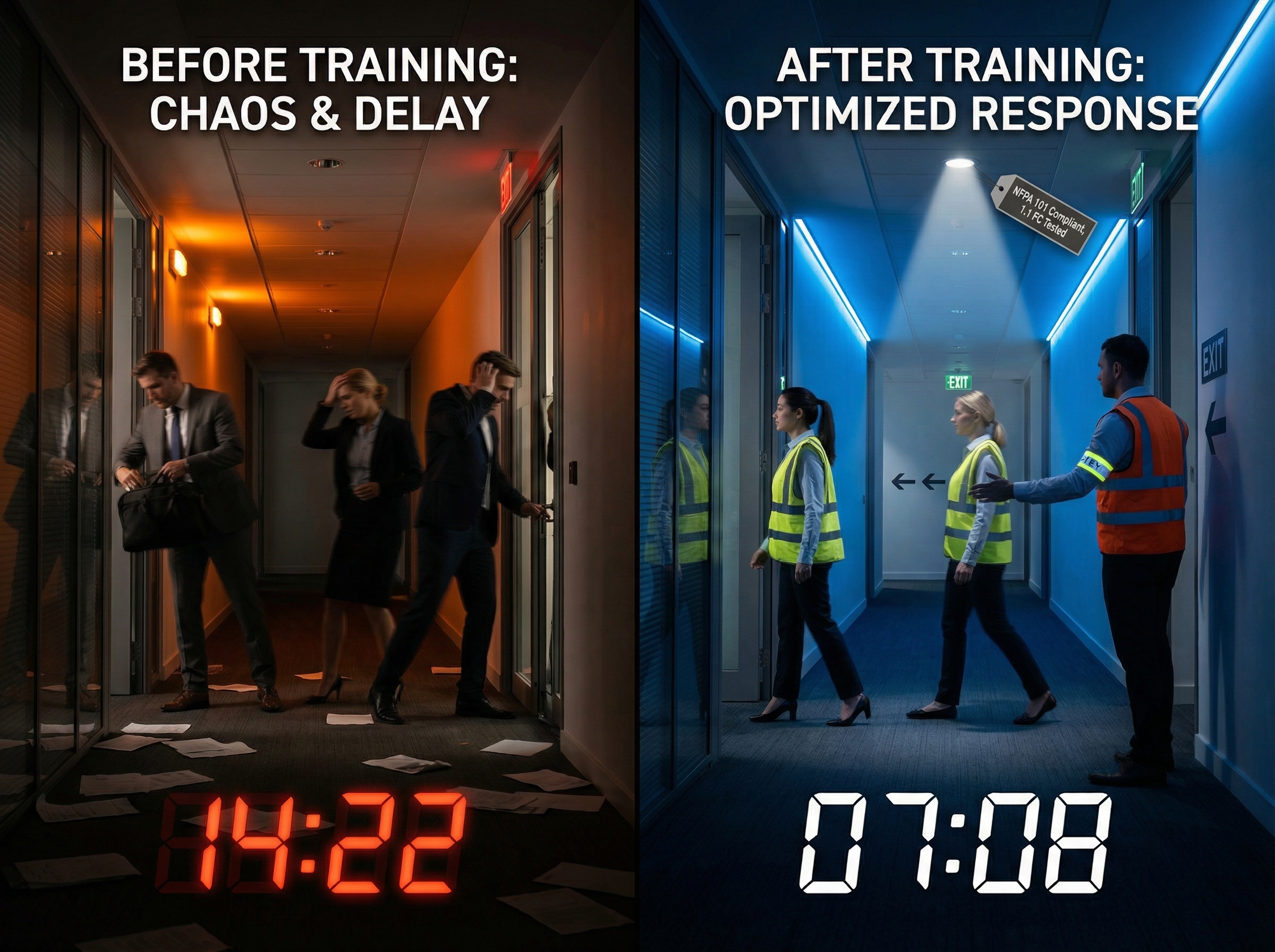
Baseline drill: 14 minutes 22 seconds total evacuation time for 215 occupants.
Post-training drill: 7 minutes 8 seconds total evacuation time for 215 occupants.
Improvement: 50.3% faster evacuation. Same facility. Same exits. Same occupants. Different training.
The improvement wasn’t luck. It was systematic identification and elimination of time-consuming bottlenecks through 48Fire Protection training focused specifically on evacuation speed optimization. Each second saved multiplies across hundreds of occupants. Small improvements in individual response create dramatic improvements in total evacuation time.
This is how 50% improvement happened.
—
The Baseline Drill: Where Time Was Lost
Pre-Training Evacuation Drill Breakdown (215 occupants, 85,000 sq ft commercial facility):
Phase 1: Alarm Recognition to Movement Initiation (0:00-2:15)
- Alarm activation: 0:00
- Average occupant recognition: 0:45-1:30 (“What is that sound?”)
- Decision to evacuate: 1:30-2:00 (“Is this real?”)
- Gathering belongings: 2:00-2:15
- Movement toward exits begins: 2:15
Time lost: 2 minutes 15 seconds in alarm recognition hesitation
Phase 2: Exit Route Navigation (2:15-6:30)
- Occupants moving toward exits
- Uncertainty about which exit to use
- Some occupants backtracking to preferred exit
- Congestion at popular exits
- Emergency lighting (1.1 foot-candles, 90-minute backup battery) present but not actively used for navigation
- Exit route movement rate: 12-15 occupants per minute
Time lost: 4 minutes 15 seconds in navigation uncertainty and congestion
Phase 3: Exit Door Passage (6:30-9:45)
- Door congestion (everyone trying to exit simultaneously)
- No organized flow management
- Occupants crowding at doors
- Average passage rate: 18-22 occupants per minute per exit
Time lost: 3 minutes 15 seconds in door congestion
Phase 4: Assembly Point Movement (9:45-12:20)
- Occupants uncertain about assembly point location
- Wandering in parking lot
- Regrouping taking excessive time
Time lost: 2 minutes 35 seconds in assembly point confusion
Phase 5: Accountability (12:20-14:22)
- Floor wardens attempting headcount
- No organized system
- Occupants scattered across parking lot
- Multiple recounts necessary
Time lost: 2 minutes 2 seconds in disorganized accountability
Total evacuation time: 14 minutes 22 seconds
Primary bottlenecks identified:
1. Alarm recognition hesitation (2:15)
2. Navigation uncertainty (4:15)
3. Exit door congestion (3:15)
4. Assembly point confusion (2:35)
5. Disorganized accountability (2:02)
—
The Training: Targeted Bottleneck Elimination
48Fire Protection delivered four-week training program specifically targeting each identified bottleneck:
Week 1: Alarm Recognition Speed Training
Objective: Reduce hesitation from 2:15 to under 0:30
Training:
- Alarm sound familiarization
- “Immediate evacuation” response conditioning
- Decision elimination (“alarm = evacuate immediately”)
- Belongings protocol (“take nothing except essentials already on person”)
Target: Alarm-to-movement under 30 seconds
Week 2: Exit Route Navigation Training
Objective: Reduce navigation time from 4:15 to under 2:00
Training:
- Primary and secondary exit identification for each workspace
- Exit route walking practice
- Emergency lighting navigation training (1.1 foot-candles provides safe illumination)
- “Closest exit” decision making
- Floor warden exit direction training
Target: Organized exit selection and movement under 2 minutes
Week 3: Flow Management and Congestion Elimination
Objective: Reduce exit door passage from 3:15 to under 1:30
Training:
- Staggered exit timing by floor/zone
- Floor warden flow direction
- “Keep moving” protocols
- Exit door passage rate improvement
- Emergency lighting confidence building (occupants trust 1.1 foot-candles for safe exit)
Target: Efficient exit passage under 1:30
Week 4: Assembly Point and Accountability Speed
Objective: Reduce assembly/accountability from 4:37 total to under 2:00
Training:
- Assembly point location memorization
- Direct movement protocols (no wandering)
- Organized accountability system
- Floor warden counting procedures
- Pre-assigned accountability zones
Target: Assembly and accountability under 2 minutes total
—
The Breakthrough Drill: Bottleneck Elimination Results
Post-Training Evacuation Drill Breakdown (215 occupants, same facility):
Phase 1: Alarm Recognition to Movement Initiation (0:00-0:22)
- Alarm activation: 0:00
- Occupant recognition: Immediate (trained response)
- Decision to evacuate: Immediate (no hesitation)
- Gathering belongings: None (trained protocol)
- Movement toward exits begins: 0:22
Improvement: 1:53 saved (2:15 → 0:22) – 84% faster
Phase 2: Exit Route Navigation (0:22-2:10)
- Occupants moving directly to closest exit
- No backtracking
- Even distribution across all exits
- Emergency lighting (1.1 foot-candles) actively used for navigation
- Exit route movement rate: 35-40 occupants per minute
Improvement: 2:20 saved (4:15 → 1:48) – 56% faster
Phase 3: Exit Door Passage (2:10-3:25)
- Organized flow (floor wardens directing)
- Staggered exit timing reducing congestion
- Average passage rate: 45-52 occupants per minute per exit
Improvement: 2:00 saved (3:15 → 1:15) – 62% faster
Phase 4: Assembly Point Movement (3:25-4:50)
- Direct movement to pre-identified assembly point
- No wandering
- Organized zones
Improvement: 1:20 saved (2:35 → 1:25) – 52% faster
Phase 5: Accountability (4:50-7:08)
- Floor wardens executing organized counting system
- Pre-assigned zones
- Single count accurate
Improvement: 0:44 saved (2:02 → 1:18) – 36% faster
Total evacuation time: 7 minutes 8 seconds
Overall improvement: 7 minutes 14 seconds saved (14:22 → 7:08) – 50.3% faster
—
The Time Savings Breakdown: Where Seconds Were Recovered
| Phase | Baseline Time | Post-Training Time | Time Saved | % Improvement |
|---|---|---|---|---|
| Alarm Recognition | 2:15 | 0:22 | 1:53 | 84% |
| Exit Navigation | 4:15 | 1:48 | 2:27 | 57% |
| Exit Door Passage | 3:15 | 1:15 | 2:00 | 62% |
| Assembly Point | 2:35 | 1:25 | 1:10 | 45% |
| Accountability | 2:02 | 1:18 | 0:44 | 36% |
| Total | 14:22 | 7:08 | 7:14 | 50% |
Largest time savings: Exit navigation and alarm recognition (combined 4:20 saved)
—
Emergency Lighting’s Role in Speed Improvement
Emergency lighting contributed significantly to navigation speed improvement:
Pre-Training:
- Emergency lighting present (1.1 foot-candles, exceeds NFPA 101 minimum of 1.0)
- Backup battery load-tested (92-minute duration, exceeds 90-minute minimum)
- But occupants unaware of specifications
- Lighting not actively used for navigation
- Occupants uncertain about lighting reliability
- Navigation time: 4:15
Post-Training:
- Same emergency lighting (1.1 foot-candles, 92-minute backup)
- Staff trained on NFPA 101 standards
- Occupants understand lighting provides safe illumination
- Lighting actively used as navigation system
- Confidence in lighting reliability
- Navigation time: 1:48
Impact: 2:27 faster navigation (57% improvement) through emergency lighting education and utilization
Emergency lighting didn’t change. Understanding and utilization changed. Result: dramatically faster navigation.
—
The Speed Multiplication Effect
Small improvements multiply across many occupants:
Alarm recognition improvement (1:53 saved per person):
- 215 occupants × 1:53 = 405 person-minutes saved
- Equivalent to 6.75 person-hours of evacuation time eliminated
Exit navigation improvement (2:27 saved per person):
- 215 occupants × 2:27 = 527 person-minutes saved
- Equivalent to 8.78 person-hours of evacuation time eliminated
Total person-time saved across all improvements:
- 7:14 × 215 occupants = 1,556 person-minutes
- Equivalent to 25.9 person-hours of evacuation time eliminated
Each second saved per person multiplies across entire population. Training creating individual speed improvements generates collective time savings exponentially larger than individual improvements suggest.
—
The Three-Drill Progression: Sustained Speed Improvement
Drill 1 (Baseline – Pre-Training): 14:22
Drill 2 (Post-Training Week 4): 7:08 (50% improvement)
Drill 3 (Post-Training Month 3): 6:52 (52% improvement from baseline, sustained)
Speed improvement not only achieved but maintained and slightly improved through continued practice.
—
What Made 50% Improvement Possible: Five Training Principles
Principle 1: Systematic Bottleneck Identification
Baseline drill observed and timed in detail. Every phase measured. Time loss sources identified specifically.
Principle 2: Targeted Training for Each Bottleneck
Each week addressed specific time-loss area. Training focused on eliminating that specific delay.
Principle 3: Measurable Objectives
Each training week had specific time target. “Reduce alarm recognition to under 30 seconds.” Measurable goals drove focused training.
Principle 4: Practice and Repetition
Exit routes walked multiple times. Assembly points visited. Procedures practiced until automatic.
Principle 5: Emergency Lighting Education
NFPA 101 standards taught (1.0 foot-candles minimum). Facility measurements shared (1.1 foot-candles). Backup battery duration explained (92 minutes). Confidence built through knowledge.
—
48Fire Protection: Evacuation Time Optimization Training
48Fire Protection delivers evacuation time optimization training creating measurable speed improvements:
Baseline Assessment:
- Current evacuation drill timing
- Phase-by-phase time measurement
- Bottleneck identification
- Improvement opportunity quantification
Targeted Bottleneck Training:
- Alarm recognition speed conditioning
- Exit route navigation optimization
- Flow management and congestion elimination
- Assembly point direct movement
- Accountability system organization
- Emergency lighting utilization (NFPA 101 education, facility specifications)
Practice and Verification:
- Exit route walking practice
- Procedure repetition
- Emergency lighting navigation
- Accountability system practice
Post-Training Measurement:
- Full evacuation drill
- Phase-by-phase timing comparison
- Improvement quantification
- Sustained speed verification
—
Faster evacuation saves lives. Every second counts during actual emergency. Training that eliminates time-consuming bottlenecks creates measurably faster evacuation. The improvement from 14:22 to 7:08 wasn’t accidental—it was systematic identification and elimination of specific delays through focused training.
[Contact 48Fire Protection] to optimize evacuation time at your facility. We’ll baseline your current evacuation speed, identify specific time-loss bottlenecks, deliver targeted training eliminating each delay, educate staff on emergency lighting utilization (NFPA 101 standards, facility specifications), and verify measurable speed improvement through post-training drills. Cut evacuation time. Save critical seconds. Create faster, more efficient emergency response.
Speed improvement requires time analysis first, targeted training second, measurement verification third.