Supervisors occupy unique position during fire emergencies. Not frontline responders like firefighters. Not general occupants evacuating. Somewhere between—responsible for others’ safety while managing emergency response. This position requires specific knowledge general occupant training doesn’t cover.
48Fire Protection identified 12 essential supervisor fire safety knowledge areas. These aren’t optional nice-to-know information. These are critical must-know items determining whether supervisors effectively protect teams during fire emergencies or inadvertently create additional risk through knowledge gaps.
Every supervisor needs these 12 pieces of knowledge before fire alarm sounds.
—
ESSENTIAL KNOWLEDGE #1: Your Authority and Limitations During Fire Emergency
What Supervisors Must Know:
You have authority to:
- Direct your team to evacuate immediately
- Identify and communicate evacuation routes
- Ensure your team reaches assembly point
- Verify team accountability
- Communicate with building management/emergency services
You do NOT have authority to:
- Delay evacuation to complete work tasks
- Re-enter building for equipment, files, or materials
- Investigate alarm cause before evacuating
- Declare “false alarm” and cancel evacuation
- Override building management emergency decisions
Critical Distinction:
Supervisors direct evacuation of their teams. Building managers coordinate overall facility response. Fire department manages fire suppression. Each has distinct role. Supervisors who overstep authority (attempting facility-wide coordination) or understep responsibility (failing to direct team evacuation) create confusion endangering occupants.
48Fire Protection Training Component:
Authority clarity—what supervisors must do, what they cannot do, where supervisor authority ends and building management authority begins.
—
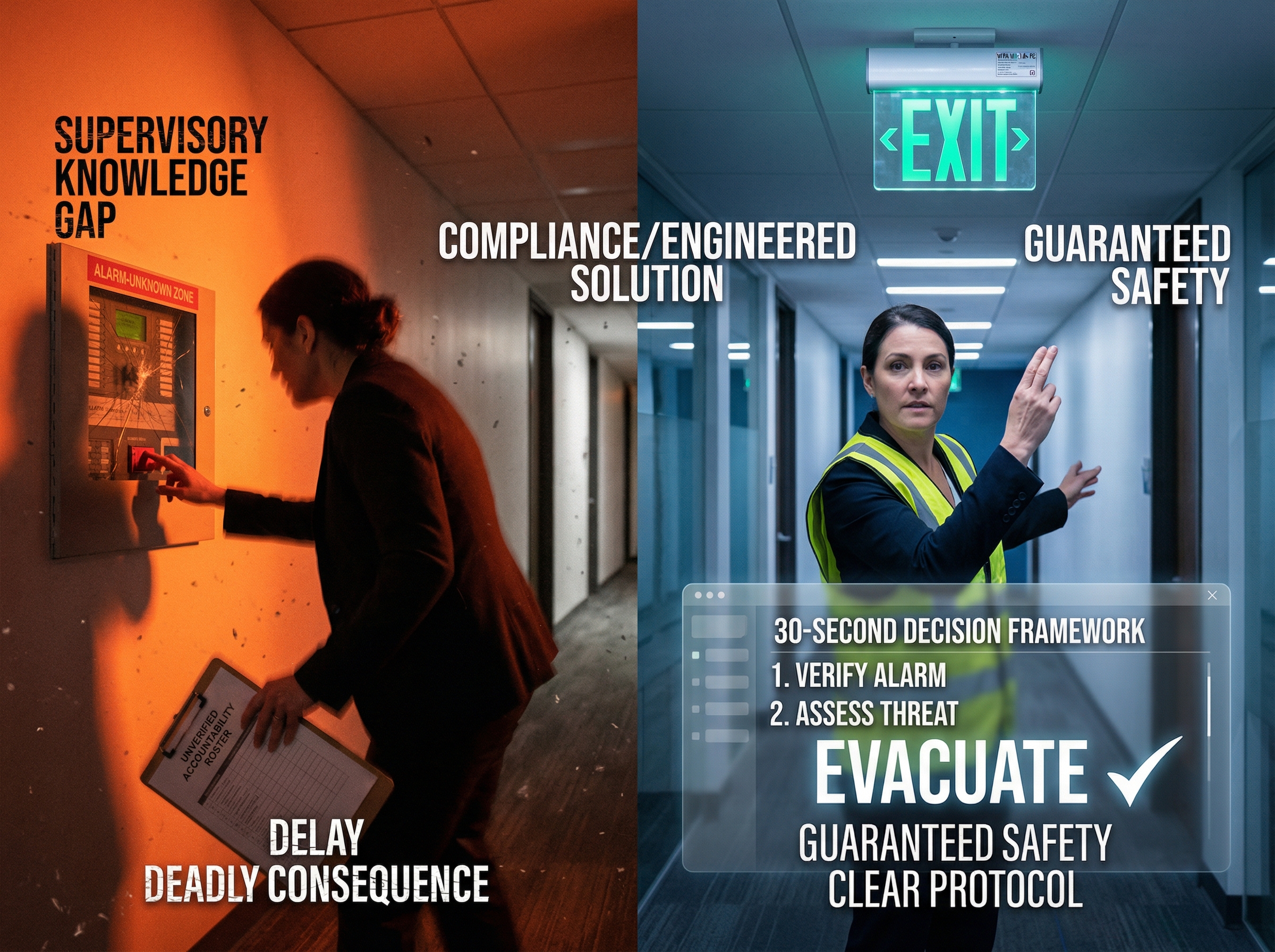
ESSENTIAL KNOWLEDGE #2: The 30-Second Decision Framework
What Supervisors Must Know:
Fire alarm sounds. Supervisor has approximately 30 seconds to make critical decisions affecting team safety:
Decision 1: Evacuation Route (10 seconds)
- Primary exit available and safe? → Direct team to primary exit
- Primary exit blocked/unsafe? → Direct team to secondary exit
- Both exits compromised? → Shelter in place, call 911, communicate with building management
Decision 2: Team Communication (10 seconds)
- All team members present and aware? → Proceed with evacuation
- Team members in different locations? → Designate person to notify each location
- Team members with mobility challenges? → Assign assistance
Decision 3: Critical Items (10 seconds)
- Take nothing except: phones (for 911 if needed), essential medications on person
- Leave everything else: laptops, files, equipment, personal belongings
- Close doors behind team (but do not lock)
Framework Application:
30 seconds. Three decisions. Lives depend on supervisor making correct decisions quickly. Training creates automatic decision-making replacing hesitation.
48Fire Protection Training Component:
30-second decision framework practice—supervisors execute framework repeatedly until decisions become automatic.
—
ESSENTIAL KNOWLEDGE #3: Emergency Lighting Specifications and What They Mean for Team Navigation
What Supervisors Must Know:
Emergency lighting isn’t decorative or backup convenience. It’s life safety system with specific requirements:
NFPA 101 Standard:
- Minimum 1.0 foot-candles illumination in exit routes
- 90-minute minimum backup battery duration
- Automatic activation when primary power fails
Facility Compliance (Typical):
- Facility measurements: 1.1-1.4 foot-candles (exceeds minimum)
- Backup battery duration: 90-92 minutes (meets/exceeds requirement)
- Annual load testing verifies 90-minute capability
Supervisor Responsibility:
- Trust emergency lighting will illuminate exit routes
- Direct team to follow illuminated paths
- Communicate to team: “Emergency lighting is functioning, follow illuminated routes to exits”
- Report non-functioning emergency lights immediately (before emergency, not during)
Common Supervisor Mistake:
Assuming emergency lighting might fail, directing team to “find alternative routes” or “look for other lighting.” Emergency lighting systems are required, tested, and reliable. Supervisor hesitation about lighting reliability creates team uncertainty. Supervisor confidence in lighting creates team confidence.
48Fire Protection Training Component:
Emergency lighting education—NFPA 101 requirements, facility specifications, backup battery systems, reliability verification, confidence building through knowledge.
—
ESSENTIAL KNOWLEDGE #4: When to Call 911 (And When Not To)
What Supervisors Must Know:
Automatic 911 Call Required:
- Fire observed (smoke, flames)
- Sprinkler activation
- Alarm sounding and exits blocked/inaccessible
- Medical emergency during evacuation
- Any life-threatening situation
911 Call NOT Needed (Building Management Handles):
- Standard fire alarm (monitoring company automatically notified)
- Routine evacuation drill
- Alarm sounding, evacuation proceeding normally
What to Tell 911:
- Location (building address, specific area if known)
- Situation (“Fire alarm sounding, smoke observed on third floor”)
- Evacuation status (“Occupants evacuating”)
- Injuries or trapped occupants (if any)
- Your callback number
What NOT to Tell 911:
- Speculation about alarm cause
- Unverified information
- “I think it’s probably false alarm” (let fire department determine)
48Fire Protection Training Component:
911 communication training—when to call, what information to provide, how to communicate clearly under stress.
—
ESSENTIAL KNOWLEDGE #5: Team Accountability Is Non-Negotiable
What Supervisors Must Know:
Supervisor’s primary post-evacuation responsibility: account for every team member.
Accountability Process:
- Reach assembly point with team
- Conduct headcount immediately
- Compare headcount to expected number (shift roster, daily attendance)
- Report status to building manager/floor warden: “Team of 12, all 12 accounted” OR “Team of 12, 11 accounted, 1 unaccounted (name)”
- DO NOT re-enter building to search for unaccounted team members (fire department responsibility)
Accountability Challenges:
- Team members at offsite meetings/appointments
- Team members on vacation/sick leave
- Team members in restroom/different floor during alarm
- New team members supervisor doesn’t recognize
Accountability Solutions:
- Maintain current team roster (updated for absences)
- Know team member locations during day
- Designate alternate person who can identify all team members
- Establish “all present” confirmation from senior team member if supervisor absent
Critical Fact:
Fire departments will not enter “all clear” until all occupants accounted. One unaccounted person delays entire building clearance, potentially endangering firefighters searching unnecessarily. Accurate accountability is life-safety requirement.
48Fire Protection Training Component:
Accountability procedure training—headcount methods, reporting protocols, handling discrepancies, documentation.
—
ESSENTIAL KNOWLEDGE #6: The Three Things You Must Tell Your Team Immediately When Alarm Sounds
What Supervisors Must Know:
Alarm activates. Team looks to supervisor. Three things supervisor must communicate immediately (10-15 seconds):
Statement 1: “Evacuate now. Leave everything.”
- Clear evacuation directive
- No ambiguity, no questions
Statement 2: “Follow me to [primary exit]. Use emergency lighting.”
- Specific exit identification
- Lighting trust building
- Leadership demonstration (supervisor leads evacuation)
Statement 3: “Assembly point is [location]. Stay together.”
- Clear destination
- Team cohesion maintained
What NOT to Say:
- “Probably just a drill” (creates complacency, delays evacuation)
- “Let me check what’s happening first” (delays evacuation, puts supervisor at risk)
- “Finish what you’re doing quickly” (unacceptable delay)
- “Maybe we should wait” (dangerous hesitation)
Communication Impact:
Supervisor confidence and clarity creates team confidence and compliance. Supervisor uncertainty or hesitation creates team confusion and delay.
48Fire Protection Training Component:
Emergency communication training—what to say, how to say it, tone and clarity practice, avoiding dangerous phrases.
—
ESSENTIAL KNOWLEDGE #7: Remote/Hybrid Team Members Need Evacuation Instructions Too
What Supervisors Must Know:
Modern workplace includes team members working remotely or hybrid. Fire emergency might occur when remote workers are in building for meetings, collaboration, or occasional on-site work.
Supervisor Responsibility:
- Ensure all team members (including remote/hybrid) receive fire safety training before first on-site day
- Communicate exit routes and assembly point to remote workers before building visits
- Include remote workers in evacuation drills when on-site
- Know which team members are in building on any given day
Remote Worker Knowledge Requirements:
- Exit routes from areas they typically work
- Assembly point location
- Emergency lighting guidance (1.0+ foot-candles, 90-minute backup)
- Accountability procedures
- Who to report to at assembly point
Common Gap:
Organizations train full-time on-site employees comprehensively but assume remote workers “won’t need it” because they’re rarely in building. When remote worker is in building during emergency, they lack knowledge, creating accountability gap and safety risk.
48Fire Protection Training Component:
Remote/hybrid worker integration—ensuring all team members receive training regardless of work location, tracking on-site presence.
—
ESSENTIAL KNOWLEDGE #8: What Fire Alarm Zones Mean (And Why Supervisors Need to Understand Them)
What Supervisors Must Know:
Fire alarm systems divide buildings into zones. When alarm activates, fire panel displays zone where alarm triggered.
Why This Matters to Supervisors:
Building manager checks fire panel: “Alarm in Zone 3B—northeast second floor.”
Supervisor needs to understand: “Zone 3B is where my team works. Evacuate immediately away from that area. Use west or south exits, not northeast stairwell.”
Zone Knowledge Requirements:
- Which zone(s) contain your work areas
- Which zones contain common areas your team uses (break rooms, conference rooms, restrooms)
- Which exits are closest to each zone
- Which exits to AVOID if alarm is in specific zones
Practical Application:
Alarm sounds. Building manager announces “Zone 2A activation.” Supervisor knows Zone 2A is south wing first floor—far from team location (north wing third floor). Supervisor directs team: “Alarm is south wing first floor. We’re evacuating from north wing third floor. Use north exit as usual.”
Contrast: Alarm sounds. Supervisor doesn’t understand zones. Supervisor cannot provide team with any situational awareness. Team evacuates with uncertainty about where fire is, increasing anxiety.
48Fire Protection Training Component:
Zone system education—facility zone map, zone identification, evacuation routing based on alarm zones.
—
ESSENTIAL KNOWLEDGE #9: Your Role Is Evacuation Leader, Not Fire Investigator
What Supervisors Must Know:
Supervisors sometimes feel responsibility to investigate alarm cause before evacuating team. This is dangerous misconception.
Supervisor Role: Evacuation Leader
- Direct team to evacuate
- Lead team to assembly point
- Verify team accountability
- Communicate with building management
Supervisor Role Is NOT: Fire Investigator
- Checking area for smoke/fire before evacuation
- Attempting to determine if alarm is “real” or “false”
- Investigating what triggered alarm
- Deciding whether evacuation is “necessary”
Why Distinction Matters:
- Alarm systems designed to detect fire before humans can
- Smoke/fire can spread rapidly (seconds to minutes)
- Supervisor investigation delays team evacuation
- Supervisor exposed to fire risk unnecessarily
- Building manager and fire department handle investigation
Correct Response:
Alarm sounds → Immediate evacuation directive → Lead team to exits → Reach assembly point → Account for team → Wait for building manager “all clear”
Incorrect Response:
Alarm sounds → “Let me check if this is real” → Supervisor investigates while team waits → Delayed evacuation → Risk increased
48Fire Protection Training Component:
Role clarity training—supervisor as evacuation leader, not investigator, immediate action protocols, avoiding dangerous investigation temptation.
—
ESSENTIAL KNOWLEDGE #10: Post-Evacuation: When Team Can Return (And Who Decides)
What Supervisors Must Know:
Team evacuated. Assembly point reached. Accountability complete. Team asks: “When can we go back inside?”
Supervisor Answer: “When building management gives ‘all clear.'”
Who Decides Return Authorization:
- Fire department inspects building
- Fire department communicates “all clear” to building management
- Building management communicates “all clear” to occupants
- Supervisors communicate building management “all clear” to teams
Supervisors Do NOT Decide:
- Whether building is safe to re-enter
- Whether alarm was “false” (even if fire department determines no fire)
- Whether team can return before official “all clear”
- Which areas are safe vs. unsafe
Why This Matters:
Supervisor allowing team to re-enter before “all clear” creates liability exposure and safety risk. Fire department may still be investigating. Systems may be offline. Hazards may exist that aren’t immediately visible.
Correct Post-Evacuation Management:
- Keep team together at assembly point
- Communicate: “We’ll return when building management gives ‘all clear'”
- Provide updates as received from building management
- DO NOT allow team members to “just grab something quickly” before “all clear”
48Fire Protection Training Component:
Post-evacuation procedures—waiting for “all clear,” managing team during extended evacuations, preventing premature return.
—
ESSENTIAL KNOWLEDGE #11: Supervisors Are Visible Leadership During Emergencies
What Supervisors Must Know:
Team performance during emergencies reflects supervisor behavior. Calm supervisor creates calm team. Panicked supervisor creates panicked team.
Supervisor Behavior Impact:
Calm, Confident Supervisor:
- Clear directions
- Steady voice
- Leading evacuation (not following)
- Visible at front of team
- Team response: Organized, efficient evacuation
Uncertain, Hesitant Supervisor:
- Unclear directions
- Questioning voice (“I think we should evacuate?”)
- Following team rather than leading
- Not visible
- Team response: Confusion, hesitation, delayed evacuation
Behavior Supervisors Should Model:
- Immediate response (no hesitation)
- Clear communication
- Confident movement
- Emergency lighting trust (“Follow the emergency lighting—it provides safe illumination”)
- Assembly point leadership (arriving with team, conducting accountability)
Behavior Supervisors Should Avoid:
- Visible panic or fear
- Asking team “What should we do?”
- Expressing doubt about procedures
- Complaining about evacuation inconvenience
- Discussing alarm as “probably false” or “waste of time”
Reality:
Supervisors may feel uncertain, stressed, or anxious during emergencies. Professional responsibility requires projecting calm confidence regardless of internal state. Training creates competence supporting genuine confidence.
48Fire Protection Training Component:
Leadership behavior training—modeling calm response, communication under stress, confidence projection, professional composure.
—
ESSENTIAL KNOWLEDGE #12: Annual Refresher Is Not Optional
What Supervisors Must Know:
Supervisor fire safety knowledge degrades without reinforcement. Annual refresher training is requirement, not suggestion.
Knowledge Retention Without Refresher:
- Month 6: 70-75% retention
- Month 12: 55-65% retention
- Month 24: 40-50% retention
Knowledge Retention With Annual Refresher:
- Month 6: 85-90% retention
- Month 12: 90-95% retention (refresher reinforces)
- Month 24: 88-93% retention (second refresher reinforces)
Supervisor Refresher Should Include:
- Emergency procedures review
- Zone system updates (if building changed)
- Emergency lighting system verification (annual load testing results shared)
- New team member accountability integration
- Procedure changes (if any)
- Decision framework practice
Why Annual Matters:
- Supervisors change positions (new work areas, different zones)
- Buildings change (renovations, new exits, zone reconfigurations)
- Teams change (new members, different sizes)
- Systems change (emergency lighting upgrades, alarm improvements)
- Knowledge fades (human memory degrades over time)
48Fire Protection Training Component:
Annual supervisor refresher training—knowledge reinforcement, procedure updates, system changes, continued competency verification.
—
48FIRE PROTECTION: SUPERVISOR FIRE SAFETY TRAINING
48Fire Protection delivers comprehensive supervisor fire safety training covering all 12 essential knowledge areas:
Authority and Responsibilities:
- Role clarity during emergencies
- Decision-making frameworks (30-second protocol)
- Authority boundaries and limitations
Technical Knowledge:
- Emergency lighting specifications (NFPA 101: 1.0+ foot-candles, 90-minute backup)
- Fire alarm zone systems
- System reliability and performance
Team Management:
- Team accountability procedures
- Communication protocols (what to say, how to say it)
- Leadership behavior modeling
Emergency Procedures:
- Evacuation direction and leadership
- 911 communication (when/what to communicate)
- Post-evacuation management (“all clear” procedures)
Special Situations:
- Remote/hybrid worker integration
- Blocked exit responses
- Extended evacuation management
Ongoing Competency:
- Annual refresher training
- Knowledge retention verification
- Procedure updates and system changes
Every supervisor trained through 48Fire Protection receives certification verifying completion of all 12 essential knowledge areas.
—
Supervisors need specific knowledge general occupant training doesn’t provide. These 12 essential areas create competent supervisor fire safety response—directing teams effectively, making correct rapid decisions, providing calm leadership, managing accountability, and protecting team members through knowledge-based action rather than uncertainty-based hesitation.
[Contact 48Fire Protection] to implement supervisor fire safety training at your facility. We’ll deliver comprehensive training covering all 12 essential knowledge areas, provide emergency lighting education (NFPA 101 standards, facility specifications, backup battery systems), teach decision-making frameworks creating rapid correct responses, develop team management and accountability skills, and certify supervisor completion of all essential competencies. Train supervisors before emergencies. Knowledge creates effective leadership when teams need it most.
Supervisors lead teams. Training creates competent leadership.