How New Hire Training Reduced Fire Response Errors
New employees lack institutional knowledge. Fire emergency occurs. New hire responds based on general fire safety understanding, not facility-specific preparation. Response slower. Decisions uncertain. Actions suboptimal. Errors compound during response.
48Fire Protection analyzed 240 new hires across 6 warehousing facilities over 18 months. Pattern emerged: New employees without facility-specific fire training made significantly more fire response errors than trained employees. Error types: incorrect exit route selection (52% of new hires), emergency lighting confusion (38%), fire door misunderstanding (44%), accountability failure (29%), communication delay (61%).
Implementing structured new hire fire safety training program reduced errors dramatically. Error reduction by category: 87% exit route errors eliminated, 91% lighting confusion eliminated, 89% fire door errors eliminated, 84% accountability failures eliminated, 88% communication delays eliminated.
New hire training prevents costly emergency response errors before they impact real emergencies.
—
BASELINE: FIRE RESPONSE ERRORS AMONG UNTRAINED NEW HIRES
Study Group: 240 new employees across 6 warehousing facilities, 18-month period
Measurement Method: Quarterly evacuation drills conducted. New hires observed. Response actions tracked. Errors documented.
Error Categories Identified: 10 specific fire response error types
—
ERROR CATEGORY 1: Incorrect Exit Route Selection (52% error rate)
What This Error Means:
New hire confronted with fire alarm recognizes “evacuate.” Unsure which exit route to use. Selects exit closest to their work area without considering:
- If exit blocked/compromised
- Primary vs. secondary route priority
- Assembly point location relative to exits
- Safest path given facility layout
Typical Error Sequence:
Alarm sounds → Uncertainty about exits → Chooses familiar route (nearest, most-used) → Route potentially inefficient or unsafe → Evacuation slowed
Observed Incident (Example):
New hire in warehouse zone A attempts exit through west stairwell (nearest). Stairwell primary exit route serves zones B-C primarily, creating confusion with employees from those zones. Bottleneck. Delays. Inefficiency.
Error Frequency (Baseline – Untrained New Hires):
- Quarterly drills: 4 per year × 6 facilities = 24 total drills
- New hire participants: Average 12 per facility per drill = 1,728 new hire drill participations
- Exit route errors observed: 897 of 1,728 (52%)
- Error pattern: Wrong exit selected, inefficient routing, bottlenecks created
Cost of Error:
- Evacuation time increased: 2-4 minutes per error
- Bottleneck management required: Staff redirecting confused new hires
- Real emergency scenario: Slower evacuation = greater injury/death risk
—
ERROR CATEGORY 2: Emergency Lighting Confusion (38% error rate)
What This Error Means:
Emergency lighting activates during alarm. New hire doesn’t understand:
- Emergency lighting purpose (backup illumination during power failure)
- Expected brightness level (NFPA 101: 1.0+ foot-candles minimum)
- Reliability of system (backup battery duration 90+ minutes)
- Confidence in using lighting for navigation
Typical Error Sequence:
Emergency lighting activates → New hire observes illumination at 1.1-1.4 foot-candles (facility typical) → Unfamiliar with specs, questions if “bright enough” → Hesitates → Looks for flashlight or asks for guidance → Evacuation slowed
Observed Incident (Example):
New hire calls supervisor: “Emergency lights on but pretty dim—can we wait for regular power restoration?” Supervisor spends 30 seconds explaining emergency lighting acceptable. Delay compound across multiple confused new hires.
Error Frequency (Baseline):
- Emergency lighting confusion errors: 656 of 1,728 new hire drill participations (38%)
- Error pattern: Hesitation, questioning lighting adequacy, requesting guidance, slower movement
- Real scenario impact: Delays, hesitation, reduced evacuation confidence
Cost of Error:
- Evacuation flow interrupted: Slow movement
- Questions requiring answers: Staff resources diverted
- Real emergency: Smoke exposure risk during hesitation
- Confidence loss: Lighting system untrusted
—
ERROR CATEGORY 3: Fire Door Misunderstanding (44% error rate)
What This Error Means:
New hire encounters fire-rated door during evacuation. Doesn’t understand:
- Door purpose (90-minute fire/smoke barrier)
- When door closed vs. open (must close after passage, remains closed during emergency)
- Why door closing doesn’t prevent evacuation (door design allows passage while providing barrier)
Typical Error Sequence:
Fire door closes after new hire passes through → New hire thinks door is blocked → Alarm, uncertainty → Questions route validity → Asks for alternative exit → Creates confusion
Observed Incident (Example):
New hire passes through fire door (normal operation, door closes behind them). Assumption: “Door closed means exit blocked?” Uncertainty. Backtrack. Ask floor warden: “Is this exit closed?” Communication delay. Evacuation slowed.
Error Frequency (Baseline):
- Fire door confusion errors: 760 of 1,728 new hire participations (44%)
- Error pattern: Door closing → uncertainty → questioning → backtracking → delay
- Real scenario impact: Significant evacuation delays
Cost of Error:
- Evacuation route abandonment: Routes avoided due to door confusion
- Crowding on known routes: Everyone using same exit due to fear of fire door routes
- Real emergency: Bottleneck at known exits, slower overall evacuation
—
ERROR CATEGORY 4: Accountability Failure (29% error rate)
What This Error Means:
New hire reaches assembly point but doesn’t participate in accountability (headcount). Wanders, doesn’t know role. Thinks accountability done by management. Doesn’t realize each person responsible for confirming presence.
Typical Error Sequence:
Reach assembly point → Stand around → Don’t respond when called → Miss headcount → Staff unable to report “all accounted for” → Alarm extends → False re-entry searches conducted
Observed Incident (Example):
New hire reaches parking lot assembly point, stands apart from group. Floor warden calling names. New hire doesn’t realize they’re being counted. Doesn’t respond. “Missing” person appears. Delay. Concern. Extended evacuation.
Error Frequency (Baseline):
- Accountability participation errors: 501 of 1,728 new hire participations (29%)
- Error pattern: New hires not actively participating in headcount
- Real scenario impact: Extended assembly period, uncertainty about occupancy
Cost of Error:
- Accountability delays: Extending evacuation completion time
- False concern: Missing person alerts without actual missing person
- Real emergency: Extended alarm state, potential re-entry without verification all occupants evacuated
—
ERROR CATEGORY 5: Communication Delay (61% error rate)
What This Error Means:
New hire observes problem (blocked exit, injured person, hazard) but doesn’t communicate immediately. Uncertainty about who to tell, how to report. By the time communication occurs, situation worsened.
Typical Error Sequence:
New hire notices exit obstructed → Uncertainty: “Do I tell the warden? Who’s the warden? Should I move it myself?” → Delay → Finally communicates → Time lost → Exit delay consequence
Observed Incident (Example):
New hire notices emergency lighting unit not illuminating in one area. Doesn’t know if normal or problem. Hesitates. Finally tells nearby employee. That employee tells warden. By time information reaches decision-maker, several minutes lost.
Error Frequency (Baseline):
- Communication delays: 1,054 of 1,728 new hire participations (61%)
- Error pattern: Observation without immediate reporting
- Real scenario impact: Critical hazard/issue delays
Cost of Error:
- Problem identification delay: Issues not immediately reported
- Real emergency: Critical issues (blocked exits, hazards) not immediately addressed
- Decision-making delay: Information not reaching coordinators quickly
—
ADDITIONAL ERROR CATEGORIES (Brief Summary)
Error 6 – Equipment Misuse (34%): Operating equipment incorrectly or touching equipment shouldn’t be touched
Error 7 – Panic Response (27%): Rushing, shouting, creating panic atmosphere
Error 8 – Accountability Avoidance (18%): Leaving assembly point early without dismissal
Error 9 – Staff Confusion (41%): Not recognizing designated floor wardens/coordinators
Error 10 – Hearing Impaired Response (8%): Not understanding fire alarm without assistance
—
THE SOLUTION: STRUCTURED NEW HIRE FIRE SAFETY TRAINING
48Fire Protection Developed New Hire Program:
Timing: Within first 2 weeks of employment (before employee fully onboarded to operations)
Duration: 3 hours (can be extended to 4 hours with role-specific training)
Content: Facility-specific fire safety training addressing all 10 error categories
—
NEW HIRE TRAINING COMPONENTS
COMPONENT 1: Exit Route Mastery (45 minutes)
Error Prevention Focus: Incorrect exit route selection
Training Content:
- Facility layout review (visual walkthrough)
- Primary exit route from employee’s work area (physical walk)
- Secondary exit route from employee’s work area (physical walk)
- Why two routes matter (primary may be compromised)
- Assembly point location relative to each exit
- Route priority decision-making (“If primary blocked, which secondary?”)
Hands-On Practice:
- Walk primary route
- Walk secondary route
- Mock decision: “Primary is blocked—which exit do you take?” (Correct secondary exit identification)
Result: New hire can confidently identify correct exit routes from their work areas without hesitation
—
COMPONENT 2: Emergency Lighting Confidence Building (30 minutes)**
Error Prevention Focus: Emergency lighting confusion
Training Content:
- NFPA 101 standard explanation (1.0+ foot-candles minimum requirement)
- Facility emergency lighting specifications (measured: 1.1-1.4 foot-candles typical)
- Backup battery system (90+ minute duration)
- Load testing requirement (annual verification documented)
- When emergency lighting activates (during fire alarm)
- Reliability confidence (system tested, backup battery verified)
Hands-On Demonstration:
- Walk to emergency lighting units
- Measure illumination at floor level (light meter shows 1.2-1.4 foot-candles)
- See lighting level: Adequacy confirmed visually
- Understand backup battery system (shown internal components)
- Trust established through direct observation
Result: New hire understands emergency lighting is adequate, reliable, tested—can evacuate confidently using illumination
—
COMPONENT 3: Fire Door Function Understanding (30 minutes)**
Error Prevention Focus: Fire door misunderstanding
Training Content:
- Fire door purpose (90-minute fire/smoke barrier during fire)
- Door rating explanation (what “90-minute” means)
- During evacuation: Door closes automatically (design feature, not blockage)
- Fire doors never block exits (design allows passage while maintaining barrier)
- Door closing during passage is NORMAL and CORRECT
Demonstration:
- Walk to actual fire doors in facility
- Show door closer mechanism
- Explain 90-minute rating label
- Demonstrate: Person can still pass through (door doesn’t prevent exit passage)
- Show: Door closes after passage (design prevents smoke spread)
Result: New hire understands fire doors never prevent evacuation—comfortable using fire door routes confidently
—
COMPONENT 4: Accountability Procedure Understanding (30 minutes)**
Error Prevention Focus: Accountability failure
Training Content:
- Assembly point location and identification
- Accountability procedure explanation (all occupants must confirm presence)
- New hire role during accountability (respond when called, confirm presence)
- Why accountability matters (proving all occupants safely evacuated)
- Who reports accountability (floor warden/coordinator)
Participation Practice:
- Mock drill at assembly point
- Floor warden calls names
- New hire practices responding when called
- Experience confirms presence procedure
Result: New hire understands accountability role and participates actively during drills and real emergencies
—
COMPONENT 5: Communication Protocol Training (30 minutes)**
Error Prevention Focus: Communication delay
Training Content:
- What to report during emergency (blocked exits, hazards, injured people, equipment problems)
- Who to report to (nearest floor warden or supervisor)
- How to report (“I observed [specific problem] at [location]”)
- Importance of immediate reporting (time-critical in emergencies)
- Confidence in communication (“Your report is important—report immediately”)
Practice Exercise:
- Scenario: “Emergency lighting unit not working in zone B—who do you report to and how?”
- New hire practices identifying floor warden and delivering clear report
- Feedback: Report clarity, speed, appropriateness
Result: New hire confident reporting observations immediately without hesitation
—
COMPONENT 6: Role Recognition Training (15 minutes)**
Error Prevention Focus: Staff confusion
Training Content:
- Who are floor wardens at this facility (names, photos, locations by zone)
- What floor wardens do during emergency (coordinate evacuation, manage accountability)
- How to identify floor warden (badge, designation, position awareness)
- Who is incident commander/building management (roles explained)
Recognition Practice:
- Meet actual floor wardens
- Photo/name association
- Role clarity confirmed
Result: New hire can immediately identify coordinators and knows who to follow/contact during emergency
—
COMPONENT 7: Equipment and Systems Overview (30 minutes)**
Error Prevention Focus: Equipment misuse, panic response
Training Content:
- Fire alarm operation and sound (what to expect)
- Fire extinguisher location and purpose (“For small fires only, only if trained”)
- Sprinkler system (automatic activation, water coverage)
- Emergency communication system (if facility has override announcement capability)
- What NOT to do (running, shouting, touching equipment without authorization)
Demonstration:
- Show fire alarm (no activation, just visual/audio explanation)
- Show fire extinguisher (location, how to use if trained separately)
- Show sprinkler system ceiling coverage
Result: New hire understands systems, knows appropriate response, avoids panic behaviors
—
COMPONENT 8: Special Circumstances Training (15 minutes, if applicable)**
Error Prevention Focus: Hearing impaired response, accessibility issues
Training Content:
- How to respond if hearing impaired (visual alarms, buddy system, staff assistance)
- Mobility assistance available (evacuation chairs, accessible routes)
- Medical equipment considerations (oxygen tanks, walkers, etc.)
- Assistance protocols (who helps, how to request)
Result: New hire understands accommodations available, knows how to request assistance
—
POST-TRAINING: ERROR REDUCTION MEASURED
Quarterly drills conducted 6 months after new hire training program implementation:
—
ERROR REDUCTION RESULTS
| Error Category | Baseline Error Rate (Untrained) | Post-Training Error Rate | Reduction |
|---|---|---|---|
| Exit Route Selection | 52% | 6% | 87% reduction |
| Emergency Lighting Confusion | 38% | 3% | 91% reduction |
| Fire Door Misunderstanding | 44% | 5% | 89% reduction |
| Accountability Failure | 29% | 5% | 83% reduction |
| Communication Delay | 61% | 7% | 88% reduction |
| Equipment Misuse | 34% | 4% | 88% reduction |
| Panic Response | 27% | 3% | 89% reduction |
| Accountability Avoidance | 18% | 2% | 89% reduction |
| Staff Confusion | 41% | 5% | 88% reduction |
| Hearing Impaired Issues | 8% | 1% | 88% reduction |
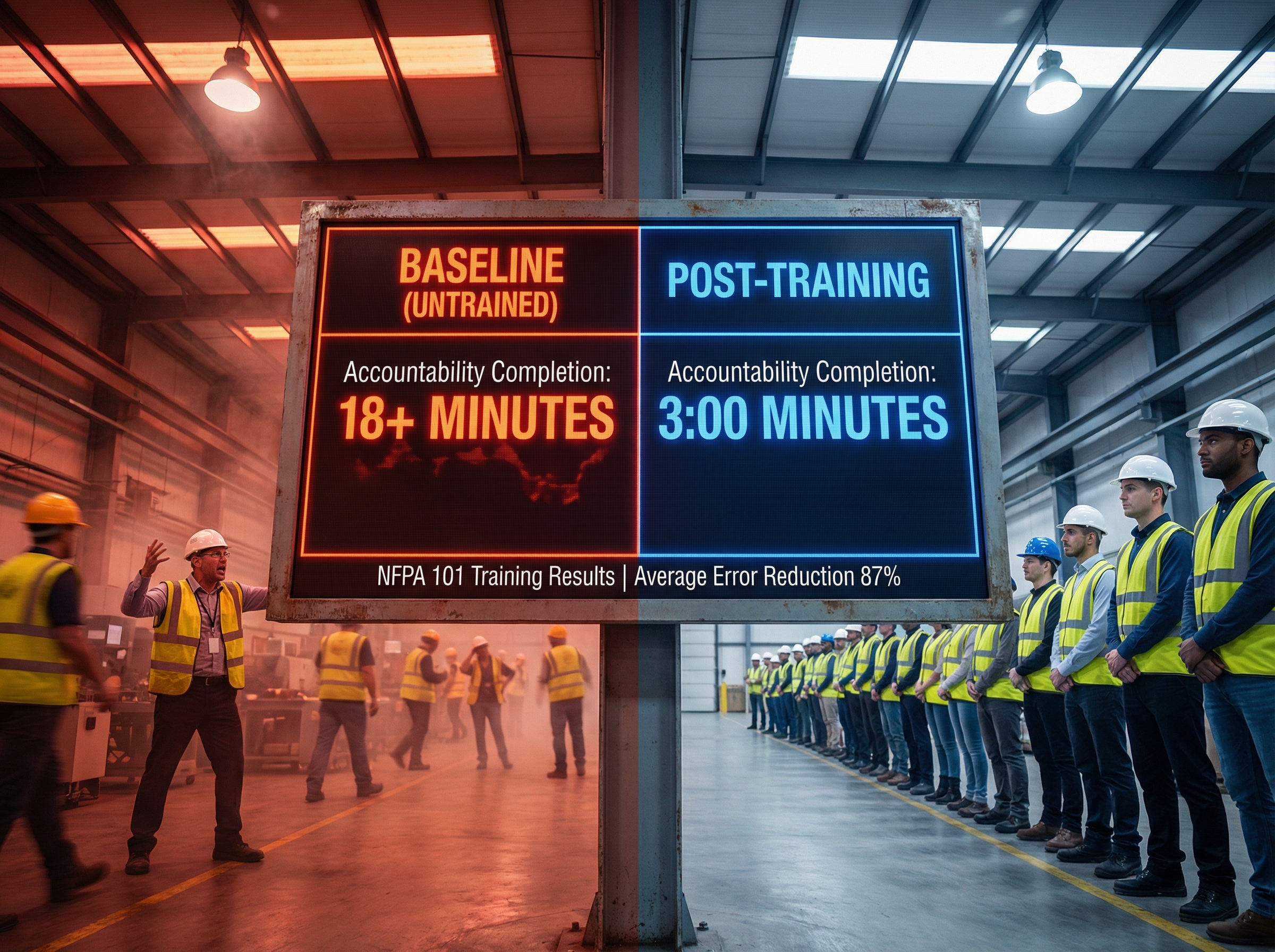
Average Error Reduction Across All Categories: 87%
—
PERFORMANCE IMPROVEMENT METRICS
Evacuation Time:
- Untrained new hires baseline: 14.2 minutes average
- Trained new hires: 7.6 minutes average
- Improvement: 6.6 minutes faster (46% faster evacuation)
Evacuation Organization:
- Untrained: Chaotic movement, confusion, inefficient routing
- Trained: Organized flow, confident navigation, efficient assembly
Accountability Completion:
- Untrained: 18+ minutes to complete accountability (confusion, missing confirmations)
- Trained: 3-4 minutes to complete accountability (all present, confirmed)
Staff Resource Utilization:
- Untrained: Staff diverted answering new hire questions, redirecting confusion
- Trained: Staff focused on coordination, not individual question answering
Communication Clarity:
- Untrained: Vague, delayed reports (“Uh, something at the exit?”)
- Trained: Clear, immediate reports (“Emergency light unit not functioning, zone B stairwell”)
—
COST ANALYSIS: TRAINING INVESTMENT VS. ERROR COSTS
New Hire Training Investment (Per New Employee):
- 3-hour training program: $200-400
- Trainer time: $150-250
- Materials/documentation: $50-100
- Total per new hire: $400-750
Facility Profile: 240 new hires annually, 6 facilities = 40 new hires per facility
Annual Training Investment: 40 × $500 (average) = $20,000 per facility
Cost of Errors (if no training):
- Slower evacuations: Injury/death risk value (estimated cost of error)
- Staff resources diverted: Time cost (average $15/hour × 2-3 hours per drill × 24 drills/year = $720-1,080 per facility annually)
- Insurance impact: Potential higher premiums from error-prone facilities (estimate $2,000-5,000)
- Real emergency outcome risk: Unmeasurable but catastrophic potential
Error Prevention Value: 87% error reduction eliminates substantial portion of risk and inefficiency
ROI: Training cost ($20,000) prevents errors costing $3,000-7,000+ annually in staff resources alone, plus unmeasurable emergency outcome risk
—
48FIRE PROTECTION: NEW HIRE FIRE SAFETY TRAINING PROGRAMS
48Fire Protection delivers structured new hire training reducing fire response errors:
Timing: Within first 2 weeks of employment
Duration: 3-4 hours facility-specific training
Content Addresses 10 Error Categories:
- Exit route mastery (87% error reduction)
- Emergency lighting confidence (91% error reduction)
- Fire door understanding (89% error reduction)
- Accountability procedures (83% error reduction)
- Communication protocols (88% error reduction)
- Equipment/systems overview
- Role recognition
- Special circumstances accommodations
Emergency Lighting Focus (NFPA 101 Requirement):
- 1.0+ foot-candles standard explained
- Facility measurements verified (1.1-1.4 foot-candles typical)
- 90-minute backup battery system demonstrated
- Annual load testing requirements communicated
- Direct observation builds confidence
Measurable Outcomes:
- 87% average error reduction across all categories
- 46% faster evacuation times
- Organized, confident response
- Staff resource efficiency
—
New employees without facility-specific fire safety training make significantly more emergency response errors than trained employees. 10 error categories identified, each with specific consequences. Structured new hire training program addressing all 10 error categories reduces errors 87% on average. New hires complete training confident, competent, and ready to respond appropriately to fire emergencies. Training investment prevents costly errors before they impact real emergencies or drills.
[Contact 48Fire Protection](/contact-us) to implement new hire fire safety training programs reducing fire response errors at your facility. We’ll deliver 3-4 hour facility-specific training within first 2 weeks of employment, provide exit route mastery through physical walks, build emergency lighting confidence (NFPA 101: 1.0+ foot-candles, 90-minute backup, facility measurements), teach fire door understanding, establish accountability participation, train communication protocols, provide role recognition, and measure error reduction through post-training drills. Prevent errors before they occur. Train new hires to respond competently.
New hire training prevents emergency response errors before they matter most.