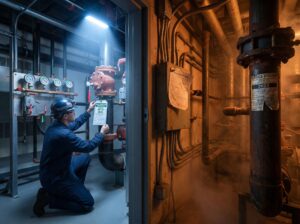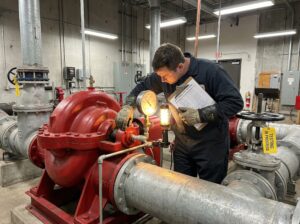
THE WARNING SIGN FRAMEWORK
Life safety lighting failures progress through visible warning stages before complete malfunction.
“`
FAILURE PROGRESSION:
STAGE 1: Early warning signs (visible symptoms)
├─ Dim illumination
├─ Flickering
├─ Slow activation
└─ Physical degradation
STAGE 2: Functional degradation (performance declining)
├─ Reduced brightness during tests
├─ Shorter duration capability
├─ Intermittent operation
└─ Mounting issues
STAGE 3: Imminent failure (critical)
├─ Units not illuminating
├─ Complete battery exhaustion
├─ Charging circuit failure
└─ Structural failure
STAGE 4: Complete failure (emergency situation)
└─ Non-functional life safety lighting
├─ Regulatory violation
├─ Life safety compromise
└─ Liability exposure
“`
Identifying early warning signs enables proactive correction before Stage 3-4 emergencies.
This article documents four critical indicators that life safety lighting requires immediate professional service, the consequences of delayed response, and 48Fire’s diagnostic and correction protocols.
—
SIGN #1 → DIM OR INCONSISTENT ILLUMINATION
Visual Brightness Degradation
What you observe:
During Normal Operation (AC Power)
SYMPTOM: Exit signs noticeably dimmer than when new
Normal brightness:
- Text/symbols clearly legible from 100 feet
- Uniform illumination across sign face
- Bright, vivid appearance
- No dark spots or shadows
Degraded brightness:
- Text/symbols difficult to read from distance
- Uneven illumination (bright areas and dim areas)
- Washed out, faded appearance
- Dark zones within sign face
What this indicates:
LED DEGRADATION:
├─ LED lifespan approaching end (50,000+ hours typical)
├─ Driver circuit failing
├─ Power supply voltage declining
└─ Replacement needed within 6-12 months
LAMP DEGRADATION (older units):
├─ Incandescent/fluorescent bulb near burnout
├─ Blackening visible on bulb
├─ Filament weakening
└─ Replacement needed within 30-90 days
“`
—
During Battery Backup (Power Failure Simulation)
SYMPTOM: Exit signs much dimmer on battery power than AC power
Normal behavior:
- Similar brightness on battery vs. AC power
- Slight reduction acceptable (10-20%)
- Consistent throughout 30-second monthly test
- No significant dimming during test
Abnormal behavior:
- Dramatic brightness reduction on battery (50%+ dimmer)
- Rapid dimming during 30-second test
- Near-complete darkness by end of test
- Flickering during battery operation
What this indicates:
BATTERY CAPACITY LOSS:
├─ Battery age exceeding lifespan (4+ years for lead-acid)
├─ Capacity degraded to 30-50% of rating
├─ Unable to provide 90-minute duration
└─ IMMEDIATE REPLACEMENT REQUIRED
CHARGING CIRCUIT FAILURE:
├─ Battery not receiving proper charge
├─ Float voltage incorrect
├─ Chronic undercharging
└─ PROFESSIONAL SERVICE NEEDED URGENTLY
“`
48Fire diagnostic protocol:
- Electronic load testing (measures actual capacity)
- Charging circuit voltage verification
- Battery replacement or circuit repair
- Verification testing confirms correction
—
Flickering Lights
SYMPTOM: Life safety lighting flickers or strobes intermittently
Flickering patterns and meanings:
| Flicker Type | Likely Cause | Urgency |
|---|---|---|
| Constant rapid flicker | Ballast/driver failure (fluorescent/LED) | Immediate (days) |
| Occasional brief flicker | Loose connection, power fluctuation | Moderate (weeks) |
| Flicker only on battery | Battery failing, connection issue | Immediate (days) |
| Flicker after extended operation | Overheating component | Moderate (weeks) |
| Random intermittent flicker | Faulty wiring, failing component | Immediate (days) |
Why flickering is critical:
- Indicates electrical instability
- Component failure imminent
- May fail completely without warning
- Creates visual distraction (occupant confusion)
- Potential fire hazard (overheating components)
Immediate action required:
Life safety lighting flickering = schedule 48Fire service within 24-48 hours to prevent complete failure.
—
SIGN #2 → PHYSICAL DAMAGE OR DETERIORATION
Housing and Mounting Issues
What you observe:
Cracked or Broken Housing
VISIBLE DAMAGE:
Minor damage:
- Small cracks in plastic housing
- Lens scratches or cloudiness
- Faded sign face
- Discoloration from age/UV exposure
Severity: Moderate (schedule service within 30 days)
Major damage:
- Large cracks exposing internal components
- Broken lens (missing pieces)
- Housing separated or hanging loose
- Water intrusion visible inside unit
Severity: Critical (schedule 48Fire emergency service within 24 hours)
Why physical damage is urgent:
IMMEDIATE CONCERNS:
├─ Moisture intrusion → Electrical short risk → Fire hazard
├─ Component exposure → Dust/contamination → Premature failure
├─ Broken lens → Reduced visibility → Code violation
└─ Loose housing → Falls on occupants → Injury liability
COMPLIANCE CONCERNS:
├─ NFPA 101 requires exit signs in good physical condition
├─ Damaged units may not pass annual inspection
├─ Fire marshal citation risk
└─ Insurance claim vulnerability if incident occurs
—
Mounting Security Issues
SYMPTOM: Exit signs loose, sagging, or improperly positioned
Mounting problems:
LOOSE MOUNTING:
├─ Sign shifts when touched
├─ Visible gap between sign and wall/ceiling
├─ Screws/bolts visibly loose
└─ Vibration causes movement
CAUSES:
├─ Improper initial installation
├─ Mounting hardware degradation
├─ Vibration over time (HVAC, traffic)
└─ Wall/ceiling material deterioration
URGENCY: HIGH
└─ Unit may fall causing injury
└─ Inspection failure certain
└─ Immediate correction required
“`
Sagging or misaligned signs:
- Sign tilted at angle (not level)
- Pendant-mount signs hanging crooked
- Arrow pointing wrong direction
- Visibility compromised from intended viewing angles
Code violation:
Exit signs must be positioned for visibility from all required approach directions. Misalignment = non-compliance.
48Fire mounting repair:
- Secure remounting with proper hardware
- Alignment verification
- Vibration-dampening if needed
- Inspection-ready positioning
—
Corrosion or Environmental Damage
SYMPTOM: Rust, corrosion, or environmental degradation visible
High-risk locations for environmental damage:
- Humid environments (restrooms, kitchens, mechanical rooms)
- Outdoor or semi-outdoor installations
- Areas with chemical exposure
- Locations near salt air (coastal properties)
- High-temperature locations (near boilers, rooftops)
Corrosion indicators:
EARLY STAGE (Schedule service within 60 days):
├─ Surface rust on metal components
├─ White/green powdery substance on terminals
├─ Slight discoloration of housing
└─ Minor weathering of outdoor units
ADVANCED STAGE (Immediate service within 7 days):
├─ Heavy rust affecting structural integrity
├─ Significant terminal corrosion
├─ Housing warping or cracking from corrosion
└─ Electrical connection compromise visible
“`
Why corrosion is serious:
- Electrical connections degraded (intermittent operation)
- Charging efficiency reduced (battery undercharged)
- Structural failure imminent (housing integrity lost)
- Water intrusion pathway created (short circuit risk)
48Fire environmental damage service:
- Terminal cleaning and protection
- Weatherproof housing installation (if needed)
- Component replacement (corroded parts)
- Environmental assessment (preventing recurrence)
—
SIGN #3 → TESTING FAILURES
Monthly or Annual Test Performance Issues
What you observe during testing:
Monthly Test Failures
NFPA 101 REQUIREMENT: 30-second minimum function test monthly
Normal monthly test result:
Push test button → Sign illuminates immediately
Brightness adequate → Consistent for 30 seconds
Test completes → Sign returns to normal operation
Result: PASS
Abnormal monthly test results requiring immediate service:
FAILURE TYPE 1: No illumination
Push test button → Sign does not illuminate
OR
Sign illuminates very briefly then goes dark
CAUSE:
├─ Dead battery (no charge retained)
├─ Complete charging circuit failure
├─ Lamp/LED failure
└─ Wiring disconnection
ACTION: 48Fire emergency service within 24 hours
COMPLIANCE: System non-functional, immediate violation
“`
FAILURE TYPE 2: Rapid dimming
Push test button → Sign illuminates initially
Sign brightness → Rapidly declines during 30 seconds
End of test → Sign very dim or dark
CAUSE:
├─ Battery capacity critically low (end of life)
├─ Excessive internal resistance
├─ Cell failure within battery
└─ Charging circuit partially failed
ACTION: 48Fire service within 48-72 hours
COMPLIANCE: Will fail 90-minute annual test, replacement urgent
“`
FAILURE TYPE 3: Intermittent operation
Push test button → Sign illuminates
During test → Flickering or cycling on/off
Behavior → Unpredictable and unstable
CAUSE:
├─ Loose connection (vibration-induced)
├─ Failing component (intermittent contact)
├─ Battery terminal corrosion
└─ Driver/ballast failure
ACTION: 48Fire service within 7 days
COMPLIANCE: Unreliable operation unacceptable
“`
Monthly testing documentation:
When monthly tests fail, document clearly and schedule immediate correction. Fire marshal inspections review monthly logs—missing tests or unresolved failures = citations.
—
Annual Test Failures
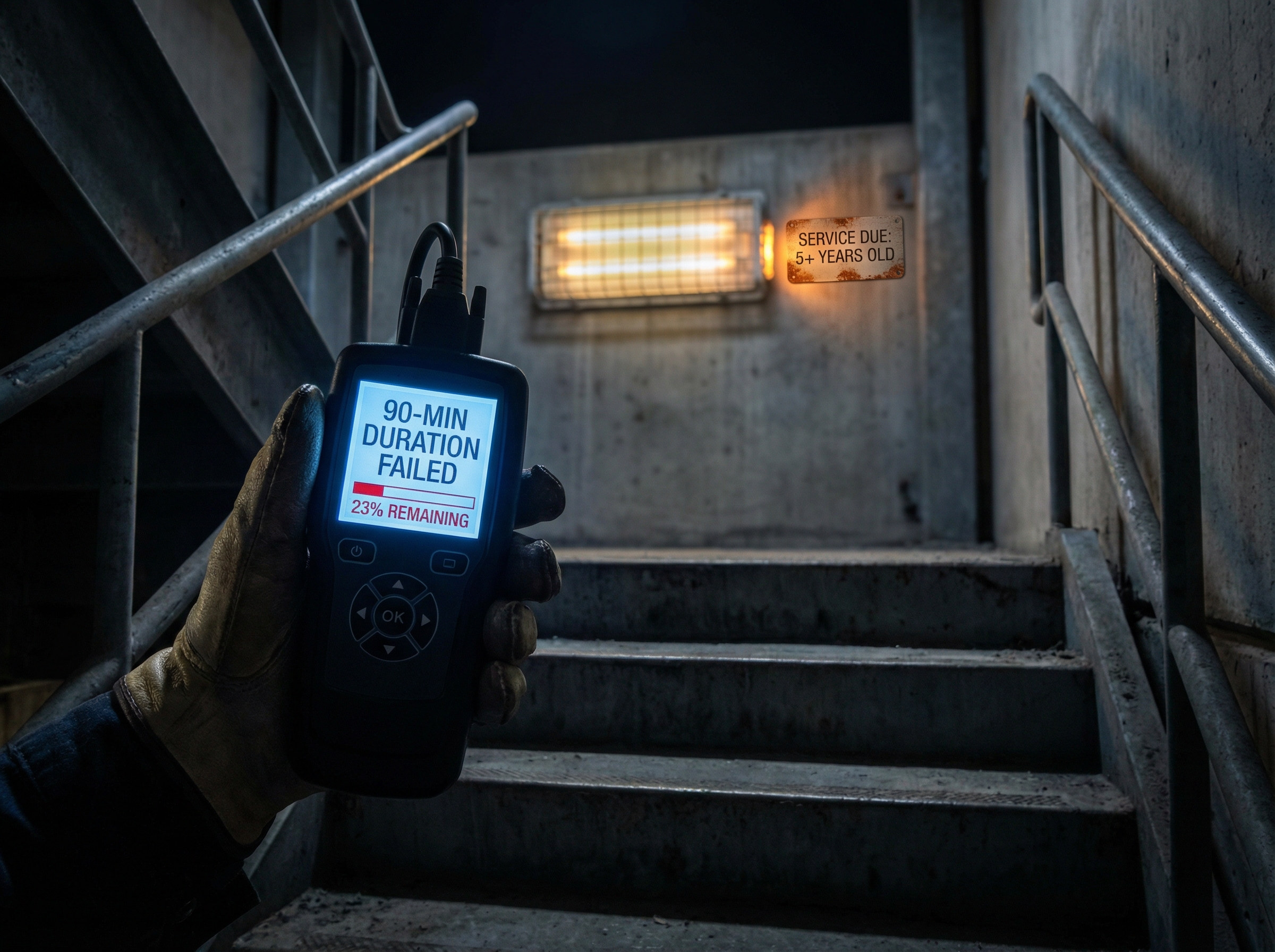
NFPA 101 REQUIREMENT: 90-minute comprehensive test annually
Normal annual test result:
AC power disconnected → Units activate immediately
90-minute duration → Brightness adequate throughout
Test completion → All units pass full duration
Certification → Professional certificate issued
Annual test failures indicating immediate service need:
FAILURE PATTERN 1: Duration failure
TEST TIMELINE:
0-30 minutes: Normal brightness
30-60 minutes: Brightness declining noticeably
60-75 minutes: Significant dimming
75+ minutes: Units too dim or dark
RESULT: FAIL (did not achieve 90-minute requirement)
CAUSE: Battery capacity below 90-minute rating
ACTION: Battery replacement required before re-test
TIMELINE: 48Fire service within 1 week, re-testing within 2 weeks
“`
FAILURE PATTERN 2: Multiple unit failures
RESULT: 6 of 20 units fail 90-minute test
INDICATION:
├─ Similar-age batteries reaching end of life
├─ Widespread component degradation
├─ Systematic maintenance neglect
└─ Comprehensive service program needed
ACTION: 48Fire complete system assessment
TIMELINE: Immediate (multiple violations)
“`
FAILURE PATTERN 3: Charging circuit issues discovered
TEST REVEALS:
├─ Float voltage outside specification (measured 12.2V, should be 13.6V)
├─ Batteries chronically undercharged
├─ PC board adjustment needed
└─ Possible circuit component replacement required
ACTION: 48Fire charging circuit service
TIMELINE: Immediate (affects all future performance)
“`
Annual test failure consequences:
- System non-compliant (cannot issue certificate)
- Liability exposure during correction period
- Insurance coverage questionable
- Occupancy restrictions possible (severe cases)
- OSHA citation risk if inspection occurs
48Fire annual testing and correction:
- Comprehensive 90-minute testing all units
- Electronic load testing reveals capacity issues
- Same-visit corrections (when possible)
- Return visit scheduled (if parts needed)
- Re-testing and certification upon completion
—
SIGN #4 → AGE AND LIFECYCLE INDICATORS
Equipment Lifespan Milestones
What equipment age reveals about service needs:
—
Battery Age Critical Thresholds
LEAD-ACID BATTERIES (Most common):
AGE 0-2 YEARS: Peak performance
├─ Service need: Routine testing only
├─ Urgency: None
└─ Action: Continue monitoring
AGE 3 YEARS: Early degradation begins
├─ Service need: Enhanced monitoring recommended
├─ Urgency: Low
└─ Action: Begin planning for Year 4 replacement
AGE 4 YEARS: Accelerated decline period
├─ Service need: PROACTIVE REPLACEMENT RECOMMENDED
├─ Urgency: MODERATE
└─ Action: Schedule 48Fire battery replacement within 6 months
AGE 5+ YEARS: Failure zone
├─ Service need: IMMEDIATE REPLACEMENT REQUIRED
├─ Urgency: CRITICAL
└─ Action: 48Fire emergency battery service within 30 days
“`
How to determine battery age:
- Check service tag (last replacement date)
- Review annual test certificates (battery dates noted)
- Inspect battery for date code (if visible)
- Contact 48Fire for records review (if service history unknown)
Why age matters:
Even if batteries pass monthly 30-second tests at Year 5, they likely lack capacity for 90-minute annual test. Proactive Year 4 replacement prevents annual test failures.
—
Complete Unit Age Thresholds
LED EMERGENCY LIGHTING/EXIT SIGNS:
AGE 0-10 YEARS: Optimal performance
├─ Expected: Minimal maintenance beyond battery replacement
├─ Service: Routine testing and battery changes only
└─ Condition: Excellent to good
AGE 10-15 YEARS: Component aging
├─ Expected: Occasional lamp/LED replacements, driver issues
├─ Service: Increased maintenance frequency
├─ Consideration: Technology upgrades available
└─ Condition: Good to fair
AGE 15+ YEARS: Lifecycle end approaching
├─ Expected: Multiple component failures, obsolete technology
├─ Service: Frequent repairs becoming costly
├─ Recommendation: REPLACEMENT MORE ECONOMICAL THAN REPAIR
└─ Condition: Fair to poor
AGE 20+ YEARS: Complete replacement recommended
├─ Technology: Obsolete (likely non-LED)
├─ Efficiency: Poor compared to modern units
├─ Compliance: May not meet current standards
├─ Cost: Maintenance exceeds replacement cost
└─ Action: 48Fire system upgrade assessment
“`
Older incandescent/fluorescent units:
- Lifespan shorter (10-15 years typical)
- Higher maintenance requirements
- Energy inefficiency significant
- LED upgrade ROI favorable
—
Visible Technology Obsolescence
SIGNS YOUR LIFE SAFETY LIGHTING IS OUTDATED:
OLD TECHNOLOGY INDICATORS:
□ Incandescent bulbs (yellow/warm light, hot to touch)
□ Fluorescent tubes (long thin bulbs, ballast hum)
□ Text-only “EXIT” signs (no green running man symbol)
□ Heavy, large housings (older manufacturing)
□ Yellowed or brittle plastic (UV degradation over decades)
MODERN STANDARDS:
□ LED technology (cool, efficient, 50,000+ hour life)
□ Green running man symbol (international standard)
□ Slim, lightweight design (modern manufacturing)
□ Smart self-testing capability (automated compliance)
□ Long battery life (lithium options available)
Why upgrade matters:
- Current code compliance (green running man for renovations)
- Maintenance cost reduction (75-85% with LED technology)
- Energy savings (70-80% reduction)
- Improved reliability (LED vs. incandescent/fluorescent)
- Automated testing (smart systems reduce labor)
48Fire technology upgrade services:
- Complete LED conversion
- Smart self-testing system installation
- Code compliance verification
- Energy savings calculation
- Maintenance cost comparison
—
IMMEDIATE SERVICE DECISION MATRIX
Determining Urgency Level
Use this matrix to assess service timeline needs:
—
EMERGENCY SERVICE (Within 24 Hours)
Indicators:
□ Exit signs not illuminating at all
□ Multiple units failed
□ Major physical damage (hanging, broken, exposed wires)
□ Moisture intrusion visible
□ Smoke or burning smell
□ Imminent inspection with known failures
Action: Call 48Fire emergency service immediately
Risk: Life safety compromise, regulatory violation, liability exposure
—
URGENT SERVICE (Within 48-72 Hours)
Indicators:
□ Severe dimming during monthly tests
□ Flickering or intermittent operation
□ Annual test failures
□ Year 5+ batteries still in service
□ Significant corrosion visible
□ Mounting severely loose
Action: Schedule 48Fire priority service
Risk: Imminent complete failure, inspection failure likely
—
PRIORITY SERVICE (Within 1-2 Weeks)
Indicators:
□ Gradual brightness reduction observed
□ Minor physical damage
□ Year 4 batteries due for replacement
□ Moderate corrosion
□ Mounting slightly loose
□ Overdue annual testing
Action: Schedule 48Fire standard service
Risk: Degradation continuing, failure within months
—
ROUTINE SERVICE (Within 30-60 Days)
Indicators:
□ Scheduled maintenance due
□ Year 3 batteries (proactive planning)
□ Technology upgrade consideration
□ Cosmetic issues only
□ Optimization opportunities
Action: Schedule 48Fire routine maintenance
Risk: Minimal current risk, proactive optimization
—
CONSEQUENCES OF DELAYED SERVICE
What Happens When Warning Signs Ignored
Failure progression when service delayed:
—
Regulatory Consequences
OSHA/Fire Marshal Citation Process:
WARNING SIGNS IGNORED
↓
Equipment fails during inspection
↓
CITATION ISSUED:
├─ Violation: Non-functional life safety lighting
├─ Penalty: $16,131 per serious violation (as of 2024)
├─ Correction order: Immediate repair required
└─ Re-inspection: Follow-up verification mandated
↓
ENHANCED OVERSIGHT:
├─ Increased inspection frequency (quarterly vs. annual)
├─ Compliance monitoring (2-3 years typical)
└─ Reputation impact (public violation records)
“`
Multiple violations:
Each non-functional unit = separate citation. 5 failed units = $80,655 potential penalty exposure.
—
Liability Exposure
INCIDENT SCENARIO:
DELAYED SERVICE CONSEQUENCES:
Power failure occurs → Exit signs non-functional
Occupants unable to locate exits → Evacuation delayed
Injuries occur during evacuation → Liability claim filed
LIABILITY INVESTIGATION:
├─ Monthly test logs reviewed → Failures documented, not corrected
├─ Service records examined → Delayed or absent maintenance
├─ Negligence established → Property owner knew of problem
└─ Damages awarded → Medical costs + pain/suffering + punitive
INSURANCE IMPACT:
├─ Claim denied → Maintenance negligence exclusion
├─ OR reduced payout → Contributory negligence
├─ Premium increase → Risk profile elevated
└─ Policy cancellation → Coverage lost
“`
48Fire professional service documentation provides liability defense through systematic maintenance records and immediate correction response.
—
Cascading Failures
ONE FAILURE LEADS TO OTHERS:
INITIAL WARNING: Battery weak (Sign #1)
IGNORED → Battery fails completely
SECONDARY EFFECT: Charging circuit stressed
↓
Circuit fails trying to charge dead battery
TERTIARY EFFECT: Other batteries on same circuit affected
↓
Multiple units now experiencing problems
RESULT: Single $80 proactive battery replacement
NOW REQUIRES: $500+ emergency multi-unit service
“`
Cost escalation:
Early intervention: $80-150
Delayed response: $500-1,500 (emergency service premium + multiple failures)
—
48FIRE DIAGNOSTIC AND CORRECTION PROCESS
Professional Service Response
Systematic approach to warning sign correction:
—
Phase 1: Comprehensive Diagnostic Assessment
48FIRE TECHNICIAN EVALUATION:
VISUAL INSPECTION:
├─ All units examined for physical condition
├─ Mounting security verified
├─ Environmental factors assessed
└─ Age/technology documented
FUNCTIONAL TESTING:
├─ Monthly test simulation (30-second activation)
├─ Brightness assessment (subjective + light meter)
├─ Battery load testing (electronic simulator)
├─ Charging circuit verification (voltage/current)
└─ Duration capability evaluation (if needed)
DOCUMENTATION REVIEW:
├─ Previous test results analyzed
├─ Service history examined
├─ Failure patterns identified
└─ Lifecycle status determined
DELIVERABLE: Complete diagnostic report with prioritized recommendations
“`
—
Phase 2: Immediate Corrections
SAME-VISIT CORRECTIONS (When Possible):
├─ Battery replacement (if batteries in stock)
├─ Lamp/LED replacement (standard inventory)
├─ Minor mounting adjustments (tools available)
├─ Terminal cleaning (routine service)
├─ Charging circuit adjustment (PC board tuning)
└─ Testing verification (confirms correction)
FOLLOW-UP CORRECTIONS (If Parts Needed):
├─ Complete unit replacement (special orders)
├─ Major mounting repairs (structural work)
├─ Charging circuit component replacement (electronics)
└─ Return visit scheduled (expedited service)
“`
—
Phase 3: Verification and Documentation
CORRECTION VERIFICATION:
├─ Re-testing all corrected units
├─ Performance confirmed meeting standards
├─ Photographic documentation (before/after)
└─ Certification provided
DOCUMENTATION DELIVERABLES:
├─ Service report (detailed findings + actions)
├─ Updated equipment records (lifecycle tracking)
├─ Testing certificates (compliance proof)
├─ Recommendations (future maintenance)
└─ Next service scheduling (proactive planning)
“`
—
CONCLUSION
Four Critical Warning Signs Requiring Immediate Life Safety Lighting Service
SIGN #1: Dim or Inconsistent Illumination
- Noticeable brightness reduction (AC or battery power)
- Flickering or strobing behavior
- Rapid dimming during tests
- Indicates: Battery degradation, charging failure, LED/lamp end-of-life
- Action: 48Fire service within 24-72 hours
SIGN #2: Physical Damage or Deterioration
- Cracked/broken housing (moisture intrusion risk)
- Loose or sagging mounting (fall hazard)
- Corrosion visible (electrical compromise)
- Indicates: Environmental stress, installation issues, age-related failure
- Action: Emergency service within 24 hours (major damage) or 7-30 days (minor)
SIGN #3: Testing Failures
- Monthly 30-second test failures (no illumination, rapid dimming)
- Annual 90-minute test failures (duration inadequate)
- Multiple unit failures (systematic issues)
- Indicates: Battery exhaustion, capacity loss, system-wide problems
- Action: 48Fire service within 48 hours to 1 week, immediate re-testing
SIGN #4: Age and Lifecycle Indicators
- Year 4+ batteries (proactive replacement zone)
- Year 5+ batteries (critical replacement urgent)
- 15-20+ year old complete units (obsolete technology)
- Indicates: End of service life approaching, failure imminent
- Action: Proactive replacement within 30-180 days (age dependent)
Consequences of delayed service:
- Regulatory violations ($16,131+ per unit)
- Liability exposure (negligence claims)
- Cascading failures (cost escalation)
- Insurance complications (claim denial risk)
- Life safety compromise (occupant protection inadequate)
48Fire immediate service capabilities:
- Emergency response (24-hour availability)
- Comprehensive diagnostics (electronic testing equipment)
- Same-visit corrections (extensive parts inventory)
- Professional documentation (compliance and liability protection)
- Proactive recommendations (preventing future failures)
When to contact 48Fire:
- ANY of the four warning signs present
- Monthly test failures
- Visible damage or deterioration
- Equipment age exceeding recommended service life
- Inspection approaching with uncertain system status
Life safety lighting warning signs are not maintenance suggestions—they are urgent indicators requiring immediate professional attention to prevent regulatory violations, liability exposure, and life safety system failure.
[Schedule Immediate Life Safety Lighting Service]
—
48Fire
Life Safety Lighting Service
24-Hour Emergency Response • Professional Diagnostics • Immediate Corrections
Contact: [/contact-us]