How Remote Alarm Monitoring Reduced Emergency Response Time
The time gap between fire start and firefighter arrival determines outcomes.
Small fires become large fires in minutes. Large fires become catastrophic in more minutes. Every 60 seconds matters during exponential growth phase.
Remote fire alarm monitoring compresses the timeline between detection and emergency response. Not by making fire trucks drive faster—that’s outside monitoring’s control. By eliminating minutes between “detector activates” and “fire department is notified and responding.”
Those minutes represent the difference between fire contained to single room versus fire extending throughout building. Between minor smoke damage versus major structural damage. Between occupants evacuating safely versus occupants trapped by fire spread.
This article examines specifically where remote monitoring saves time, quantifies that time savings, and explains why those minutes matter more than people realize.
—
PART ONE: THE TIMELINE BREAKDOWNS
Understanding requires examining specific timelines step by step.
Scenario A: Remote Monitored Building
Building type: Office building, 40,000 square feet, three floors
Time: 2:30 AM Thursday
Occupancy: Empty (security guard makes rounds but currently not in building)
Fire origin: Third floor storage room, electrical fault in HVAC control panel
—
2:30:00 – Arc fault inside HVAC control panel. Insulation ignites.
2:31:45 – Smoke accumulates at ceiling level in storage room.
2:32:15 – Smoke detector 30 feet from fire origin reaches alarm threshold. Device activates.
2:32:16 – Fire alarm control panel receives detector signal. Panel activates building horns and strobes. Panel’s cellular communicator begins dialing monitoring station.
2:32:19 – Monitoring station receiver equipment logs incoming signal (3 seconds transmission time via cellular).
2:32:19 – Monitoring station computer generates operator alert. Screen displays: “Smith Office Building, 2400 Oak Street, Smoke Detector 342 Third Floor Storage Room.”
2:32:28 – Operator reviews account information (9 seconds). Verifies: alarm signal (not test), no test mode scheduled, full dispatch required per account settings.
2:32:29 – Operator picks up phone, dials fire department dispatch line.
2:32:35 – Fire dispatcher answers (6 seconds).
2:32:55 – Operator provides: building address, cross streets, alarm type (automatic smoke detector activation), device location (third floor storage room), building type (three-story office building), special information (building empty, key box at main entrance). Fire dispatcher acknowledges and confirms dispatch. (20 seconds conversation)
2:33:05 – Fire dispatcher assigns units: Engine 7, Engine 12, Ladder 3, Battalion 1. Broadcasts dispatch via radio. (10 seconds)
2:33:25 – All assigned units acknowledge dispatch and begin response. (20 seconds for all units to acknowledge)
2:33:25 – Units responding from stations. Travel distance: Engine 7 (closest) 1.4 miles.
2:38:40 – Engine 7 arrives on scene. (5 minutes 15 seconds travel time)
—
Total time from fire ignition to first fire unit arrival: 8 minutes 40 seconds
Total time from detector activation to first unit arrival: 6 minutes 25 seconds
Total time from detector activation to fire department dispatch: 1 minute 6 seconds
—
Scenario B: Same Building, No Remote Monitoring
Same building, same fire, same conditions—but building has fire alarm system WITHOUT remote monitoring. System has horns and strobes alerting occupants, but no automatic signal to monitoring company. Relies on occupants calling 911.
—
2:30:00 – Arc fault inside HVAC control panel. Insulation ignites.
2:31:45 – Smoke accumulates at ceiling level.
2:32:15 – Smoke detector activates. Fire alarm panel activates building horns and strobes.
2:32:15 – Building is empty except for security guard. Guard is in parking lot performing vehicle patrol (routine security check). Does not hear alarms from parking lot.
2:38:20 – Security guard completes parking lot patrol, returns to building entrance. Hears fire alarm sounding. (6 minutes 5 seconds after alarm activation)
2:38:50 – Guard enters building. Checks annunciator panel—sees “Zone 3 Alarm” (conventional system, doesn’t identify specific device). Uncertain whether false alarm or real fire. (30 seconds)
2:39:20 – Guard begins investigating. Checks first floor—nothing visible. Checks second floor—nothing visible. (30 seconds first floor, 30 seconds second floor including stair climbing)
2:40:10 – Guard reaches third floor. Smells smoke. Sees haze in corridor. Identifies this as real emergency. (50 seconds)
2:40:30 – Guard pulls out cell phone. Dials 911. (20 seconds—finding phone, unlocking, dialing)
2:40:50 – 911 center answers. Guard reports: “Fire at 2400 Oak Street, Smith Office Building. Third floor. I can see smoke.” (20 seconds—guard speaking quickly, somewhat panicked)
2:41:10 – 911 operator asks clarifying questions: “Are you inside the building? Are there other occupants? What is the exact address? Cross streets?” Guard provides information. (20 seconds Q&A)
2:41:20 – 911 operator confirms address and transfers call to fire dispatch. (10 seconds)
2:41:30 – Fire dispatcher receives transfer, confirms information with guard. (10 seconds)
2:41:45 – Fire dispatcher assigns same units: Engine 7, Engine 12, Ladder 3, Battalion 1. Broadcasts dispatch. (15 seconds)
2:42:10 – Units acknowledge and begin response. (25 seconds)
2:47:25 – Engine 7 arrives on scene. (5 minutes 15 seconds travel time—same as Scenario A)
—
Total time from fire ignition to first fire unit arrival: 17 minutes 25 seconds
Total time from detector activation to first unit arrival: 15 minutes 10 seconds
Total time from detector activation to fire department dispatch: 9 minutes 30 seconds
—
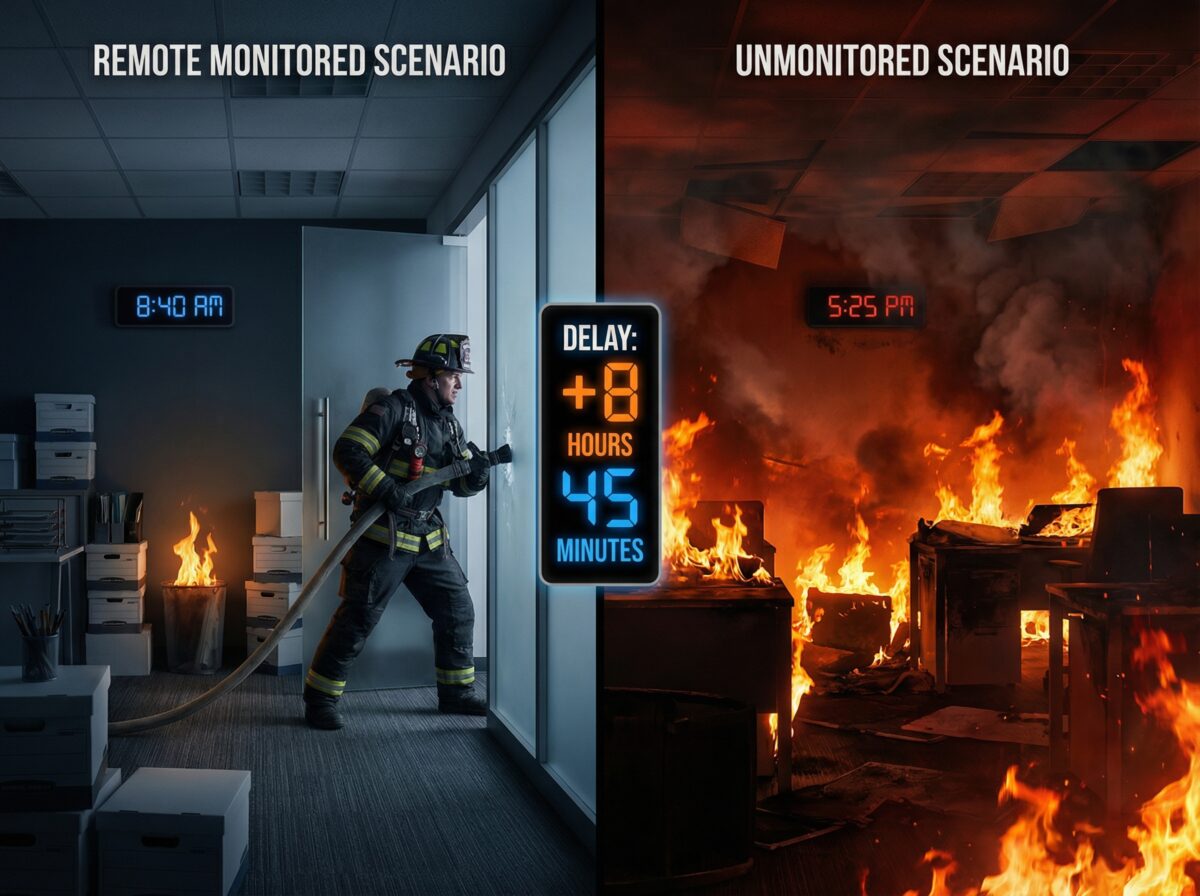
The 8-Minute Difference
Scenario A (remote monitoring): Fire department on scene 8 minutes 40 seconds after ignition
Scenario B (no monitoring): Fire department on scene 17 minutes 25 seconds after ignition
Difference: 8 minutes 45 seconds
Where did those 8+ minutes go?
- Guard not immediately aware of alarm: 6 minutes
- Guard investigation time: 2 minutes
- Guard calling 911 and providing information: 1 minute
- 911 processing and transfer: 30 seconds
- Slight increase in dispatch time (911 call vs. monitoring company call): 20 seconds
The critical insight: Remote monitoring didn’t make fire trucks arrive faster. Travel time identical in both scenarios (5 minutes 15 seconds).
Remote monitoring eliminated the notification delay—the time between alarm activation and fire department dispatch.
—
PART TWO: WHAT HAPPENS IN 8 MINUTES
Fire doesn’t wait politely during notification delays.
Fire Growth Characteristics
Fire behavior during growth phase follows predictable patterns (though exact rates vary by fuel type, ventilation, and geometry).
Typical fire development timeline:
Minutes 0-2: Incipient phase
- Small flame
- Minimal smoke production
- Localized heat
- Often controllable with portable extinguisher
Minutes 2-5: Early growth phase
- Flame spreads to adjacent combustibles
- Smoke production increases significantly
- Heat buildup accelerates
- Portable extinguisher may still be effective if applied immediately
Minutes 5-10: Active growth phase
- Flame involves multiple items
- Heavy smoke throughout room
- Temperatures at ceiling reaching 500-1000°F
- Room approaching flashover conditions
- Portable extinguisher no longer effective—requires hose line
Minutes 10-15: Fully developed room fire
- Entire room contents involved (if sufficient fuel)
- Flashover occurred or imminent (simultaneous ignition of all combustible surfaces)
- Temperatures at ceiling 1200-1500°F
- Fire extending to adjacent spaces through conduction, convection, and radiation
- Structural damage beginning
Minutes 15-20: Fire extension phase
- Fire has extended beyond room of origin
- Multiple rooms involved
- Structural members failing
- Defensive operations required (firefighters cannot enter)
Fire Size Calculation
Using conservative fire doubling time of 90 seconds during active growth:
Scenario A arrival (8:40):
- Fire has been growing for approximately 6-7 minutes since detection
- Approximate doubling cycles: 4-5
- Fire size relative to origin: 16-32 times original
Scenario B arrival (17:25):
- Fire has been growing for approximately 15 minutes since detection
- Approximate doubling cycles: 10
- Fire size relative to origin: 1,024 times original
These aren’t abstract numbers.
Scenario A arrival: Fire likely contained to storage room or just beginning extension to corridor. Single room involved. One or two hose lines sufficient. Fire extinguished in 10-20 minutes. Limited water damage. Building potentially reoccupied within days after cleanup.
Scenario B arrival: Fire extended beyond storage room into corridor and adjacent offices. Multiple rooms involved. Defensive operations from exterior or protected positions. Fire extinguished in 45-90 minutes. Significant water damage throughout third floor. Possible partial structural collapse. Building closure for weeks or months for reconstruction.
Damage estimate comparison:
Scenario A: $25,000-75,000 (smoke and water damage, storage room contents, equipment replacement)
Scenario B: $500,000-1,200,000 (structural damage, multiple rooms, extended water damage, business interruption)
The 8-minute monitoring advantage prevented $475,000-1,125,000 in additional damage.
Return on investment for monitoring service (costing $400-600 annually) becomes very clear in this context.
—
PART THREE: OCCUPIED VS. UNOCCUPIED TIME ADVANTAGE
Monitoring’s time advantage varies dramatically depending on building occupancy.
During Occupied Hours
Monitoring advantage: 2-5 minutes typically
Example: Daytime office fire, 10:30 AM, 40 people in building
With monitoring:
- Detection: 0:00
- Monitoring station notification: 0:03
- Fire department dispatch: 0:45
- Fire department responding: 1:30
Without monitoring (occupant calls):
- Detection: 0:00
- Occupant notices smoke: 1:00 (someone near fire location)
- Occupant investigates: 2:00 (checking what’s burning)
- Occupant calls 911: 2:10
- 911 processes call: 3:30
- Fire department responding: 4:00
Monitoring advantage: 2.5 minutes
This assumes:
- Someone is near fire location and notices quickly
- They decide to call 911 rather than trying to handle it themselves
- They provide clear information to 911 operator
- 911 operator processes call efficiently
If any of these factors delayed, monitoring advantage increases.
During Unoccupied Hours
Monitoring advantage: 10-60+ minutes (or indefinite)
Example: Same building, 2:00 AM fire, building empty
With monitoring:
- Detection to dispatch: 1 minute (as shown in Scenario A)
Without monitoring:
- Fire grows undetected until:
- Passerby sees smoke/flames (could be 15-30+ minutes)
- Security guard makes next round (could be 1-4 hours)
- Fire breaks through roof (could be 30-60 minutes)
- Sprinkler activates and waterflow alarm monitored (if building has sprinklers and waterflow monitored)
Monitoring advantage: Potentially unlimited—monitoring may provide the ONLY timely notification
The Occupancy Analysis
Many commercial buildings occupied less than half the time:
Typical office building:
- Occupied: Monday-Friday 8 AM – 6 PM (50 hours/week)
- Unoccupied: Nights and weekends (118 hours/week)
- Occupancy rate: 30%
Typical retail (non-24-hour):
- Occupied: 7 days/week, 10 AM – 9 PM (77 hours/week)
- Unoccupied: Overnight (91 hours/week)
- Occupancy rate: 46%
Industrial facility (single shift):
- Occupied: Monday-Friday 6 AM – 3 PM (45 hours/week)
- Unoccupied: Nights and weekends (123 hours/week)
- Occupancy rate: 27%
Buildings are unoccupied 50-75% of the time. During those periods, monitoring provides the most dramatic time advantage—often the difference between timely response and catastrophic loss.
—
PART FOUR: THE COMMUNICATION COMPARISON
Why does remote monitoring save time compared to 911 calls?
Information Pre-Positioning
Monitoring company advantage: All building information entered in database before emergency occurs.
Operator sees immediately:
- Exact building address with cross streets
- Fire department jurisdiction and phone number
- Building type and occupancy
- Contact information
- Special hazards or access information
911 call disadvantage: Caller must provide all information during emergency.
Caller must remember and communicate:
- Exact address (may not know if visitor or security guard)
- Cross streets (often doesn’t know)
- Building description
- Specific fire location within building
- Phone number for callback
Communication delays and errors common. Panicked callers forget information, provide wrong information, or struggle to communicate clearly.
Direct vs. Indirect Notification
Monitoring company: Calls fire department dispatch directly using pre-programmed non-emergency line.
Connection typically immediate. Fire dispatcher recognizes monitoring company caller ID. Knows to expect clear, structured information. Conversation efficient.
911 call: Routes through 911 call center, then transfers to fire dispatch.
Additional steps:
- 911 center answers (may have queue during busy periods)
- 911 operator determines emergency type
- 911 operator obtains address and details
- 911 operator transfers to appropriate fire dispatch
- Fire dispatcher receives transfer and confirms information
Each transfer point adds time.
Caller Training and Experience
Monitoring operators: Trained specifically for emergency notification. Process dozens of alarms weekly. Follow structured scripts. Remain calm. Provide complete information efficiently.
Building occupants: Untrained. May be in panic. Calling 911 possibly first time. Don’t know what information fire department needs. May forget critical details.
Training and experience difference shows in notification quality and speed.
Language Considerations
Monitoring operators: English-speaking, trained in emergency communication terminology.
Building occupants: May have language barriers. May struggle communicating with 911 operator. Translation delays or miscommunication possible.
Remote monitoring eliminates language barrier issues—system communicates in standardized digital format, operator communicates professionally in English.
—
PART FIVE: MONITORING LIMITATIONS AND REALISTIC EXPECTATIONS
Remote monitoring provides time advantage but not unlimited benefits.
What Monitoring Cannot Control
Travel time: Once fire department dispatched, arrival time depends on:
- Distance from fire station
- Traffic conditions
- Weather
- Other simultaneous emergencies affecting unit availability
Monitoring gets notification completed faster but can’t make fire trucks drive faster.
Fire growth rate: Building construction, fuel loading, and ventilation determine fire development speed. Monitoring accelerates response but doesn’t slow fire growth.
Detection speed: Monitoring response time begins when detector activates. If fire goes undetected due to coverage gaps, disabled detectors, or detection system failures, monitoring provides no benefit.
Occupant behavior: During occupied periods, occupants must evacuate appropriately. Monitoring accelerates fire department notification but doesn’t guarantee occupant safety if they delay evacuation, don’t hear alarms, or make poor decisions.
When Monitoring Advantage is Minimal
Very small buildings with constantly present occupants:
Single-room building with owner working inside continuously. Owner would notice fire immediately and call 911 directly. Monitoring saves little time because occupant detection essentially instantaneous.
Buildings with on-site security constantly monitoring fire alarm panel:
If security guard is stationed at fire alarm panel 24/7 and trained to call fire department immediately upon alarm, monitoring advantage reduced. However, most security personnel aren’t stationed at fire alarm panels continuously.
Buildings adjacent to fire stations:
If building is 200 feet from fire station, 3-minute notification advantage matters less when travel time only 30 seconds regardless. Monitoring still provides value during unoccupied periods but time savings less dramatic during occupied hours.
The False Alarm Consideration
Remote monitoring dispatches fire department to false alarms as well as real fires.
This creates:
- False alarm fines in many jurisdictions (typically after 3-5 alarms annually)
- Fire department response fatigue (too many false alarms reduces response urgency)
- Occupant complacency (people ignore alarms assuming false)
Proper system maintenance and alarm verification procedures (where appropriate) help minimize false alarms.
But monitoring doesn’t solve false alarm problems—it responds to whatever alarm signals the system generates.
—
PART SIX: OPTIMIZING MONITORING RESPONSE TIME
Several factors affect how quickly monitoring translates detection into emergency response.
Communication Technology Selection
Phone line (POTS) communicators:
- Signal transmission: 15-45 seconds (includes dialing time)
- Reliable when phone service working
- Vulnerable to physical line cuts
- Many areas phasing out analog service
Cellular communicators:
- Signal transmission: 2-5 seconds typical
- Independent of building utilities
- Requires adequate cellular signal strength
- Technology lifecycle concerns (3G discontinued, eventually 4G will be)
IP (Internet) communicators:
- Signal transmission: 1-3 seconds typical
- Very fast when working
- Depends on building network reliability
- Power failures affect network equipment
Dual-path communication (cellular + IP):
- Provides redundancy
- If one path fails, other maintains monitoring
- Slightly higher cost but significant reliability improvement
Fastest reliable option: Dual-path cellular + IP provides sub-5-second transmission with redundancy backup.
Monitoring Company Selection
Not all central stations provide equal response times.
UL 827 requirement: 90 seconds maximum from signal receipt to fire department notification.
High-performing stations achieve: 30-60 seconds average.
Low-performing stations: May approach 90-second maximum regularly.
Difference between 30-second and 90-second operator processing represents additional minute of fire growth.
Questions to ask monitoring company:
- What is your average fire alarm response time? (signal receipt to fire department notification)
- How many operators on duty during overnight hours?
- Do you have redundant monitoring centers?
- What is your UL audit performance history?
Monitoring company quality directly affects time advantage monitoring provides.
Account Information Accuracy
Monitoring operators rely on database information.
Critical information:
- Building address (must be exact—wrong address catastrophic)
- Fire department jurisdiction (must call correct fire department)
- Building description (helps fire department preparation)
- Contact information (for follow-up notification)
Outdated information causes delays:
- Wrong fire department called—must transfer or recall
- Address errors—fire department goes to wrong location
- Missing information—operator must research during emergency
Property manager responsibility: Update monitoring company immediately when:
- Building address changes
- Fire department jurisdiction changes
- Building undergoes major renovations
- Contact information changes
Current information ensures monitoring response proceeds without information-gathering delays.
Testing Frequency
Regular testing verifies monitoring functioning.
NFPA 72 minimum: Annual communication testing
Industry best practice: Daily automatic test signals
Monthly manual testing: Provides additional verification and familiarizes staff with procedures
Why testing matters for response time:
Communication failures that go undetected mean building thinks it has monitoring but actually doesn’t. Fire occurs—no monitoring signal sent—building relies on occupant notification. All monitoring time advantage lost.
Daily test signals identify communication failures within 24 hours rather than waiting up to 12 months between manual tests.
Companies like 48fire include regular communication testing in maintenance programs, ensuring monitoring connections verified frequently and communication problems identified quickly.
—
PART SEVEN: QUANTIFYING THE VALUE
Is monitoring’s time advantage worth the cost?
Direct Cost Analysis
Annual monitoring cost: $400-600 typical for small to medium commercial buildings (UL-listed central station, single-path communication)
Dual-path monitoring: $600-900 annually
Break-even calculation:
If monitoring prevents ONE fire from progressing from early stage to fully developed stage over system’s life (15-20 years):
- Small fire damage (early response): $25,000-50,000
- Large fire damage (delayed response): $250,000-750,000
- Difference: $225,000-700,000
Total monitoring cost over 20 years: $8,000-18,000
Even single avoided catastrophic loss pays for monitoring many times over.
Risk-Adjusted Value
Probability of fire in commercial building:
Varies by occupancy type:
- Office buildings: Approximately 1-2 fires per 1,000 buildings per year
- Retail: 2-3 per 1,000 buildings per year
- Restaurants: 5-8 per 1,000 buildings per year
- Manufacturing: 3-5 per 1,000 buildings per year
Over 20-year period, many buildings will experience fire event. Monitoring ensures fastest possible response when that event occurs.
Insurance Perspective
Some insurance carriers offer premium reductions for monitored fire alarm systems:
- 2-5% premium reduction typical when offered
- On $5,000 annual premium, 3% reduction = $150 annual savings
- Over 20 years: $3,000 savings
Premium reduction alone doesn’t fully offset monitoring cost, but combined with loss prevention value, insurance benefits add to monitoring ROI.
The Unquantifiable Value
Peace of mind: Building owners and property managers sleep better knowing fire protection operates 24/7 regardless of occupancy.
Liability protection: Documented monitoring and emergency notification procedures support defense if litigation follows fire incident.
Tenant confidence: Commercial tenants value knowing building has professional fire protection.
Code compliance: Many jurisdictions require commercial fire alarm monitoring. Monitoring provides compliance rather than optional enhancement.
These intangible benefits don’t appear in cost-benefit calculations but represent real value to building owners and managers.
—
CONCLUSION: THE MINUTES THAT MATTER
Remote fire alarm monitoring reduces emergency response time by eliminating notification delays between detection and fire department dispatch.
Time savings: 2-5 minutes during occupied periods. 10-60+ minutes (or indefinite) during unoccupied periods.
Why it matters: Fire growth is exponential. Minutes saved during early growth phase prevent fires from progressing to fully developed stages. Smaller fires mean less damage, faster suppression, reduced business interruption, and better life safety outcomes.
The mechanism: Pre-positioned information, direct fire department notification, trained operators, and automatic signal transmission combine to compress notification timeline from several minutes to under one minute typically.
The value: Even single avoided catastrophic loss over building’s life justifies monitoring cost many times over. Regular monitoring cost represents insurance premium protecting against notification failure during critical emergency.
The limitation: Monitoring doesn’t prevent fires, doesn’t guarantee detection, doesn’t control travel time, and doesn’t guarantee particular outcomes. Monitoring provides time advantage within fire protection system—one important component of comprehensive fire safety strategy.
The decision: For commercial buildings, particularly those unoccupied significant hours, monitoring’s time advantage justifies cost for most risk profiles. Combined with code requirements and insurance considerations, monitoring represents standard practice for responsible fire protection rather than optional enhancement.
Buildings with aging or no monitoring should evaluate whether current fire alarm notification methods provide adequate emergency response speed. Time advantages monitoring provides aren’t theoretical—they’re measurable and consequential.
—
Need assessment of your building’s fire alarm monitoring configuration? [Talk to fire protection experts](/contact-us) at 48fire who can evaluate current monitoring response times, recommend improvements to reduce notification delays, and ensure your fire alarm system provides the rapid emergency notification that translates detection into timely fire department response—every hour of every day.