How Our Monitoring Team Caught a Fire Before It Spread
Opening Scenario
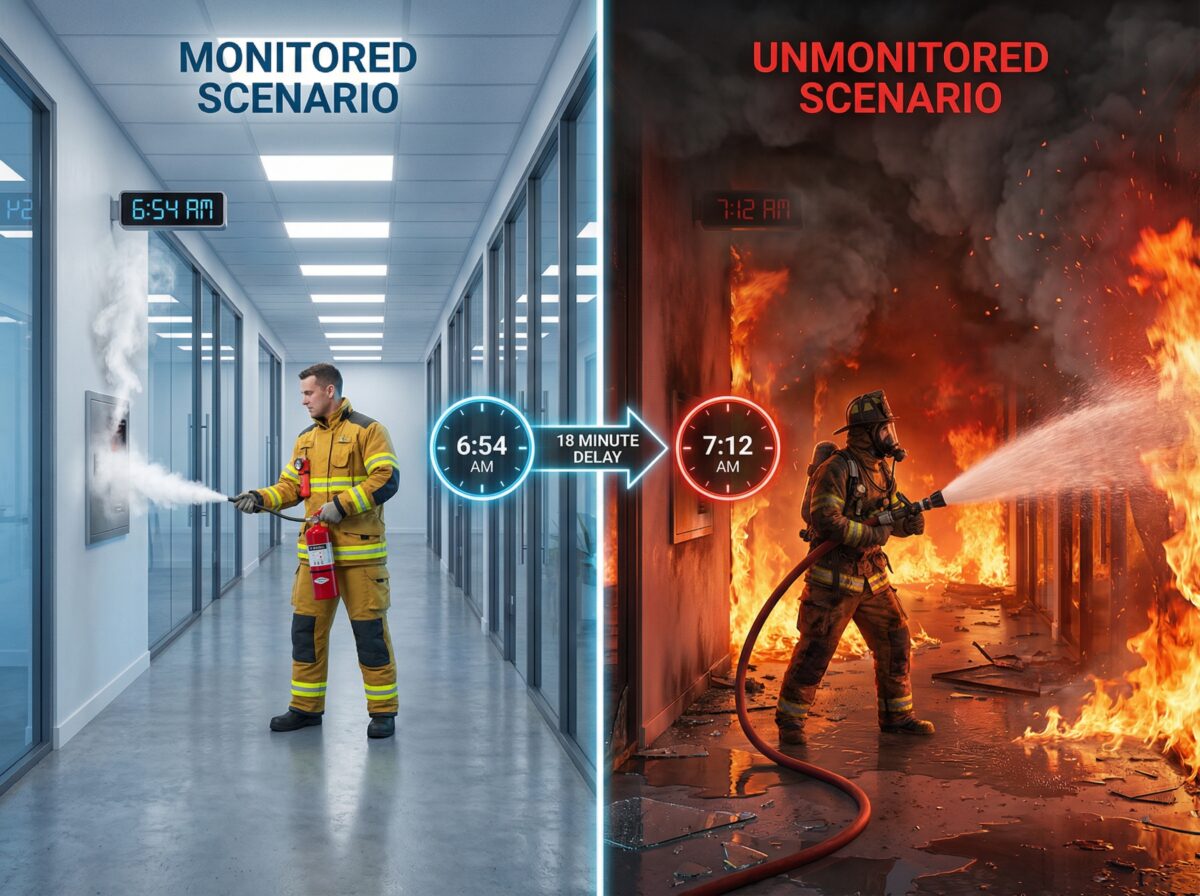
Office building. Tuesday morning, 6:47 AM. Building empty except for cleaning crew on second floor.
Third-floor electrical room: Circuit breaker panel experiencing internal fault. Arc flash creates temperatures exceeding 3,000°F inside panel enclosure. Insulation begins burning. Smoke accumulates.
6:49 AM – Smoke detector 40 feet from electrical room reaches alarm threshold. Device activates.
6:49:03 AM – Fire alarm control panel receives detector signal. Panel activates building horns and strobes. Panel’s cellular communicator dials monitoring station.
6:49:06 AM – Monitoring station receives alarm signal. Operator sees: “Office building, 2400 Industrial Parkway, Zone 3 Smoke Detector.”
6:49:18 AM – Operator calls fire department dispatch: “Automatic fire alarm, smoke detector activation, third floor electrical room area.”
6:50:30 AM – Fire engine company and ladder truck respond from Station 12, 1.8 miles away.
6:54:15 AM – First fire unit arrives. Firefighters investigate third floor. Locate smoldering electrical panel. Use CO2 extinguisher. Power secured to affected circuit. Fire contained to panel interior.
Damage: Electrical panel destroyed ($3,200 replacement). Light smoke damage to electrical room ($800 cleaning). Zero fire extension beyond panel enclosure. Building operational by 9:00 AM after electrical contractor completes repairs.
Total timeline from ignition to fire suppression: Approximately 7-8 minutes.
—
The Alternative Timeline
Same electrical fault. Same building. No monitoring service—building relies on occupants calling 911 if fire discovered.
6:47 AM – Circuit fault creates arc flash. Smoke begins.
6:49 AM – Smoke detector activates. Building horns sound. No signal transmitted to monitoring station (building doesn’t have monitoring service). Cleaning crew on second floor hears alarms. Confused whether real emergency or false alarm.
6:52 AM – Cleaning supervisor investigates. Checks second floor—sees nothing. Checks first floor—sees nothing. Smells smoke but can’t locate source.
6:55 AM – Supervisor calls building manager (property manager’s after-hours number). Voicemail. Calls property management company main number. Answering service.
6:58 AM – Supervisor decides to call 911. Waits on hold 30 seconds (busy morning for dispatch).
6:59 AM – 911 operator answers. Supervisor explains situation in broken English (language barrier). Operator asks questions. Supervisor doesn’t know exact building address (cleaning crew doesn’t work there regularly). Operator uses phone location services determining approximate address.
7:01 AM – 911 operator dispatches fire department with limited information: “Possible fire, caller reports smoke smell and alarm sounding, unclear location within building.”
7:02 AM – Fire units respond from Station 12.
7:06 AM – Fire units arrive. Supervisor meets them at front entrance. Communication difficulties explaining where smoke detected.
7:09 AM – Firefighters locate electrical room. Fire grown beyond panel enclosure—now involving adjacent storage shelves with supplies. Active flames visible.
7:12 AM – Fire suppressed using hose line (water damage to electrical room).
Damage: Electrical panel destroyed ($3,200). Adjacent storage shelves and contents burned ($4,800). Water damage to electrical room and equipment ($12,000). Smoke damage throughout third floor ($8,500). Building operations disrupted until Friday while repairs completed and smoke remediation finished.
Total timeline from ignition to suppression: Approximately 25 minutes.
Additional response time (compared to monitored scenario): 17-18 minutes.
Additional damage (compared to monitored scenario): Approximately $25,000.
—
Why These Timelines Differ
The scenarios above represent realistic response patterns for monitored versus unmonitored commercial buildings during unoccupied periods. The differences stem from specific factors.
Detection Speed: Identical
Both scenarios have working smoke detector activating at same point. Detection timing doesn’t differ—both buildings have functional fire alarm systems detecting smoke quickly.
The monitoring difference appears AFTER detection occurs.
Notification Speed: Dramatically Different
Monitored building:
- Panel transmits signal: 3 seconds after detector activation
- Monitoring operator receives signal: Immediately
- Fire department called: 12-15 seconds after operator receives signal
- Total notification time: Under 20 seconds from detection to fire department dispatch
Unmonitored building:
- Occupant must discover fire: 3-10 minutes typical (or much longer if building unoccupied)
- Occupant must decide to call 911: 1-3 minutes (investigation, confirmation, overcoming hesitation)
- Occupant must reach 911 and communicate information: 1-3 minutes (hold times, language barriers, address confusion)
- Total notification time: 5-16 minutes from detection to fire department dispatch (or never if building completely empty)
This notification gap—the minutes between detection and fire department learning about emergency—drives outcome differences.
Fire Growth During Notification Gap
Fire behavior during growth phase follows predictable patterns.
Fire doubling time: Fire size approximately doubles every 30-90 seconds during active growth phase (exact rate depends on fuel type, ventilation, and geometry). Using conservative 60-second doubling time:
- At 1 minute: Baseline fire size
- At 2 minutes: 2× baseline
- At 3 minutes: 4× baseline
- At 4 minutes: 8× baseline
- At 5 minutes: 16× baseline
- At 10 minutes: 512× baseline
- At 15 minutes: 16,384× baseline
An additional 15 minutes of growth doesn’t mean 15-times larger fire. It means fire potentially 16,000+ times larger.
This exponential growth explains why monitored building had small contained fire while unmonitored building had fire extending beyond origin point requiring water application and causing major damage.
Response Effectiveness: Fire Size Dependent
Firefighters arriving to small fires (monitored scenario) have different tactical options than firefighters arriving to larger fires (unmonitored scenario).
Small fires (early response):
- Portable extinguisher may suffice
- Single hose line controls fire quickly
- Minimal water damage
- Overhaul and ventilation straightforward
- Property damage limited
Larger fires (delayed response):
- Multiple hose lines required
- Defensive operations may be necessary
- Significant water damage from suppression
- Extended overhaul operations
- Major property damage
Earlier notification doesn’t just mean firefighters arrive sooner. It means they arrive to manageable fire instead of developed fire requiring different response strategies.
—
The Monitoring Process Step-By-Step
Understanding what actually happens during monitored fire alarm response clarifies where time savings occur.
Step 1: Fire Alarm Device Activation
Smoke detector, heat detector, or manual pull station activates.
Addressable systems: Device sends specific identification to panel. Panel knows exactly which device activated (Device 247, Third Floor Electrical Room).
Conventional systems: Device activation causes zone to alarm. Panel knows general area (Zone 3, Third Floor East) but not specific device.
Timing: Instantaneous once device reaches alarm threshold.
Step 2: Panel Processing
Fire alarm control panel receives device signal.
Panel actions:
- Identifies alarm condition (not trouble or supervisory)
- Activates notification appliances (horns, strobes, speakers)
- Logs alarm with timestamp
- Initiates transmission to monitoring station
Timing: Under 1 second from device activation to transmission initiation.
Step 3: Signal Transmission
Communication device transmits alarm signal to monitoring station.
Cellular communicators: 2-5 seconds typical
IP communicators: 1-3 seconds typical
Phone line dialers: 15-45 seconds typical (includes dialing time)
Information transmitted:
- Account number
- Alarm type (fire)
- Device/zone information
- Timestamp
Step 4: Monitoring Station Receipt
Central station monitoring equipment receives signal.
Receiver actions:
- Logs signal arrival with timestamp
- Forwards to operator console
- Generates operator alert (audible tone, screen display)
Timing: Instantaneous upon signal arrival.
Step 5: Operator Processing
Monitoring station operator reviews alarm information.
Operator sees:
- Building name and address
- Account type and priority
- Device/zone that activated
- Contact information
- Special instructions
Operator determines:
- Is this test mode? (No)
- Verification required? (Typically no for commercial fire alarms)
- Special dispatch procedures? (Check account notes)
Timing: 5-15 seconds for straightforward commercial fire alarm.
Step 6: Fire Department Notification
Operator calls fire department.
Call content:
- Monitoring company identification
- Building address with cross streets
- Alarm type (automatic fire alarm, smoke detector activation)
- Device location if known
- Building type and special information
Fire department actions:
- Acknowledges alarm
- Assigns response units
- Broadcasts dispatch to units
- Provides incident number
Timing: 30-60 seconds for call completion.
Step 7: Fire Department Response Initiation
Fire units acknowledge dispatch and respond.
Response composition varies by jurisdiction:
- Typical commercial building: 1-2 engines, 1 ladder truck, 1 battalion chief
- High-rise: Enhanced response with additional units
- Healthcare facilities: Specialized response protocols
Travel time varies by:
- Distance from fire station to building
- Traffic conditions
- Time of day
- Weather conditions
Typical travel time: 4-8 minutes for urban/suburban areas.
Step 8: Building Contact Notification
Operator attempts contacting building management.
Contact sequence:
- Primary contact (property manager, building engineer)
- Secondary contacts if primary unavailable
- Continued attempts until reaching someone
Information provided:
- Fire alarm activation occurred
- Device/zone location
- Fire department dispatched
- Time of alarm
Timing: Begins during or immediately after fire department notification, continues until contact established.
—
Monitoring Company Standards and Requirements
Professional monitoring operates under specific regulatory standards.
UL 827 Certification Requirements
UL (Underwriters Laboratories) certifies central station monitoring companies meeting defined operational standards.
UL 827 requirements include:
Operator response timing:
- Fire alarm signals processed within 90 seconds maximum
- Time measured from signal receipt to emergency services notification
- Most UL-listed stations achieve 30-60 second average
Equipment redundancy:
- Backup signal receivers (if primary fails)
- Backup power systems (generators and batteries)
- Redundant critical components
Staffing:
- Trained operators on duty 24/7/365
- No unstaffed periods
- Backup operators available
Record keeping:
- All signals logged with timestamps
- Operator actions documented
- Response times recorded
- Records retained for inspection
Annual audits:
- Unannounced UL audits verify compliance
- Equipment inspection
- Procedure review
- Record examination
Why UL listing matters:
Many building codes specifically require UL-listed central station monitoring for commercial fire alarm systems. Insurance companies often require UL-listed monitoring. Fire marshals verify monitoring company UL certification during inspections.
Non-UL monitoring services may be less expensive but don’t meet code requirements in many jurisdictions and lack third-party verification of procedures and capabilities.
NFPA 72 Communication Requirements
NFPA 72 Chapter 26 establishes requirements for fire alarm communication to supervising stations (monitoring companies).
Key requirements:
Section 26.6.3.1.1 – Transmission timing:
Alarm signals must transmit to supervising station within 90 seconds of alarm initiation at protected premises.
Modern equipment transmits much faster (typically under 5 seconds), but 90-second requirement accommodates older technology and transmission delays.
Section 26.6.1.1 – Automatic transmission:
Signals must transmit automatically without manual intervention. No one needs to push button or initiate transmission—panel does it automatically upon alarm.
Section 26.6.3.2.2 – Testing frequency:
Communication paths must be tested every 12 months minimum. Many buildings exceed this requirement with daily automatic test signals.
Section 26.6.3 – Approved communication methods:
- Cellular networks
- Internet protocol (IP)
- Public switched telephone network (phone lines)
- Other methods approved by authority having jurisdiction
Standards allow various technologies meeting performance requirements rather than mandating specific method.
—
Common Monitoring Failure Points
Monitoring effectiveness depends on multiple system components working properly.
Communication Path Failures
Problem: Alarm signal cannot reach monitoring station.
Causes:
- Cellular network outage (tower failure, carrier network problems)
- Internet service interruption (ISP outage, building network failure)
- Phone line cut or out of service
- Communication device malfunction
- Power failure without battery backup
Prevention:
- Dual-path communication (cellular + internet provides redundancy)
- Daily automatic test signals (identifies communication failures within 24 hours)
- Battery backup for all fire alarm equipment
- Regular communication testing during maintenance visits
- Prompt response to communication trouble signals
Impact if failure occurs during fire:
Monitoring station receives no signal. Building dependent on occupant discovery and 911 calls—eliminates monitoring time advantage completely.
Outdated Account Information
Problem: Monitoring station has incorrect building information.
Causes:
- Contact phone numbers changed (personnel turnover, disconnected numbers)
- Building address changed (renumbering, annexation)
- Fire department jurisdiction changed
- Special instructions outdated
- Account never properly set up initially
Prevention:
- Annual account information review
- Immediate updates when contacts change
- Verification during fire alarm testing
- Account accuracy confirmation during monitoring company audits
Impact during fire:
Fire department dispatched to wrong address. Building contacts unreachable. Special access information unavailable. Response delayed while errors corrected.
System Maintenance Deficiencies
Problem: Fire alarm system doesn’t detect fires or transmits unreliable signals.
Causes:
- Dirty detectors (contamination prevents proper smoke detection)
- Failed detectors (reached end of service life)
- Wiring problems (loose connections, damaged cables)
- Panel malfunctions (power supply issues, programming errors)
- Battery failures (backup power unavailable during utility outage)
Prevention:
- Annual comprehensive inspection per NFPA 72
- Quarterly or semi-annual preventive maintenance
- Immediate trouble signal response
- Detector cleaning and sensitivity testing
- Battery replacement on schedule
Impact during fire:
Detector fails to activate (no signal sent to monitoring station). Late activation (fire larger before detection). Communication equipment failure (signal cannot transmit).
Well-maintained systems detect fires promptly and transmit signals reliably. Neglected systems may fail at critical moment despite paying for monitoring service.
Testing Without Notification
Problem: Building conducts fire alarm testing without placing account on test mode.
Cause:
Building personnel perform monthly inspections or annual testing without calling monitoring company first. Each device activation generates alarm signal to monitoring station.
Result:
Monitoring station receives multiple alarm signals. Operators dispatch fire department to each alarm (following standard procedures). Fire department responds to false alarms. Building receives false alarm citations and potential fines.
Prevention:
Always call monitoring company BEFORE any fire alarm testing. Request account placed on test mode. Monitoring station receives signals but doesn’t dispatch fire department. Call monitoring company after testing confirming completion and requesting return to normal monitoring.
Companies like 48fire coordinate with monitoring providers ensuring proper test mode procedures followed during all testing and maintenance activities, preventing unnecessary false alarm dispatches.
—
Response Time Analysis
Comparing monitored versus unmonitored response timing shows monitoring’s practical advantage.
Occupied Building Scenarios
Scenario: Daytime office fire, building occupied
Monitored response:
- Fire starts: 0:00
- Detection: 0:03 (smoke reaches detector)
- Transmission: 0:03:02 (2 seconds)
- Operator processing: 0:03:15 (13 seconds)
- Fire department notified: 0:03:45 (30 seconds)
- Units responding: 0:05:00 (dispatch time)
- Units arrive: 0:10:00 (5-minute travel)
Unmonitored response:
- Fire starts: 0:00
- Occupant notices: 0:05 (sees smoke)
- Occupant investigates: 0:07 (looks for source)
- Occupant calls 911: 0:07:00
- 911 answers: 0:07:20 (20-second hold)
- Conversation/address: 0:08:30 (1:10 conversation)
- Units responding: 0:09:30 (dispatch time)
- Units arrive: 0:14:30 (5-minute travel)
Monitoring advantage: 4-5 minutes earlier response
Unoccupied Building Scenarios
Scenario: Overnight fire, building empty
Monitored response:
- Fire starts: 0:00
- Detection: 0:04
- Transmission/processing: 0:04:15
- Fire department notified: 0:05:00
- Units arrive: 0:10:00
Unmonitored response:
- Fire starts: 0:00
- No occupants present
- Fire grows undetected
- Passerby notices smoke: 0:25 (if lucky)
- Passerby calls 911: 0:26:00
- 911 processing: 0:28:00
- Units arrive: 0:33:00
Monitoring advantage: 23+ minutes earlier response
Unoccupied period monitoring advantage dramatically larger than occupied period advantage. During occupied hours, monitoring provides several minutes earlier response. During unoccupied hours, monitoring often provides ONLY means of timely fire detection and response.
Fire Growth Impact
Fire size comparison using 60-second doubling time:
At 10 minutes (monitored response):
Fire approximately 512 times original size at ignition.
At 33 minutes (unmonitored overnight response):
Fire approximately 8.5 million times original size at ignition.
This isn’t theoretical—represents real difference between small, controllable fire and fully-developed fire causing major damage or total loss.
—
Monitoring Limitations and Realistic Expectations
Professional monitoring provides valuable service but cannot solve all fire protection problems.
What Monitoring Does
Accelerates emergency notification:
Monitoring reduces time from detection to fire department notification. This time advantage measured in minutes or tens of minutes depending on circumstances.
Provides 24/7 coverage:
Monitoring works continuously including nights, weekends, holidays when buildings unoccupied.
Ensures consistent response:
Professional operators follow documented procedures. Response doesn’t depend on occupant training, judgment, or availability.
Documents emergency response:
Monitoring companies maintain detailed records of signal receipt, dispatch timing, and actions taken.
What Monitoring Cannot Do
Cannot prevent fires:
Monitoring is reactive—responds after fire starts. Fire prevention requires housekeeping, maintenance, smoking policies, and hot work controls.
Cannot guarantee detection:
Monitoring depends on fire alarm system detecting fires. Coverage gaps, disabled detectors, or detector failures prevent detection regardless of monitoring quality.
Cannot control fire department response:
After dispatch, response timing depends on fire station location, staffing, traffic, and other calls. Monitoring gets notification completed quickly but cannot make fire trucks arrive faster.
Cannot guarantee fire control:
Fire outcome depends on fire size at detection, available fuel, building construction, sprinkler operation, and firefighting tactics. Monitoring improves outcomes through faster response but doesn’t guarantee particular result.
Cost Versus Value Assessment
Typical monitoring costs:
Small to medium commercial buildings: $300-600 annually for basic UL-listed monitoring
Larger facilities or dual-path communication: $600-1,200+ annually
Value provided:
Time savings: Minutes to tens of minutes faster emergency response compared to occupant-initiated 911 calls.
24/7 protection: Coverage during unoccupied periods when occupant notification impossible.
Code compliance: Many jurisdictions require commercial fire alarm monitoring.
Insurance benefits: Some carriers offer premium reductions for monitored systems.
Liability protection: Documented emergency notification procedures.
For most commercial buildings, monitoring cost represents reasonable investment relative to fire damage potential and business interruption risk.
Very small buildings (under 2,000 square feet) or low-value buildings (storage sheds, outbuildings) might question monitoring value. However, even small buildings benefit from after-hours protection and code compliance monitoring provides.
—
Improving Monitoring Effectiveness
Property managers can take specific actions ensuring monitoring performs optimally.
Verify Monitoring Company Credentials
Confirm UL 827 listing:
Request current UL certificate from monitoring company. Certificate should list fire alarm monitoring services (not just burglar alarm). Verify certificate current (renewed annually).
Check monitoring company reputation:
Research years in business, customer references, industry association memberships (CSAA, ESA).
Understand response procedures:
Ask about average response times, operator training, redundant systems, quality assurance procedures.
Maintain Current Account Information
Annual information review:
Schedule yearly account review with monitoring company. Verify all information current.
Immediate updates for:
- Contact personnel changes
- Phone number changes
- Building address changes (renumbering, annexation)
- Fire department jurisdiction changes
- Building use or occupancy changes
Contact list requirements:
Provide multiple contacts (minimum 3-4). Include after-hours numbers. Verify numbers reachable. Update immediately when personnel leave organization.
Test Communication Regularly
Daily automatic test signals:
Verify fire alarm panel configured for daily automatic test transmission. Confirm monitoring company receiving daily signals.
Quarterly manual testing:
Between annual inspections, conduct quarterly communication tests:
- Call monitoring company requesting test mode
- Activate device causing alarm
- Verify monitoring company received signal
- Document test results
Annual comprehensive testing:
Include communication testing in annual NFPA 72 inspection. Test all communication paths (if dual-path system). Measure transmission times. Verify information accuracy.
Respond Promptly to Troubles
Communication troubles are urgent:
Panel displaying communication trouble means building may be unmonitored. Schedule service call within 24-48 hours maximum.
Test signal failures:
If monitoring company notifies you they’re not receiving daily test signals, treat as urgent. Communication problems prevent alarm signal transmission during actual fires.
Battery troubles:
Failed batteries mean communication loss during power failures. Replace batteries promptly when low battery troubles occur.
Coordinate Testing Properly
Always notify before testing:
Call monitoring company before any fire alarm testing. Request test mode activation. Prevent false alarm dispatches.
Confirm test mode active:
Don’t begin testing until monitoring company confirms account on test mode.
Call after testing complete:
Notify monitoring company when testing finished. Request return to normal monitoring. Verify monitoring company received test signals (confirms communication working).
Fire protection companies like 48fire handle monitoring coordination as standard service, ensuring proper test mode procedures followed during all maintenance and testing activities.
—
Professional fire alarm monitoring accelerates emergency response by reducing notification time from detection to fire department dispatch. This time advantage—typically several minutes during occupied periods and tens of minutes during unoccupied periods—affects fire growth, damage severity, and suppression requirements.
Monitoring effectiveness depends on three critical factors: fire alarm system detecting fires and transmitting signals reliably, monitoring company processing signals efficiently and dispatching appropriately, and building management maintaining current account information and communication equipment.
Buildings with well-maintained fire alarm systems, dual-path communication, current account information, and UL-listed monitoring receive maximum monitoring value. Buildings with maintenance deficiencies, outdated information, or communication problems receive limited monitoring benefit despite paying for service.
The realistic expectation for monitoring should be faster, more consistent emergency notification compared to occupant-initiated 911 calls—not perfect prevention or guaranteed outcomes. Monitoring is valuable component of comprehensive fire protection strategy but works best when combined with proper detection system design, regular maintenance, and effective building emergency procedures.
Property managers should view monitoring as essential service requiring ongoing attention to account information accuracy, communication testing, and system maintenance rather than set-and-forget service purchased once and ignored.
Need to establish professional fire alarm monitoring or evaluate your current monitoring effectiveness? [Talk to an expert](/contact-us) at 48fire who can connect you with UL-listed monitoring providers, verify communication reliability, update account information, and ensure your fire alarm system provides the rapid detection and consistent emergency notification that makes professional monitoring effective during actual fire events.