REVISED ARTICLE: How One Hotel Passed Fire Inspections with Zero Violations
Imagine a midsize hotel achieving what many property managers consider nearly impossible: passing a comprehensive fire safety inspection with zero violations. This scenario isn’t wishful thinking—it’s what happens when properties implement systematic fire extinguisher service and maintenance that transforms fire protection compliance from reactive to proactive.
Here’s what makes the difference:
- Monthly fire extinguisher inspections performed consistently, not just before scheduled audits
- Professional annual maintenance by certified technicians who document every service call
- Strategic placement following NFPA 10 and OSHA 1910.157 travel distance requirements
- Complete recordkeeping that proves compliance history to inspectors
- Staff training on visual inspection protocols and proper extinguisher use
This approach to fire extinguisher service offers a roadmap for any commercial property facing fire code requirements. Partnership with a dependable fire extinguisher service provider like 48Fire can turn fire safety from a headache into a competitive advantage.
—
The Problem: Recurring Violations and Rising Costs
Many hotels struggle with fire inspection failures year after year. Each violation means reinspections, potential fines, and—worst of all—increased liability exposure. Common issues include:
Pressure gauge problems. Extinguishers show needles outside the green zone, indicating loss of charge. Some units may be completely empty.
Missing or damaged inspection tags. Annual maintenance tags become outdated or absent entirely, making it impossible to prove compliance history.
Broken tamper seals. Extinguishers get used or tampered with but never recharged or replaced.
Incorrect placement. Travel distances exceed the 75-foot maximum for Class A hazards in hallways. Kitchen extinguishers for Class K fires aren’t positioned within the required 30-foot travel distance.
Corroded units. Extinguishers in basement mechanical rooms show rust and corrosion that should trigger replacement.
When facility managers realize random vendor calls for emergency service aren’t cutting it, they need a systematic fire extinguisher inspection and maintenance program.
—
The Solution: Partnering with 48Fire
Hotels that achieve compliance success typically connect with 48Fire after researching fire protection companies with proven expertise. What sets 48Fire apart is a comprehensive approach to fire extinguisher service that addresses every aspect of NFPA 10 and OSHA requirements.
Initial Assessment and Inventory
48Fire starts with a complete facility audit. Technicians document:
- Every extinguisher location, type, and current condition
- Compliance gaps in placement and travel distances
- Units requiring immediate service or replacement
- Missing signage and visibility issues
- Recordkeeping deficiencies
A typical assessment for a hotel might reveal dozens of portable fire extinguishers across all floors, common areas, kitchens, and mechanical spaces. Often, many units need immediate replacement or recharging, and all require proper documentation.
Compliance Roadmap
48Fire creates a detailed compliance plan:
Immediate corrections. Replace failed units, recharge low-pressure extinguishers, and install proper signage. This addresses the most critical violations that could trigger inspection failures.
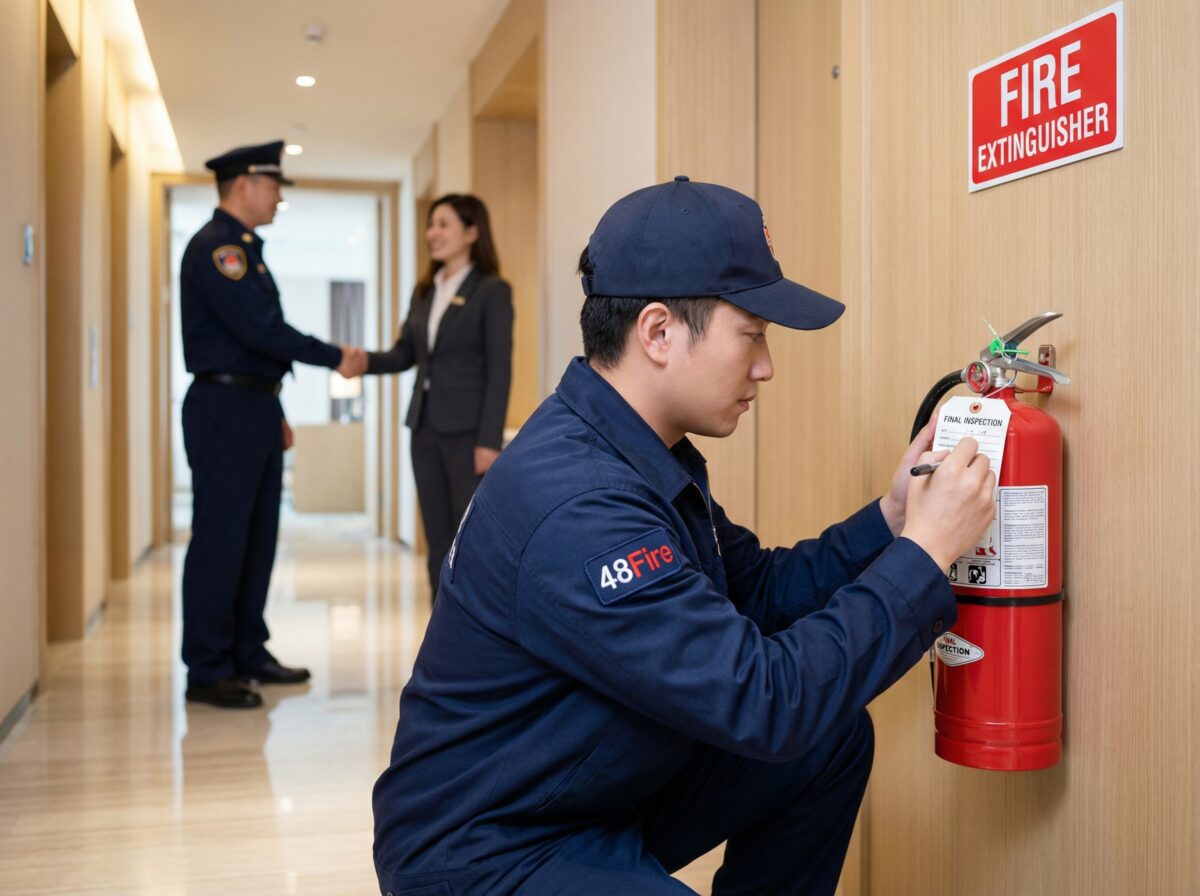
Monthly inspection program. 48Fire implements visual inspections every 30 days as required by NFPA 10. Each inspection verifies pressure, seals, accessibility, and physical condition. Technicians document findings digitally, creating a compliance trail.
Annual maintenance schedule. Professional maintenance by certified technicians includes internal examinations, mechanical checks, and new tamper seals with dated tags. 48Fire coordinates these appointments in advance, ensuring no unit is ever overdue.
Six-year and twelve-year service. The plan incorporates long-term maintenance requirements, including the six-year internal examination for stored pressure extinguishers and twelve-year hydrostatic testing.
Staff training. 48Fire trains hotel staff to perform basic visual checks between professional inspections. Employees learn what to look for and when to report issues immediately.
—
Implementation: Building a Fire Safety Culture
Properties implementing comprehensive fire extinguisher service programs roll them out systematically.
Phase One: Emergency Corrections
48Fire technicians replace all failed extinguishers within 48 hours of assessment. They install proper ABC multipurpose extinguishers in corridors and guest areas, Class K wet chemical units in kitchens, and CO2 extinguishers near electrical panels.
Every new unit receives a fresh inspection tag and is positioned according to mounting height requirements—handles between 3.5 and 5 feet from the floor for units under 40 pounds.
Clear signage goes up immediately. Red signs with white lettering mark extinguisher locations, making them visible even in emergencies.
Phase Two: Establishing Routine
Monthly inspections become part of operational rhythm. 48Fire technicians arrive on scheduled dates, perform visual inspections, and provide same-day reports.
The maintenance team receives inspection checklists and learns to perform quick visual checks weekly. They verify:
- Pressure gauges remain in the green zone
- Pins and seals stay intact
- No physical damage or obstruction
- Extinguishers remain in designated locations
This dual-layer approach—professional monthly service plus internal weekly checks—catches problems early.
Phase Three: Proving Compliance
By the time annual fire inspections arrive, properties have months of documented compliance. Every extinguisher has:
- Current monthly inspection records
- Fresh annual maintenance tags from certified technicians
- Proper pressure readings
- Intact seals
- Clear accessibility
- Correct placement according to fire class and travel distance requirements
48Fire provides a complete compliance binder with:
- Facility inventory showing all extinguisher locations
- Monthly inspection logs with technician signatures
- Annual maintenance records with certification numbers
- Photos documenting proper placement and signage
- Staff training documentation
—
The Inspection: Achieving Zero Violations
When fire marshals conduct annual inspections at well-prepared properties, the difference is immediately apparent.
Inspectors check extinguisher locations in corridors, finding units properly placed within the 75-foot travel distance requirement for Class A fires. Kitchen extinguishers meet the 30-foot maximum for Class K hazards.
Every pressure gauge shows needles firmly in the green zone. Tamper seals remain intact across all units. Inspection tags display current dates with certified technician information.
The compliance binder provides complete documentation. Inspectors can trace the maintenance history of every extinguisher, verifying the property has met all NFPA 10 monthly inspection and annual maintenance requirements.
Physical condition inspection reveals no corrosion, damage, or accessibility issues. Signage is clear and properly positioned. Mounting heights meet code.
The result: Zero violations. Properties with systematic fire extinguisher service programs consistently pass complete fire safety inspections without deficiencies.
—
The Business Impact Beyond Compliance
Passing inspection solves the immediate compliance problem, but the benefits extend further.
Insurance and Liability
Insurance carriers review fire extinguisher service programs during annual risk assessments. Documented compliance and professional maintenance support renewal negotiations. Risk managers note systematic approaches as positive factors in overall fire protection posture.
Guest and Tenant Confidence
Modern travelers and commercial tenants increasingly research property safety. Visible fire safety equipment and clear emergency information create confidence. Sales teams can highlight perfect fire inspection records in group bookings and corporate contracts.
Operational Efficiency
Properties eliminate emergency service calls and last-minute scrambles before inspections. 48Fire’s scheduled maintenance means predictable costs and no surprises. Facility managers can focus on other priorities instead of constantly worrying about fire code compliance.
Staff Confidence
Employees feel better prepared to respond in emergencies. Training on extinguisher location and proper use creates a safety-conscious culture. Maintenance teams take pride in their role supporting compliance.
—
Key Lessons for Other Properties
Successful fire extinguisher service implementation offers practical lessons for any commercial property managing fire code requirements.
Professional Service Beats DIY
Attempting to handle fire extinguisher maintenance without certified expertise leads to gaps. NFPA 10 requires trained technicians for annual maintenance and hydrostatic testing. Professional service providers like 48Fire have the tools, training, and documentation systems to ensure complete compliance.
Monthly Inspections Are Non-Negotiable
NFPA 10 mandates visual inspections at minimum 30-day intervals. These quick checks catch problems before they become violations. Skipping monthly inspections might save time short-term but creates massive risk during annual fire marshal visits.
Documentation Proves Compliance
Inspectors need evidence, not promises. Complete records showing consistent monthly inspections and annual maintenance demonstrate a property’s commitment to fire safety. 48Fire provides digital documentation that creates an audit trail inspectors can verify instantly.
Placement Matters as Much as Maintenance
Even perfectly maintained extinguishers fail inspection if placement violates travel distance requirements. Properties must ensure:
- Class A hazards: 75-foot maximum travel distance
- Class B hazards: 50-foot maximum travel distance
- Class K hazards (kitchens): 30-foot maximum travel distance
48Fire conducts placement audits to verify compliance with OSHA 1910.157 and NFPA 10 standards.
Training Creates a Safety Culture
Equipment alone doesn’t ensure safety. Staff training on visual inspection protocols, proper extinguisher use (PASS technique), and when to call for professional service creates organizational awareness that supports compliance.
—
Maintaining Success: The Ongoing Program
Properties that achieve zero-violation inspections maintain perfect compliance through continued partnership with 48Fire.
The monthly inspection schedule never wavers. Technicians arrive on predetermined dates, perform thorough visual inspections, and document findings in the digital system. Any issues trigger immediate service—pressure loss means recharging, broken seals mean replacement, corrosion means new units.
Annual maintenance happens like clockwork. 48Fire schedules these appointments months in advance, ensuring every extinguisher receives its required yearly service within the proper timeframe. Fresh tags go on each unit, and documentation updates immediately.
The six-year internal examination cycle is mapped out for units approaching that milestone. 48Fire tracks these longer-term requirements automatically, notifying properties well before deadlines.
Staff training happens annually for new employees and refresher sessions for existing team members. Facility managers credit this ongoing education with maintaining the safety-conscious culture that supports compliance.
—
Beyond Extinguishers: Comprehensive Fire Protection
Fire extinguisher service success often leads to expanded partnership with 48Fire for comprehensive fire protection needs.
Fire alarm system inspections happen on the same reliable schedule. Quarterly testing ensures all notification devices, smoke detectors, and control panels function properly.
Emergency lighting testing verifies egress illumination works during power failures. Monthly tests and annual full-duration tests meet code requirements.
Fire sprinkler system inspections follow NFPA 25 schedules for quarterly, semi-annual, and annual testing. Backflow preventer testing, valve inspections, and flow tests document complete system reliability.
The consolidated approach through 48Fire simplifies vendor management, improves communication, and ensures all fire protection systems receive coordinated, professional service.
—
The Real Value: Peace of Mind
The greatest benefit of systematic fire extinguisher service isn’t avoiding violations—it’s confidence.
Confidence that every extinguisher is properly maintained and documented. Confidence that staff knows how to respond in emergencies. Confidence that the next fire inspection will verify compliance, not expose deficiencies.
That confidence comes from partnering with 48Fire—a fire protection services provider that understands compliance requirements and delivers consistent, professional service.
—
Start Your Path to Zero Violations
Your property doesn’t need to struggle with fire extinguisher inspection failures. 48Fire provides the certified expertise, systematic service, and complete documentation that transforms fire safety compliance from a burden into a competitive advantage.
Every commercial property faces the same NFPA 10 and OSHA requirements. The difference between violation-free inspections and repeated failures is a professional fire extinguisher service program that addresses:
- Monthly visual inspections with documented findings
- Annual maintenance by certified technicians
- Proper recharging and hydrostatic testing schedules
- Strategic placement meeting travel distance requirements
- Complete recordkeeping proving compliance history
48Fire serves commercial properties, hotels, multifamily housing, healthcare facilities, and industrial clients across the United States. Local technicians understand regional fire code requirements and provide responsive service when you need it.
Talk to an Expert! Contact 48Fire at [/contact-us](/contact-us) to schedule a fire extinguisher service assessment. Our certified technicians will evaluate your current compliance status, identify gaps, and create a customized maintenance program that ensures your property passes every inspection with confidence.
—
Frequently Asked Questions
How often must fire extinguishers be inspected?
NFPA 10 requires visual inspections monthly (minimum 30-day intervals) and professional maintenance annually by certified technicians. Additional requirements include six-year internal examinations and twelve-year hydrostatic testing depending on extinguisher type.
What happens during a monthly fire extinguisher inspection?
Monthly visual inspections verify the extinguisher is accessible, the pressure gauge shows proper charge, seals and pins are intact, and there’s no physical damage or corrosion. Inspections take minutes per unit but must be documented to prove compliance.
Can hotel staff perform fire extinguisher inspections themselves?
Staff can perform monthly visual inspections after proper training. However, annual maintenance, recharging, and hydrostatic testing must be performed by certified technicians with appropriate tools and training. 48Fire provides both professional service and staff training.
What are the travel distance requirements for fire extinguishers?
OSHA 1910.157 and NFPA 10 specify maximum travel distances based on fire class: 75 feet for Class A (ordinary combustibles), 50 feet for Class B (flammable liquids), and 30 feet for Class K (cooking oils/fats). Travel distance is measured along walking paths, not straight lines.
How long do fire extinguishers last?
Fire extinguishers typically last 5-15 years depending on type, environment, and maintenance. However, they require regular service throughout their lifespan—monthly inspections, annual maintenance, six-year internal examination, and hydrostatic testing every 5-12 years based on type. Proper maintenance extends usable life.
What documentation do fire inspectors require?
Inspectors need proof of monthly visual inspections, annual maintenance by certified technicians, and any recharging or hydrostatic testing. Documentation should include dates, technician certification numbers, and service details. 48Fire provides complete digital recordkeeping that satisfies inspector requirements.
What types of fire extinguishers does a hotel need?
Hotels typically require multiple extinguisher types: ABC dry chemical for corridors and common areas (Class A, B, C fires), Class K wet chemical for kitchens (cooking oil fires), and CO2 for electrical/server rooms. Specific requirements depend on facility layout, hazards present, and local fire codes.
How much does professional fire extinguisher service cost?
Costs vary based on property size, number of extinguishers, and service frequency. Professional programs typically include monthly inspections, annual maintenance, and emergency service. 48Fire provides transparent pricing and customized service plans. Contact us at [/contact-us](/contact-us) for a detailed assessment and quote.