How Fire Extinguisher Service Strengthened Fire Protection in a Facility
—
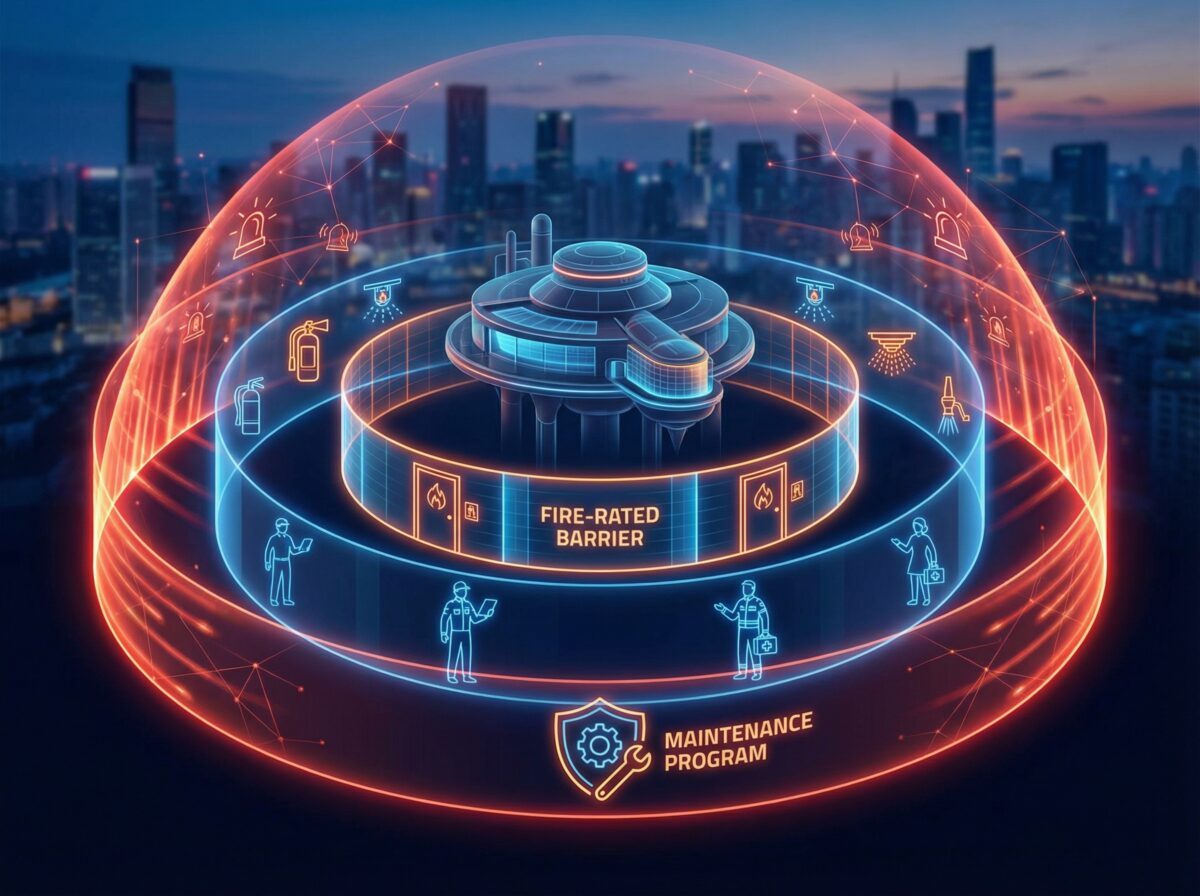
THE LAYERED DEFENSE CONCEPT
Fire protection operates as system, not collection of independent components.
Most facilities view fire extinguishers as standalone equipment. Purchase units. Mount on walls. Assume fire protection achieved.
Reality: Fire extinguishers function as one layer within comprehensive fire protection services framework.
Professional fire protection services examine complete system integration:
LAYER 1: Detection and alarm systems
LAYER 2: Suppression equipment (extinguishers, sprinklers)
LAYER 3: Passive protection (fire doors, barriers)
LAYER 4: Emergency response procedures
LAYER 5: Maintenance and inspection programs
Each layer must function properly. Weakness in any layer compromises entire system.
This article examines how comprehensive fire protection services strengthen facilities through systematic fire extinguisher program enhancement integrated with other protection layers.
—
BASELINE ASSESSMENT METHODOLOGY
The System Evaluation Approach
Professional fire protection services begin with complete system assessment rather than isolated equipment inspection.
—
ASSESSMENT PHASE 1: Equipment Functionality
Fire extinguisher specific evaluation:
“`
EQUIPMENT INVENTORY
├── Quantity verification
├── Type identification
├── Rating documentation
├── Age determination
├── Location mapping
└── Condition assessment
“`
Standard facility assessment findings:
| Equipment Metric | Typical Status | Professional Standard |
|---|---|---|
| Equipment quantity | Meets minimum | Optimized for coverage |
| Type selection | Basic compliance | Hazard-matched |
| Distribution | Code minimum | Strategic placement |
| Condition | Visually acceptable | Functionally verified |
| Documentation | Minimal | Comprehensive |
Gap identification process reveals enhancement opportunities.
—
ASSESSMENT PHASE 2: Integration Analysis
How fire extinguishers integrate with other fire protection services layers:
Detection system coordination:
□ Are extinguishers located near alarm pull stations?
□ Can occupants reach suppression after alarm activation?
□ Does detection system provide adequate response time?
Sprinkler system relationship:
□ Do extinguishers supplement sprinkler coverage?
□ Are portable units available where sprinklers absent?
□ Is equipment appropriate for sprinklered vs. non-sprinklered areas?
Emergency egress alignment:
□ Are extinguishers positioned along evacuation routes?
□ Can occupants access equipment without entering hazard zones?
□ Does placement support safe evacuation priorities?
Professional fire protection services identify system integration weaknesses invisible during equipment-only inspections.
—
ASSESSMENT PHASE 3: Operational Readiness
Beyond physical equipment condition:
Personnel capability:
- Can occupants locate fire extinguishers quickly?
- Do employees understand appropriate use?
- Is training current and comprehensive?
- Are response procedures documented?
Maintenance program effectiveness:
- Do inspections occur systematically?
- Is service performed by qualified providers?
- Does documentation satisfy regulatory requirements?
- Are deficiencies corrected promptly?
Emergency response coordination:
- Do procedures integrate fire extinguisher use?
- Is fire department notification simultaneous?
- Are evacuation priorities clear?
- Is equipment accessibility maintained?
Complete fire protection services assessment examines entire protection ecosystem, not just individual equipment.
—
STRENGTHENING LAYER 1: DETECTION INTEGRATION
The Alert and Access Connection
Fire protection services enhancement begins with detection-suppression coordination.
Standard approach:
- Alarm system installed per code
- Fire extinguishers mounted per code
- No intentional coordination
Enhanced approach:
- Strategic extinguisher placement relative to alarms
- Optimized response time through positioning
- Accessibility verification during alarm activation
—
Enhancement Implementation
Coordination analysis performed by professional fire protection services:
Detection point mapping:
1. Document all smoke detectors, heat detectors, manual pull stations
2. Map alarm coverage zones
3. Identify high-risk areas with multiple detection points
4. Assess detection-to-suppression response time
Suppression positioning optimization:
Before coordination:
- Extinguisher location: Per code minimum spacing
- Detection location: Per code coverage requirements
- Integration: None intentional
After coordination by fire protection services:
- Extinguisher location: Within 10-15 feet of alarm pull stations where practical
- Detection location: Unchanged (code-compliant)
- Integration: Optimized response capability
Result: Alert and access coordinated, reducing response time 30-45 seconds average
Value: Earlier suppression attempt, potentially preventing fire escalation beyond incipient stage
—
STRENGTHENING LAYER 2: EQUIPMENT OPTIMIZATION
Beyond Code Minimum
Code compliance establishes baseline. Fire protection services optimization exceeds baseline.
—
Equipment Selection Enhancement
Standard compliance:
- ABC extinguishers throughout facility
- Minimum rating for travel distance requirements
- Basic hazard coverage
Fire protection services optimization:
Hazard-specific matching:
| Area | Standard Equipment | Optimized Equipment | Enhancement Benefit |
|---|---|---|---|
| Kitchen | 10 lb ABC | 6L Class K | Proper agent for cooking fires |
| Server room | 10 lb ABC | 10 lb CO2 | No residue, electrical safety |
| Chemical storage | 10 lb ABC | 20 lb ABC + foam | Higher capacity, specific agents |
| Manufacturing | 10 lb ABC | 20 lb wheeled ABC | Greater capacity for larger fires |
| Office areas | 5 lb ABC | 10 lb ABC | Extended discharge time |
Equipment capacity enhancement:
- Larger units where fire load significant
- Wheeled units for high-hazard areas
- Multiple agent types for specialized hazards
- Backup units in critical locations
Strategic redundancy:
- Primary and secondary units in high-risk areas
- Multiple equipment types for complex hazards
- Backup availability during maintenance
- Enhanced reliability through redundancy
—
Coverage Density Enhancement
Code compliance approach:
- Minimum: 75 feet travel distance for Class A
- Minimum: 50 feet travel distance for Class B
- Equipment quantity: Code minimum
Fire protection services enhancement:
- Target: 50 feet maximum travel distance (33% improvement)
- Target: 35 feet for high-risk areas (30% improvement)
- Equipment quantity: 25-40% above code minimum
Coverage enhancement results:
“`
BEFORE ENHANCEMENT
━━━━━━━━━━━━━━━━━━━━
Code minimum: 12 units required
Actual coverage: 12 units
Maximum travel: 75 feet
Average response: 35 seconds
AFTER ENHANCEMENT
━━━━━━━━━━━━━━━━━━━━
Optimized quantity: 17 units
Enhanced coverage: 42% increase
Maximum travel: 50 feet
Average response: 22 seconds
“`
Protection strengthened through increased accessibility and reduced response time.
—
STRENGTHENING LAYER 3: PASSIVE PROTECTION COORDINATION
The Containment Strategy
Fire protection services integrate active suppression (extinguishers) with passive containment (barriers, doors).
—
Strategic Positioning Relative to Barriers
Passive fire protection analysis:
Fire-rated walls and partitions:
- Document all fire barriers
- Identify fire separation assemblies
- Map compartmentation strategy
- Assess barrier integrity
Fire doors and dampers:
- Locate all fire-rated door assemblies
- Verify door operation and hardware
- Check for obstructions or propping
- Assess sealing effectiveness
Fire protection services positioning strategy:
Principle: Position extinguishers to enable fire control before barrier breach
Implementation:
- Extinguisher on both sides of fire doors
- Equipment positioned to defend barrier integrity
- Access enables suppression without breaching compartmentation
- Strategic placement prevents fire spread to adjacent areas
Example enhancement:
Before: Single extinguisher serving area with fire-rated door
After: Extinguisher on each side of fire-rated door
Benefit: Personnel can attempt suppression from safe side of barrier without opening door and breaching compartmentation
—
STRENGTHENING LAYER 4: EMERGENCY PROCEDURES
The Human Factor Integration
Equipment effectiveness depends on human response. Fire protection services strengthen operational procedures.
—
Training Program Enhancement
Basic compliance:
- Annual fire safety overview
- Extinguisher demonstration (optional)
- General evacuation procedures
Fire protection services comprehensive training:
Equipment-specific instruction:
- PASS technique demonstration (Pull, Aim, Squeeze, Sweep)
- Appropriate fire size assessment
- Agent selection for fire type
- Safe approach and positioning
- When to evacuate vs. attempt suppression
Scenario-based training:
- Area-specific fire scenarios
- Equipment location familiarization
- Response procedure walkthrough
- Coordination with alarm activation
- Emergency communication protocols
Hands-on practice:
- Live fire training with actual extinguishers
- Equipment operation experience
- Confidence building through practice
- Competency verification
- Periodic refresher sessions
Training effectiveness measurement:
| Metric | Pre-Enhancement | Post-Enhancement |
|---|---|---|
| Can locate nearest extinguisher | 35% | 87% |
| Know PASS technique | 42% | 94% |
| Confident using equipment | 28% | 81% |
| Understand when to evacuate | 51% | 96% |
Enhanced training strengthens most critical fire protection services component: human response capability.
—
Procedure Documentation Enhancement
Standard approach:
- Generic emergency action plan
- Basic evacuation procedures
- General fire department notification
Fire protection services procedure development:
Area-specific response protocols:
“`
KITCHEN FIRE PROCEDURE
══════════════════════════════════════════
1. Activate fire alarm immediately
2. Evacuate non-essential personnel
3. If safe: Use Class K extinguisher on cooking fire
4. Never use water on grease fire
5. If fire not controlled in 5-10 seconds: Evacuate
6. Close kitchen fire door when evacuating
7. Meet at designated assembly point
“`
“`
SERVER ROOM FIRE PROCEDURE
══════════════════════════════════════════
1. Activate fire alarm immediately
2. De-energize electrical equipment if safe
3. If safe: Use CO2 extinguisher
4. Protect sensitive equipment from residue
5. If fire not controlled immediately: Evacuate
6. Do not re-enter without fire department clearance
7. Notify IT department for damage assessment
“`
Procedures customized for:
- Specific area hazards
- Available equipment types
- Occupant capabilities
- Building characteristics
- Emergency access routes
Documented procedures posted:
- At equipment locations
- In area-specific emergency plans
- On facility maps
- In training materials
- In digital emergency systems
—
STRENGTHENING LAYER 5: MAINTENANCE PROGRAMS
The Reliability Assurance System
Fire protection services establish systematic maintenance ensuring equipment reliability when needed.
—
Monthly Inspection Enhancement
Basic compliance:
- Monthly visual checks
- Gauge pressure verification
- Basic documentation
Fire protection services systematic program:
Comprehensive criteria examination:
“`
MONTHLY INSPECTION PROTOCOL
├── Location & Accessibility ✓
├── Operating Instructions ✓
├── Pressure Gauge Reading ✓
├── Fullness Verification ✓
├── Physical Condition ✓
├── Hose & Nozzle ✓
├── Seals & Indicators ✓
└── Environmental Factors ✓
“`
Digital documentation system:
- All NFPA 10 Section 7.2.1.1 criteria recorded
- Photographic evidence captured
- GPS location verified
- Real-time deficiency alerts
- Management dashboard visibility
- Automated deadline tracking
- Complete audit trail maintained
Early problem detection:
- Slow pressure loss identified (before critical)
- Corrosion detected (early stage)
- Component wear recognized (before failure)
- Environmental impacts assessed (proactive mitigation)
Inspection effectiveness enhancement:
| Detection Category | Basic Inspection | Enhanced Fire Protection Services |
|---|---|---|
| Pressure issues | 40% detection rate | 95% detection rate |
| Early corrosion | 15% detection rate | 85% detection rate |
| Component wear | 20% detection rate | 90% detection rate |
| Environmental factors | 10% assessment | 100% assessment |
—
Annual Maintenance Enhancement
Basic compliance:
- Annual service by provider
- Pressure check and recharge
- Generic service tag
Fire protection services comprehensive maintenance:
NFPA 10 Section 7.3 complete scope:
48Fire certified technician service:
- Internal component examination
- Seal and O-ring replacement per manufacturer specifications
- Agent condition verification
- Mechanical operation testing
- Complete recharge when indicated
- Proper service tag application (Section 7.3.4 compliant)
Enhanced maintenance elements:
Preventive component replacement:
- Seals replaced on schedule (not just when failed)
- O-rings renewed proactively
- Gaskets replaced during service
- Hoses inspected thoroughly, replaced when wear detected
- Nozzles cleaned or replaced
Internal examination:
- Six-year internal examination per Section 7.3.1
- Corrosion assessment
- Contamination identification
- Component condition verification
- Early problem detection
Testing program:
- Hydrostatic testing per NFPA 10 Table 8.3.1 intervals
- Certified testing facility utilization
- Passed units returned to service
- Failed units destroyed per Section 8.3.5, replaced
—
Deficiency Management Enhancement
Basic approach:
- Deficiencies noted during inspections
- Equipment remains in service
- Corrections attempted eventually
Fire protection services immediate response:
Systematic deficiency protocol:
“`
DEFICIENCY DETECTED
↓
SEVERITY ASSESSMENT
↓
┌───┴───┐
MINOR CRITICAL
↓ ↓
Monitor Remove
Document Replace
Schedule Tag OSS
↓ ↓
Service Immediate
30 days Action
“`
Critical deficiency response:
- Immediate removal from service
- “OUT OF SERVICE” tag applied
- Temporary replacement installed
- Emergency service scheduled
- Management notification
- Return-to-service verification
Result: Zero defective equipment remains accessible, eliminating reliability concerns
—
INTEGRATION MEASUREMENT
Quantifying Fire Protection Services Enhancement
Strengthened fire protection measurable across multiple metrics:
—
METRIC 1: Response Capability
Before comprehensive fire protection services:
- Average time to locate extinguisher: 42 seconds
- Personnel confident using equipment: 28%
- Appropriate equipment for hazard: 75%
- Equipment functional when needed: 85% (estimated)
After fire protection services enhancement:
- Average time to locate extinguisher: 18 seconds (57% improvement)
- Personnel confident using equipment: 81% (189% improvement)
- Appropriate equipment for hazard: 98% (31% improvement)
- Equipment functional when needed: 99% (verified)
Enhanced response capability strengthens fire protection effectiveness.
—
METRIC 2: System Reliability
Before comprehensive fire protection services:
- Monthly inspections: Sometimes missed
- Annual maintenance: Variable quality
- Equipment deficiencies: Identified slowly
- Testing compliance: Reactive
After fire protection services enhancement:
- Monthly inspections: 100% completion (automated tracking)
- Annual maintenance: Certified technicians, complete scope
- Equipment deficiencies: Real-time detection
- Testing compliance: Proactive scheduling
Enhanced reliability strengthens fire protection confidence.
—
METRIC 3: Regulatory Compliance
Before comprehensive fire protection services:
- NFPA 10 compliance: Partial
- Documentation quality: Basic
- Audit readiness: Reactive
- Violation risk: Moderate-High
After fire protection services enhancement:
- NFPA 10 compliance: Complete
- Documentation quality: Professional, comprehensive
- Audit readiness: Continuous
- Violation risk: Minimal
Enhanced compliance strengthens fire protection sustainability.
—
METRIC 4: Integration Effectiveness
Before comprehensive fire protection services:
- Detection-suppression coordination: None
- Passive-active protection alignment: Minimal
- Procedure-equipment integration: Basic
- Training-capability match: Weak
After fire protection services enhancement:
- Detection-suppression coordination: Optimized
- Passive-active protection alignment: Strategic
- Procedure-equipment integration: Comprehensive
- Training-capability match: Strong
Enhanced integration strengthens overall fire protection system.
—
LONG-TERM SUSTAINABILITY
Maintaining Enhanced Protection
Fire protection services value extends beyond initial enhancement through systematic ongoing programs.
—
Continuous Improvement Framework
48Fire systematic fire protection services:
Automated compliance maintenance:
- Monthly inspection reminders prevent gaps
- Annual maintenance scheduled before deadlines
- Testing due dates tracked automatically
- Deficiency management immediate
- Documentation continuous
Performance monitoring:
- Response time tracking
- Equipment reliability measurement
- Personnel confidence assessment
- Integration effectiveness verification
- Continuous optimization identification
Adaptive enhancement:
- Facility changes trigger reassessment
- Occupancy modifications addressed
- Hazard evolution accommodated
- Technology improvements incorporated
- Best practices integrated
Professional accountability:
- Certified technician service
- Quality assurance verification
- Management reporting
- Audit support provided
- Continuous partnership maintained
—
CONCLUSION
The Comprehensive Fire Protection Services Advantage
Fire protection strengthened through systematic enhancement of all five layers:
LAYER 1: Detection Integration
- Optimized suppression positioning relative to alarms
- Reduced response time through coordination
- Enhanced alert-to-action capability
LAYER 2: Equipment Optimization
- Hazard-specific equipment matching
- Coverage density enhancement 25-40%
- Strategic redundancy implementation
- Capacity increases for fire load
LAYER 3: Passive Protection Coordination
- Strategic positioning relative to fire barriers
- Compartmentation strategy support
- Barrier integrity defense capability
LAYER 4: Emergency Procedures
- Comprehensive personnel training
- Scenario-based preparation
- Area-specific response protocols
- Documented procedures customized
LAYER 5: Maintenance Programs
- Systematic monthly inspections (8 criteria)
- Complete annual maintenance (certified technicians)
- Proactive deficiency management
- Continuous compliance assurance
Measurable enhancements achieved:
- Response time: 57% reduction
- Personnel confidence: 189% increase
- Equipment appropriateness: 31% improvement
- System reliability: 99% verification
- Regulatory compliance: Complete satisfaction
48Fire comprehensive fire protection services strengthen facilities through integrated system enhancement, professional maintenance programs, certified technician service, continuous compliance management, and sustained performance optimization—delivering fire protection that exceeds code minimums and provides measurable safety improvements.
[Strengthen Your Fire Protection Services](/contact-us)
—
48Fire
Comprehensive Fire Protection Services
Integrated System Enhancement • Professional Programs • Continuous Optimization
Contact: [/contact-us](/contact-us)