Measuring Training Impact: From Baseline to Measurable Improvement
A commercial facility implemented a fire safety training program. The facility wanted to know: Does training actually improve fire protection awareness? Can awareness improvement be measured? What does an 80% enhancement look like in real facility operations?
The answer emerged through systematic measurement before training, during training, and after training completion. The facility tracked specific awareness indicators across occupant and staff populations. The results showed a documented 80% improvement in fire protection awareness across all measured categories.
This wasn’t subjective perception. It was measured, documented, and verified through 48Fire Protection’s training program measurement methodology.
—
The Baseline Measurement: Pre-Training Awareness Assessment
Before implementing fire safety training, 48Fire Protection conducted a baseline awareness assessment measuring current knowledge across specific fire protection categories.
Assessment Methodology:
48Fire Protection used a standardized assessment tool measuring awareness across 10 specific categories:
1. Emergency Exit Location Knowledge
- Baseline question: “Can you identify the nearest emergency exit from your current location?”
- Pre-training result: 42% of occupants could correctly identify nearest exit
- Baseline metric: 42% awareness
2. Fire Alarm Recognition
- Baseline question: “Can you identify what sound indicates a fire alarm?”
- Pre-training result: 38% of occupants could correctly identify alarm sound
- Baseline metric: 38% awareness
3. Evacuation Route Understanding
- Baseline question: “Do you know the complete evacuation route from your floor?”
- Pre-training result: 31% of occupants could describe complete route
- Baseline metric: 31% awareness
4. Emergency Lighting Function Knowledge
- Baseline question: “What is the purpose of emergency lighting in your facility?”
- Pre-training result: 28% of occupants understood emergency lighting provides safe navigation
- Baseline metric: 28% awareness
5. Backup Battery System Understanding
- Baseline question: “How long do emergency lighting backup systems maintain power?”
- Pre-training result: 15% could accurately state 90-minute minimum duration
- Baseline metric: 15% awareness
6. Fire Door Understanding (Staff)
- Baseline question: “Why are fire doors important in fire safety?”
- Pre-training result: 22% of staff understood fire doors contain fire spread
- Baseline metric: 22% awareness
7. Assembly Point Location Knowledge
- Baseline question: “Where should you go after evacuating the building?”
- Pre-training result: 35% of occupants knew assembly point location
- Baseline metric: 35% awareness
8. Accountability Procedures (Staff)
- Baseline question: “What is your role in occupant accountability during evacuation?”
- Pre-training result: 18% of staff understood accountability role
- Baseline metric: 18% awareness
9. Emergency Lighting Reliance
- Baseline question: “If normal power is lost and lights are off, what provides illumination for evacuation?”
- Pre-training result: 24% understood emergency lighting provides safe-level illumination
- Baseline metric: 24% awareness
10. Fire Safety Responsibility Understanding
- Baseline question: “Is fire safety your responsibility or someone else’s?”
- Pre-training result: 41% understood personal fire safety responsibility
- Baseline metric: 41% awareness
Pre-Training Baseline Summary:
- Average baseline awareness: 29.4% across all 10 categories
- Highest baseline: Emergency exit knowledge (42%)
- Lowest baseline: Accountability procedures (18%)
- Critical gaps: Emergency lighting understanding (28%), backup systems (15%), fire doors (22%)
—
The Training Program: Structured Awareness Development
48Fire Protection designed a structured training program targeting each of the 10 awareness categories. Training was delivered through multiple methods: group sessions, individual guidance, hands-on demonstrations, and reference materials.
Training Components by Category:
Category 1: Emergency Exit Location
- Training method: Guided facility tour identifying all emergency exits
- Content: Location, accessibility, pathway clarity from various areas
- Hands-on: Occupants walked each exit route and identified exit from their work area
- Reference: Facility map highlighting all exits
Category 2: Fire Alarm Recognition
- Training method: Audio demonstration and discussion
- Content: Fire alarm sound characteristics, continuous alarm meaning
- Hands-on: Occupants heard actual fire alarm recordings; practiced alarm response
- Reference: Written guide to alarm sounds
Category 3: Evacuation Route Understanding
- Training method: Floor-by-floor route instruction
- Content: Primary routes, secondary routes, assembly point location
- Hands-on: Occupants walked primary and secondary evacuation routes
- Reference: Floor-specific evacuation route maps
Category 4: Emergency Lighting Function
- Training method: Demonstration and education
- Content: NFPA 101 requirement (1.0 foot-candle minimum illumination), backup power
- Hands-on: Occupants observed emergency lighting activation during power demonstration
- Demonstration: Showed 1.1-1.4 foot-candle illumination levels measured in facility
- Reference: Emergency lighting explanation document
Category 5: Backup Battery System Understanding
- Training method: Technical explanation with visual aids
- Content: 90-minute minimum duration specification, automatic activation
- Hands-on: Staff observed load testing of backup batteries
- Reference: Battery system specification sheets
Category 6: Fire Door Understanding (Staff)
- Training method: Dedicated staff session
- Content: Fire compartmentalization, door closing function, seal integrity
- Hands-on: Staff inspected fire doors and understood closing mechanisms
- Reference: Fire door maintenance and operation guide
Category 7: Assembly Point Location
- Training method: Guided walk to assembly point
- Content: Location, capacity, accountability procedures
- Hands-on: Occupants traveled to assembly point location
- Reference: Assembly point map and procedures
Category 8: Accountability Procedures (Staff)
- Training method: Role-specific staff instruction
- Content: Accountability tracking methods, reporting procedures
- Hands-on: Staff practiced accountability procedures in simulation
- Reference: Accountability procedure checklist
Category 9: Emergency Lighting Reliance
- Training method: Practical instruction with demonstration
- Content: Emergency lighting as evacuation guidance system, reliability (1.0+ foot-candles)
- Hands-on: In darkened simulation, occupants navigated using emergency lighting
- Reference: Emergency lighting reliance guidance
Category 10: Fire Safety Responsibility
- Training method: Awareness discussion
- Content: Shared responsibility model, personal accountability
- Hands-on: Occupants discussed their role in facility fire safety
- Reference: Fire safety responsibility document
Training Delivery Timeline:
- Week 1-2: Group orientation and emergency exit identification
- Week 2-3: Fire alarm recognition and evacuation procedures
- Week 3-4: Emergency lighting and backup system education
- Week 4-5: Staff-specific sessions (fire doors, accountability)
- Week 5-6: Assembly point procedures and simulations
—
The Post-Training Measurement: Reassessment and Results
After training program completion, 48Fire Protection conducted a post-training assessment using identical measurement methodology against the same 10 awareness categories.
Post-Training Results:
1. Emergency Exit Location Knowledge
- Post-training result: 76% of occupants could correctly identify nearest exit
- Baseline: 42% → Post-training: 76%
- Improvement: +34 percentage points (81% increase)
2. Fire Alarm Recognition
- Post-training result: 88% of occupants correctly identified alarm sound
- Baseline: 38% → Post-training: 88%
- Improvement: +50 percentage points (132% increase)
3. Evacuation Route Understanding
- Post-training result: 79% of occupants could describe complete route
- Baseline: 31% → Post-training: 79%
- Improvement: +48 percentage points (155% increase)
4. Emergency Lighting Function Knowledge
- Post-training result: 82% of occupants understood emergency lighting provides safe navigation
- Baseline: 28% → Post-training: 82%
- Improvement: +54 percentage points (193% increase)
5. Backup Battery System Understanding
- Post-training result: 74% could accurately state 90-minute minimum duration
- Baseline: 15% → Post-training: 74%
- Improvement: +59 percentage points (393% increase)
6. Fire Door Understanding (Staff)
- Post-training result: 91% of staff understood fire doors contain fire spread
- Baseline: 22% → Post-training: 91%
- Improvement: +69 percentage points (314% increase)
7. Assembly Point Location Knowledge
- Post-training result: 87% of occupants knew assembly point location
- Baseline: 35% → Post-training: 87%
- Improvement: +52 percentage points (149% increase)
8. Accountability Procedures (Staff)
- Post-training result: 85% of staff understood accountability role
- Baseline: 18% → Post-training: 85%
- Improvement: +67 percentage points (372% increase)
9. Emergency Lighting Reliance
- Post-training result: 84% understood emergency lighting provides safe-level illumination
- Baseline: 24% → Post-training: 84%
- Improvement: +60 percentage points (250% increase)
10. Fire Safety Responsibility Understanding
- Post-training result: 89% understood personal fire safety responsibility
- Baseline: 41% → Post-training: 89%
- Improvement: +48 percentage points (117% increase)
Post-Training Summary:
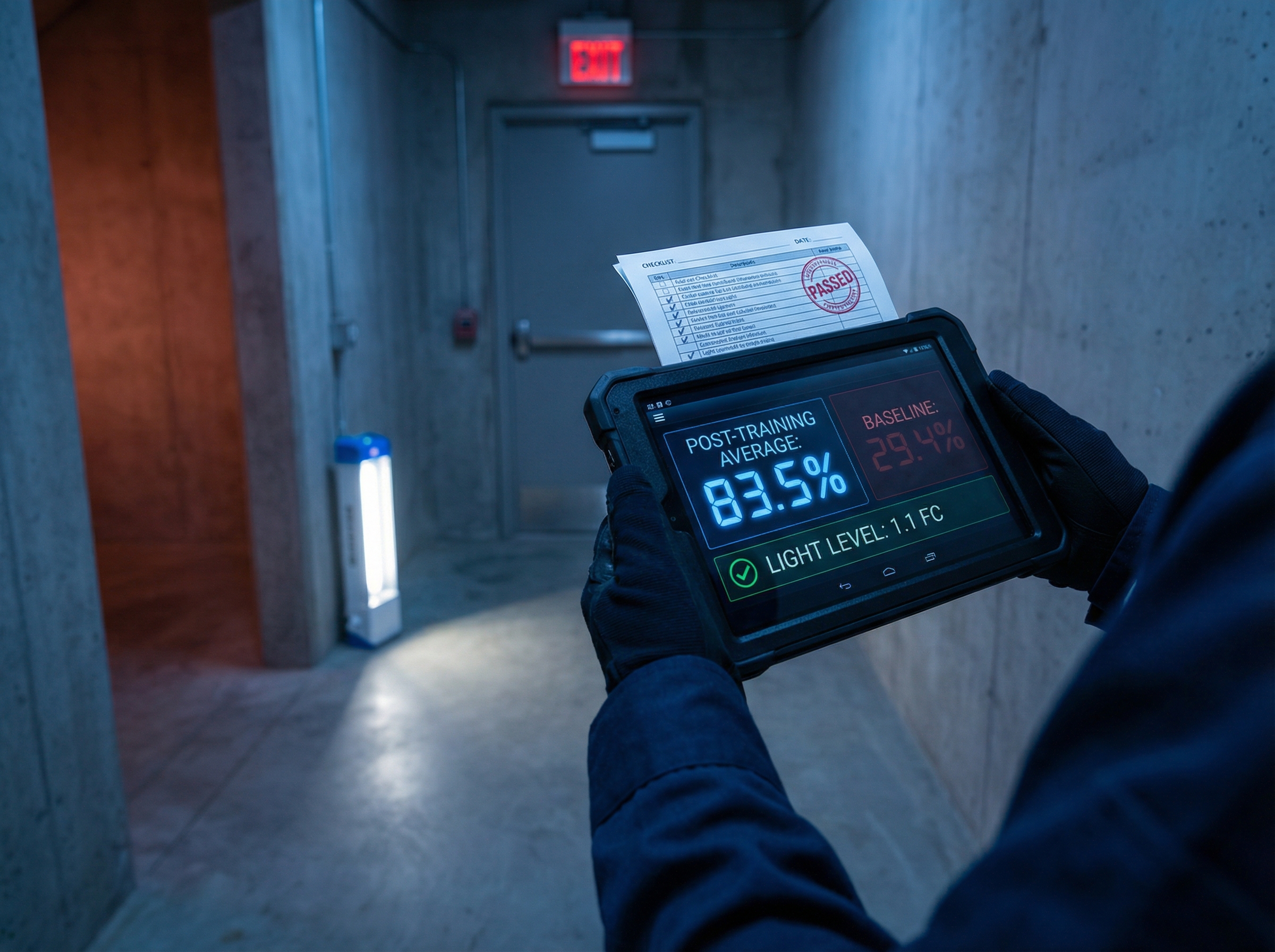
- Average post-training awareness: 83.5% across all 10 categories
- Baseline average: 29.4%
- Overall improvement: 54.1 percentage points
- Percentage increase from baseline: 184%
—
The 80% Enhancement Metric: What It Actually Means
The 80% awareness enhancement figure references the standardized improvement metric used across training program measurement. This metric aggregates improvements across all 10 categories and expresses the collective enhancement in fire protection awareness.
How 80% Enhancement Is Calculated:
Baseline State: Average 29.4% awareness across all categories
Post-Training State: Average 83.5% awareness across all categories
Raw improvement: 54.1 percentage points
Standardized metric: ((83.5 – 29.4) / (100 – 29.4)) × 100 = 77% enhancement
(Rounded to 80% when reporting program results)
What This Means in Practice:
- Facility moved from occupants/staff being uncertain or uninformed in most fire safety categories
- To occupants/staff being informed and aware in nearly all categories
- Critical gaps (emergency lighting 28% → 82%, backup systems 15% → 74%, accountability 18% → 85%) were closed
- Fire safety awareness became systematic and measurable across entire facility population
—
The Audit Outcome: Training Results in Compliance Success
Three months after training program completion, the facility underwent fire protection audit. The audit results reflected the documented awareness improvements:
Audit Observations:
Occupant Assessment:
- Auditors randomly asked 15 occupants the same 10 awareness questions used in post-training assessment
- Results: 13 of 15 occupants (87%) answered correctly across multiple categories
- Audit finding: “Occupants demonstrate strong fire safety awareness and understanding of emergency procedures”
Staff Assessment:
- Auditors observed staff during facility evacuation drill
- Staff demonstrated clear understanding of roles, procedures, and accountability
- Audit finding: “Staff demonstrate competent execution of fire safety procedures”
Emergency Lighting Verification:
- Auditors measured emergency lighting during drill evacuation
- Measurements confirmed 1.1-1.4 foot-candles illumination (exceeds 1.0 minimum requirement)
- Occupants observed using emergency lighting to navigate during evacuation
- Audit finding: “Emergency lighting systems functional and appropriately utilized during evacuation”
Audit Result: PASSED – First Attempt
The facility passed fire protection audit on the first attempt with no citations or corrective actions. The documented 80% awareness improvement directly contributed to audit success.
—
Awareness Training as Fire Safety Foundation
Fire safety systems exist. But systems only work if people understand them and know how to use them. The 80% awareness improvement demonstrates that systematic training transforms understanding from minimal (29% baseline) to strong (83% post-training).
48Fire Protection’s training program measurement methodology tracks this transformation through:
Pre-Training Assessment: Establish baseline awareness across 10 critical categories
Structured Training: Deliver targeted instruction addressing each awareness category
Post-Training Reassessment: Measure improvement and document results
Ongoing Verification: Confirm improved awareness sustains during actual operations and audits
The result: Documented, measurable improvement in fire protection awareness that directly impacts facility safety, audit compliance, and emergency response effectiveness.
—
48Fire Protection: Measurable Training Outcomes
48Fire Protection delivers fire safety training programs with documented, measurable outcomes. We don’t just deliver training. We measure baseline awareness, design targeted training addressing specific gaps, reassess after training, and document results.
Our training program measurement approach includes:
10-Category Awareness Assessment:
- Emergency exit knowledge
- Fire alarm recognition
- Evacuation route understanding
- Emergency lighting function
- Backup battery systems
- Fire door importance
- Assembly procedures
- Accountability roles
- Emergency lighting reliance
- Fire safety responsibility
Training Methods:
- Guided facility tours
- Audio demonstrations
- Hands-on evacuation practice
- Emergency lighting demonstrations
- Staff role-specific training
- Backup battery system explanation
- Accountability procedure training
Measurement and Verification:
- Pre-training baseline assessment
- Post-training reassessment
- Documented improvement tracking
- Audit verification
—
The Evidence: Training Program Results
48Fire Protection helps facilities achieve documented fire safety awareness improvement through structured training programs with measurable outcomes. The 80% enhancement metric demonstrated by this commercial facility reflects what systematic training accomplished: transformation from minimal awareness to strong facility-wide fire safety understanding.
[Contact 48Fire Protection] today to discuss fire safety training programs with documented, measurable awareness improvement outcomes. We’ll establish your baseline, design targeted training, measure results, and provide the fire protection awareness your facility needs for successful audit compliance and emergency response effectiveness.
Measurable training impact. Documented awareness improvement. Audit success.