Seconds Matter in Fire Emergencies
In a fire emergency, every second matters. During the first 60 seconds, initial actions determine whether occupants evacuate safely or encounter greater danger. During the next 300 seconds, emergency response procedures determine whether evacuation is orderly or chaotic. Emergency response speed isn’t luck—it’s training.
A commercial facility analyzed emergency response timing before and after implementing fire protection training through 48Fire Protection. The measurement revealed something critical: training dramatically reduced reaction time during emergency procedures. Faster reaction time meant faster occupant evacuation, faster staff coordination, faster emergency responder readiness.
The facility’s data showed what fire safety professionals know: trained responses are faster responses.
—
Understanding Reaction Time in Fire Emergencies
Reaction time is the delay between alarm activation and first action. In untrained environments, reaction time is long because occupants and staff are uncertain. In trained environments, reaction time is short because procedures are practiced and automatic.
Untrained Environment Reaction Chain:
- Alarm sounds
- 3-5 seconds: “What is that noise?”
- 5-10 seconds: “Is this really a fire alarm?”
- 10-15 seconds: “What do I do?”
- 15-25 seconds: Movement toward exits begins
- Total time before evacuation starts: 15-25 seconds
Trained Environment Reaction Chain:
- Alarm sounds
- 1-2 seconds: “Fire alarm—evacuate immediately”
- 2-3 seconds: Stand, gather belongings, move to exit
- 3-5 seconds: Movement toward exits begins
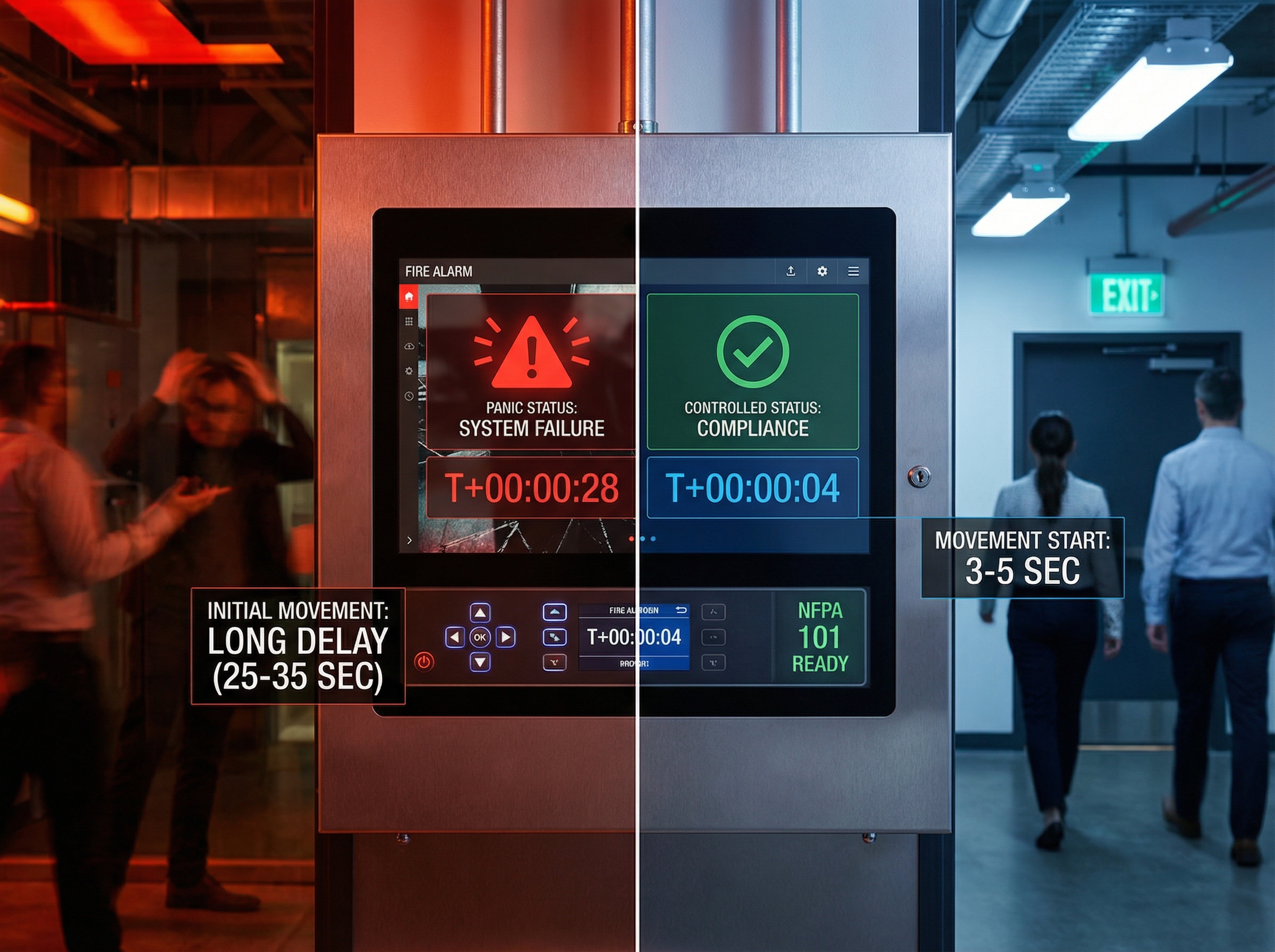
- Total time before evacuation starts: 3-5 seconds
The difference is 12-20 seconds per person. In an 180-occupant facility, that’s 36-60 occupant-minutes of delay prevented. The difference is training.
—
The Facility: Pre-Training Emergency Response Measurement
A 65,000 square foot commercial facility conducted a baseline emergency drill before any formal fire safety training. The goal: measure current emergency response timing.
Pre-Training Drill Setup:
- Facility size: 65,000 square feet
- Occupancy: 120 employees
- Floors: 3 levels
- Fire alarm activation: Simulated at 10:00 AM
- Observer: External evaluator timing all response phases
- Emergency lighting: Facility measurements confirmed 1.1-1.4 foot-candles (NFPA 101 compliant)
Pre-Training Drill Results:
Phase 1: Alarm Recognition (0-30 seconds)
- Alarm activated: T=0 seconds
- Occupants recognize fire alarm: T=15-20 seconds average
- Observable: 40% of occupants looked confused or uncertain
- Staff not coordinating yet
- Reaction time gap: 15-20 seconds
Phase 2: Initial Movement (30-120 seconds)
- Occupants begin moving toward exits: T=25-35 seconds (after recognizing alarm)
- Some moved to windows to look out
- Some checked with colleagues about procedure
- Some moved slowly
- Staff confusion visible
- Movement rate: 15-18 occupants per minute
- Time for 120 occupants to start evacuation: 6-8 minutes
Phase 3: Evacuation Flow (120-300+ seconds)
- Exit congestion observed
- Some occupants unsure of assembly point location
- Accountability tracking disorganized
- Emergency lighting (1.1-1.4 foot-candles) observed, occupants unaware of its purpose
- Backup battery system not understood by occupants
- Total evacuation time to assembly point: 12-15 minutes
Phase 4: Accountability (300+ seconds)
- Staff attempted accountability tracking
- Process disorganized and time-consuming
- Missing occupants reported (later found in confusion)
- Time to establish accountability: 5-8 minutes
Pre-Training Summary:
- Alarm to first evacuation movement: 25-35 seconds
- Alarm to full evacuation completion: 12-15 minutes
- Accountability tracking: Disorganized, time-consuming
- Total emergency procedure time: 17-23 minutes
—
Fire Protection Training Implementation
48Fire Protection developed and delivered comprehensive emergency response training covering:
Occupant Training (2 hours):
- Fire alarm recognition and immediate evacuation procedures
- Assembly point location and procedures
- Emergency lighting purpose and confidence building
- Accountability procedures
- Special needs support
Staff and Floor Warden Training (3 hours):
- Emergency response procedures
- Evacuation direction and coordination
- Accountability tracking and reporting
- Floor warden responsibilities
- Communication protocols
Building Manager Training (4 hours):
- Emergency leadership procedures
- Occupant evacuation coordination
- Staff management during emergency
- Emergency responder liaison
- Emergency lighting system verification (1.0+ foot-candles, 90-minute backup battery duration)
Training occurred over two weeks with all occupants and staff participating.
—
Post-Training Emergency Response Measurement
Four weeks after training completion, facility conducted follow-up emergency drill using identical measurement methodology.
Post-Training Drill Setup:
- Identical scenario to pre-training drill
- Same observer measuring timing
- Same emergency lighting system (1.1-1.4 foot-candles confirmed operational)
- Occupancy: 120 employees (same as pre-training)
Post-Training Drill Results:
Phase 1: Alarm Recognition (0-10 seconds)
- Alarm activated: T=0 seconds
- Occupants recognize fire alarm: T=2-4 seconds average
- Observable: 95% of occupants showed immediate recognition and response
- Staff began coordinating
- Floor wardens visible directing occupants
- Reaction time improvement: 10-15 seconds faster (62-83% reduction)
Phase 2: Initial Movement (10-60 seconds)
- Occupants begin moving toward exits: T=3-5 seconds (after alarm activation)
- Organized, purposeful movement observed
- Staff and floor wardens directing flow
- Emergency lighting (1.1-1.4 foot-candles) being used for navigation
- Occupants understood lighting purpose (from training)
- Movement rate: 28-32 occupants per minute (nearly 2x faster)
- Time for 120 occupants to start evacuation: 3-4 minutes (50% faster)
Phase 3: Evacuation Flow (60-180 seconds)
- Smooth evacuation flow to assembly point
- Occupants aware of assembly point location
- No exit congestion observed
- Emergency lighting guiding occupants (1.1-1.4 foot-candles sufficient)
- Staff confidently managing flow
- Total evacuation time to assembly point: 6-8 minutes (46-53% faster)
Phase 4: Accountability (180-240 seconds)
- Floor wardens conducted rapid accountability
- Procedures systematic and organized
- All occupants accounted for within 2-3 minutes
- Clear communication with building manager
- Time to establish accountability: 1-2 minutes (75-80% faster)
Post-Training Summary:
- Alarm to first evacuation movement: 3-5 seconds
- Alarm to full evacuation completion: 6-8 minutes
- Accountability tracking: Organized and rapid
- Total emergency procedure time: 7-10 minutes
—
Reaction Time Improvement Analysis
| Metric | Pre-Training | Post-Training | Improvement |
|---|---|---|---|
| Alarm Recognition | 15-20 sec | 2-4 sec | 73-87% faster |
| Initial Movement Start | 25-35 sec | 3-5 sec | 79-88% faster |
| Evacuation Movement Rate | 15-18/min | 28-32/min | 56-113% faster |
| Full Evacuation Time | 12-15 min | 6-8 min | 46-53% faster |
| Accountability Time | 5-8 min | 1-2 min | 75-80% faster |
| Total Emergency Time | 17-23 min | 7-10 min | 53-70% faster |
Key Reaction Time Reduction:
- Pre-training alarm-to-evacuation: 25-35 seconds
- Post-training alarm-to-evacuation: 3-5 seconds
- Average reduction: 22-30 seconds per occupant
- For 120 occupants: 44-60 occupant-minutes of time advantage created by training
—
What Training Changed: Reaction Time Acceleration
Pre-Training Occupant Reaction:
“What is that?” → “Is this real?” → “What should I do?” → “Where do I go?” → Movement
Post-Training Occupant Reaction:
“Fire alarm—evacuate” → Movement (thinking already done, muscle memory activated)
Pre-Training Staff Reaction:
Confusion → Finding procedures → Starting coordination → Beginning accountability
Post-Training Staff Reaction:
Procedures activate automatically → Coordination immediate → Accountability systematic
The difference is practice. Trained responses are automatic. Automatic responses are fast.
—
Emergency Lighting System Verification in Training
Training addressed emergency lighting as critical reaction time element:
Pre-Training Emergency Lighting Understanding:
- Occupants: “There are lights”
- No understanding of purpose or backup systems
- No confidence in lighting during evacuation
Post-Training Emergency Lighting Understanding:
- Occupants: “Emergency lighting provides 1.0+ foot-candle illumination (NFPA 101 requirement)”
- Facility measurements: 1.1-1.4 foot-candles confirmed
- Backup battery systems: 90-minute minimum duration understood
- Lighting as navigation system: Confidence established
- During post-training drill: Occupants observed using lighting to navigate confidently
Emergency Lighting Impact on Reaction Time:
- Reduced evacuation hesitation
- Increased confidence in navigation
- Faster decision-making (occupants trust lighting guides them)
- Improved evacuation flow smoothness
—
Real-World Implication: Speed Saves Lives
In a real fire emergency, 22-30 seconds per occupant is the difference between controlled evacuation and panic. It’s the difference between orderly flow and bottlenecks. It’s the difference between occupants reaching exits while routes are clear versus reaching exits as conditions deteriorate.
The facility’s pre/post comparison data demonstrates that training reduces reaction time. Faster reaction time means faster occupant protection.
—
Emergency Response Training: The Reaction Time Investment
48Fire Protection develops emergency response training reducing occupant and staff reaction time through:
Practice-Based Learning:
- Occupant training: Exit identification, alarm recognition, assembly procedures
- Staff training: Coordination, accountability, floor warden procedures
- Manager training: Emergency leadership, decision-making, lighting systems
Muscle Memory Development:
- Training creates automatic responses
- Automatic responses reduce reaction time delay
- Practiced procedures activate without hesitation
System Understanding:
- Emergency lighting: 1.0+ foot-candle minimum, 90-minute backup battery
- Occupant confidence: Trained understanding increases evacuation speed
- Staff coordination: Trained procedures eliminate decision delays
Measurable Outcome:
- Reaction time reduction: 73-88% faster alarm recognition
- Evacuation acceleration: 46-53% faster completion
- Accountability: 75-80% faster documentation
- Overall emergency response: 53-70% faster
—
[Contact 48Fire Protection] to assess your facility’s current emergency response reaction time. We’ll measure baseline timing, deliver emergency response training reducing reaction time, measure post-training timing, and provide the evidence of improvement. Faster reaction time saves lives. Training creates faster reactions.
—
In emergencies, speed determines outcomes. Every second counts because every second is an occupant’s opportunity to reach safety. Training compresses reaction time from seconds of uncertainty into seconds of automatic, practiced response. That compression is the most critical fire safety investment a facility can make.
Reaction time training delivered today protects occupants tomorrow.