What Makes Fire Protection Training Effective?
Commercial buildings face unique fire protection challenges. Occupancy varies. Building layouts differ. Operations create different hazards. Equipment systems function differently. Yet certain fire protection training principles apply universally. These principles, when properly implemented, create effective training across any commercial building environment.
48Fire Protection identified and documented fire protection training best practices through years of commercial building training implementation. The principles are based on what actually works—not theory, but proven results from training that improved occupant safety, reduced emergency response time, and increased audit compliance across diverse commercial facilities.
Fire protection training effectiveness isn’t luck. It’s deliberate application of established best practices.
—
The Five Principles of Effective Fire Protection Training
Principle 1: Role-Specific Training
Best practice: Train people for their specific role, not generic fire safety.
Building occupants need different training than floor wardens. Floor wardens need different training than building managers. Security staff need different training than maintenance personnel. Effective training addresses specific role responsibilities and required knowledge.
What this means:
- Occupants: Exit identification, alarm recognition, assembly procedures, emergency lighting understanding
- Floor wardens: Evacuation direction, accountability tracking, staff coordination
- Security staff: Emergency procedure execution, occupant flow management, accountability reporting
- Building managers: System knowledge, emergency leadership, staff coordination, code compliance understanding
- Operations staff: System maintenance, testing, documentation, emergency lighting verification
Principle 2: Competency-Based Verification
Best practice: Verify that training creates competency, not just awareness.
Training succeeds when participants demonstrate competency, not just attend training sessions. Competency means people can perform required tasks and make correct decisions under pressure. Effective training includes competency verification—testing knowledge and observed capability.
What this means:
- Knowledge assessment: Written or verbal verification of understanding
- Practical demonstration: Participants show they can perform procedures
- Consistent performance: Behavior change observed over time
- Documented proof: Records showing training and competency verification
Principle 3: Emergency Lighting System Integration
Best practice: Ensure all training emphasizes emergency lighting as critical evacuation guidance system.
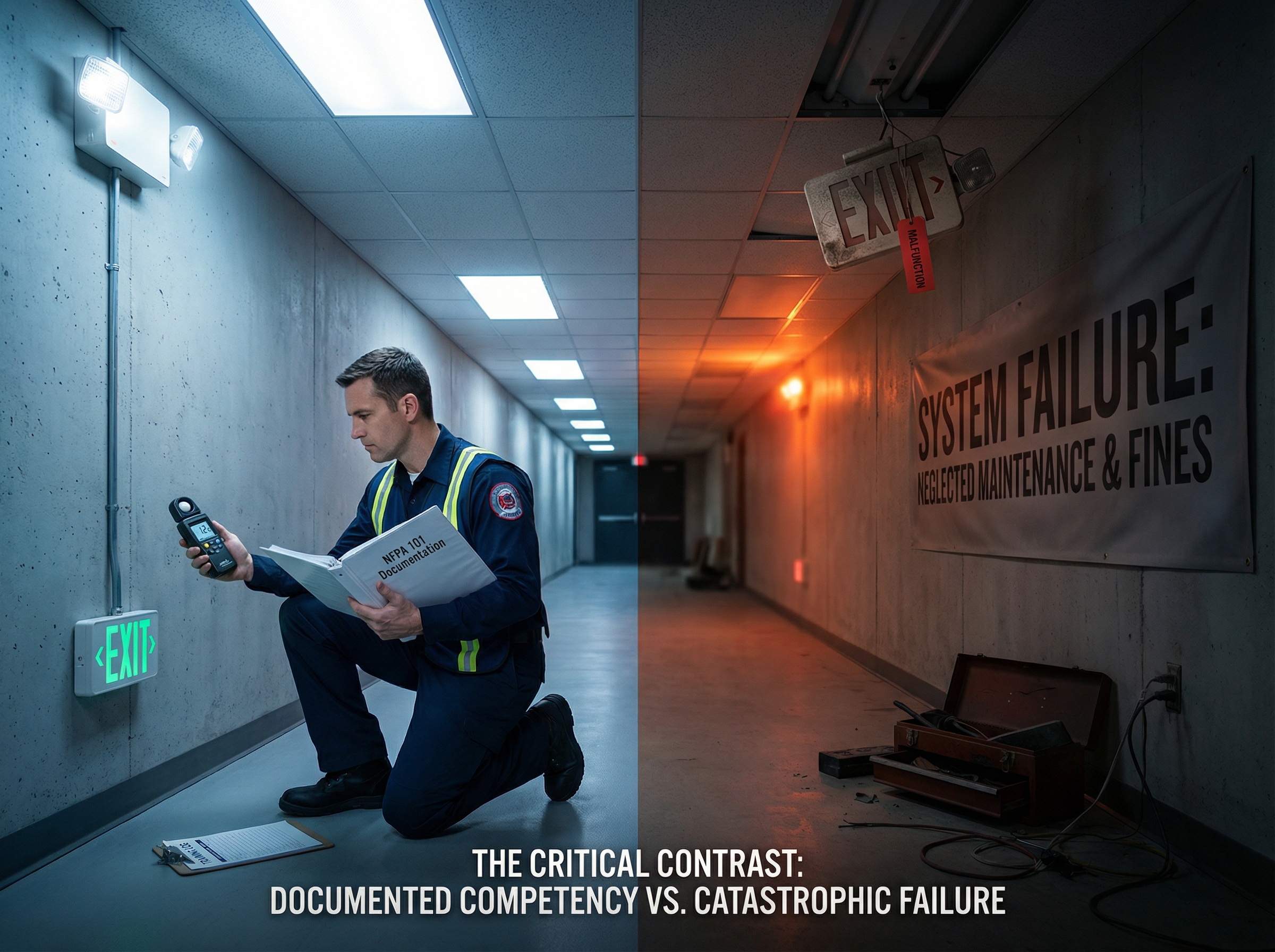
Emergency lighting (NFPA 101 requirement: 1.0+ foot-candle illumination in exit routes) is occupant’s primary navigation system during evacuation. Effective training addresses emergency lighting at every level:
Occupant understanding:
- Emergency lighting provides safe-level illumination (1.0+ foot-candles minimum)
- Backup battery systems maintain illumination if power lost
- 90-minute minimum duration ensures evacuation time covered
- Lighting guides evacuation to safe exit
- Confidence in lighting increases evacuation speed
Operations understanding:
- Load testing verifies backup battery 90-minute capability
- Illumination measurements confirm 1.0+ foot-candle minimum
- Annual maintenance keeps system reliable
- Documentation proves system functionality
- Staff responsibility for system stewardship
What this means:
- Emergency lighting education in every occupant training
- Load testing procedures in operations training
- Illumination measurement in building manager training
- System reliability emphasis at all levels
Principle 4: Systematic Practice and Reinforcement
Best practice: Training must be reinforced through systematic practice (drills) and regular refresher training.
Initial training creates awareness. Repeated practice and reinforcement create automatic response. Effective training includes:
First training: Comprehensive introduction to all procedures and knowledge
Initial drills: First practice of emergency procedures
Reinforcement training: Periodic refresher sessions
Ongoing drills: Regular evacuation drills (at least annually)
Updated procedures: Training reflects current procedures
What this means:
- Initial training program delivery
- First evacuation drill 2-4 weeks after training
- Annual refresher training for all participants
- Annual evacuation drills (or more frequent)
- Updated training when procedures change
Principle 5: Documentation and Accountability
Best practice: Document all training, drill results, and competency verification.
Effective training leaves evidence. Auditors, insurance companies, and regulators assess fire safety partly by reviewing training documentation. Documented training demonstrates:
- Training delivery (who participated, what was covered, when)
- Competency verification (who demonstrated understanding)
- Drill participation (who participated, when, with what results)
- System functionality (emergency lighting tested, backup systems verified)
- Continuous improvement (changes made based on drill results)
What this means:
- Training records with attendance and topics
- Competency verification documentation
- Drill execution records with timing and participation
- Emergency lighting test results (illumination measurements, load testing)
- Maintenance and system documentation
—
The Best Practices Framework: Eight Core Elements
Element 1: Assessment and Planning
Before training begins, effective implementation includes:
- Current facility fire safety status assessment
- Occupancy and role identification
- Training needs analysis for each role
- Customized training plan development
- Emergency lighting system baseline (illumination measurements)
Element 2: Occupant-Level Training
For all building occupants (typically 1-2 hours):
- Facility emergency procedures overview
- Exit location identification and practice
- Fire alarm recognition
- Assembly point procedures
- Emergency lighting purpose and reliance (1.0+ foot-candles, 90-minute backup)
- Special needs support procedures
Element 3: Floor Warden Training and Certification
For floor wardens (typically 2-3 hours):
- Evacuation procedure execution
- Occupant direction and floor management
- Accountability tracking and reporting
- Communication with building management and security
- Coordination with other floor wardens
- Emergency lighting reliance for occupant guidance
Element 4: Security Staff Training
For security/access control (typically 1-2 hours):
- Emergency procedure activation
- Occupant evacuation direction
- Accountability coordination with floor wardens
- Emergency responder liaison
- Emergency situation documentation
Element 5: Building Manager Training
For facility managers (typically 3-4 hours):
- Fire protection systems knowledge (alarm, sprinkler, suppression, fire doors)
- Emergency lighting specifications (NFPA 101: 1.0+ foot-candle minimum)
- Backup battery systems and load testing procedures
- Emergency leadership procedures
- Staff coordination during emergencies
- Post-emergency documentation
Element 6: Operations Staff Training
For maintenance/operations (typically 2-3 hours):
- System maintenance procedures
- Testing and verification methodologies
- Emergency lighting load testing (verifying 90-minute duration)
- Illumination measurement techniques (1.0+ foot-candles verification)
- Record documentation requirements
- System reliability responsibility
Element 7: Initial Drill and Assessment
2-4 weeks after training completion:
- Full-facility evacuation drill
- Emergency procedures executed
- Emergency lighting observed during drill
- Accountability procedures tested
- Results documented
- Competency assessment
Element 8: Ongoing Reinforcement and Drills
Annually and when procedures change:
- Refresher training for all participants
- Annual evacuation drill
- Emergency lighting system verification during drill
- Documentation of drill results
- Updates to procedures based on results
—
Implementation Best Practice: The 12-Week Model
Week 1-2: Assessment and Planning
- Current status evaluation
- Role and occupancy identification
- Training plan customization
- Emergency lighting system baseline measurement
Week 3-4: Occupant Training Delivery
- All-hands occupant training sessions
- Exit identification and assembly procedures
- Emergency lighting education and confidence building
- Questions and clarification
Week 5: Floor Warden and Security Training
- Floor warden certification training
- Security staff emergency procedure training
- Coordination procedures
- Accountability methodology
Week 6: Building Manager and Operations Training
- Building manager comprehensive training
- Operations staff system training
- Emergency lighting load testing training
- Documentation procedures
Week 7-8: Questions and Reinforcement
- Follow-up sessions addressing questions
- Clarification of procedures
- Additional practice as needed
Week 9: Initial Evacuation Drill
- Full-facility drill execution
- All procedures tested under realistic conditions
- Emergency lighting utilized during drill
- Observer assessment of competency and procedure execution
Week 10: Drill Debrief and Adjustments
- Results discussion with staff
- Procedure adjustments based on drill results
- Documentation of drill results and observations
Week 11-12: Documentation and Baseline
- All training records compiled
- Competency verification documentation completed
- Emergency lighting system documentation
- Training and drill baseline established for future comparison
—
Emergency Lighting Best Practice Integration
Effective fire protection training integrates emergency lighting at every level:
Occupant Level:
- Education: NFPA 101 requirement (1.0+ foot-candle illumination in exit routes)
- Understanding: Backup batteries maintain 90-minute minimum
- Practical: Exit identification includes noting emergency lighting placement
- Confidence: Trust that illumination will guide evacuation
- Drill observation: See emergency lighting in action
Floor Warden Level:
- Direction: Guide occupants toward illuminated exit signs
- Confidence: Know that lighting provides safe-level illumination (1.0+ foot-candles)
- Understanding: Backup systems support evacuation duration
- Procedures: Include emergency lighting reliance in accountability assessment
Building Manager Level:
- System knowledge: NFPA 101 standards, illumination requirements (1.0+ foot-candles minimum)
- Verification: Illumination measurements confirm 1.0+ foot-candles throughout
- Maintenance: Annual load testing verifies 90-minute backup duration
- Responsibility: Ensure system reliability and staff understanding
Operations Level:
- Load testing: Annual verification of backup battery 90-minute capability
- Measurement: Illumination testing (foot-candle meters) confirming 1.0+ foot-candles
- Maintenance: Regular replacement and upkeep
- Documentation: Records proving system functionality
—
Best Practice Success Indicators
Effective fire protection training shows these outcomes:
Knowledge Indicators:
- 95%+ occupant exit knowledge
- 90%+ alarm recognition correctness
- 85%+ assembly procedure understanding
- 100% floor warden accountability competency
- Building manager system knowledge demonstration
Behavior Indicators:
- Organized evacuation during drills (not panicked)
- Correct exit usage (not wrong exits)
- Assembly point procedure adherence
- Floor warden accountability tracking accuracy
- Emergency lighting reliance (occupants using illumination to navigate)
System Indicators:
- Emergency lighting verified: 1.0+ foot-candles measured throughout
- Backup battery tested: 90-minute load testing completed annually
- Documentation complete: All training and drill records organized
- Improvement documented: Drill results reviewed and procedures adjusted
Audit Indicators:
- Compliance audit scores improved
- Insurance classification improved or maintained
- Regulatory assessments positive
- Zero unsafe procedures identified
—
Common Best Practice Mistakes to Avoid
Mistake 1: One-Size-Fits-All Training
- Avoid: Generic fire safety training for everyone
- Best practice: Role-specific training addressing actual responsibilities
Mistake 2: Training Without Competency Verification
- Avoid: Conducting training without assessing competency
- Best practice: Verify knowledge through assessment and observation
Mistake 3: Neglecting Emergency Lighting Education
- Avoid: Not emphasizing emergency lighting (1.0+ foot-candles, 90-minute backup)
- Best practice: Integrate emergency lighting understanding at every training level
Mistake 4: No Drills or Reinforcement
- Avoid: One-time training with no follow-up drills
- Best practice: Initial training followed by drills and annual reinforcement
Mistake 5: Poor Documentation
- Avoid: No records of training completion or competency
- Best practice: Comprehensive documentation supporting training and competency proof
—
48Fire Protection: Best Practices Fire Protection Training
48Fire Protection delivers fire protection training based on proven best practices:
Assessment and Customization:
- Facility evaluation
- Role identification
- Customized training development
Comprehensive Training:
- Occupant training (exits, procedures, emergency lighting understanding)
- Floor warden certification (evacuation management, accountability)
- Security training (emergency procedures, occupant coordination)
- Building manager training (systems, leadership, emergency lighting verification)
- Operations training (maintenance, testing, load testing procedures)
Emergency Lighting Focus:
- NFPA 101 standards education (1.0+ foot-candle minimum)
- Load testing procedures (90-minute backup verification)
- Illumination measurement techniques
- Staff and occupant understanding emphasis
Drill and Reinforcement:
- Initial evacuation drill coordination
- Annual drill scheduling
- Results documentation
- Continuous improvement planning
Documentation and Evidence:
- Training records
- Competency verification
- Drill results
- System testing documentation
—
Effective fire protection training for commercial buildings isn’t haphazard. It’s systematic application of best practices—role-specific training, competency verification, emergency lighting integration, regular drills, and comprehensive documentation. Commercial buildings following these best practices demonstrate higher audit scores, better occupant safety, and faster emergency response.
[Contact 48Fire Protection] to discuss fire protection training best practices for your commercial building. We’ll assess your facility, develop customized training, provide role-specific certification, integrate emergency lighting education, coordinate drills, and establish documentation proving training effectiveness and occupant competency.
Best practices aren’t shortcuts. They’re proven methods delivering proven results.