Fire Protection Requirements Before Opening Day
Opening a new business or a renovated facility comes with a long to-do list. But among the highest-impact items—often overlooked or rushed at the last minute—are the fire protection and life-safety requirements that must be in place before customers and employees set foot inside. If you skip or delay these steps, you’re not just risking fines or project delays—you’re risking lives.
This article lays out a comprehensive, practical blueprint for mastering pre-opening fire protection requirements. We’ll anchor the guidance in authoritative standards, spotlight jurisdictional nuances (California, Tennessee, and beyond), and provide concrete checklists you can adapt to your project. By the end, you’ll have a clear path from planning through occupancy, with the confidence that your facility is compliant, safe, and ready for open day.
> Before reoccupying a building, verify that all in-building life-safety systems are current and meet NFPA standards. This is not a “nice-to-have” step—it’s a core safety and compliance requirement that protects lives and minimizes liability. [NFPA Fire & Life Safety Checklist for Reopening a Building](https://www.portland.gov/fire/permits-inspections/reopening-building-checklist)
—
Why pre-opening checks are non-negotiable
You’re preparing to welcome employees, customers, contractors, and vendors. The environment must be secure, predictable, and compliant with a web of fire and life-safety codes. Skipping or rushing pre-opening checks creates a cascade of risk:
- The risk of fire incident or smoke-related injuries due to insufficient or outdated systems.
- The risk of penalties, permit revocation, and forced closures if inspectors find noncompliant conditions during occupancy or special events.
- The risk of costly retrofits delayed by rework, project re-scopes, and schedule slip.
- The risk of insurance coverage gaps or increased premiums if the facility does not meet recognized standards.
There’s a practical truth here: fire protection is a system, not a collection of individual components. The overall effectiveness depends on the interworking status of water-based suppression (sprinklers, standpipes), alarm and detection (fire alarms, smoke detectors), egress and doors (rating, automatic closures), smoke control and coordination, kitchen exhaust suppression, emergency lighting and exit signage, and ongoing maintenance programs.
The good news is that a deliberate, well-documented pre-opening plan reduces risk dramatically and helps you avoid delays. It also sets a foundation for ongoing compliance as your business grows and operations evolve.
—
Key standards and regulatory anchors you’ll encounter
To navigate pre-opening requirements with confidence, you must understand the backbone standards and regulatory triggers. While local jurisdiction rules drive the exact steps, several widely adopted frameworks consistently shape pre-opening activities:
- NFPA 25: Standard for the Inspection, Testing, and Maintenance of Water-Based Fire Protection Systems
- NFPA 72: National Fire Alarm and Signaling Code
- NFPA 80: Standard for Fire Doors and Other Opening Protectives
- NFPA 101: Life Safety Code
- NFPA 105: Fire Door and Smoke Door Assembly Rating
- NFPA 1: Fire Code
- NFPA 96: Exhaust Systems for Commercial Cooking Operations
- NFPA 25 and related NFPA standards underpinning a robust ITM (inspection, testing, and maintenance) program
In addition to NFPA standards, you’ll encounter state-specific codes and processes that govern pre-opening activities:
- California requires pre-opening plan reviews and life-safety inspections for state-owned buildings and for certain events, with adherence to state codes such as Title 19 and Title 24 and related NFPA standards; for special events, the submission window is typically no later than 10 business days before opening. This is a critical pattern to understand for large events and state-owned facilities. [Fire and Life Safety | OSFM (California)](https://www.fire.ca.gov/osfm/what-we-do/fire-and-life-safety)
- In Nashville, Tennessee, pre-opening operational permits are mandatory for events and specific occupancies, with a recommended lead time of at least 15 business days before the event date. Permits cover a range of types (e.g., Amusement Buildings, Tents) to ensure fire code compliance. [Operational Permits | Nashville Fire Marshal’s Office](https://www.nashville.gov/departments/fire/fire-marshal-office/operational-permits)
Citations:
- [NFPA Fire & Life Safety Checklist for Reopening a Building](https://www.portland.gov/fire/permits-inspections/reopening-building-checklist)
- [Fire and Life Safety | OSFM (California)](https://www.fire.ca.gov/osfm/what-we-do/fire-and-life-safety)
- [Nashville Fire Marshal’s Office Operational Permits](https://www.nashville.gov/departments/fire/fire-marshal-office/operational-permits)
—
A practical, comprehensive pre-opening checklist you can use
The following sections break down the pre-opening process into digestible steps, organized around the lifecycle of a project—from planning through occupancy. Each section includes checklists, responsible parties, and sample timelines. Use the formatting tools below to tailor the plan to your facility.
1) Planning and regulatory overview
This is where you align design intent with regulatory expectations. Start by mapping your occupancy type, egress requirements, and critical life-safety systems, then identify the agencies that will review plans and perform inspections.
Key actions:
- Define occupancy classification and occupant load in accordance with NFPA 101 and the local fire code.
- Confirm the authority having jurisdiction (AHJ) and the required plan-review submittals.
- Gather code references for all life-safety systems and ensure alignment with NFPA standards.
Table: Typical plan-review and inspection triggers
| Trigger | Typical AHJ Action | Reference/Notes |
|---|---|---|
| Plan submission | Plan review by fire marshal or building department | Include fire alarm, suppression, egress, and kitchen systems |
| Plan approval | issuance of permit to construct | May require revisions; track approvals by discipline |
| Final inspections | life-safety review, ITM completion, occupancy permit | May include special event considerations for openings |
Citations:
- California OSFM page confirms: pre-opening plan reviews and life-safety inspections; Title 19/Title 24 references; special events require submittal ~10 business days prior. [OSFM Fire and Life Safety](https://www.fire.ca.gov/osfm/what-we-do/fire-and-life-safety)
2) Pre-opening plan review and life-safety inspections
The plan review is the mechanism by which you verify that your building’s fire protection design aligns with code requirements before construction finishes or operations begin.
What to prepare:
- Architectural plans showing egress paths, occupancy limits, and door hardware compliant with NFPA 101.
- Mechanical drawings and sequence of operations for fire suppression and fire alarm systems.
- Documentation of fire-rated assemblies, fire doors, and smoke doors with ratings and testing to NFPA 105 and NFPA 80 requirements.
- Kitchen exhaust and suppression design in line with NFPA 96.
- Smoke control and smoke control system design, if applicable.
During plan review and inspections:
- Be prepared for a back-and-forth cycle with the AHJ; revisions are common.
- Ensure your ITM program is documented as part of the submission (NFPA 25-oriented):
- Fire sprinkler systems inspection and testing status
- Fire alarm system testing status
- Emergency lighting and exit signage status
- Fire dampers and smoke control devices where required
- Confirm your permit and inspection calendar aligns with your project milestones.
Citations:
- The Portland reopening checklist emphasizes verifying ITM and life-safety systems meet NFPA standards as part of reoccupying a building. This concept underpins the plan-review and inspection process for pre-opening. [NFPA Fire & Life Safety Checklist for Reopening a Building](https://www.portland.gov/fire/permits-inspections/reopening-building-checklist)
- California OSFM emphasizes pre-opening plan reviews and life-safety inspections for state-owned buildings and special events, with processed-based lead times. [OSFM Fire and Life Safety](https://www.fire.ca.gov/osfm/what-we-do/fire-and-life-safety)
3) ITM and life-safety systems: current and documented
A robust ITM program is the backbone of ongoing reliability. It is not enough to install a system; you must actively test, inspect, and maintain it, with documentation that demonstrates compliance.
What to verify:
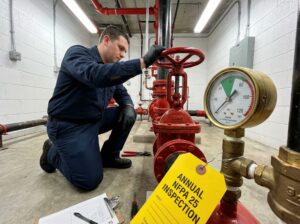
- Water-based fire protection systems: sprinkler systems, standpipes, and related components must be installed per design and be subject to regular inspections and testing per NFPA 25. The ITM documentation must exist and be easily auditable.
- Fire alarm and detection systems: ensure all notification devices, control panels, initiations, and interface equipment are tested in accordance with NFPA 72. Tests should be documented, including functional tests of initiating devices and notification appliances.
- fire doors and opening protectives: NFPA 80 requires periodic testing and maintenance of doors and their hardware; ensure doors swing, latch, and self-closing devices operate correctly.
- Smoke doors and smoke control devices: NFPA 105-compliant doors and assemblies need testing; ensure proper operation and labeling.
- Kitchen fire suppression: NFPA 96 compliance for kitchen hood systems; suppression agents and fusible links, valve actuation, and integration with fire alarm systems must be verified.
- Fire-rated egress and emergency lighting: NFPA 101-compliant emergency lighting and exit signage must be functioning and tested.
Example note: The NFPA ecosystem is designed to ensure not only that devices work but that the overall system functions cohesively during an emergency. Having a documented ITM schedule that covers all major life-safety systems is essential for occupancy permits and for ongoing safety.
Citations:
- NFPA 25, NFPA 72, NFPA 80/101, NFPA 105, NFPA 1, NFPA 96 are all part of the referenced life-safety framework when reoccupying or opening a building. The Portland checklist highlights these standards as the baseline for reoccupancy. [NFPA Fire & Life Safety Checklist for Reopening a Building](https://www.portland.gov/fire/permits-inspections/reopening-building-checklist)
4) Fire alarm systems, suppression systems, and documentation
A “document-first” approach pays off in the long run. You’ll need not only the physical systems but the chain-of-custody documentation that proves compliance.
Key documents to assemble and keep up-to-date:
- System design drawings and as-built revisions for fire alarms, sprinklers, standpipes, and kitchen suppression.
- Manufacturer manuals, test reports, and commissioning records.
- Maintenance agreements and service logs (with dates and technician IDs).
- ITM test dates, results, and residual issues with remediation dates.
- Emergency lighting and exit signage test results and battery backup testing dates.
- Official permits and inspection approvals from the AHJ.
Common pitfalls:
- Using outdated drawings during construction and in the field for acceptance testing.
- Failing to attach test reports to permit submittals or to update ITM logs after inspections.
- Missing or incomplete commissioning statements that demonstrate systems are operational under full design conditions.
Citations:
- The OSFM California framework emphasizes the need for adherence to state codes and NFPA standards as a baseline for pre-opening safety. Submittal and inspection practices are an essential part of the process. [OSFM Fire and Life Safety](https://www.fire.ca.gov/osfm/what-we-do/fire-and-life-safety)
5) Egress, doors, and occupancy controls
Egress design is a core life-safety objective. The building’s egress path must be clearly marked, unobstructed, and equipped with doors that function as intended during both normal and emergency conditions.
What to verify:
- Exit access paths should remain unobstructed and clearly illuminated; exit doors should have proper hardware and no locking arrangements that hinder egress unless they are compliant with NFPA 101 and local code (often requiring panic hardware or hardware meeting specific standards).
- Fire doors and smoke doors must comply with NFPA 80 and NFPA 105, including labeling, inspection, and maintenance.
- Door operations should be tested as part of the final life-safety inspection.
Important nuance:
- In many jurisdictions, life-safety inspections specifically verify that egress paths and doors function under simulated emergency conditions (e.g., power loss, alarm activation). This is not optional; it’s a gating factor for occupancy approval.
Citations:
- NFPA 101 Life Safety Code and NFPA 80/105 guidance underpin door and egress requirements. The Portland checklist notes the importance of these standards for safer occupancy. [NFPA Fire & Life Safety Checklist for Reopening a Building](https://www.portland.gov/fire/permits-inspections/reopening-building-checklist)
6) Kitchen exhaust, hood suppression, and cooking operations
Commercial kitchens are high-risk environments due to hydrocarbon fuels and high heat loads. Fire protection specific to kitchens includes both detection and suppression components.
Best practices:
- Install and test a listed kitchen hood suppression system per NFPA 17A (or NFPA 12 for other suppression configurations), and NFPA 96 for exhaust hoods.
- Ensure fusible links, pull stations, and interlocks are properly coordinated with building fire alarm systems.
- Verify that extinguisher/extinguishing agent maintenance meets the manufacturer’s recommendations and NFPA guidelines.
Citations:
- NFPA 96 (Exhaust Systems for Commercial Cooking Operations) represents the standard for kitchen vent hoods and suppression integration; Jenkins-style checklists and third-party resources will reflect this integration. The Portland re-opening checklist references NFPA standards for kitchen systems as part of the overall life-safety package. [NFPA 96 and related guidance referenced in reopening checklists](https://www.portland.gov/fire/permits-inspections/reopening-building-checklist)
7) Special events vs permanent facilities
Temporary or pop-up events introduce unique fire code considerations. Pre-opening permits and inspections for events ensure that temporary facilities comply with life-safety standards without the permanent infrastructure changes that a building owner might typically implement.
Key considerations:
- Special-event permits may require plan review and fire code compliance data tailored to tents, amusement devices, portable structures, and crowd management.
- For state-owned or high-profile events, jurisdictions like California require early submittals (typically at least 10 business days before opening for special events) to guarantee a smooth review and inspection process.
- Event-specific requirements can include crowd management, emergency egress capacities, temporary power distribution, and fire extinguisher provisioning.
Citations:
- California OSFM guidance for pre-opening plan reviews and life-safety inspections, with special-event considerations and lead times, informs event planning and submission windows. [OSFM Fire and Life Safety](https://www.fire.ca.gov/osfm/what-we-do/fire-and-life-safety)
- Nashville’s operational permits for events highlight the importance of a proactive permitting approach for temporary or event-focused openings. [Operational Permits | Nashville Fire Marshal’s Office](https://www.nashville.gov/departments/fire/fire-marshal-office/operational-permits)
8) Permitting timelines and coordination
A successful pre-opening program requires deliberate scheduling and coordination among multiple stakeholders: building owners, design teams, contractors, AHJs, and fire protection vendors.
General timeline suggestions:
- Step 1 (T-minus 90–120 days): Define occupancy type, select AHJs, and assemble permit-related submittal packages.
- Step 2 (T-minus 60–90 days): Submit initial plan reviews, begin ITM program documentation, and coordinate kitchen and cooking operations plans.
- Step 3 (T-minus 30–45 days): Finalize permit approvals, schedule final inspections, and plan for any required rework. Ensure all commissioning testing and ITM documentation is ready for AHJ review.
- Step 4 (T-minus 15–30 days): Prepare for occupancy; ensure emergency lighting, exit signage, and egress are functional, and all critical systems are ready for final inspection.
- Step 5 (Opening day): Complete the occupancy permit, finalize all administrative documents, and implement a transitional ITM schedule for ongoing compliance.
Citations:
- Nashville’s explicit requirement for pre-opening operational permits underscores the need for advance planning and scheduling. [Operational Permits | Nashville Fire Marshal’s Office](https://www.nashville.gov/departments/fire/fire-marshal-office/operational-permits)
- California’s explicit lead-time guidance for special events (10 business days) reinforces the same principle: plan early to meet requirements. [OSFM Fire and Life Safety](https://www.fire.ca.gov/osfm/what-we-do/fire-and-life-safety)
—
A practical, field-tested pre-opening workflow (bridging planning to occupancy)
To convert the above into a workable plan, here’s a step-by-step workflow you can reproduce for most commercial openings, including retail, mixed-use, office, and restaurant facilities.
1) Assemble the pre-opening compliance team
- Owner representative, general contractor, electrical/mechanical/plumbing trades, fire protection contractor, architect/designer, AHJ liaison, and a compliance manager.
2) Define the regulatory scope and occupancy parameters
- Identify the AHJ, applicable NFPA standards, life-safety code requirements, and adjacent jurisdictions (if the facility spans multiple zones).
3) Prepare design packages with enforceable compliance targets
- Include egress calculations, door hardware specifications, fire alarm design, water-based suppression layout, and kitchen hood/fire-suppress design.
4) Initiate the plan-review submission and permit process
- Submit to AHJs with all required documentation, including performance testing plans and commissioning schedules.
5) Implement an integrated ITM program
- Establish a documented ITM plan; schedule testing windows for sprinklers, alarms, doors, lights, and kitchen suppression.
6) Conduct commissioning and inspections
- Complete system commissioning to validate performance against design intent; coordinate final inspections with the AHJ.
7) Prepare occupancy and post-opening plans
- Ensure that the occupancy permit is obtained, and that a post-opening compliance program is in place to sustain safety.
8) Document ongoing maintenance and re-test cycles
- Keep a living record of all tests, maintenance activities, and any corrective actions.
—
Practical formats to manage the work (checklists, tables, and more)
To manage the breadth of pre-opening requirements, use value-adding formats that you can share with your team and auditors.
- Checklists with [ ] checkboxes:
- [ ] Occupancy classification and occupant load completed
- [ ] AHJ notified and plan review submitted
- [ ] ITM program established and documented
- [ ] Fire alarm and suppression systems commissioned
- [ ] Emergency lighting and exit signage tested
- [ ] Kitchen hood suppression tested and documented
- [ ] Egress routes verified and doors inspected
- [ ] Permits obtained and inspected
- [ ] Final occupancy permit secured
- Bold labels for quick-reference:
- Key point: ITM documentation is a non-negotiable deliverable for occupancy.
- Warning: Do not rely on as-built documents alone; field verification and testing are essential.
- Pro tip: Build a 4-week pre-opening sprint with weekly milestones to maintain momentum.
- Tables for comparison or planning:
- Table: State-specific pre-opening requirements (illustrative)
| State | Pre-opening requirement | Lead time (typical) | Notable notes |
|---|---|---|---|
| California | Pre-opening plan reviews and life-safety inspections; Title 19/24; special events submittal 10 business days prior | 10 business days for certain events | Special events may require additional documentation; confirm with OSFM. |
| Tennessee (Nashville) | Pre-opening operational permits for events and occupancies | Minimum 15 business days prior | Permits cover Amusement Buildings, Tents, etc. |
| General | Plan review and final inspections | Varies by AHJ | Ensure ITM and NFPA compliance across systems |
- Horizontal rule separators to segment sections cleanly:
———
—
Real-world insights: what often trips openings up
Understanding where many openings stumble helps you build guardrails into your process.
- Inadequate planning windows: When lead times are compressed, plan reviews, ITM testing, and commissioning get rushed, increasing the likelihood of missing items or rework.
- Fragmented documentation: A scattered set of PDFs, email chains, and paper files can make it impossible to demonstrate compliance quickly during a final inspection.
- Underestimated event risk: For events or temporary occupancies (tents, pop-ups), the absence of robust pre-opening event planning can lead to noncompliance or last-minute changes to the layout or operations.
- Kitchen safety gaps: If kitchen suppression and extraction systems are not integrated with building fire alarm and the status isn’t clearly documented, inspectors may reject openings or require costly retrofits.
By anticipating these issues and implementing a disciplined process, you can dramatically reduce the risk of delays and noncompliance.
—
Practical cross-references: integrating credible sources
- The NFPA-based approach to reopening is widely recognized as a best practice. The Portland Fire Bureau’s “Reopening Building Checklist” reinforces the essential requirement that ITM and life-safety systems be current and NFPA-compliant before reoccupying a building. This form of guidance is widely applicable to new buildings and to reopenings after major renovations. [NFPA Fire & Life Safety Checklist for Reopening a Building](https://www.portland.gov/fire/permits-inspections/reopening-building-checklist)
- California’s OSFM site clarifies the necessity of pre-opening plan reviews and life-safety inspections for state-owned buildings and special events, with clear timing expectations (e.g., submittal windows). This demonstrates how state agencies structure the workload and expectations for pre-opening safety compliance. [OSFM Fire and Life Safety](https://www.fire.ca.gov/osfm/what-we-do/fire-and-life-safety)
- For event-specific compliance, the Nashville Fire Marshal’s Office documents the requirement for pre-opening operational permits with lead times. This provides a concrete example of how cities manage occupancy events and mass gatherings. [Operational Permits | Nashville Fire Marshal’s Office](https://www.nashville.gov/departments/fire/fire-marshal-office/operational-permits)
—
A dedicated section: 48Fire Protection’s services to support pre-opening compliance
At 48Fire Protection, we specialize in turning complex fire code requirements into practical, auditable action plans. Our pre-opening package is designed to minimize risk, avoid delays, and drive a smooth occupancy process. Here’s how we can help your project—from early planning through the first 90 days of operation.
- Compliance gap analysis and risk assessment
- We review your designs, specifications, and documentation against NFPA and applicable state and local codes to identify gaps, prioritize fixes, and map remediation timelines.
- Plan-review coordination and permit management
- We work with your architect and contractor to assemble AHJ-submittal packages, track approvals, and coordinate revisions, ensuring alignment with lead times (e.g., California’s 10-business-day special-event window or Nashville’s 15-business-day lead time).
- ITM program development and execution
- We design a robust ITM schedule for water-based systems, fire alarms, doors and opening protectives, smoke control devices, and kitchen hood suppression; our team conducts testing, documents results, and certifies compliance.
- Commissioning and final inspections
- We conduct pre-occupancy commissioning to verify that systems operate as designed under simulated fire conditions; we coordinate with AHJs to secure occupancy approvals.
- Documentation packages for occupancy
- We assemble and deliver a complete package of design drawings, test reports, maintenance records, and commissioning certificates to support the occupancy permit and future audits.
- Ongoing compliance support
- Post-opening, we offer preventive maintenance programs, scheduled re-testing, and updates to ITM records as changes occur in the building or operations.
Representative services you can expect:
- Fire alarm system testing and integration with life-safety protocols
- Fire suppression system inspection and re-testing (sprinklers, standpipes)
- Kitchen hood suppression inspection and maintenance per NFPA 96
- Fire doors and opening protectives inspection, maintenance, and labeling
- Emergency lighting and exit signage testing and certification
- Permit coordination and AHJ liaison
- Training for facility staff on emergency procedures and basic maintenance reporting
With this integrated approach, you gain a single-competence partner who understands both the technical requirements and the practical realities of opening a facility on schedule.
—
The bottom line: a 4-part playbook for success
If you want a concise, repeatable plan, here’s a four-step playbook you can apply to most pre-opening scenarios:
1) Start early and map the regulatory landscape
- Identify AHJs, applicable NFPA standards, and state/clocal codes.
- Create a master timeline that includes plan reviews, ITM milestones, and permit deadlines.
2) Build a live, auditable compliance dossier
- Collect and maintain all design documents, commissioning reports, maintenance records, and permit approvals in a centralized repository.
- Use checklists with clear owners and due dates to prevent gaps.
3) Test, document, and verify
- Schedule commissioning and ITM inspections; ensure results are documented and referenced in the occupancy submission.
- Confirm emergency procedures, occupant loads, and egress are validated under normal and emergency conditions.
4) Prepare for occupancy and ongoing compliance
- Obtain occupancy permits and deliver a comprehensive handover package for operations staff.
- Establish a quarterly or semi-annual ITM and maintenance cadence to keep the facility compliant.
—
Quick reference: sample pre-opening timeline (illustrative)
- Week 12–16: Confirm occupancy type, AHJ, and lead times; begin plan-review package preparation.
- Week 10–12: Submit plans; begin ITM program design; coordinate kitchen equipment and hood suppression design.
- Week 8–10: AHJ feedback; address revisions; secure tentative approvals.
- Week 6–8: Schedule final inspections; complete commissioning test plan.
- Week 4–6: Final ITM testing; compile documentation and submittals for occupancy permit.
- Week 1–2: Occupancy permit issued; staff training and handover complete.
- Week 0: Open day.
Note: Adjust the timeline to match your jurisdiction’s lead times (California 10 business days for certain special-event submittals, Nashville’s 15-business-day minimum, etc.). See the cited resources for specifics. [OSFM Fire and Life Safety](https://www.fire.ca.gov/osfm/what-we-do/fire-and-life-safety) [Operational Permits | Nashville Fire Marshal’s Office](https://www.nashville.gov/departments/fire/fire-marshal-office/operational-permits)
—
Final notes: turning compliance into a competitive advantage
A rigorous pre-opening fire protection program isn’t just about avoiding fines or shutdowns—it’s a strategic advantage. A facility that demonstrates thorough planning and reliable life-safety system performance reassures investors, insurance underwriters, tenants, and customers. It can translate to:
- Faster occupancy approvals and fewer last-minute changes
- Lower risk of operational disruptions due to system failures
- Stronger insurance terms and potential premium reductions
- A culture of safety that resonates with employees and patrons
The best way to realize these benefits is to treat pre-opening fire protection as a core project deliverable—and to partner with experts who can translate regulatory language into practical, field-ready actions.
—
About 48Fire Protection: why we’re the partner you want for pre-opening compliance
- Deep regulatory fluency: Our experts are proficient across NFPA standards and state-specific codes, ensuring your plan review and permit submissions are robust and accurate from day one.
- End-to-end pre-opening support: From gap analyses to ITM planning, commissioning, and occupancy documentation, we align every step with your timeline and AHJ expectations.
- Field-ready documentation: We deliver organized, auditable documentation packages with clear traceability for all systems—sprinklers, alarms, doors, smoke control, kitchen suppression, and emergency lighting.
- Post-opening continuity: We aren’t a one-and-done shop. We provide ongoing compliance programs designed to keep your facility safe and code-compliant as operations evolve.
If you’re preparing for a new opening or a major reopening, contact us to tailor a pre-opening fire protection plan that fits your project, budget, and schedule.
[Contact 48Fire Protection](/contact-us)