What Most Facilities Forget: The Containment Layer
A six-story commercial office building had alarms. It had sprinklers. It had emergency lighting. But like many facilities, it had never focused on systematic inspection of fire doors and risers—the components that actually contain fire and smoke within specific compartments.
When 48Fire Protection conducted a detailed fire protection systems inspection focusing on compartmentalization, the findings were sobering: fire doors and vertical risers were the overlooked components that actually determined whether the facility’s entire fire protection strategy worked.
The facility learned an essential lesson: alarms detect fires. Sprinklers suppress fires. But fire doors and risers contain fires. Containment is the foundation of everything else.
—
Understanding Fire Compartmentalization
Fire compartmentalization is the principle that fires are contained within specific areas to prevent rapid spread throughout a building.
Fire doors and risers are the physical components that create compartmentalization.
Fire Doors:
- Seal openings in fire-rated walls
- Prevent smoke and fire passage between compartments
- Require specific ratings (typically 20-minute, 45-minute, or 60-minute based on wall rating)
- Depend on functioning seals, hinges, closers, and latches
Vertical Risers:
- Contain vertical passages (elevator shafts, stairwells, mechanical chases, cable runs)
- Prevent fire and smoke from traveling vertically through floors
- Require specific penetration sealing based on riser type and occupancy
- Depend on maintained seals and barriers
—
Why Compartmentalization Matters
Imagine a fire starting on the third floor of a six-story building.
Without proper compartmentalization:
- Fire and smoke spread rapidly through unsealed risers
- Fire reaches the fourth floor within minutes
- Smoke fills stairwell exits on upper floors
- Evacuation becomes impossible as primary and secondary exits are compromised
- Fire protection systems (alarms, sprinklers) can’t stop vertical spread
With proper compartmentalization:
- Fire-rated doors seal the third-floor compartment
- Sealed risers prevent vertical spread
- Fourth, fifth, and sixth floors remain clear of smoke
- Multiple evacuation routes remain viable
- Fire protection systems have time to suppress the fire within the compartment
The difference: compartmentalization can be the factor that determines whether occupants can evacuate safely.
—
The Inspection Challenge: Fire Doors and Risers Are Hidden
Fire doors look like regular doors. Risers are behind walls and above ceilings.
Most facility managers can see obvious fire protection: alarm boxes, sprinkler heads, emergency lighting.
Fire doors and risers aren’t obvious. They’re forgotten.
This creates a dangerous gap: facilities maintain their visible fire protection systems while the containment systems that depend on those visible systems deteriorate.
—
What Deteriorates in Fire Doors
Fire doors fail through specific, measurable mechanisms.
Door Seal Deterioration
Fire-rated doors rely on seals around the perimeter. Over time, seals deteriorate through:
- Normal wear and tear from repeated opening and closing
- Damage from moving equipment
- Weather exposure (in certain locations)
- Age (rubber seals typically last 10-15 years)
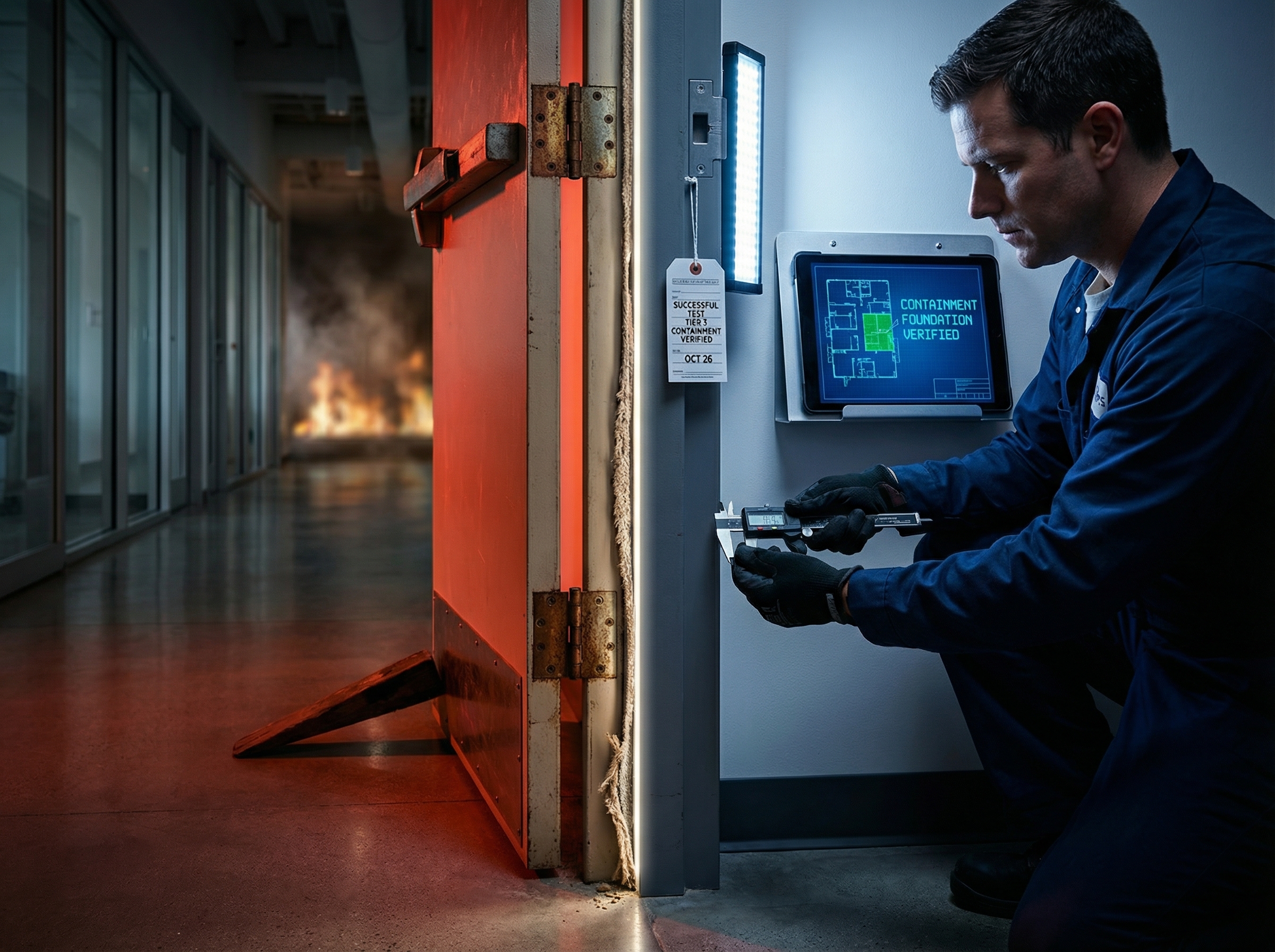
Testing reveals the problem: When door seal integrity is tested by visual inspection and measurement, gaps of 1/4 inch or larger indicate non-compliance. A door with a 1/4 inch gap fails to prevent smoke passage.
Closing Mechanism Failure
Fire-rated doors must close automatically. Mechanisms that fail include:
- Door closers losing hydraulic pressure
- Latches that don’t engage properly
- Hinges that don’t hold doors closed
- Wedges or props that hold doors open
Testing reveals the problem: When automatic closing is tested, doors that don’t close or close slowly fail to provide required protection.
Latch Engagement Failure
Latches must fully engage when the door closes. Failures include:
- Strike plates misaligned through frame settling
- Latches worn and unable to fully extend
- Repeated slamming that damages latch mechanisms
Testing reveals the problem: When latch engagement is tested, doors that latch incompletely fail to maintain seals.
Hinge Deterioration
Hinges hold the door in the frame and must remain functional despite repeated use. Deterioration includes:
- Wear that causes doors to hang improperly
- Rust or corrosion that causes binding
- Damage from impact or impact loading
Testing reveals the problem: When hinge operation is tested, doors that don’t swing freely or hang improperly fail to seal properly.
—
What Deteriorates in Vertical Risers
Risers are unsealed pathways that fire and smoke can travel through. Unlike fire doors (which are obvious components), riser deterioration happens invisibly—behind walls, above ceilings, within walls.
Penetration Seal Deterioration
Penetrations are openings where utilities pass through fire-rated walls. Examples:
- Electrical conduit passing through a wall
- HVAC ducts penetrating walls
- Plumbing pipes passing through walls
- Communication cables running through walls
Penetration seals (caulking, fire-stopping materials, dampers) deteriorate through:
- Material aging (caulking typically lasts 10-20 years)
- Movement and vibration (especially in mechanical systems)
- Thermal cycling (caulking fails through repeated expansion and contraction)
- Water exposure (moisture accelerates seal failure)
Testing reveals the problem: When penetration seals are visually inspected and measured, gaps, cracks, or missing sealant indicate failure. A 1-inch gap in a riser seal completely defeats the riser’s fire-containment purpose.
Damper Deterioration
Dampers are automatic closure devices in risers that seal when high temperatures are detected. Deterioration includes:
- Rust or corrosion preventing proper closure
- Mechanical linkage failure that prevents activation
- Thermostatic triggers that no longer respond to temperature
- Missing or damaged dampers
Testing reveals the problem: When damper operation is tested, dampers that don’t close or respond slowly fail to prevent smoke passage.
Chase or Structural Damage
Vertical chases (enclosed spaces containing risers) can be damaged by:
- Impact damage creating holes or cracks
- Water damage from roof leaks or pipe breaks
- Deterioration from material failure
- Modifications made without proper fire-stopping
Testing reveals the problem: When risers are visually inspected, structural gaps or damage indicate failed containment.
—
The Inspection Process: How Fire Doors and Risers Are Tested
Proper fire protection systems inspection includes detailed fire door and riser assessment.
Fire Door Inspection:
1. Verify fire-rating (labeled rating must match installation location rating)
2. Measure door seal gaps (maximum acceptable gap: 1/8 inch)
3. Test automatic closing (door must close without manual assistance)
4. Test latch engagement (latch must fully engage when closed)
5. Inspect hinges (hinges must operate smoothly without binding)
6. Verify closing force (doors must close with appropriate force without slamming)
7. Test seals (seals must be continuous without breaks or deterioration)
Riser Inspection:
1. Visually inspect accessible penetration seals (no gaps, cracks, or missing material)
2. Test damper operation (dampers must close when activated)
3. Verify damper labels (dampers must be labeled for location and fire rating)
4. Inspect riser enclosure (no structural damage, holes, or cracks)
5. Verify proper sealing materials (fire-stopping materials must meet code standards)
6. Document riser pathway (confirm all penetrations are sealed)
—
A Real Facility: What Inspection Revealed
A 45,000 square foot commercial office building underwent comprehensive fire protection systems inspection focusing on fire doors and risers.
Fire Door Assessment:
- Facility had 23 fire-rated doors
- Inspection revealed:
- 7 doors with seal gaps exceeding 1/8 inch
- 3 doors with non-functioning closers
- 2 doors with latch engagement issues
- 4 doors being propped open with wedges
Riser Assessment:
- Building had 4 vertical risers (electrical, HVAC, plumbing, communication)
- Inspection revealed:
- 12 penetration seal failures (cracks, gaps, missing material)
- 2 dampers non-functional (rust prevented closure)
- 3 riser chase areas with structural damage from water leaks
The Bottom Line:
The facility’s compartmentalization system had failed at multiple points. Fire or smoke could:
- Move through unsealed doors (7 doors)
- Travel vertically through unsealed penetrations (12 failures)
- Spread through non-functional dampers (2 failures)
The facility’s elaborate alarm and sprinkler systems were compromised by failed containment.
—
What Changed After Inspection
The facility implemented systematic repairs:
Fire Door Corrections:
- All 7 doors with seal gaps: seal replacement ($4,200)
- 3 doors with non-functioning closers: closer replacement ($1,800)
- 2 doors with latch issues: latch repair ($600)
- 4 wedged-open doors: installed door holders and staff training ($800)
- Total: $7,400
Riser Corrections:
- All 12 penetration seal failures: caulking and fire-stopping material ($6,200)
- 2 non-functional dampers: damper replacement ($2,400)
- 3 riser chase water damage areas: structural repair and resealing ($3,100)
- Total: $11,700
Ongoing Maintenance:
- Semi-annual fire door testing schedule established
- Annual penetration seal inspection schedule established
- Annual damper operation verification established
- Staff training on fire door operation and wedge prohibition
Total Investment: $19,100
Timeline: 60 days for all corrections
—
The Criticality Hierarchy: Why Fire Doors and Risers Matter Most
Fire protection systems can be understood as a hierarchy:
Tier 1: Detection (Alarms)
- Alarms detect fires and alert occupants
- Essential for evacuation initiation
- But alarms don’t stop fires
Tier 2: Suppression (Sprinklers)
- Sprinklers suppress fires and reduce damage
- Essential for limiting fire growth
- But sprinklers work best if fire doesn’t spread
Tier 3: Containment (Fire Doors & Risers)
- Fire doors and risers contain fires within compartments
- Essential for preventing rapid spread
- This is the foundational layer
Without containment, detection and suppression are limited in effectiveness. A fire that spreads rapidly through unsealed risers renders suppression systems ineffective on upper floors. Occupants on upper floors face smoke from lower-floor fires regardless of alarm notification.
Containment is the foundation. Detection and suppression are the response.
—
Why Fire Doors and Risers Are Overlooked
Fire doors and risers are overlooked because:
1. They’re not visible. Alarm boxes are visible. Sprinkler heads are visible. Fire doors look like regular doors. Risers are behind walls.
2. They don’t activate visibly. Alarms ring and light flash. Sprinklers flow water. Fire doors just sit closed.
3. Failure isn’t immediately apparent. A fire door can look closed while seals are deteriorated. Risers can have hidden penetration seal failures.
4. They’re not “systems.” Alarms are a system. Sprinklers are a system. Fire doors and risers are just components scattered throughout the building.
This creates a dangerous illusion: facilities believe they have fire protection because they have alarms and sprinklers, while their compartmentalization—the foundation that makes alarms and sprinklers effective—silently deteriorates.
—
The Business Case: Why Inspection Matters
Fire door and riser inspection might seem like an extra cost. In reality, it’s insurance for your entire fire protection strategy.
Cost of Inspection:
Comprehensive fire door and riser inspection: $2,500-$5,000 depending on facility size
Cost of Failure:
If compartmentalization fails:
- Fire spreads rapidly through unsealed risers
- Multiple floors are affected instead of one floor
- Evacuation becomes impossible as exits fill with smoke
- Damage extends to multiple floors instead of isolated floor
- Property loss increases exponentially
Cost of Correction:
As the 45,000 sq ft facility discovered: $19,100 to address deteriorated doors and risers
The Math:
- Inspection cost: ~$3,000
- Correction cost if issues found: ~$19,100
- Damage cost if failure occurs: Millions in property loss + liability exposure + lives at risk
Inspection is the low-cost insurance policy that prevents catastrophic failure.
—
Fire Door and Riser Inspections: The Critical Component Assessment
48Fire Protection conducts detailed fire protection systems inspections that specifically include comprehensive fire door and riser assessment.
Rather than viewing fire doors and risers as secondary components, we evaluate them as the critical containment layer that determines whether your entire fire protection system actually works.
The inspection process identifies:
- Seal deterioration in fire doors
- Mechanical failure in door closers, latches, and hinges
- Penetration seal failures in risers
- Damper deterioration and non-functionality
- Structural damage in riser chases
- Occupant behaviors (wedged-open doors) that defeat containment
Each finding includes documentation and recommended corrections.
—
Moving From Invisible to Inspected
The 45,000 sq ft facility moved from “probably protected” to “verified protected” by implementing systematic fire door and riser inspection.
What was invisible—deteriorated seals, failed dampers, structural damage—became visible, documented, and corrected.
The facility’s fire protection system moved from:
- Alarms + Sprinklers (detection + suppression)
To:
- Alarms + Sprinklers + Verified Compartmentalization (detection + suppression + containment)
That’s the real fire protection system.
—
Your Facility Needs Fire Door and Riser Inspection
Most commercial facilities have fire doors and risers but don’t inspect them systematically.
The result: compartmentalization that looks intact but has actually failed—a dangerous illusion of protection.
48Fire Protection helps commercial facilities identify and address fire door and riser deterioration through comprehensive fire protection systems inspection. We measure seal integrity, test mechanical systems, inspect penetration seals, verify damper operation, and assess structural integrity.
[Contact 48Fire Protection] today to schedule a fire protection systems inspection with specific focus on fire door and riser assessment. We’ll verify whether your compartmentalization is actually protecting your facility, identify deterioration, and recommend corrections.
Fire doors and risers contain fires. Make sure yours are actually working.