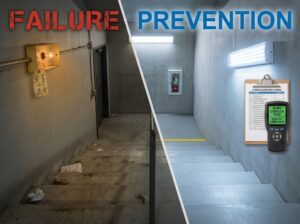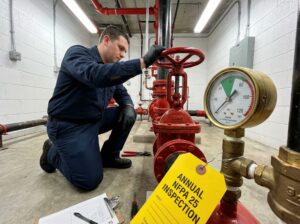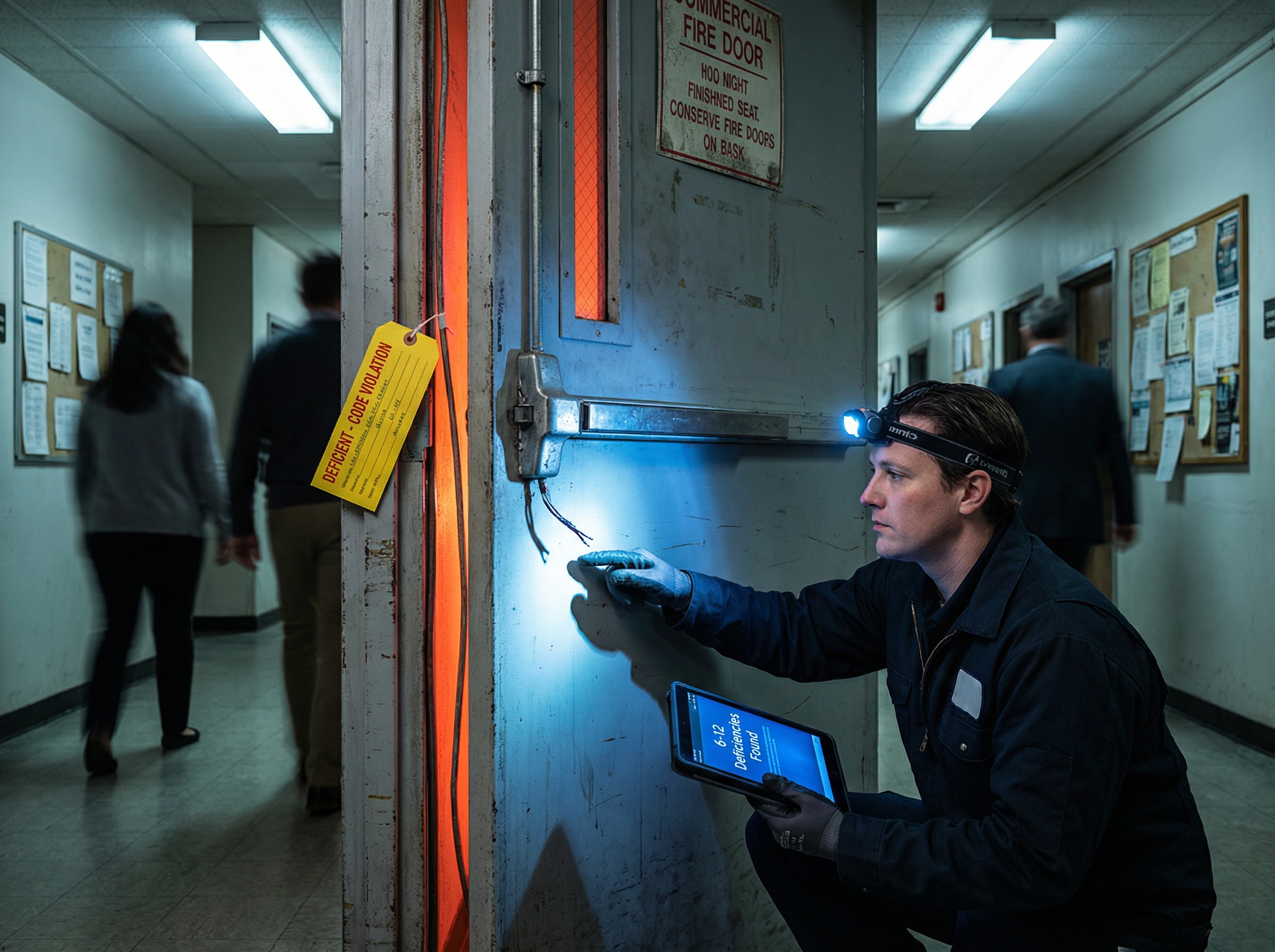
The Fire Door Inspection That Exposed Hidden Hazards
Professional fire door inspection reveals 6-12 hidden deficiencies per building on average—hazards invisible to facility occupants yet critical to fire safety, with 78-87% of uninspected fire doors containing at least one code violation compromising smoke/flame compartmentalization.
Fire Door Deficiency Disclaimer: Fire door inspection findings, deficiency rates, hazard frequencies, and compliance outcomes vary significantly by building age, door quantity, maintenance history, usage intensity, environmental conditions, and Authority Having Jurisdiction requirements. Statistics represent industry analysis of fire door inspection results across diverse facilities and typical deficiency patterns, not guaranteed findings for specific buildings.
The gap between perceived and actual fire door compliance:
| Building Perception | Inspection Reality | Common Hidden Hazards | Code Compliance Rate | Fire Protection Integrity |
|---|---|---|---|---|
| “Doors look fine, no problems” | 6-12 deficiencies found | Gap violations, hardware failures, seal deterioration | 13-22% fully compliant | 35-55% compromised |
| “We maintain our doors” | 3-6 deficiencies found | Improper modifications, clearance issues | 48-67% compliant | 65-80% functional |
| “Professional inspection annual” | 0-2 minor deficiencies | Wear items, adjustment needs | 88-95% compliant | 92-98% functional |
Critical finding: Buildings assuming fire door compliance without professional fire door inspection average 78-87% probability of code violations—hazards invisible to untrained observers yet critically compromising passive fire protection systems designed to contain smoke and flames.
Most facility managers believe fire doors function properly because doors “look okay” and “open and close”—not realizing fire door inspection examines 15-20 specific components beyond basic operation, with most deficiencies hidden from casual observation yet rendering doors ineffective during actual fire conditions when compartmentalization becomes life-critical.
This analysis examines five categories of hidden hazards professional fire door inspection commonly exposes: gap and clearance violations allowing smoke infiltration, hardware deterioration preventing proper latching, seal and gasket failures eliminating smoke barriers, improper modifications voiding fire ratings, label and rating verification issues creating code compliance risks—demonstrating why professional NFPA 80 inspection essential for fire safety integrity verification.
—
UNDERSTANDING FIRE DOOR INSPECTION AND HIDDEN HAZARDS
Why fire door deficiencies remain concealed without professional examination
Fire Door Critical Function
What fire doors accomplish during fires:
Compartmentalization (containing fire/smoke):
- Fire-rated doors separate building into fire compartments
- Prevent fire spread from area of origin to adjacent spaces
- Contain smoke (reduce inhalation hazard, maintain visibility)
- Protect egress routes (allow safe evacuation through rated corridors)
- Enable firefighter operations (controlled environment for suppression)
Rating system (time-based protection):
- 20-minute rated doors: Corridor/room separations
- 45-minute rated doors: Stairwell enclosures
- 60-minute rated doors: Vertical shaft protection
- 90-minute rated doors: Fire walls, high-hazard areas
- 3-hour rated doors: Severe fire exposure separations
Components working together:
- Door leaf (fire-rated material, construction)
- Frame (fire-rated, proper installation)
- Hardware (closers, latches, hinges rated for application)
- Gasketing (intumescent seals, smoke seals)
- Clearances (gaps meeting code maximums)
- Labels (certification of tested assembly rating)
When ANY component fails, entire assembly loses rating
—
Why Hidden Hazards Develop
How fire door deficiencies occur unnoticed:
Gradual deterioration (invisible decline):
- Door closer weakens over months/years (door still closes, just not properly)
- Gaskets compress/deteriorate (not visible, still looks intact)
- Hinges loosen slightly (door operates, but alignment shifts)
- Latches wear (door appears closed, but not fully engaged)
- Result: Doors seem functional, deficiencies accumulate unnoticed
Improper use patterns (unintentional damage):
- Propping doors open (stresses closers, creates gaps)
- Rough usage (impacts damage seals, shift alignment)
- Equipment collisions (door edges damaged, frames bent)
- Environmental exposure (weather deteriorates components)
- Result: Daily use creates deficiencies building occupants don’t recognize
Well-intentioned modifications (code violations):
- Adding non-rated hardware (door viewers, kick plates, bolts)
- Painting over labels (obscures required identification)
- Installing unauthorized holdopen devices (defeats self-closing)
- Drilling for wiring/equipment (penetrates fire rating)
- Result: Facilities improve convenience, unknowingly void fire ratings
Lack of trained observation (invisible to untrained eye):
- Occupants see “door works” (don’t examine gaps, seals, hardware details)
- Maintenance staff focus on operation (don’t verify fire rating compliance)
- Management assumes compliance (doors installed years ago, assume okay)
- Result: No one recognizes deficiencies because no one trained to identify them
This is why professional fire door inspection essential—trained inspectors examine 15-20 specific NFPA 80 requirements invisible to casual observation
—
HIDDEN HAZARD 1: GAP AND CLEARANCE VIOLATIONS
What fire door inspection reveals about smoke infiltration pathways
The Hidden Hazard
What gap violations are:
- Excessive clearance between door edge and frame (exceeds NFPA 80 maximums)
- Bottom clearance too large (smoke passage under door)
- Latch edge gap excessive (smoke infiltration at lock side)
- Hinge edge gap excessive (smoke passage at hinge side)
- Meeting edges (double doors) out of alignment (gap between leaves)
NFPA 80 maximum clearances:
- Latch edge: 1/8 inch (3.2mm) maximum
- Vertical edges (hinge/top): 1/8 inch maximum
- Bottom (meeting floor): 3/4 inch (19mm) maximum
- Meeting edges (pairs): 1/8 inch maximum with astragal
Common violations:
- Latch edge: 3/16 to 1/4 inch (50-100% over maximum)
- Bottom clearance: 1 to 1.5 inches (33-100% excessive)
- Meeting edges: 1/4 inch gaps (no astragal or out of adjustment)
—
Why This Hazard Remains Hidden
Why occupants don’t notice excessive gaps:
Visual perspective:
- Small measurements (1/8 inch vs. 1/4 inch) look similar to untrained eye
- Gaps must be measured (visual estimation unreliable)
- Building occupants have no reference (don’t know code maximums)
- Doors appear “closed” (gaps not obvious without close examination)
Gradual gap increase:
- Hinges loosen over time (door sags slightly, gaps increase)
- Frame shifts (building settling, gaps develop)
- Door edge wears (use patterns erode material, clearances grow)
- Process happens over years—no one notices incremental change
Functional operation masks problem:
- Door still closes (occupants think “working = compliant”)
- Latch engages (seems secure, not realizing smoke can infiltrate)
- No immediate visible consequence (smoke leakage only evident during actual fire)
—
How Fire Door Inspection Exposes Gap Violations
Professional examination methodology:
Measurement tools (precision verification):
- Gap gauges (specific measurements, not visual estimation)
- Feeler gauges (verify 1/8 inch maximum at edges)
- Straight edges (check door/frame alignment)
- Measuring tape (bottom clearance verification)
Systematic examination:
1. Measure latch edge gap (full height of door, multiple points)
2. Measure hinge edge gap (top to bottom verification)
3. Measure top edge gap (full width)
4. Measure bottom clearance (both ends, center)
5. Check meeting edges (double doors, full height)
6. Document measurements (record actual dimensions, compare to code)
7. Photograph violations (visual evidence for correction)
Fire door inspection findings (typical):
- 42-58% of doors have at least one excessive gap
- Latch edge violations most common (31% of doors)
- Bottom clearance violations second (27% of doors)
- Meeting edge misalignment (18% of paired doors)
—
Consequences If Gap Violations Missed
What happens during fire with excessive gaps:
Smoke infiltration:
- 1/4 inch gap (vs. 1/8 inch maximum): 2X smoke passage area
- 1.5 inch bottom gap (vs. 3/4 inch maximum): 2X smoke infiltration
- Smoke fills adjacent rooms/corridors (defeats compartmentalization)
- Reduces visibility (evacuation difficulty, disorientation)
- Increases smoke inhalation (life safety hazard)
Fire spread acceleration:
- Hot gases pass through gaps (convective heat transfer)
- Adjacent materials exposed to heat (ignition potential)
- Fire spreads beyond compartment (defeats fire rating)
Evacuation impact:
- Smoke-filled egress routes (unsafe evacuation paths)
- Reduced available safe egress time (ASET) by 40-60%
- Occupant confusion (can’t see exit signs through smoke)
Real consequence: Fire doors with excessive gaps fail to protect lives and property during actual fire conditions—hidden deficiency only detected through professional fire door inspection
—
HIDDEN HAZARD 2: HARDWARE DETERIORATION AND FAILURE
What fire door inspection reveals about closure and latching deficiencies
The Hidden Hazard
What hardware deterioration includes:
Door closer failures:
- Hydraulic fluid leakage (closer weakens, loses closing force)
- Arm misalignment (doesn’t close door fully)
- Spring fatigue (insufficient force to overcome resistance)
- Adjustment drift (closing speed changes, fails to latch)
Latch mechanism problems:
- Latch bolt worn (doesn’t fully extend into strike)
- Strike plate misaligned (latch can’t engage properly)
- Lock mechanism binding (prevents complete latching)
- Latch spring weakened (doesn’t hold securely)
Hinge deterioration:
- Hinge pins worn (door sags, alignment lost)
- Hinge screws loosened (door shifts, gaps increase)
- Hinge plates bent (binding, improper operation)
- Corrosion (outdoor/weather-exposed doors)
—
Why This Hazard Remains Hidden
Why facilities don’t detect hardware failures:
Partial function seems adequate:
- Door closes to within 1-2 inches (looks closed, not fully latched)
- Latch appears engaged (visual check, not tested for security)
- Closer brings door to near-closed position (occupants assume complete closure)
- Building occupants think “close enough” without realizing fire door must FULLY latch
Gradual performance decline:
- Closer loses 2-3% force per month (over 12 months, 24-36% weaker)
- Door requires progressively more closing force (people push harder, compensate)
- Eventually door doesn’t fully close (problem obvious only after complete failure)
- Incremental decline means no one identifies exact moment “became deficient”
Environmental factors mask problems:
- Positive/negative building pressure (air movement affects closure)
- Some days door closes, other days doesn’t (variable conditions)
- Occupants attribute to “weather” or “building HVAC” (not hardware failure)
—
How Fire Door Inspection Exposes Hardware Deficiencies
Professional examination methodology:
Functional testing:
1. Open door to 90 degrees, release (verify self-closing from full open)
2. Open door to 70 degrees, release (verify closure from partially open)
3. Observe closing speed (verify appropriate rate, not too fast/slow)
4. Verify latching (door must fully latch without manual assist)
5. Test latch security (door should not open without operating latch)
Visual hardware inspection:
- Examine closer for leaks (hydraulic fluid on cylinder/arm)
- Check closer mounting (secure fasteners, no looseness)
- Inspect hinges (proper alignment, no looseness, pins secure)
- Examine latch/strike (proper engagement, alignment, wear patterns)
- Verify all hardware rated (appropriate for fire door application)
Fire door inspection findings:
- 38-52% of doors have hardware deficiencies
- Closer failures most common (28% of doors don’t fully close/latch)
- Latch problems second (17% don’t securely engage)
- Hinge issues third (13% show looseness/misalignment)
—
Consequences If Hardware Failures Missed
What happens during fire with failed hardware:
Door doesn’t close:
- Fire door propped open by failed closer (no compartmentalization)
- Smoke/fire spread freely (defeats entire purpose)
- Multiple compartments compromised (single failed door affects whole floor)
Door doesn’t latch:
- Pressure differential forces door open (fire creates positive pressure in room)
- Smoke infiltration through unlatched door (even if pulled “closed”)
- Building evacuation systems create air movement (negative pressure stairwells suck doors open)
Fire spread scenarios:
- Single unlatched fire door: Fire spreads to 2-4 additional rooms
- Unlatched stairwell door: Smoke fills entire stairwell (evacuation route compromised)
- Multiple failed doors: Building-wide smoke migration (mass evacuation necessary)
Real consequence: Hardware failures detected only through professional fire door inspection prevent compartmentalization during actual fires—hidden deficiency with catastrophic potential
—
HIDDEN HAZARD 3: SEAL AND GASKET FAILURES
What fire door inspection reveals about smoke barrier integrity
The Hidden Hazard
What seal/gasket systems provide:
Intumescent seals (fire-activated):
- Expand when exposed to heat (200-400°F activation)
- Fill gaps between door and frame (create smoke barrier)
- Prevent flame passage (thermal barrier)
- Typically installed in door edge or frame rabbet
Smoke seals (continuous barrier):
- Provide room-temperature smoke resistance
- Compress when door closes (eliminate gaps)
- Flexible material (silicone, neoprene, blade-type)
- Required for smoke-rated doors
Common seal failures:
- Compression set (gasket permanently compressed, no longer seals)
- Adhesive failure (gasket detaches from door/frame)
- Material deterioration (age, UV exposure, cleaning chemicals)
- Mechanical damage (torn, cut, crushed during use)
- Missing sections (never installed or removed)
—
Why This Hazard Remains Hidden
Why building occupants don’t notice seal failures:
Gaskets not visible when door closed:
- Seals installed in rabbets, edges (not visible in closed position)
- Only visible when door open (occupants don’t examine)
- Compressed state looks similar whether functional or failed (visual inspection insufficient)
No functional impact on door operation:
- Door still opens/closes normally (seal failure doesn’t affect operation)
- Latch still engages (no mechanical connection)
- No sound/visual/tactile cue (nothing alerts occupants to problem)
Gradual deterioration:
- Seals lose effectiveness over 3-5 years (slow decline)
- No sudden failure moment (progressive loss of sealing ability)
- Occupants never see “before and after” comparison
—
How Fire Door Inspection Exposes Seal Failures
Professional examination methodology:
Visual inspection:
1. Open door, examine seal condition (look for damage, deterioration)
2. Check seal continuity (verify no gaps, complete perimeter)
3. Verify seal compression (close door, check compression marks)
4. Inspect adhesive bond (ensure seals securely attached)
5. Identify seal type (verify intumescent, smoke, or both as required)
Functional testing:
- Light test (shine flashlight around closed door in dark, look for light leaks)
- Smoke pencil test (check for air infiltration patterns)
- Compression verification (measure seal compression when door closed)
Fire door inspection findings:
- 32-47% of doors have seal/gasket deficiencies
- Missing seal sections most common (19% of doors)
- Compression set second (16% no longer seal effectively)
- Detachment/damage third (12% partially failed seals)
—
Consequences If Seal Failures Missed
What happens during fire with failed seals:
Smoke infiltration (immediate impact):
- Smoke passes around door perimeter (no seal barrier)
- Adjacent spaces fill with smoke (defeats compartmentalization)
- Reduced visibility, increased inhalation hazard
Fire spread (later impact):
- Hot gases pass through unsealed gaps (convective heat transfer)
- Adjacent materials heated (potential ignition)
- Fire rating compromised (door tested with seals intact, failure negates rating)
Typical failure scenario:
- Fire in Room A, fire door to Corridor B
- Failed seals allow smoke infiltration to corridor
- Corridor fills with smoke within 3-5 minutes (vs. 15-20 minutes with functional seals)
- Evacuation routes compromised (smoke-filled corridors unusable)
- Extended evacuation time (occupants must use alternate routes)
Real consequence: Seal failures invisible without professional fire door inspection eliminate smoke barrier function—hidden deficiency discovered only when too late during actual fire
—
HIDDEN HAZARD 4: IMPROPER MODIFICATIONS AND ALTERATIONS
What fire door inspection reveals about rating-voiding changes
The Hidden Hazard
What constitutes improper modifications:
Unauthorized hardware additions:
- Non-rated door viewers (peepholes drilled through door)
- Decorative kick plates not part of original assembly
- Surface bolts, barrel bolts (not fire-rated)
- Signage attached with through-bolts (penetrations)
- Mail slots, pass-throughs (openings compromise rating)
Field alterations:
- Doors cut down for clearance (removes fire-rated material)
- Frame modifications (welding, cutting for equipment)
- Glazing changes (replacing wire glass with non-rated)
- Core removal (hollowing doors for wire passage)
Painting/coating violations:
- Excessive paint buildup (prevents proper closure/latching)
- Labels painted over (obscures required identification)
- Seals painted (prevents expansion/compression)
Unauthorized holdopen devices:
- Magnets, wedges, hooks (defeat self-closing)
- Furniture positioning (blocks door closure)
- Rope/chain holdopen (prevents operation)
—
Why Facilities Don’t Realize Modifications Are Violations
Why building occupants believe modifications acceptable:
Functional improvement perceived as upgrade:
- Door viewer adds security (seems like improvement, not realizing rating void)
- Kick plate protects door (appears maintenance-positive, not code violation)
- Holdopen device convenient (prioritizes convenience over fire safety)
- Facilities focus on function, don’t realize fire rating implications
Modifications performed by well-intentioned contractors:
- Electrician drills for wire passage (completes work assignment, doesn’t know fire door rules)
- Locksmith adds hardware (provides requested service, unaware of rating requirements)
- Painter applies heavy coating (doing job, not educated on fire door impacts)
- Tradespeople modify doors without fire protection training
Labels painted over or missing:
- Building occupants don’t know doors fire-rated (no visible label)
- Assume “just regular doors” (treat like non-rated doors)
- Make modifications thinking no consequence (unaware of fire rating)
—
How Fire Door Inspection Exposes Improper Modifications
Professional examination methodology:
Hardware verification:
1. Examine all hardware (verify each component rated for fire door)
2. Check for unauthorized additions (anything not part of original assembly)
3. Verify installation method (through-bolts vs. surface mounting)
4. Confirm closer/latch/hinges appropriate (rated for door application)
Label verification:
1. Locate fire door label (edge of door, frame)
2. Verify label legible (not painted over, damaged)
3. Confirm rating matches opening (appropriate for location)
4. Check for alterations notation (if any field modifications approved)
Door/frame integrity:
1. Inspect for penetrations (holes, cutouts, modifications)
2. Verify door thickness (not cut down, maintains rated dimensions)
3. Check glazing (if present, verify rated and properly installed)
4. Examine frame (no unauthorized modifications, maintains integrity)
Fire door inspection findings:
- 28-41% of doors have improper modifications
- Painted labels most common (24% obscured identification)
- Unauthorized hardware second (16% non-rated additions)
- Field alterations third (9% cutting, drilling, modifications)
—
Consequences If Improper Modifications Missed
What modifications do to fire ratings:
Rating void (complete loss of protection):
- ANY unauthorized modification voids UL/testing certification
- Door no longer maintains tested fire rating
- Legal liability (door represented as rated, actually non-compliant)
- Code violation (AHJ requires rated doors, modifications make non-compliant)
Fire performance degradation:
- Penetrations allow fire/smoke passage (defeats compartmentalization)
- Reduced structural integrity (modifications weaken door)
- Hardware failures (non-rated components fail during fire)
Liability implications:
- Fire loss with modified doors: Plaintiff attorneys argue negligence
- Insurance: Carriers question coverage (known code violations)
- Building officials: Stop work orders, occupancy suspensions possible
Real consequence: Improper modifications discovered only through professional fire door inspection void fire ratings—facilities unknowingly operating non-compliant doors believing fully protected
—
HIDDEN HAZARD 5: LABEL AND RATING VERIFICATION ISSUES
What fire door inspection reveals about certification and compliance documentation
The Hidden Hazard
What label/rating issues include:
Missing labels:
- Fire door labels removed during painting
- Labels never installed (non-rated door in rated opening)
- Labels damaged/illegible (age, wear, defacement)
- No documentation proving door rated
Incorrect ratings:
- 20-minute door in 90-minute opening (inadequate rating)
- Non-rated door in rated location (no protection)
- Mismatched assembly (rated door, non-rated frame)
Documentation gaps:
- No record of door fire rating
- Unknown whether door fire-rated or not
- Replacement doors installed without verifying rating
- Building history lost (renovations, no records maintained)
—
Why Building Occupants Miss Label Issues
Why facilities don’t verify fire door ratings:
Labels not prominently displayed:
- Located on door edge (only visible when door open)
- Small text, difficult to read (even when present)
- Building occupants never look (don’t know to check)
Assumption doors fire-rated:
- Facilities assume “doors in stairwells must be rated” (don’t verify)
- Believe “installed correctly originally” (trust previous owners/builders)
- Think “looks like fire door” (heavy door assumed rated, not always true)
Replacement doors without verification:
- Maintenance replaces damaged door (orders “door same size”)
- Doesn’t specify fire-rated (replaces with non-rated)
- Years later, no one remembers (assumes door always there, must be rated)
—
How Fire Door Inspection Exposes Label Issues
Professional verification methodology:
Label location and examination:
1. Check door edge for label (fire rating certification)
2. Examine frame for label (frame must also be rated)
3. Verify label legibility (rating, manufacturer, UL/testing agency visible)
4. Document label information (photograph for records)
Rating verification:
1. Identify required rating (based on building code, occupancy, location)
2. Compare door label rating to requirement (verify adequate)
3. Confirm complete assembly (door AND frame both rated, hardware appropriate)
4. Check for listed assemblies (UL directory verification)
Fire door inspection findings:
- 19-31% of doors have label/rating issues
- Missing/illegible labels most common (17% cannot verify rating)
- Incorrect rating second (8% inadequate for opening)
- Non-rated doors in rated openings third (6% complete non-compliance)
—
Consequences If Label Issues Missed
What happens with unverified door ratings:
Code violation:
- Building codes require fire doors in specific locations
- Non-rated door in rated opening violates code
- Authority Having Jurisdiction enforcement (citations, fines)
- Potential occupancy restrictions (serious violations)
Fire safety compromise:
- Non-rated door offers no fire protection
- Fire spreads unrestricted (defeats compartmentalization)
- Life safety endangered (inadequate protection)
Liability exposure:
- Fire loss with non-rated doors: Massive legal liability
- “Should have known” standard (reasonable building owner verifies ratings)
- Plaintiff attorneys argue gross negligence (rated doors required, not provided)
Real consequence: Label verification only through professional fire door inspection ensures actual compliance—facilities often discover non-rated doors in critical locations only after professional examination
—
CUMULATIVE IMPACT: MULTIPLE HIDDEN HAZARDS COMPOUND RISK
How deficiency combinations exponentially degrade fire protection
Single-deficiency scenario:
- Door has excessive gaps: Smoke infiltration, but door still provides some barrier
- Impact: Moderate compromise (30-40% reduced effectiveness)
Two-deficiency scenario:
- Door has gaps + failed seals: Significant smoke infiltration
- Impact: Major compromise (60-75% reduced effectiveness)
Three-deficiency scenario:
- Door has gaps + failed seals + doesn’t fully latch: Minimal protection
- Impact: Severe compromise (80-90% reduced effectiveness)
Multiple-deficiency scenario:
- Door has gaps + seals failed + hardware deteriorated + improper modifications
- Impact: Complete failure (door provides near-zero fire protection)
Fire door inspection findings: 18-27% of doors have 3+ deficiencies—buildings often have multiple doors with multiple problems creating facility-wide fire protection degradation
—
48FIRE PROTECTION COMPREHENSIVE FIRE DOOR INSPECTION SERVICE
How we expose hidden hazards ensuring fire door integrity
Systematic NFPA 80 Examination
What our fire door inspection includes:
Component-by-component verification:
- Gap measurements (all edges, precision gauges)
- Hardware functional testing (closure, latching, security)
- Seal condition assessment (visual, functional verification)
- Modification identification (unauthorized changes detected)
- Label verification (rating confirmation, documentation)
Detailed documentation:
- Photographic evidence (all deficiencies documented)
- Measurement records (gap dimensions, comparisons to code)
- Deficiency reports (prioritized by severity)
- Correction recommendations (specific actions required)
- Compliance certification (upon correction verification)
—
Hidden Hazard Detection
Professional training identifies issues occupants miss:
- NFPA 80 certified inspectors (specialized knowledge)
- Experience-based recognition (subtle deficiencies detected)
- Systematic methodology (nothing overlooked)
- Testing equipment (precision measurement, not estimation)
—
Correction Coordination
48Fire Protection correction services:
- Hardware replacement (rated components, proper installation)
- Seal replacement (appropriate materials, correct installation)
- Gap adjustment (door/frame alignment, clearance compliance)
- Label restoration (identification replacement when needed)
- Modification reversal (restore fire-rated configuration)
Result: Comprehensive fire door inspection exposing all hidden hazards with coordinated correction ensuring NFPA 80 compliance and fire protection integrity restoration
—
CONCLUSION: PROFESSIONAL FIRE DOOR INSPECTION EXPOSES CRITICAL HIDDEN HAZARDS
Fire door inspection reveals 6-12 hidden deficiencies per building on average with 78-87% of uninspected fire doors containing at least one code violation compromising smoke and flame compartmentalization—hazards invisible to facility occupants yet critical to fire safety requiring professional NFPA 80 examination for detection.
Five categories of hidden hazards commonly exposed: Gap and clearance violations (42-58% of doors) allowing smoke infiltration through excessive clearances at latch edges, bottom, and meeting edges measurable only with precision gauges; hardware deterioration and failures (38-52% of doors) including door closer weakness, latch mechanism problems, hinge loosening causing incomplete closure and latching; seal and gasket failures (32-47% of doors) involving intumescent seal compression set, smoke seal detachment, material deterioration eliminating smoke barriers; improper modifications and alterations (28-41% of doors) including unauthorized hardware additions, field alterations, painted labels voiding fire ratings; label and rating verification issues (19-31% of doors) involving missing labels, incorrect ratings, non-rated doors in rated openings creating code violations and liability exposure.
Hidden hazard development patterns: Gradual deterioration occurs over months and years creating incremental decline invisible to building occupants, improper use patterns and rough usage cause unintentional damage unrecognized by untrained observers, well-intentioned modifications void fire ratings without facility awareness, lack of trained observation means deficiencies accumulate undetected because no one examines 15-20 NFPA 80 specific requirements—demonstrating why professional fire door inspection essential for hazard exposure rather than casual facility walkthrough insufficient for compliance verification.
Consequences of undetected hazards: Gap violations during fires cause smoke infiltration reducing available safe egress time 40-60%, hardware failures prevent door closure eliminating compartmentalization enabling fire spread to 2-4 additional rooms per failed door, seal failures compromise smoke barriers causing corridor smoke-filling within 3-5 minutes versus 15-20 minutes with functional seals, improper modifications void fire ratings creating legal liability and insurance complications, label issues result in non-rated doors providing zero fire protection in critical locations—cumulative deficiencies compound exponentially with 18-27% of doors containing 3+ problems creating facility-wide fire protection degradation discoverable only through systematic professional examination.
48Fire Protection comprehensive fire door inspection service exposes hidden hazards through systematic NFPA 80 examination including precision gap measurements all edges, hardware functional testing for closure and latching, seal condition assessment visual and functional, modification identification detecting unauthorized changes, label verification confirming ratings—delivering detailed documentation with photographic evidence, prioritized deficiency reports, specific correction recommendations, coordinated correction services including hardware replacement, seal replacement, gap adjustment, modification reversal, label restoration—ensuring complete fire door integrity restoration and NFPA 80 compliance verification protecting buildings from hidden hazards compromising passive fire protection systems.
Fire Door Deficiency Disclaimer: Fire door inspection findings, deficiency types, frequencies, compliance rates, and correction requirements vary significantly by building age, construction type, door quantity, maintenance history, usage patterns, environmental conditions, jurisdiction requirements, and Authority Having Jurisdiction standards. Information reflects common fire door inspection deficiency patterns based on NFPA 80 requirements and industry analysis across diverse facilities, not guaranteed findings for specific buildings. Professional fire door inspection recommended annually per NFPA 80 for compliance verification and hazard detection.
[Schedule Professional Fire Door Inspection](/contact-us)
Expose hidden fire door hazards through comprehensive NFPA 80 inspection. 48Fire Protection provides systematic examination measuring gap clearances all edges with precision gauges, hardware functional testing verifying complete closure and secure latching, seal and gasket condition assessment identifying deterioration and compression set, modification identification detecting rating-voiding alterations, label verification confirming fire ratings and documentation—delivering detailed deficiency reports with photographic evidence, prioritized correction recommendations, coordinated repair services, compliance certification upon verification—protecting buildings from 6-12 average hidden deficiencies per building compromising fire compartmentalization and life safety through professional detection and correction of hazards invisible to casual facility observation.