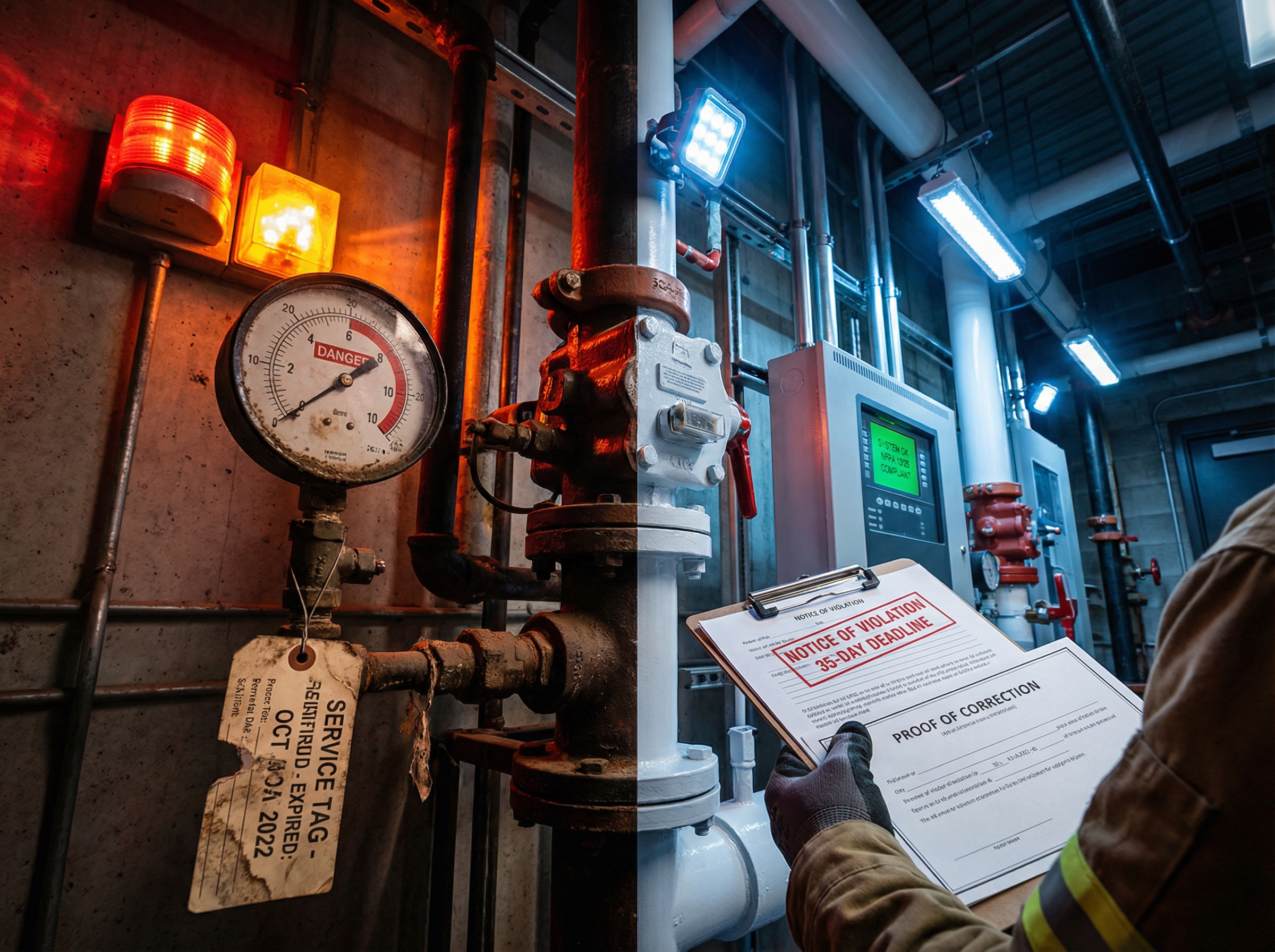
If your facility just received a notice from the fire department, you’re likely staring at a clock you didn’t set: a fire code violation deadline. The moment inspectors walk away, the real countdown begins. The length of that countdown isn’t the same everywhere. It depends on where you are, what was found, and what your local jurisdiction requires for correction, re-inspection, and possible hearings or appeals. In practice, many facility managers face a narrow window to address dangerous or noncompliant conditions before penalties or enforcement actions escalate.
This article walks you through how long you have to fix a fire code violation, what a Notice of Violation (NOV) really means, how fire inspections reinspection timelines typically work, and how to navigate each jurisdiction’s expectations without jeopardizing your operations. We’ll pull in real-world examples from major U.S. cities to illustrate common timelines and penalties, and then offer a practical, battle-tested plan you can use to move from notice to compliance efficiently.
—
Opening question: How long do you really have to fix a fire code violation?
Most facility managers ask a simple, practical question after a fire inspection: “What’s the deadline to fix this, and what happens if I miss it?” The answer is nuanced. Some cities set a fixed deadline in the NOV; others require you to complete repairs and file a correction or comply with an order within a specified timeframe, while still keeping open the option for a hearing or an appeal if you disagree with the findings. And in many places, even when the NOV itself has no monetary penalties, an ensuing Order to Comply can carry daily fines.
To manage expectations and plan correctly, you must understand both the wording on the notice and the policy framework your jurisdiction uses for correction, re-inspection, and enforcement.
Below, you’ll find a jurisdiction-by-jurisdiction look at how long you have to fix violations, followed by practical steps to respond, repair, and close out the case with the least disruption to your operations.
—
What constitutes a fire code violation? A quick map of typical issues
Before diving into deadlines, it helps to categorize what inspectors commonly tag as violations. While exact language varies by city, most NOVs fall into several broad buckets:
- Fire protection system deficiencies (e.g., impaired alarms, partial sprinkler coverage, blocked egress, improper testing)
- Obstructed egress or blocked fire doors
- Nonfunctional extinguishers or out-of-date maintenance records
- Inadequate means of egress lighting or exit signage
- Clearances around mechanical rooms or storage areas (combustibles improperly stored, clutter)
- Documentation gaps (missing service records, annual inspections not completed, or failure to follow NFPA protocol)
Each category often has its own recommended window for correction. Some jurisdictions require you to fix all items and complete a correction by a single deadline; others allow staged corrections, with a sequence of re-inspections.
As you consider your next steps, keep this distinction in mind: the deadline to correct is about safety and reliability, but the precise timeline is a legal and administrative instrument that some cities use to ensure swift remediation.
Citations you can consult for context on how cities structure their programs include the following:
- Portland’s two-year cycle for commercial fire safety inspections and typical corrected-window and reinspection timing: [How the Fire Safety Inspection Program works]
- San Francisco’s requirement that NOVs specify a time for compliance and re-inspection, plus 30 days’ notice for hearings: [Terms of Notice of Fire Code Violations]
- Seattle’s approach where NOVs have a defined compliance date, and an Order to Comply can impose fines: [Violations and Citations – Fire]
- New York City’s requirement to correct and file a Certificate of Correction within 35 days, or appear at a hearing: [Violations – NYC FDNY]
- Philadelphia’s process to fix all listed violations or file an appeal, with a compliance inspection step: [Resolve a code violation at your property – Philadelphia]
—
A Snapshot in Key Jurisdictions: How deadlines typically work
To give you a practical sense of what to expect, here’s a compact comparison of common timelines and penalties in several major U.S. jurisdictions. Note that local codes can and do change, so always verify the exact language on your NOV and with your local fire department.
| Jurisdiction | Typical NOV/Correction Date | Reinspection Timing | Penalties / Fines | Notable notes |
|---|---|---|---|---|
| Portland, OR | Commercial fire safety inspections every two years; minimum 10-day correction window for common violations; reinspections typically on or after 40 days | Reinspections usually scheduled on or after 40 days from the NOV or the correction notice | Noted penalties are generally tied to remediation timelines; see jurisdiction specifics | Emphasizes a two-year cycle and structured remediation windows [How the Fire Safety Inspection Program works] |
| San Francisco, CA | NOV specifies a time for compliance; if correction isn’t immediate, there is a defined deadline for compliance and re-inspection; hearing requires 30 days’ notice | Reinspection arranged after correction or after notice, with hearing options available | Hearing may be required; penalties depend on corrective actions and orders | The notice explicitly outlines timeframes and hearing rights [Terms of Notice of Fire Code Violations] |
| Seattle, WA | NOV includes a correction date; there is no monetary penalty for NOVs per se, but an Order to Comply can impose fines up to $1,000 per day | Reinspection scheduling depends on compliance status; an Order to Comply can trigger ongoing penalties | Fines up to $1,000 per day with an Order to Comply | NOVs alone do not incur fines, but enforcement tools can escalate quickly [Violations and Citations – Fire] |
| New York City, NY | FDNY violations require correction and filing a Certificate of Correction within 35 days of issuance; otherwise, you must appear at a hearing | Reinspection occurs as part of the enforcement process; a certificate of correction is a formal compliance document | Hearing or penalties apply if not corrected within 35 days | Certificate of Correction is a critical mechanism for legal closure of the violation [Violations – NYC FDNY] |
| Philadelphia, PA | You must fix all listed violations or file an appeal; the process includes scheduling a compliance inspection | Compliance inspection follows the correction or appeal; ongoing enforcement possible until compliant | Fees may apply; enforcement depends on compliance status | Appeals provide a path when there’s a dispute about the NOV [Resolve a code violation at your property] |
—
The NOV: What it means and what you must do
A Notice of Violation is not a formality. It is a formal document that records noncompliant conditions and sets expectations for remediation. The NOV may be issued for a single critical deficiency or multiple items across a facility.
Key elements you should look for on the NOV:
- The list of violations cited and the exact code sections involved
- The stated correction deadline or a method to establish a correction plan
- Instructions for submitting evidence of corrective actions
- Information about required re-inspection and how to schedule it
- Any rights to request a hearing or appeal, including deadlines for such requests
A critical step after receiving an NOV is to verify the accuracy of the findings. It’s not unusual for there to be items that can be quickly addressed and others that require more extensive work. If you disagree with any item, you should understand your jurisdiction’s hearing or appeals process outlined in the NOV or on the issuing agency’s website.
Citations and guidance from relevant city portals provide deeper context about how these processes operate:
- San Francisco’s policy on NOVs and hearings: [Terms of Notice of Fire Code Violations]
- Seattle’s framework for NOVs and enforcement actions: [Violations and Citations – Fire]
- NYC’s Certificate of Correction pathway to compliance: [Violations – NYC FDNY]
- Philadelphia’s complaint-to-correction pipeline, including compliance inspections: [Resolve a code violation at your property]
—
A practical, step-by-step plan: From notice to compliance
The following 7-step plan is designed to be actionable regardless of jurisdiction, while allowing for adaptations based on local rules. It aligns with the common themes in the cited cities and gives you a structured path to meet or beat your fire code violation deadline.
1) Read the NOV thoroughly and confirm the deadlines
- Confirm the exact dates for compliance, re-inspection, and any hearing rights.
- Note any items that you might dispute or require clarification on (e.g., ambiguous citations, mischaracterized conditions).
2) Delegate and schedule internal tasks
- Assign a primary point of contact for the NOV.
- Create a timeline with owners for each violation, repair tasks, and documentation to collect.
3) Prioritize life-safety and critical systems first
- Address life-safety issues with the highest risk (e.g., impaired alarm systems, blocked exits, fire doors that don’t seal properly).
- Ensure critical systems remain operational or are brought into compliance as a matter of top priority.
4) Gather and document corrective actions
- Photograph pre- and post-repair conditions.
- Collect third-party inspection records, maintenance logs, and test results.
- Log dates, personnel, and materials used with a clear audit trail.
5) Schedule re-inspection (or prepare for hearing)
- If the NOV requires re-inspection, coordinate with the authority to set a date and time.
- If you anticipate a hearing, prepare your case with data, plans, and any expert testimony or documentation.
6) Implement the fixes and verify compliance
- Complete all required repairs or corrective actions.
- Verify repairs through tests, inspections, and certification from qualified professionals as required by code.
7) Close the loop with the issuing agency
- Submit the Certificate of Correction or equivalent documentation when required (e.g., NYC’s 35-day window for Certificate of Correction).
- If you filed an appeal or requested a hearing, ensure you attend and present your evidence.
- Schedule or confirm the re-inspection to close the case.
A robust checklist you can reuse:
- [ ] Read NOV and deadlines
- [ ] Assign owner and build timeline
- [ ] Prioritize life-safety items
- [ ] Collect and organize evidence
- [ ] Complete repairs
- [ ] Run tests and verification
- [ ] Schedule re-inspection or hearing
- [ ] Submit required documentation
- [ ] Confirm compliance and close the case
Pro tip: If you’re juggling multiple locations, maintain a centralized, shareable defect-tracking document (or an issue-tracking platform) that all stakeholders can access. This helps prevent items from slipping through the cracks, especially when deadlines are tight.
—
Implementation: A closer look at real-world timelines
Let’s pull the threads together with a deeper dive into how timelines often play out in practice, using the city examples introduced earlier.
- Portland’s approach gives a starting correction window of at least 10 days for common violations, with re-inspections typically 40 days after a notice. This structure encourages early remediation but also recognizes that some fixes require more time, particularly if contractors or equipment replacements are involved [How the Fire Safety Inspection Program works].
- In San Francisco, a NOV will specify when you must comply, and if you need a hearing due to a dispute or complexity in the fix, the city provides at least 30 days’ notice for that hearing. This means you must plan for both compliance and the potential of a hearing in your response strategy [Terms of Notice of Fire Code Violations].
- Seattle’s system separates the NOV from monetary penalties. A NOV itself does not automatically incur a fine; but an Order to Comply can levy up to $1,000 per day if you fail to meet the required correction. This incentivizes timely action but also gives you a path to appeal or rectify through formal channels [Violations and Citations – Fire].
- NYC’s process is highly prescriptive: you must correct the condition and file a Certificate of Correction within 35 days of issuance, or you must appear at a hearing. The Certificate of Correction is a formal, binding document that clears the violation when approved [Violations – NYC FDNY].
- Philadelphia requires that you fix all listed violations or file an appeal. The process includes scheduling a compliance inspection; you can pursue an appeal if you disagree with the NOV, but you must engage the process to avoid enforcement escalation [Resolve a code violation at your property].
These patterns illustrate a broader principle: most jurisdictions require a defined fix window, some rely on a staged approach with re-inspections, and others link remediation to fines or hearings. The common thread is that speed, documentation, and clear communication with the enforcing agency are crucial to minimize risk and downtime.
—
Common pitfalls and how to avoid them
Even well-intentioned facility teams can stumble when facing a fire code violation. Here are some frequent missteps and practical fixes:
- Pitfall: Underestimating the scope of repairs
- Fix: Conduct a quick but thorough assessment of all items on the NOV and create a scoping document with estimated time and budget for each repair.
- Pitfall: Inadequate documentation
- Fix: Build a single, auditable trail of evidence: photos, service reports, test results, product datasheets, and contractor invoices. Store them in a shared, time-stamped folder.
- Pitfall: Delaying re-inspection scheduling
- Fix: Schedule the re-inspection or hearing as soon as possible after finalizing corrective actions; confirm dates in writing with the enforcing agency.
- Pitfall: Misunderstanding the deadline language
- Fix: If the NOV language is ambiguous, contact the issuing agency for clarification in writing. If needed, obtain a formal determination or request a hearing to ensure you’re acting under the correct deadline.
- Pitfall: Not considering future compliance
- Fix: Build in a corrective plan that not only fixes the issue but also prevents recurrence (e.g., enhanced maintenance schedules, automatic reminders for tests, standard operating procedures).
- Pitfall: Failing to consult qualified professionals
- Fix: Engage licensed professionals for critical systems (sprinklers, alarms, fire doors) and keep their certifications on file as part of your compliance package.
- Pitfall: Overlooking updates to codes
- Fix: Fire codes evolve. Ensure your remediation aligns with the current edition of NFPA standards or your local amendments, and document this alignment in your submission.
—
Expert insight: Why timing matters for safety and cost
A fire code violation deadline is not just a bureaucratic requirement; it is a safety commitment. The longer a facility operates with noncompliant conditions, the higher the risk to occupants and to property. Timely remediation reduces the potential for:
- Increased risk of fire incidents or degraded safety performance
- Higher enforcement penalties or escalation to higher fines
- Operational downtime due to emergency responses, evacuation drills, or system failures
- Negative impacts on insurance coverage or risk profiles
In practice, the fastest, most cost-effective path to compliance is often to fix critical issues first, then implement a durable maintenance plan that keeps systems in continuous compliance. This aligns with how many jurisdictions handle notices: a focus on both immediate correction and longer-term reliability.
Quote from field practice: “When you treat a NOV as a live safety issue rather than a paperwork burden, you’re protecting people, property, and your organization’s reputation. The right plan reduces risk and cost in the long run.” [For context on how inspection programs work and their timelines, see sources about city programs and enforcement mechanisms above.]
—
The 48Fire Protection perspective: How we help you meet fire code deadlines
At 48Fire Protection, our approach to fire code compliance is designed to minimize disruption and maximize safety. We help organizations keep pace with deadlines and ensure a durable path to full compliance, including the often-overlooked reinspection step. Here are several ways we support your efforts:
Comprehensive fire code compliance audits
- We review your current fire protection systems against the latest NFPA standards and local amendments to identify noncompliant conditions and gaps before an NOV is issued.
Fire protection system inspection and testing
- Regular, documented testing (smoke detectors, alarms, sprinklers, extinguishers, electrical interlocks) helps prevent NOVs and keeps timelines predictable when an issue arises.
Corrective action planning and project management
- We translate inspection findings into actionable remediation plans with clear responsibilities, milestones, and documentation readiness.
Re-inspection coordination
- We work with the issuing agencies to schedule efficient re-inspections and ensure all required documentation is prepared and presented correctly.
Permit review and plan verification
- If changes require permit approvals or new plans, we provide plan review services to streamline approvals and prevent delays.
Documentation and certificate of correction support
- We help assemble the evidence package needed for submission, including test results, professional attestations, and photos that demonstrate compliance.
Training and procedure updates
- We provide targeted training and update standard operating procedures to align with current requirements and reduce the risk of future NOVs.
Post-violation risk mitigation
- We help implement long-term maintenance and testing schedules to protect against reoccurrence, giving you a durable compliance posture.
If you’re facing a fire code violation, or you want to proactively prevent them, our team has the experience to help you move from notice to safe, verifiable compliance—efficiently and clearly.
—
A quick-read framework you can share with stakeholders
- The NOV is the official record of noncompliance and the starting point for remediation.
- Deadlines vary by jurisdiction, but the expected flow is: correct → re-inspect → certify or appear at a hearing if required.
- Prioritize life-safety issues first and document every action.
- Engage the right experts early, especially for critical life-safety systems.
- Maintain meticulous records to support the correction and defense if needed.
- Use a structured project plan with a clear ownership map and a visible timeline.
—
Additional resources and considerations
- If you operate in multiple jurisdictions or have facilities in different states or cities, consider adopting a standardized internal process for NOVs that can be adapted per jurisdiction. A single, auditable process reduces delays caused by miscommunication or missing documentation.
- Understand that some jurisdictions issue separate actions (e.g., an NOV followed by an Order to Comply). In those cases, you may have to manage parallel workflows: immediate remediation to address NOV items and a separate plan to resolve any order-based penalties.
- Consider a risk-based approach to prioritize remediation steps. Some violations pose more immediate risk and may trigger more intense enforcement actions if not addressed quickly. Your plan should reflect this risk assessment.
- Budget for contingencies. In many cases, repairs are not just about hardware replacement but about scheduling tests, permits, and contractor availability. Build in buffers to avoid missing deadlines due to scheduling constraints.
—
Real-world example workflows
To illustrate how this workflow might look in practice, here are two simplified example timelines for common scenarios:
- Example A: Life-safety critical issue (e.g., nonfunctional alarm panel) in a jurisdiction with a 10-day minimum correction window and a 40-day typical reinspection window (Portland-like).
Day 0: NOV issued.
Day 2–6: Quick triage and interim protective actions (if needed).
Day 7–20: Complete the critical repairs; document and test.
Day 21–40: Schedule and conduct re-inspection; Submit documentation.
Day 41+: NOV closed if compliant; otherwise escalate to hearing or enforcement per local rules.
- Example B: Non-life-safety items (e.g., signage, minor clearance issues) with a longer correction window in a jurisdiction with a hearing option (San Francisco-like).
Day 0: NOV issued with a defined compliance deadline; hearing option may apply.
Day 7–30: Complete corrective actions; prepare for potential hearing if necessary.
Day 31–60: Re-inspection scheduling; if necessary, hearing scheduled with at least 30 days’ notice.
Day 61+: Compliance confirmed or hearing decision in place; case closed.
—
Is there a silver bullet? Not quite. But there is a best-practice approach.
A single “silver bullet” to guarantee instant compliance doesn’t exist because the process is tied to local regulations, the extent of the corrections, and the efficiency of your team and contractors. However, there is a consistently effective strategy:
- Start fast with a precise plan and a dedicated owner.
- Prioritize life-safety issues and minimize downtime for critical systems.
- Communicate clearly with the enforcing agency and secure written confirmations of deadlines and expectations.
- Build a robust evidence package to support corrections and quick re-inspection.
- Engage qualified professionals for complex systems to ensure compliance alignment with NFPA standards and local amendments.
- Create a sustainable maintenance program to prevent future NOVs.
In practice, this approach reduces time to compliance, minimizes penalties, and maintains facility operations—three factors that matter most when deadlines loom.
—
Key takeaways
- Fire code violation deadlines and correction routes vary by jurisdiction, but the underlying priorities are consistent: fix the issues safely and verifiably, and do so promptly to minimize risk and cost.
- A well-documented NOV response plan that prioritizes life-safety issues and includes a clear path to re-inspection or hearings will reduce the chance of escalation.
- The elements of successful remediation include a precise scope, robust documentation, timely scheduling, and engagement of qualified professionals when required by the code.
—
48Fire Protection: Our services designed to keep you compliant
- Fire code compliance audits and gap analyses
- Fire protection system inspection, testing, and certification
- Remediation planning and project management for NOVs
- Re-inspection coordination and documentation preparation
- Permit and plan review for required code changes
- Training programs and SOP updates for ongoing compliance
- Certificate of Correction assistance and compliance closure support
- Ongoing maintenance programs to prevent future violations
If you’re navigating a fire code violation deadline, or you want to minimize the risk of receiving one, contact our team to assess your facility and build a proactive, defensible plan that keeps you compliant, safe, and operational.
—
Final note
This article is designed to guide you through the realities of fire code violation deadlines and the process to achieve timely compliance across different jurisdictions. Always verify current local requirements directly with your fire department or permit office, as codes and timelines can change.