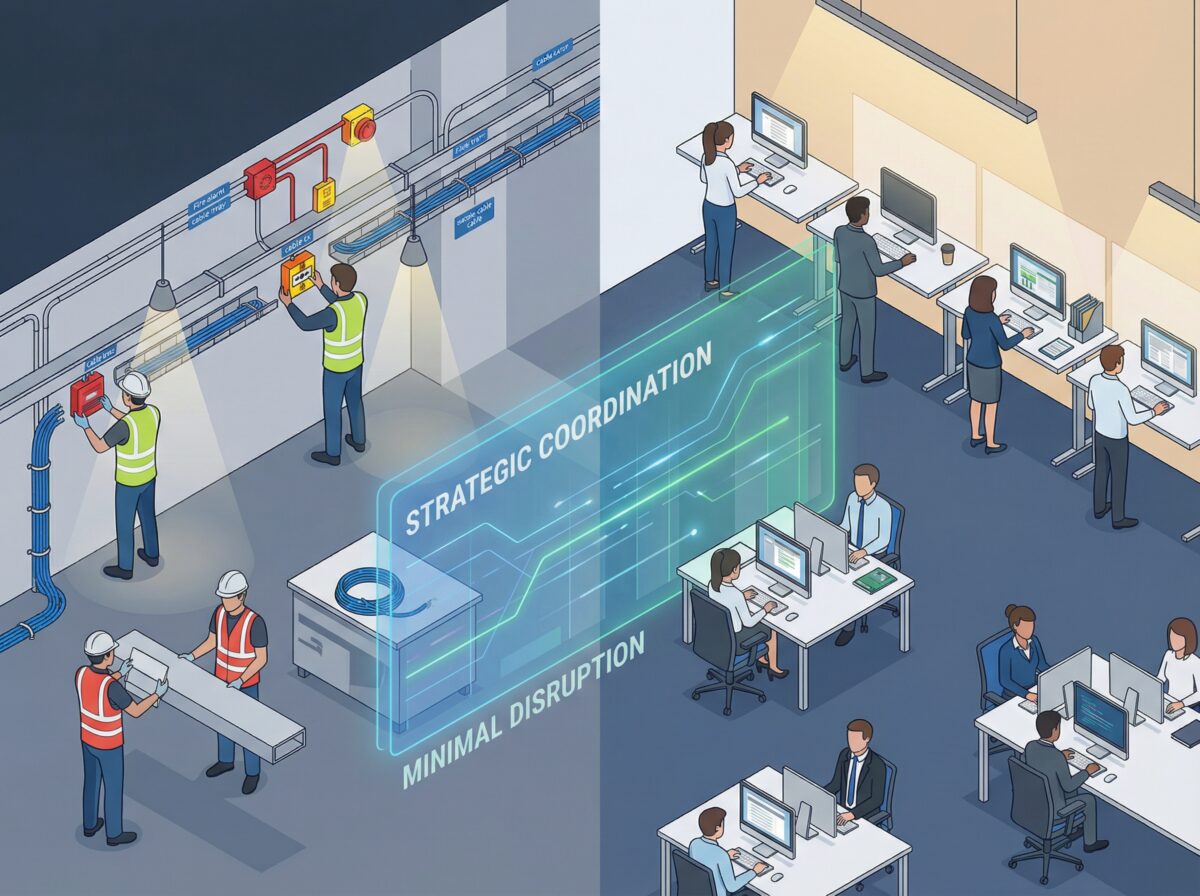
Planning Methods That Actually Reduce Disruption
Fire alarm installations disrupt business operations. Running conduit, mounting devices, testing systems—all require access to spaces where people work.
The difference between 45% downtime and minimal disruption comes down to planning approach, not installation speed.
Standard installation timeline:
- 15,000 square foot office building
- Addressable fire alarm system
- 87 devices total
- Typical approach: 8-12 days of installation
- Business disruption: 6-8 days affecting normal operations
Strategic installation timeline:
- Same building and system
- Phased installation approach
- Off-hours scheduling for critical areas
- Advanced coordination with building operations
- Total installation: 10-14 days
- Business disruption: 3-4 days affecting operations
The math:
Standard approach disrupts 6-8 days of operations. Strategic approach disrupts 3-4 days. Reduction: 3-4 days fewer disruptions = 45-50% less downtime.
Where time gets saved:
Not through faster installation—through smarter sequencing. Installing fire alarm systems in occupied buildings requires coordination between:
- Electrical rough-in work (conduit and wire pulling)
- Device mounting and connection
- System programming and testing
- Building operations and occupant schedules
- Other trades working simultaneously
Poor coordination means work stops repeatedly waiting for access, creating extended disruption periods. Strategic coordination sequences work minimizing operational impact.
What actually matters:
Installation speed matters less than installation timing. Crew working 8-hour day shift in occupied office causes full-day disruption. Same crew working 4-hour evening shift after business hours causes zero operational disruption.
Total installation time might actually increase with strategic approach—but business impact decreases dramatically.
—
Pre-Installation Planning That Prevents Problems
Most installation delays result from problems discovered after work begins. Thorough pre-installation planning identifies issues beforehand.
Comprehensive site survey requirements
Fire alarm contractors must understand building conditions before starting installation.
What site surveys should document:
Ceiling types and access:
- Drop ceiling tiles (easy device access)
- Hard ceiling drywall (requires cutting and patching)
- Exposed structure (conduit routing visible)
- Ceiling height variations throughout building
Existing infrastructure:
- Electrical panels and available circuits
- Telephone/data rooms for monitoring connections
- Conduit pathways and available raceways
- Fire alarm panel location options
Occupancy patterns:
- Business operating hours
- High-traffic vs. low-traffic periods
- Areas requiring 24/7 access
- Spaces with scheduled downtime (weekends, evenings)
Construction conditions:
- Active renovation work
- Furniture and equipment placement
- Storage blocking access areas
- Other trades scheduled simultaneously
Access restrictions:
- Security requirements
- Areas requiring escorts
- Spaces with hazardous materials
- Clean rooms or controlled environments
Contractors performing thorough site surveys before quoting identify potential problems early. Quotes based on assumptions rather than actual site conditions inevitably lead to change orders and delays.
Building operations coordination
Fire alarm installation affects building occupants. Coordination minimizes disruption.
Information needed from building management:
Occupancy schedules:
- Department locations and headcounts
- Critical business processes by area
- Flexible vs. inflexible operations
- Preferred installation timeframes
Access requirements:
- Key or badge access procedures
- Escort requirements for contractors
- Parking and loading dock access
- Security check-in processes
Communication protocols:
- Who authorizes access to specific areas
- How occupants get notified about work
- Emergency contact procedures
- Change approval process
Coordination with other work:
- HVAC projects affecting ceiling access
- IT infrastructure installations
- Renovation schedules
- Moving or furniture delivery dates
Building managers knowing installation schedule details can plan around disruptions. Last-minute “we need access to conference room today” requests create operational problems that advance coordination prevents.
Material procurement and staging
Having materials on-site before installation starts prevents delays.
Lead time considerations:
Common fire alarm equipment ships within days:
- Standard smoke and heat detectors: 1-2 weeks
- Pull stations and notification devices: 1-2 weeks
- Basic control panels: 2-3 weeks
Specialized equipment requires longer:
- Custom-configured addressable panels: 4-6 weeks
- Voice evacuation systems: 6-8 weeks
- Aspirating smoke detection: 8-12 weeks
- Large battery backup systems: 4-8 weeks
Order specialized equipment immediately after contract signing. Standard components can ship closer to installation start, but long-lead items need early ordering preventing schedule delays.
Staging area requirements:
Fire alarm installations generate materials needing secure storage:
- Control panels and equipment (protect from damage/theft)
- Conduit and fittings (organized by installation phase)
- Devices in original packaging (prevent contamination before installation)
- Tools and testing equipment
Ideal staging location characteristics:
- Lockable space protecting materials overnight
- Close to primary work areas (reduces material transport time)
- Adequate size for multiple days of materials
- Loading dock or freight elevator access
- Climate controlled (protects sensitive electronics)
Buildings lacking suitable staging areas face daily material deliveries causing loading dock congestion and installation delays. Secure staging space established before work starts streamlines installation flow.
Permit acquisition timeline
Fire alarm permits require weeks to months for approval depending on jurisdiction.
Typical permit timeline:
Week 1-2: Submit permit application
- System design drawings
- Equipment specifications and cut sheets
- Contractor license documentation
- Building permit fees
Week 3-6: Plan review process
- Fire marshal reviews design for code compliance
- Building department checks electrical requirements
- Comments issued if revisions needed
- Resubmittal if changes required
Week 7-8: Permit issuance
- Approved stamped drawings returned
- Permit placard issued for display
- Inspection schedule established
Timeline variables:
- Jurisdiction workload (busy departments slower)
- Design complexity (simple systems faster approval)
- Code compliance issues (violations require resubmittal)
- Completeness of application (missing documents delay review)
Starting permit process 8-12 weeks before desired installation date provides buffer for approval delays. Contractors waiting until permit approved before ordering equipment extend project timelines unnecessarily.
Better approach: Submit permits and order long-lead equipment simultaneously. Both processes happen in parallel reducing overall project duration.
—
Phased Installation Strategies
Breaking installations into phases allows work in some areas while others remain operational.
Zone-based installation sequencing
Divide building into installation zones based on operational impact.
Zone priority classification:
Priority 1 – Critical Operations (Install Last):
- Data centers and server rooms
- Executive offices and boardrooms
- Customer-facing areas (retail floors, reception)
- Production lines or manufacturing areas
- Call centers or high-density workspaces
These areas get fire alarm coverage last, minimizing disruption to critical functions. Temporary fire watch or existing detection remains active until new system operational.
Priority 2 – Moderate Impact (Install Mid-Project):
- General office spaces
- Conference rooms (schedulable downtime)
- Break rooms and common areas
- Storage and warehouse spaces
- Back-of-house operations
These areas tolerate moderate disruption with advance notice. Installation during normal business hours acceptable if occupants notified.
Priority 3 – Low Impact (Install First):
- Vacant or under-renovation spaces
- After-hours only areas (mechanical rooms, electrical rooms)
- Exterior areas (parking structures, loading docks)
- Unoccupied floors or future expansion space
- Utility corridors and telecommunications rooms
Starting with low-impact zones allows contractors establishing work rhythm and identifying unforeseen issues before entering critical areas. Mistakes in vacant areas don’t disrupt operations.
Phased approach benefits:
Building maintains partial fire protection throughout installation. Existing system remains operational in uncompleted zones while new system activates in finished zones. Never leaves entire building without fire alarm coverage.
Contractor crews work continuously without waiting for access. While high-priority areas unavailable, crews work in accessible zones maintaining productivity.
Building occupants experience disruption in smaller increments rather than building-wide chaos. Department affected one week while others work normally creates manageable impact.
Vertical vs. horizontal phasing
Multi-story buildings choose between floor-by-floor or area-by-area installation.
Vertical phasing (floor-by-floor):
Complete one floor entirely before starting next floor.
Advantages:
- Clear progress markers (Floor 1 done, Floor 2 in progress)
- Simplified staging (materials on one floor at time)
- Easier inspection scheduling (inspect complete floors)
- Reduced crew travel between floors
Disadvantages:
- Entire floor disrupted simultaneously
- May affect same department across multiple weeks if spread across floors
- Difficult if vertical risers require access across multiple floors
Best for: Buildings with distinct floor-by-floor tenants or departments. Each floor operates independently, so completing floors sequentially minimizes cross-floor coordination.
Horizontal phasing (area-by-area):
Complete specific areas across multiple floors before moving to next area type.
Advantages:
- Similar work done together (all conference rooms, all offices)
- Occupant notification simpler (affects same groups building-wide)
- Vertical riser work done once serving multiple floors
- Department disruption concentrated in shorter period
Disadvantages:
- Work spreads across building simultaneously
- More complex progress tracking
- Materials staged on multiple floors
- Inspections require checking scattered areas
Best for: Buildings with consistent floor layouts and distributed departments. Installing all similar spaces together creates installation efficiencies even across multiple floors.
System cutover planning
Transitioning from existing fire alarm to new system requires careful coordination.
Cutover approaches:
Complete replacement (new system entirely separate):
Install new fire alarm system completely independent from existing system. Old system remains operational during installation. Switch to new system happens in single cutover event.
Process:
- Install all new devices, wiring, and panels
- Test new system thoroughly
- Schedule cutover during low-occupancy period
- Disconnect old system, activate new system
- Remove old equipment after successful cutover
Advantages:
- Building maintains fire protection throughout installation
- New system fully tested before going live
- Single cutover minimizes confusion
- Easy rollback if problems discovered
Disadvantages:
- Some devices (pull stations, notification devices) may need doubled temporarily
- More expensive due to parallel systems
- May require temporary monitoring of both systems
Progressive cutover (section by section):
Transition building sections from old to new system as installation completes in each area.
Process:
- Install new system in Zone 1
- Test Zone 1 thoroughly
- Cut Zone 1 from old system to new system
- Move to Zone 2 while Zone 1 operational on new system
- Repeat until building complete
Advantages:
- No building-wide cutover event
- Immediate use of new system as areas complete
- Spreads transition risk across multiple events
- Lower temporary equipment costs
Disadvantages:
- Complex coordination between old and new systems
- Multiple cutover events multiply transition risks
- Different building areas on different systems temporarily
- More inspection events required
Cutover timing considerations:
Weekend cutover:
- Minimal occupancy during transition
- Two-day window allows problem resolution
- Return to normal operations Monday morning
- Requires weekend labor premiums
After-hours cutover:
- Evening work (6 PM – midnight typical)
- Limited window requires efficient execution
- Occupants return to operational system next morning
- Lower labor premiums than weekends
Scheduled shutdown cutover:
- Building closes for holidays or planned maintenance
- Extended time for cutover and troubleshooting
- Zero operational impact
- May delay project if waiting for shutdown period
Choose cutover timing matching building operations and risk tolerance. Critical facilities needing 24/7 fire protection favor complete replacement with single cutover. Buildings tolerating incremental transitions prefer progressive cutover reducing costs.
—
Off-Hours Installation Techniques
Working outside normal business hours eliminates operational disruption but requires different approaches.
Evening shift installations
After-hours work (5 PM – midnight typically) allows installation in occupied spaces without daytime disruption.
Effective evening work tasks:
Ceiling work:
- Device mounting and wiring connections
- Conduit installation in drop ceilings
- Testing device functionality
- Cleanup and ceiling tile replacement
Evening crews access offices after occupants leave. Morning arrival finds completed work with minimal evidence installation occurred overnight.
Noisy work:
- Core drilling for conduit penetrations
- Hammer drilling for device anchors
- Pipe cutting and threading
- Equipment deliveries
Noisy tasks completed during evening hours don’t disturb daytime operations. Building HVAC systems often run reduced schedules evenings, making noise less disruptive to occupied areas.
Panel programming and testing:
- Addressable device programming
- Notification appliance circuit testing
- Interface connection verification
- System functional testing
Programming work requiring system interruptions happens evenings avoiding daytime alarm disruptions.
Tasks NOT suitable for evening work:
Coordination-dependent work:
- Building system integration (HVAC, elevators, doors) requiring facilities staff
- Testing requiring occupant participation or observation
- Work needing building management decisions
- Inspections requiring authority having jurisdiction presence
These tasks need daytime scheduling when necessary personnel available.
Cost considerations:
Evening labor rates typically 10-25% premium over standard daytime rates. Weekend rates increase 25-50% above standard.
Cost-benefit analysis:
15,000 square foot office building installation:
- Standard daytime approach: $28,000 installation + $12,000 business disruption costs = $40,000 total
- Evening shift approach: $32,000 installation (premium labor) + $3,000 disruption = $35,000 total
- Net savings: $5,000 through reduced operational impact
Premium labor costs offset by reduced business disruption. Buildings with high operational costs per hour (call centers, trading floors, retail) see greatest benefit from off-hours installation.
Weekend installation windows
Saturday-Sunday work provides extended uninterrupted installation time.
Optimal weekend tasks:
Major cutover events:
- Old system to new system transition
- Panel replacement and reprogramming
- System-wide testing and commissioning
- Final inspections and approvals
Weekend cutovers provide 48-hour window for problems. Issues discovered Saturday have Sunday for resolution before Monday morning operations resume.
High-disruption work:
- Riser conduit installation through occupied floors
- Work blocking building entrances or exits
- Testing requiring full system activation
- Modifications affecting entire building
Weekend scheduling prevents occupant disruption and allows focused work without constant coordination interruptions.
Continuous work requiring extended access:
- Wire pulling through long conduit runs
- Device installation across large floor plates
- Testing sequences requiring hours of continuous access
- Cleanup and restoration after messy work
Uninterrupted weekend access allows completing tasks that would require multiple days if broken into short after-hours sessions during week.
Weekend work planning:
Friday preparation:
- Stage all materials for weekend work
- Verify building access arranged
- Confirm crew scheduling
- Brief building management on scope
Saturday execution:
- Start early (6-7 AM typical)
- Aggressive work schedule taking advantage of empty building
- Problem identification and resolution
- Progress assessment by end of day
Sunday completion:
- Finish remaining installation work
- System testing and verification
- Cleanup and restoration
- Final walkthrough confirming ready for Monday
Monday follow-up:
- Brief building management on completion status
- Address any weekend work items requiring follow-up
- Document lessons learned for future weekend sessions
Seasonal timing advantages
Time of year affects installation disruption levels.
Summer installations (June-August):
Advantages:
- Vacation schedules reduce building occupancy
- Longer daylight hours extend workday (exterior work)
- Better weather for outdoor components
- Educational facilities often vacant
Disadvantages:
- Higher HVAC loads make ceiling work uncomfortable
- Contractor crews vacationing may limit availability
- Peak construction season increases material costs
- Permit office workload highest (slower approvals)
Year-end installations (November-December):
Advantages:
- Holiday shutdowns provide installation windows
- Budget spending deadlines motivate completion
- Moderate weather conditions
- Building renovations often scheduled year-end
Disadvantages:
- Contractor availability limited during holidays
- Compressed schedules to complete before year-end
- Winter weather delays outdoor work
- Permit offices closed during holiday weeks
Spring/Fall installations (March-May, September-October):
Advantages:
- Moderate temperatures ideal for all work types
- Stable weather minimizes delays
- Contractor availability good (off-peak seasons)
- Permit offices normal processing times
Disadvantages:
- No natural building shutdown periods
- Standard occupancy levels throughout
- Competing construction projects scheduling trades
- Fiscal year timing may delay budget approvals
Choose installation timing considering building-specific factors:
- Retail facilities avoid holiday season (peak business)
- Educational facilities prefer summer (minimal occupancy)
- Medical facilities schedule around budget years
- Corporate offices leverage year-end shutdowns
—
Coordination With Other Building Systems
Fire alarm integration with building systems requires careful scheduling.
HVAC system coordination
Fire alarms control HVAC equipment during alarms through duct detectors and shutdown relays.
Installation coordination requirements:
Duct detector installation timing:
Install duct detectors during HVAC system downtime avoiding heating/cooling disruption:
- Spring/fall shoulder seasons (heating/cooling both off)
- Weekend HVAC shutdowns
- Scheduled maintenance windows
- After-hours when HVAC runs reduced schedules
Duct detectors require cutting holes in ductwork, installing detector housings, and verifying airflow switches. Work that disrupts air handling needs careful timing.
HVAC shutdown relay wiring:
Fire alarm panels send shutdown signals to HVAC equipment through relay connections at air handling units. Wiring these connections requires:
- Access to HVAC controls (often in mechanical rooms)
- HVAC contractor coordination verifying connection points
- Temporary HVAC shutdown for safe connection
- Testing requiring HVAC restart after connection
Schedule HVAC coordination during regular HVAC maintenance windows. Many buildings have quarterly or semi-annual HVAC preventive maintenance—coordinate fire alarm interface work with these scheduled shutdowns.
System interface testing:
Verify fire alarm properly controls HVAC requiring:
- Duct detector activation test
- HVAC unit shutdown verification
- System reset and HVAC restart
- Multiple tests ensuring reliable operation
Testing impacts building temperature control. Schedule during moderate weather when HVAC downtime tolerable, or after-hours when occupancy minimal.
Elevator system integration
Fire alarms automatically recall elevators to designated floors during alarms.
Elevator recall wiring requirements:
Fire alarm systems connect to elevator controllers through firefighter service circuits:
- Wiring from fire alarm panel to elevator machine room
- Connection to elevator controller firefighter service inputs
- Smoke detector installation at elevator lobbies
- Alternate floor recall programming
Coordination challenges:
Elevator machine room access:
- Often limited access requiring building management approval
- May require elevator contractor presence for controller work
- Testing requires taking elevators out of service temporarily
Elevator testing scheduling:
Testing elevator recall functions requires:
- Activating smoke detectors near elevators
- Verifying elevators return to designated recall floor
- Testing alternate recall if fire on primary recall floor
- Confirming Phase I and Phase II firefighter service
Schedule elevator testing during:
- Low building traffic periods (early morning, late evening)
- Weekends when fewer occupants using elevators
- Building maintenance windows allowing elevator downtime
- Coordination with elevator service contractor
Multi-elevator buildings:
Test elevators individually rather than simultaneously. Leaving some elevators operational while testing others maintains building functionality. Testing all elevators simultaneously can strand occupants on upper floors.
Door release and magnetic holder integration
Fire alarms control electromagnetic door locks and magnetic door holders.
Installation requirements:
Electromagnetic lock wiring:
Fire alarm systems release electromagnetic locks on exit doors during alarms:
- Power relays from fire alarm panel to door locks
- Fail-safe wiring (locks release on power loss)
- Manual release buttons at doors
- Testing verifying doors release during alarm
Magnetic door holder wiring:
Fire doors held open by magnetic holders during normal operations close during fire alarms:
- Control wiring from panel to door holder electromagnets
- Power removal allows spring-loaded doors to close
- Visual verification doors close completely
- Testing ensuring proper fire barrier closure
Access control coordination:
Many buildings integrate fire alarm, access control, and door hardware. Installation requires coordination between:
- Fire alarm contractor (life safety functions)
- Access control contractor (security functions)
- Door hardware contractor (mechanical operation)
- Locksmith (keying and operation)
Testing requirements:
Door release testing must verify:
- Electromagnetic locks release during alarm
- Manual release buttons function properly
- Doors push open freely after release
- Magnetic holders release allowing doors to close
- Access control doesn’t prevent life safety operation
Testing requires fire alarm activation affecting building operations. Schedule during low-occupancy periods or coordinate occupant notification preventing alarm confusion.
Building automation system connections
Fire alarm integration with building management systems provides centralized monitoring.
Integration approaches:
Relay-based integration (simple):
Fire alarm panel provides dry contact outputs indicating:
- Alarm condition
- Trouble condition
- Supervisory condition
- AC power failure
Building automation system monitors these contacts logging events and generating alerts.
Network integration (advanced):
Fire alarm panel connects to building network providing:
- Device-level status information
- Real-time alarm and trouble data
- Historical event logs
- Remote programming capability (where code allows)
Coordination requirements:
Network infrastructure:
- Ethernet connection from fire alarm panel to building network
- Network switch configuration allowing fire alarm traffic
- Firewall rules permitting fire alarm communication
- IP address assignment and network security
Requires IT department coordination. Information technology staff often protective of building networks requiring extensive documentation before allowing fire alarm system connection.
Programming coordination:
Building automation programming incorporating fire alarm data requires:
- Fire alarm protocol documentation
- Data point mapping between systems
- Alarm routing configuration
- User interface customization
Work performed by building automation contractor with fire alarm contractor support. Schedule integration after fire alarm system operational ensuring base system works independently before adding BMS connection.
Testing integration:
Verify fire alarm properly communicates with building automation system:
- Generate test alarms confirming BMS receives signals
- Create trouble conditions verifying BMS reports properly
- Check historical data logging works correctly
- Test user interface displays accurate information
Testing requires activating devices creating alarms and troubles. Coordinate testing during established maintenance windows minimizing occupant confusion.
—
Communication and Occupant Management
Installation disruption minimized through effective communication.
Pre-construction notification
Building occupants need adequate notice before installation begins.
Notification timeline:
30 days before start:
- General announcement describing project scope
- Overall timeline and affected areas
- Expected noise and disruption levels
- Contact information for questions
14 days before start:
- Detailed schedule by area or floor
- Specific dates when access needed
- Parking and entrance restrictions
- Safety requirements (hard hats, clearances)
7 days before start:
- Final schedule confirmation
- Day-by-day work plan for first week
- Staging area locations
- Emergency contact procedures
Day before work:
- Reminder notification
- Specific areas affected next day
- Expected completion time
- Alternative workspace information if needed
Notification methods:
Email announcements:
- Reach desk workers efficiently
- Include attachments (schedules, maps, contacts)
- Allow occupants forwarding information to relevant staff
- Create documentation record
Building signage:
- Posted at entrances, elevators, common areas
- Include project overview and contacts
- Show work schedule and affected areas
- Updated weekly reflecting current activities
Department meetings:
- Direct communication with affected groups
- Opportunity for questions and concerns
- Customized information for specific departments
- Build relationships between occupants and contractors
Building management portal/intranet:
- Centralized project information
- Updated daily or weekly
- Document repository (schedules, permits, contacts)
- Feedback mechanism for issues
Daily disruption communication
Ongoing updates keep occupants informed during installation.
Morning notifications:
Day-of email (sent before 8 AM):
- Today’s work locations and scope
- Expected noise or disruption times
- Access restrictions or closures
- Estimated completion time
Building entrance signage:
- “Fire Alarm Installation in Progress – Areas Affected Today”
- List specific locations
- Expected completion time
- Contact for questions or concerns
Verbal communication:
Contractor foreman briefing building management every morning:
- Work plan for the day
- Potential problems or delays
- Resource needs (access, equipment, utilities)
- Progress toward schedule milestones
Building management communicating with department managers:
- Areas being worked today
- Expected disruption levels
- Any schedule changes from previous plans
- Addressing concerns or complaints
Real-time updates:
Schedule changes:
Installation plans change due to:
- Access problems (locked doors, occupied spaces)
- Unforeseen conditions (hidden obstructions, undocumented infrastructure)
- Material delays (equipment not delivered on time)
- Coordination issues (other trades conflict)
When schedules change, notify affected occupants immediately:
- Email updates sent as soon as changes confirmed
- Direct communication with affected department managers
- Update building signage reflecting revised schedule
- Apologize for inconvenience, explain reason for change
Emergency notifications:
Unexpected situations requiring immediate communication:
- Fire alarm testing creating audible alarms
- Power shutdowns extending longer than planned
- Safety incidents requiring area evacuation
- Damage discovery requiring immediate repairs
Emergency communication channels:
- Building-wide email for widespread impact
- Direct phone calls to affected department managers
- PA system announcements if available
- Security/reception desk briefed for occupant questions
False alarm prevention communication
Construction-related fire alarm activations confuse occupants and waste emergency resources.
Before testing notification:
When testing creates actual alarms:
- 24-hour advance notice minimum
- Specific time window (not “sometime afternoon”)
- Expected duration of alarm condition
- Instruction NOT to evacuate (if approved by fire marshal)
- Confirmation notification after testing complete
During construction monitoring:
Contractors work near devices risking accidental activation:
- Cover detectors during dusty work (with fire watch if required)
- Isolate zones being worked on (if system allows)
- Station crew member at panel monitoring activations
- Immediate response to unplanned activations
Post-activation communication:
If construction accidentally triggers alarm:
- Immediate notification to building management
- All-building communication explaining cause
- Apology for disruption
- Steps taken to prevent recurrence
Feedback and issue resolution
Occupant concerns addressed promptly maintain project support.
Issue reporting mechanisms:
Email hotline:
- Dedicated project email address
- Checked multiple times daily
- Forwarded to appropriate parties (contractor, building management)
- Response within 4 hours during business days
Phone hotline:
- Direct line to project manager or site supervisor
- Voicemail monitored during off-hours
- Emergency issues escalated immediately
- Non-emergency issues addressed next business day
Building management as intermediary:
- Some occupants prefer reporting through building management
- Management logs issues and forwards to contractors
- Provides occupant advocacy ensuring concerns addressed
- Tracks patterns suggesting systemic problems
Issue resolution process:
- Acknowledge receipt: Confirm issue received within 1 hour
- Assess situation: Investigate problem and determine solution
- Communicate plan: Explain how issue will be resolved and timeline
- Implement solution: Complete corrective action
- Verify resolution: Confirm with reporting party issue resolved satisfactorily
- Document lesson: Record issue and solution preventing recurrence
Common occupant concerns:
Noise complaints:
- Response: Provide specific schedule when noisy work will occur
- Offer: Move most disruptive work to after-hours if possible
- Alternative: Provide temporary workspace in quieter area
Access disruptions:
- Response: Minimize duration of access restrictions
- Offer: Alternative routes or access methods during work
- Alternative: Schedule work during times when access less critical
Dust and debris:
- Response: Increase cleanup frequency in affected areas
- Offer: Plastic sheeting barriers containing dust to work areas
- Alternative: HEPA filtration if sensitive environments affected
Safety concerns:
- Response: Investigate immediately (safety issues priority)
- Offer: Additional safety measures (barriers, signage, escorts)
- Alternative: Modify work procedures eliminating hazard
Responsive issue resolution builds occupant cooperation throughout project. Ignored concerns create resistance making future access difficult and generating complaints to building ownership.
Need help planning fire alarm installation that minimizes business disruption? [Talk to an expert] at 48fire who specializes in phased installation strategies, off-hours scheduling, and coordination techniques that keep your operations running smoothly.