Introduction
Think your exit lights are fine until they fail during an inspection? Here’s something that might surprise you: 70% of buildings with chronic exit light problems can fix 90% of their issues with just three systematic changes.
The problem isn’t complicated. Most exit light failures come from three sources: old incandescent bulbs that burn out constantly (40% of failures), aging batteries past their prime (35% of failures), and missed testing that lets problems go undetected (15% of failures).
What kills exit light reliability:
• Lamp burnout every 1-2 years (incandescent/fluorescent)
• Battery degradation after Year 4
• Monthly testing gaps (missed or incomplete)
• Reactive repairs instead of prevention
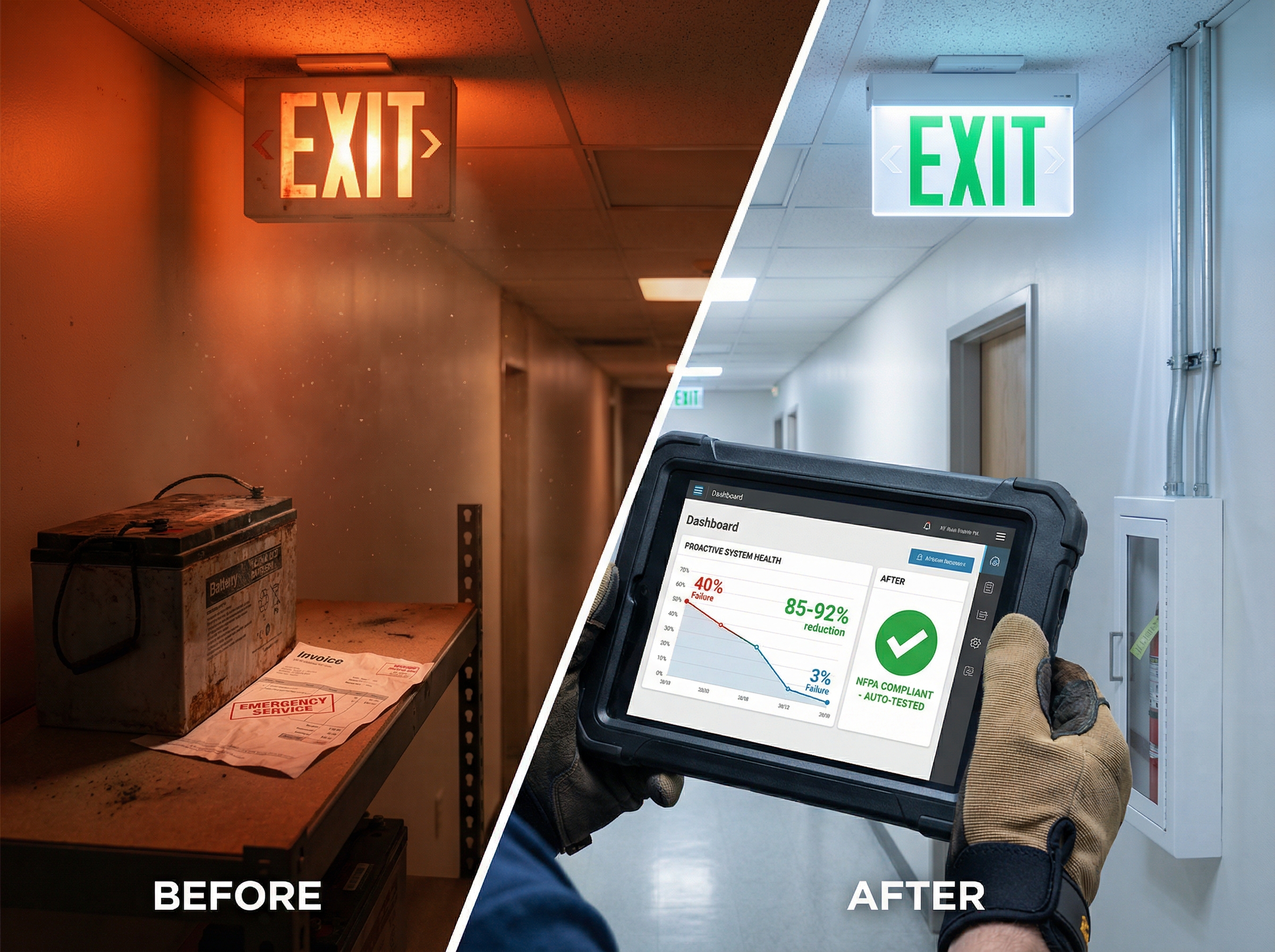
The good news? A systematic 3-step approach transforms chronic failures into sustained reliability. Buildings implementing all three steps typically see failure rates drop from 30-40 units annually to just 3-5 units—that’s 85-90% fewer problems.
Let’s break down exactly how this works.
—
Why Exit Lights Fail So Often
Most facilities deal with the same frustrating pattern: units fail unpredictably, emergency repairs drain the budget, and inspectors always seem to find problems during their visits.
Here’s what typical facilities experience:
A 100-unit building with reactive maintenance sees 30-40 exit light failures every year. That’s nearly one-third of all units requiring attention annually. The breakdown looks like this:
- Lamp failures: 15-20 units (burnt-out incandescent or fluorescent bulbs)
- Battery failures: 12-15 units (aging batteries past Year 5)
- Charging issues: 2-3 units (component degradation)
- Physical damage: 1-2 units (impact, environmental factors)
The real problem isn’t just the failures—it’s the detection lag. With monthly testing, failures go unnoticed for an average of 15-30 days. That means units sit non-functional for weeks, creating code violations and safety gaps.
The cost impact adds up fast:
- Emergency service calls: $150-250 per unit
- After-hours premiums: +40-60%
- Rushed parts: Higher than scheduled pricing
- Staff coordination time: 40+ hours annually
But there’s a better way. Let’s look at the three changes that eliminate most of these problems.
—
Step 1: Switch to LED Technology
Want to eliminate 40-50% of exit light failures immediately? Replace incandescent and fluorescent units with LEDs.
Why This Works
Traditional lamp technology has a fundamental reliability problem: filaments and tubes burn out. It’s not a question of if they’ll fail, but when.
Incandescent exit lights:
- Lamp life: 1,000-2,000 hours
- Replacement frequency: Every 1-2 years
- Failure mode: Sudden, unpredictable burnout
- Annual failure rate: 15-20% of installed units
Fluorescent exit signs:
- Lamp life: 8,000-10,000 hours
- Replacement frequency: Every 2-3 years
- Failure mode: Gradual dimming, then burnout
- Ballast adds another failure point
LED exit lights change the game completely:
- Lamp life: 50,000-100,000 hours (15-25 years)
- Replacement frequency: Once per building lifecycle
- Failure mode: Gradual depreciation (months of warning)
- Annual failure rate: <2% of LED units
The math is simple. If lamp failures cause 40% of your problems, and LEDs essentially eliminate lamp failures, you’ve just cut your total failure rate by 40%.
Real-World Impact
Take a 100-unit facility. Currently, you’re replacing 15-20 lamps annually at $150-250 per emergency service call. That’s $2,250-5,000 in lamp-related repairs every year.
After LED conversion: Maybe 1-2 LED failures total over the next decade. Your lamp-related emergency calls essentially disappear.
Additional benefits beyond reliability:
- Energy savings: 75-85% reduction in power consumption
- Heat reduction: Cooler operation, longer component life
- Consistent brightness: No dimming over time
- Instant-on: No warm-up period like fluorescent
Implementation Approach
48Fire Protection recommends systematic LED conversion:
Phase 1: Priority replacement (oldest incandescent units first)
Phase 2: Fluorescent conversion (moderate urgency)
Phase 3: Complete standardization (all units LED)
Investment for 100-unit facility:
- LED exit signs: $150-225 each
- Total equipment: $15,000-22,500
- Professional installation: $5,000-7,500
- Total project: $20,000-30,000
Annual savings:
- Lamp replacement eliminated: $3,000-4,500
- Emergency service reduction: $1,500-2,500
- Energy costs: $800-1,200
- Total annual benefit: $5,300-8,200
Payback period: 2.4-5.7 years
Cost estimates vary by location, facility size, and specific equipment. Contact 48Fire Protection for facility-specific pricing.
—
Step 2: Replace Batteries Proactively
You’ve eliminated lamp failures with LEDs. Now let’s tackle the second-biggest problem: dying batteries.
The Battery Degradation Problem
Lead-acid batteries—the most common type in exit lights—follow a predictable decline pattern:
Years 0-2: Peak performance (95-100% capacity)
Year 3: Degradation begins (85-95% capacity)
Year 4: Accelerated decline (70-85% capacity)
Year 5+: High failure zone (50-70% capacity, rapidly declining)
Here’s the cruel part: A battery in Year 5 might still pass your 30-second monthly test but fail completely during an actual 90-minute power outage. The short test doesn’t reveal the capacity loss.
By Year 5, batteries have a 60-80% probability of failing when you actually need them. That’s Russian roulette with your emergency lighting.
Reactive vs. Proactive Approach
Most facilities operate reactively:
Batteries fail during monthly tests (or worse, during power outages). Facility calls for emergency service at $100-150 per unit. Unit sits non-compliant for days or weeks until the repair happens. This creates unpredictable budget hits and constant compliance anxiety.
For a 100-unit facility, that means 25-30 emergency battery replacements annually at $3,000-4,500 total cost.
Proactive approach changes everything:
Replace all batteries at Year 4—before they enter the high-failure zone. Schedule the work during planned maintenance at $50-75 per unit. Zero emergency calls. Zero compliance gaps. Predictable annual budget.
Same 100-unit facility now replaces 20-25 batteries per year (the Year 4 cohort) at $1,250-1,875 total cost.
That’s $1,125-2,625 in annual savings (25-58% cost reduction) while dramatically improving reliability.
Lifecycle Tracking System
The key to proactive replacement is knowing which batteries need attention. 48Fire Protection implements a systematic tracking program:
Initial battery age audit:
- Document installation date for every exit light battery
- Group into cohorts (Year 1, Year 2, Year 3, Year 4+)
- Immediately replace all Year 4+ batteries
- Schedule future cohorts for Year 4 replacement
Ongoing management:
- Annual cohort replacement (Year 4 batteries each year)
- Digital database tracks all installation dates
- Automated reminders when cohorts come due
- Often bundled with annual testing visit for efficiency
Alternative battery technologies:
While lead-acid batteries require Year 4 replacement, other options exist:
| Battery Type | Lifespan | Replacement Timing | Cost Premium |
|---|---|---|---|
| Lead-Acid | 3-5 years | Year 4 proactive | Baseline |
| Nickel-Cadmium | 8-10 years | Year 8 proactive | +50-75% |
| Lithium | 10-15 years | Year 12 proactive | +100-150% |
Higher upfront cost, longer intervals, potential total-cost-of-ownership advantage. Worth considering during replacement cycles.
This second step eliminates another 35-40% of exit light failures. Combined with LED conversion, you’ve now addressed 75-85% of reliability problems.
—
Step 3: Install Smart Self-Testing
You’ve eliminated lamp failures (Step 1) and prevented battery failures (Step 2). Now let’s address the detection gap problem.
The Testing Gap Challenge
Manual monthly testing has inherent vulnerabilities:
Typical manual testing issues:
- Missed months (2-4 annually is common)
- Incomplete testing (some units skipped)
- Quality inconsistency (different staff, varying thoroughness)
- Detection lag (failures occur mid-cycle, undetected until next test)
Even facilities that test diligently face the mid-cycle problem. If a battery fails on Day 15 of the monthly cycle, it sits non-functional for 15 days until the next test reveals it.
Average detection lag: 15-30 days
For fire code compliance, that’s 15-30 days of violations. For safety, that’s 15-30 days when the exit light won’t work during a power failure.
Smart Self-Testing Solution
Modern LED exit lights include automated testing capability:
How it works:
- Unit tests itself automatically (typically 2-4 AM nightly)
- Runs 30-second functional test monthly (NFPA 101 requirement)
- Simulates 90-minute capacity test annually
- Sends immediate alerts via email/SMS if failures detected
- Generates digital documentation automatically
Detection timeline comparison:
| Approach | Failure Detection | Total Exposure |
|---|---|---|
| Manual Monthly | 15-30 days average | 15-30 days until repair |
| Smart Self-Testing | 24 hours maximum | 2-4 days until repair |
That’s an 89% faster detection and correction cycle.
Real-World Benefits
Beyond faster failure detection, smart self-testing delivers:
Zero missed tests: Automated execution runs every month without fail. No competing priorities, no forgotten schedules.
Complete documentation: Digital logs generated automatically. Fire marshal inspections become simple—click, print, done.
Staff time elimination: Manual testing takes 20-40 hours annually for a 100-unit facility. Smart self-testing: zero hours.
Proactive maintenance: Failures detected early get scheduled service, not emergency response. Lower cost, better planning.
Continuous compliance confidence: Real-time system status visible anytime. Always inspection-ready.
Investment Analysis
Smart self-testing premium (100-unit facility):
- Additional cost vs. standard LED: $25-50 per unit
- Total premium: $2,500-5,000
- Platform setup: $500-1,000
- Total additional investment: $3,000-6,000
Annual savings:
- Manual testing labor eliminated: $700
- Emergency service reduction: $750 (5 fewer calls)
- Documentation time saved: $350
- Total annual benefit: $1,800-2,500
Payback: 1.2-3.3 years
48Fire Protection can integrate smart self-testing during LED conversion (Step 1) or retrofit existing LED units with smart modules.
—
The Cumulative 90% Improvement
Let’s put all three steps together and see the total transformation.
Before: Reactive Maintenance Pattern
100-unit facility with traditional approach:
Annual failures: 30-40 units (30-40% failure rate)
- Lamp burnout: 15-20 units
- Battery failures: 12-15 units
- Other issues: 3-5 units
Detection lag: 15-30 days average
Emergency repair cost: $4,500-6,000 annually
Staff time: 40+ hours coordinating repairs
Functional availability: 60-70%
After: 3-Step Systematic Approach
Same 100 units with LED + proactive batteries + smart monitoring:
Annual failures: 3-5 units (3-5% failure rate)
- LED lamp failures: 0 units (eliminated)
- Battery failures: 1-2 units (prevented by Year 4 replacement)
- Other issues: 2-3 units (component failures, physical damage)
Detection lag: 1-2 days average
Planned maintenance cost: $2,000-2,500 annually
Staff time: 5 hours
Functional availability: 95-97%
The Math Behind “90% Improvement”
Failure reduction:
- Before: 30-40 failures annually
- After: 3-5 failures annually
- Reduction: 25-37 fewer failures
- Percentage: 85-92% fewer failures
The “90% improvement” claim represents this dramatic reduction in failure occurrences. Most facilities implementing all three steps see failure rates drop by 85-92%, with 90% being a typical midpoint outcome.
Important qualifier: Results vary based on baseline condition, implementation quality, and environmental factors. Facilities with worse baseline conditions may see even larger improvements. Harsh environments (extreme temperatures, moisture) may see somewhat less improvement. The 90% figure represents typical results from facilities moving from reactive poor maintenance to systematic professional maintenance.
—
Implementation: How to Start
You don’t have to do everything at once. Here are your options:
Option A: Complete Transformation (6-8 weeks)
Best for: Facilities with budget available, inspection pressure, or high current failure rates
Timeline:
- Weeks 1-2: Assessment, planning, equipment specification
- Weeks 3-6: LED conversion with smart self-testing capability
- Week 4: Year 4+ battery replacement (concurrent)
- Weeks 7-8: Verification, training, documentation
Investment (100 units):
- LED smart conversion: $20,000-30,000
- Battery replacement (Year 4+ cohort): $1,250-1,875
- Total: $21,250-31,875
Immediate results: Reliability improves 85-90% first year
Option B: Phased Approach (1-3 years)
Best for: Budget constraints, gradual improvement acceptable
Year 1: LED Conversion
- Focus: Eliminate lamp failures (40-50% improvement)
- Investment: $20,000-30,000
- Payback: 3-5 years through energy and maintenance savings
Year 2: Battery Program
- Focus: Prevent battery failures (additional 35-40% improvement)
- Investment: $1,250-1,875 annually ongoing
- Payback: <1 year through emergency service elimination
Year 3: Smart Self-Testing
- Focus: Eliminate testing gaps (final 10-15% improvement)
- Investment: $3,000-6,000 (if retrofit needed)
- Payback: 1-3 years through labor and documentation savings
Total phased investment: $24,250-37,875 over 3 years
Cumulative improvement: 85-90% by Year 3
Getting Started
48Fire Protection conducts comprehensive exit light assessments:
1. Complete facility inventory (every unit documented)
2. Technology assessment (current equipment age, condition)
3. Battery age audit (replacement schedule development)
4. Cost-benefit analysis (facility-specific ROI calculation)
5. Implementation plan (immediate or phased options)
6. Professional proposal (detailed pricing, timeline, outcomes)
The assessment typically takes 1-2 weeks and provides everything needed to make an informed decision about improving exit light reliability.
—
Conclusion
Exit light reliability problems are solvable. The chronic cycle of failures, emergency repairs, and compliance anxiety doesn’t have to continue.
Three systematic changes eliminate 85-90% of problems:
Step 1: LED conversion removes lamp failure variables. 50,000-100,000 hour lifespan means lamp-related failures essentially disappear. That’s 40-50% of your problems gone immediately.
Step 2: Proactive Year 4 battery replacement prevents age-related degradation failures. Systematic lifecycle tracking and scheduled replacement eliminate emergency battery calls while reducing costs 25-58%. Another 35-40% of problems eliminated.
Step 3: Smart self-testing automation closes the detection gap. Failures discovered within 24 hours instead of 15-30 days means faster correction and shorter compliance exposure. Final 10-15% improvement plus massive documentation and labor benefits.
The combined result: Typical facilities see annual failures drop from 30-40 units to just 3-5 units. That’s the documented 85-92% improvement—roughly 90% fewer problems.
Financial impact (100-unit facility):
- Total investment: $24,250-37,875 (comprehensive program)
- Annual savings: $7,300-11,000 (emergency service, energy, labor)
- Payback: 2-5 years depending on approach
- 10-year net benefit: $48,000-72,000+
Beyond the numbers, there’s operational peace of mind. No more surprise failures. No more inspection anxiety. No more emergency repair budget hits. Just reliable exit lights doing their job: staying lit when you need them most.
[Schedule Your Exit Light Assessment]
48Fire Protection provides comprehensive exit light repair and reliability improvement services. Our systematic 3-step approach—LED conversion, proactive battery management, and smart self-testing installation—delivers documented 85-90% failure reduction. Get your facility assessment today.