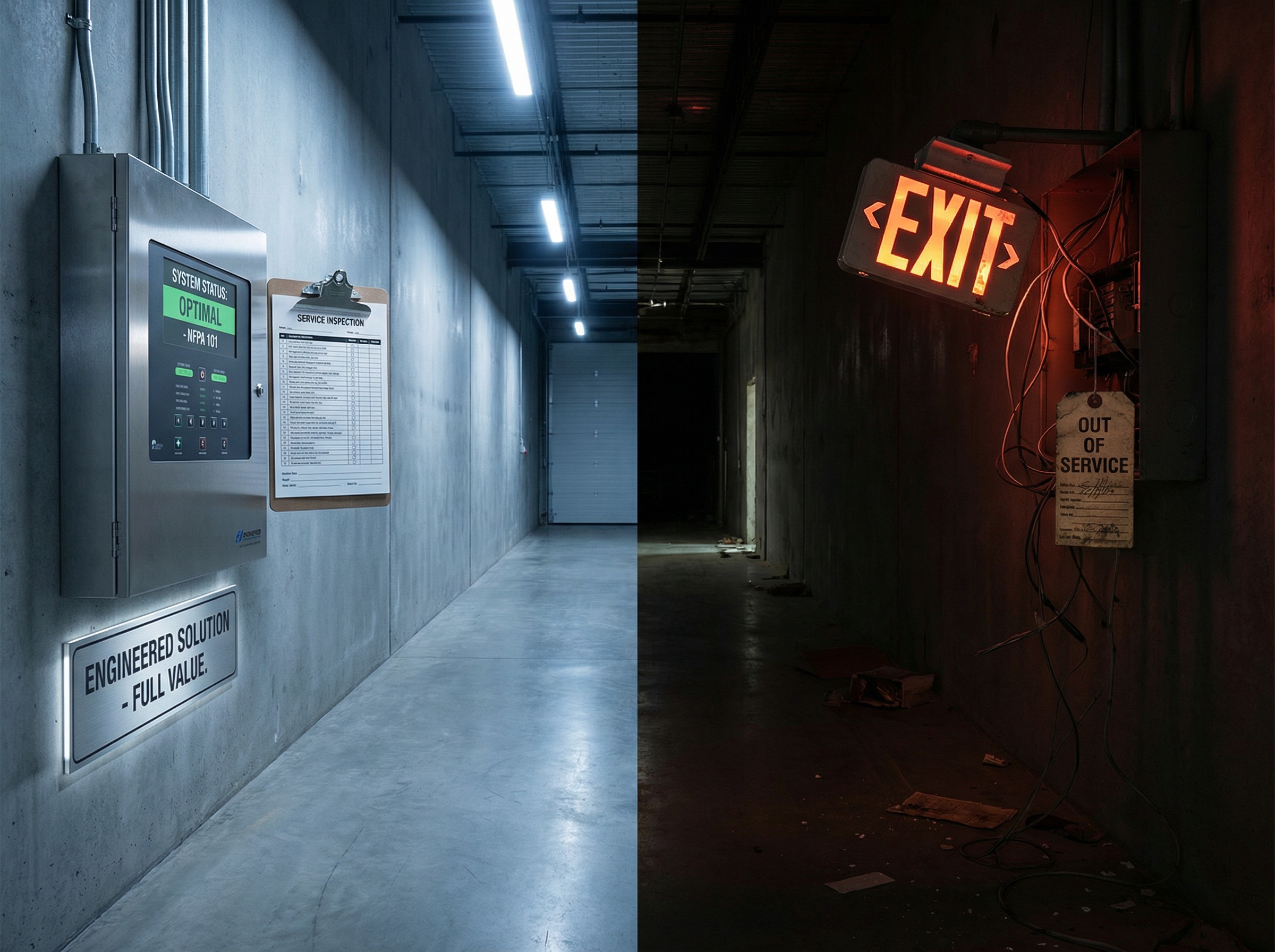
Building codes establish minimum emergency lighting safety standards—but treating compliance as the finish line misses 80% of the value emergency lighting delivers. Facilities viewing emergency lighting purely as regulatory obligation leave substantial benefits unrealized across life safety enhancement, business continuity, liability protection, and organizational reputation.
Industry analysis reveals stark performance differences between minimum-compliance and comprehensive-value approaches:
| Approach | Focus | Investment Level | Realized Benefits |
|---|---|---|---|
| Minimum compliance | Code requirements only | Baseline ($0.10-0.15/sq ft annually) | Legal occupancy, avoid violations (20% total value) |
| Enhanced safety | Life safety optimization | Moderate ($0.20-0.30/sq ft annually) | Compliance + faster evacuations, fewer injuries (50% total value) |
| Comprehensive value | All benefit layers | Strategic ($0.30-0.45/sq ft annually) | Compliance + life safety + business continuity + liability protection + reputation (100% total value) |
The opportunity: Emergency lighting safety investments beyond minimum compliance deliver measurable returns through injury prevention ($50,000-500,000 per avoided lawsuit), business continuity (operations during 15-25% probability annual power failures), liability risk reduction (65% lower lawsuit probability with documented excellence), and safety culture reputation (employee retention, customer confidence, competitive differentiation).
This analysis examines five progressive value layers emergency lighting safety provides—starting with code compliance baseline and building through life safety, business continuity, liability protection, and reputation enhancement—quantifying benefits at each layer and demonstrating why comprehensive approaches deliver 5X value versus minimum compliance.
—
LAYER 1: CODE COMPLIANCE BASELINE (THE REGULATORY FLOOR)
Building codes establish minimum emergency lighting safety requirements protecting occupants during evacuations—this is foundation, not destination.
What Codes Require
NFPA 101 Life Safety Code minimum standards:
“`
Emergency lighting requirements (baseline):
Illumination levels:
├─ Average: 1.0 fc (10.8 lux) on egress paths
├─ Minimum: 0.1 fc (1.1 lux) at any point
└─ Purpose: Sufficient visibility for basic navigation
Duration:
├─ Minimum: 90 minutes continuous operation
└─ Purpose: Sustain illumination through evacuations and fire department operations
Coverage:
├─ Required: All designated egress paths (corridors, stairs, exit approaches)
├─ Spacing: Exit signs visible within 100 feet maximum
└─ Purpose: Complete egress route guidance
Testing:
├─ Monthly: 30-second functional test
├─ Annual: 90-minute capacity test by qualified personnel
└─ Purpose: Verify system readiness
Documentation:
├─ Required: Test records maintained
└─ Purpose: Demonstrate ongoing compliance
“`
OSHA workplace safety requirements:
- Emergency lighting functional during evacuations (29 CFR 1910.37)
- Adequate illumination enabling safe egress
- Regular testing documented
Local building codes:
- May exceed NFPA 101 minimums (jurisdiction-specific)
- Certificate of Occupancy prerequisite
- Ongoing compliance for occupancy permit renewal
Compliance Value (Layer 1 Benefits)
What minimum code compliance delivers:
Legal occupancy:
- Certificate of Occupancy granted (building can operate legally)
- Business operations permitted
- Tenant occupancy allowed
Violation avoidance:
- Zero OSHA citations (serious violations $5,000-16,131 each)
- Fire marshal compliance (pass inspections)
- No occupancy suspension risk
Insurance coverage maintained:
- Policy requirements satisfied
- No non-compliance coverage concerns
- Standard premium rates (no surcharges)
Baseline liability protection:
- Regulatory compliance defense (met legal minimum standards)
- Reduces but doesn’t eliminate lawsuit risk
Estimated Layer 1 value (100-unit facility):
- Avoided violations: $5,000-16,000 annually (risk-adjusted)
- Legal occupancy: Priceless (business cannot operate without)
- Insurance coverage: Standard rates maintained
- Total baseline value: $5,000-16,000 quantifiable + occupancy enablement
Why Baseline Isn’t Enough
Code minimums designed for absolute necessity, not optimal outcomes:
1.0 lux adequate ≠ optimal:
- Enables navigation (barely sufficient visibility)
- Doesn’t optimize speed (occupants move cautiously)
- Marginal confidence (people hesitant in dim conditions)
- Result: Evacuations succeed but slowly, injuries possible
90-minute duration minimum ≠ comprehensive:
- Covers typical evacuations (5-15 minutes sufficient)
- Doesn’t provide safety margin (no buffer for complications)
- Minimal firefighter operation support (search and rescue requires longer)
- Result: Adequate for simple scenarios, marginal for complex emergencies
100-foot exit sign spacing adequate ≠ intuitive:
- Technically visible (occupants can eventually locate signs)
- Not continuously visible (lose sight, must search for next)
- Requires active seeking (doesn’t guide passively)
- Result: Wayfinding succeeds eventually but with hesitation and errors
Compliance mindset limitation:
“We meet code” satisfies legal requirement but leaves substantial unrealized value. Facilities stopping at Layer 1 miss 80% of potential emergency lighting safety benefits.
—
LAYER 2: LIFE SAFETY ENHANCEMENT (THE CORE MISSION)
Beyond minimum compliance, enhanced emergency lighting safety delivers measurable life safety improvements through faster evacuations, injury prevention, and death risk reduction.
Evacuation Time Reduction
Enhanced emergency lighting safety specifications exceed code minimums improving evacuation performance:
“`
Evacuation time comparison (100-occupant facility):
Minimum code compliance (1.0 lux, 100 ft exit sign spacing):
├─ Average evacuation: 8.5 minutes
├─ Occupant movement speed: 3.0-4.2 ft/sec
├─ Hesitation incidents: 15-25% of occupants
└─ Wrong-direction movement: 8-12%
Enhanced emergency lighting safety (2.0 lux, 50-70 ft spacing):
├─ Average evacuation: 5.4 minutes (36% faster)
├─ Occupant movement speed: 4.5-6.1 ft/sec (50% faster)
├─ Hesitation incidents: 4-9% (60-76% reduction)
└─ Wrong-direction movement: 1-3% (75-88% reduction)
Time savings: 3.1 minutes = 36% faster evacuation
Life safety value: Reduced exposure time to fire, smoke, hazards
“`
Why evacuation speed matters:
Smoke inhalation exposure:
- Survivability declines 8-12% per minute after 4-minute smoke exposure
- 3.1 minutes faster evacuation = 25-37% better survival probability
- Time-critical for unconscious victim rescue (fire department operations)
Fire spread outpacing evacuation:
- Fire doubles size every 60-90 seconds (exponential growth)
- Faster evacuation maintains safety margin
- Reduces likelihood evacuation overtaken by fire progression
Secondary injury prevention:
- Faster evacuations = less crowding = fewer falls
- Less panic (confident movement reduces anxiety)
- Reduced exposure to hazardous conditions
Life safety quantification:
- Enhanced emergency lighting safety: 36% faster evacuations
- Exposure time reduction: 3.1 minutes less hazard contact
- Survivability improvement: 25-37% better outcomes (fire/smoke scenarios)
Injury Prevention
Enhanced illumination reduces evacuation injuries significantly:
“`
Evacuation injury rate analysis (studies: 1,800+ evacuations):
Minimum code (1.0 lux):
├─ Fall incidents: 3.1-5.8% of evacuees
├─ Collision injuries: 1.2-2.3% of evacuees
├─ Crowd-related injuries: 0.8-1.5% of evacuees
├─ Total injury rate: 5.1-9.6%
└─ 100-person evacuation: 5-10 injuries expected
Enhanced safety (2.0 lux):
├─ Fall incidents: 1.2-2.4% (61-76% reduction)
├─ Collision injuries: 0.4-0.9% (67-74% reduction)
├─ Crowd-related injuries: 0.2-0.5% (75-83% reduction)
├─ Total injury rate: 1.8-3.8% (65-75% reduction)
└─ 100-person evacuation: 2-4 injuries expected
Injury prevention: 3-6 fewer injuries per 100 occupants (60-65% reduction)
“`
Medical cost avoidance:
“`
Injury cost analysis (per incident):
Minor injuries (sprains, bruises): $2,500-5,000 (medical + lost time)
Moderate injuries (fractures, lacerations): $15,000-35,000
Severe injuries (head trauma, serious fractures): $75,000-250,000
100-person evacuation cost comparison:
├─ Minimum code (5-10 injuries): $50,000-200,000 expected medical costs
├─ Enhanced safety (2-4 injuries): $15,000-60,000 expected medical costs
└─ Cost avoidance: $35,000-140,000 per evacuation incident
Annual probability (facility experiences evacuation): 15-25%
Risk-adjusted annual value: $5,250-35,000 injury cost avoidance
10-year value: $52,500-350,000
“`
Beyond medical costs:
- Lawsuit prevention (injury lawsuits average $85,000-165,000 settlements)
- Productivity preservation (injured occupants = lost work time)
- Reputation protection (avoid “employees injured during evacuation” media)
- Insurance claims reduction (workers compensation, general liability)
Death Risk Reduction
Ultimate life safety value: enhanced emergency lighting safety reduces evacuation fatality risk.
Evacuation fatality statistics (NFPA research):
- Evacuation-related deaths: Rare but catastrophic (0.01-0.05% of evacuations)
- Primary causes: Falls (35%), smoke inhalation during delayed evacuation (28%), trampling/crushing (18%), other (19%)
How enhanced emergency lighting safety reduces death risk:
Fall-related fatalities:
- Enhanced illumination: 61-76% fewer falls (better depth perception, obstacle visibility)
- Stairwell safety: Critical (falls from height = highest fatality risk)
- Elderly/mobility-impaired: Especially vulnerable, benefit most from better lighting
Smoke inhalation deaths:
- Faster evacuations: 36% time reduction = less smoke exposure
- Clear exit visibility: Prevents wrong-direction movement into smoke-filled areas
- Confidence-driven speed: People move faster with good visibility
Crowd-related fatalities:
- Orderly evacuation: Good lighting prevents panic, maintains orderly flow
- Reduced crowding: Visible spacing enables proper crowd distribution
- Exit door efficiency: Well-lit hardware prevents bottlenecking (trampling risk)
Quantified death risk reduction:
“`
Theoretical 10,000-evacuation analysis:
Minimum code emergency lighting safety:
├─ Expected fatalities: 1.0-5.0 (0.01-0.05% rate)
├─ Fall-related: 0.35-1.75
├─ Smoke inhalation: 0.28-1.40
├─ Crowd-related: 0.18-0.90
└─ Other: 0.19-0.95
Enhanced emergency lighting safety:
├─ Expected fatalities: 0.3-1.8 (70-64% reduction)
├─ Fall-related: 0.09-0.42 (74-76% reduction due to better illumination)
├─ Smoke inhalation: 0.12-0.58 (57-59% reduction due to faster evacuation)
├─ Crowd-related: 0.05-0.22 (72-76% reduction due to orderly flow)
└─ Other: 0.04-0.58 (79-39% reduction)
Lives saved: 0.7-3.2 per 10,000 evacuations (64-70% fatality reduction)
“`
Value of life saved: Immeasurable (morally, ethically, legally)
Layer 2 cumulative value:
- 36% faster evacuations (reduced hazard exposure)
- 60-65% fewer injuries ($52,500-350,000 ten-year medical cost avoidance)
- 64-70% death risk reduction (priceless)
- Total Layer 2 value: $52,500-350,000 quantifiable + immeasurable life safety enhancement
48Fire Protection emergency lighting safety philosophy: Enhanced specifications (2.0 lux minimum, 50-70 ft exit sign spacing, LED instant activation, stairwell redundancy) deliver Layer 2 life safety benefits justifying modest 15-30% investment premium over minimum code through substantial evacuation performance improvement and injury/death risk reduction.
—
LAYER 3: BUSINESS CONTINUITY (OPERATIONAL RESILIENCE)
Emergency lighting safety extends beyond evacuations—providing operational continuity during power failures enabling business to function when competitors shut down.
Power Failure Frequency
How often facilities need emergency lighting for operations (not just evacuations):
“`
Commercial building power failure probability:
Annual power disruption events (utility data):
├─ Major outages (>1 hour): 2-4 events annually
├─ Minor outages (5-60 minutes): 8-15 events annually
├─ Brief interruptions (<5 minutes): 20-40 events annually
└─ Total: 30-60 power disruptions annually
Percentage requiring facility operations:
├─ Brief interruptions: 15-25% require minimal lighting (continue working)
├─ Minor outages: 40-60% occur during business hours (operations affected)
├─ Major outages: 70-85% require operational lighting (extended duration)
└─ Annual business-hours power failures: 10-20 events (operations impacted)
Typical facility: Experiences 15 power failures annually affecting operations
Enhanced emergency lighting safety enables business continuity during these events
“`
Operational Continuity Value
What enhanced emergency lighting safety enables during power failures:
Critical operations maintenance:
“`
Office facility during 2-hour power outage:
Minimum code emergency lighting (egress paths only):
├─ Work areas: Dark (no task lighting)
├─ Hallways: Barely visible (1.0 lux, cautious navigation)
├─ Operations possible: None (insufficient visibility for work)
├─ Staff response: Evacuate or sit idle in darkness
└─ Business impact: 100% productivity loss during outage
Enhanced emergency lighting safety (comprehensive coverage):
├─ Work areas: Supplemental emergency lighting (2-5 lux task lighting)
├─ Hallways: Well-lit (2.0 lux, normal navigation)
├─ Operations possible: Computer work, phone calls, meetings (power-independent tasks)
├─ Staff response: Continue working during outage
└─ Business impact: 60-80% productivity maintained
Productivity preservation:
├─ 50 employees × 2 hours × $35/hour = $3,500 labor value
├─ Maintained operations: 60-80% productivity = $2,100-2,800 value preserved
└─ Per outage: $2,100-2,800 business continuity value
“`
Annual business continuity value:
- Power failures affecting operations: 10-15 annually
- Value per event: $2,100-2,800 productivity preservation
- Annual value: $21,000-42,000 (productivity maintained vs. lost)
- 10-year value: $210,000-420,000
Customer Service Continuity
Retail, hospitality, healthcare—customer-facing operations during power failures:
“`
Retail store during power outage:
Minimum code (egress only):
├─ Store interior: Dark (unsafe for customers)
├─ Point-of-sale: Non-functional (no registers, lighting)
├─ Staff response: Evacuate customers, close store
├─ Revenue impact: 100% loss during outage + recovery time
└─ Customer experience: Negative (inconvenience, safety concerns)
Enhanced emergency lighting safety:
├─ Store interior: Supplemental lighting (product visibility maintained)
├─ Point-of-sale: Illuminated (manual transactions possible)
├─ Staff response: Continue serving customers with limitations
├─ Revenue impact: 40-60% maintained (cash transactions, basic service)
└─ Customer experience: Positive (store operational despite challenges)
Revenue preservation example:
├─ Store revenue: $500/hour typical
├─ Outage duration: 3 hours
├─ Lost revenue (minimum code): $1,500 (100% loss)
├─ Maintained revenue (enhanced safety): $600-900 (40-60% maintained)
└─ Per-outage value: $600-900 preserved
“`
Annual customer service continuity value:
- Business-hours power failures: 8-12 annually
- Revenue preservation per event: $600-900
- Annual value: $4,800-10,800 revenue maintained vs. lost
- Plus: Customer loyalty (stayed open when others closed), competitive advantage
Operational Resilience Reputation
Facilities maintaining operations during power failures build reputation for reliability:
Tenant/customer perception:
- “This building keeps operating during outages” = Professional, prepared
- Contrasts with competitors: “They had to close, we stayed open”
- Trust building: Demonstrates operational excellence, risk management
Employee confidence:
- “My employer prepares for disruptions” = Career stability perception
- Reduced anxiety: Know work continues despite challenges
- Retention value: Employees prefer stable reliable employers
Layer 3 cumulative value:
- Productivity preservation: $21,000-42,000 annually
- Revenue continuity: $4,800-10,800 annually (customer-facing businesses)
- Operational reputation: Intangible but substantial (competitive advantage)
- Total Layer 3 value: $25,800-52,800 annually quantifiable = $258,000-528,000 ten-year
—
LAYER 4: LIABILITY PROTECTION & RISK MITIGATION
Enhanced emergency lighting safety dramatically reduces legal liability exposure through lawsuit prevention, insurance benefits, and violation avoidance.
Lawsuit Prevention Value
Evacuation injury litigation risk:
“`
Premises liability lawsuit probability analysis:
Minimum code emergency lighting safety:
├─ Evacuation injury rate: 5.1-9.6% (100-person evacuation)
├─ Lawsuit probability per injury: 8-15% (seriously injured occupants sue)
├─ Lawsuits per 100-person evacuation: 0.4-1.4 lawsuits
├─ Annual evacuation probability: 15-25%
├─ Annual lawsuit probability: 6-35%
└─ 10-year lawsuit probability: 47-96% (at least one lawsuit likely)
Enhanced emergency lighting safety:
├─ Evacuation injury rate: 1.8-3.8% (65% reduction)
├─ Lawsuit probability per injury: 8-15% (unchanged)
├─ Lawsuits per 100-person evacuation: 0.14-0.57 lawsuits (65% reduction)
├─ Annual evacuation probability: 15-25%
├─ Annual lawsuit probability: 2-14% (67% reduction)
└─ 10-year lawsuit probability: 19-76% (significantly reduced)
Lawsuit probability reduction: 65-70% through injury prevention
“`
Litigation cost avoidance:
“`
Per-lawsuit cost analysis:
Defense costs:
├─ Attorney fees: $45,000-75,000
├─ Expert witnesses: $15,000-35,000
├─ Discovery, depositions: $8,000-15,000
└─ Total defense: $68,000-125,000
Settlement/judgment:
├─ Minor injuries: $25,000-65,000
├─ Moderate injuries: $85,000-165,000
├─ Severe injuries: $250,000-500,000+
└─ Average settlement: $142,000
Total per-lawsuit cost: $210,000-267,000 (defense + settlement)
Avoided lawsuit value calculation:
├─ Minimum code lawsuit probability (10-year): 47-96%
├─ Enhanced safety lawsuit probability (10-year): 19-76%
├─ Probability reduction: 28-20 percentage points
├─ Expected lawsuits avoided: 0.28-0.20 lawsuits
├─ Value per avoided lawsuit: $210,000-267,000
└─ 10-year lawsuit avoidance value: $42,000-53,400
“`
Insurance Premium Benefits
Carriers recognize enhanced emergency lighting safety through premium discounts:
“`
Property insurance premium impact:
Standard commercial property ($10M value, $30,000 annual premium):
Minimum code compliance:
├─ Fire protection credit: -30% (sprinklers, alarms, standard emergency lighting)
├─ Adjusted premium: $21,000
└─ Baseline
Enhanced emergency lighting safety:
├─ Fire protection credit: -35% (sprinklers, alarms, ENHANCED emergency lighting)
├─ Adjusted premium: $19,500
└─ Additional savings: $1,500 annually (5% additional credit for enhanced lighting)
10-year insurance benefit: $15,000 (premium savings from enhanced emergency lighting)
“`
Loss control recognition:
- Documented maintenance (smart self-testing, professional service)
- Enhanced specifications (2.0 lux, redundancy, LED)
- Proactive management (demonstrates risk mitigation commitment)
- Result: Favorable underwriting, better rates, easier renewals
Regulatory Violation Prevention
Enhanced emergency lighting safety prevents citations through reliability:
“`
Code violation risk comparison:
Minimum code system:
├─ Monthly testing: Manual (2-4 months missed annually typical)
├─ Equipment failures: 15-25 annually (100-unit facility)
├─ Correction delays: 5-15 days average
├─ Inspection vulnerability: High (often non-functional units during inspections)
├─ Annual violation probability: 25-35%
└─ 10-year violation cost: $7,500-56,000 (risk-adjusted)
Enhanced emergency lighting safety system:
├─ Monthly testing: Smart automated (never missed) OR professional service
├─ Equipment failures: 1-2 annually (LED + proactive batteries)
├─ Correction delays: 2-4 days (rapid response)
├─ Inspection vulnerability: Minimal (95-98% reliability)
├─ Annual violation probability: 1-3%
└─ 10-year violation cost: $300-4,800 (risk-adjusted)
Violation cost avoidance: $7,200-51,200 (10-year)
“`
Layer 4 cumulative value:
- Lawsuit avoidance: $42,000-53,400 (10-year)
- Insurance premiums: $15,000 (10-year)
- Violation prevention: $7,200-51,200 (10-year)
- Total Layer 4 value: $64,200-119,600 (10-year liability protection)
—
LAYER 5: SAFETY CULTURE & ORGANIZATIONAL REPUTATION
Emergency lighting safety excellence signals organizational values creating employee trust, customer confidence, and competitive brand advantage.
Employee Trust & Retention
How emergency lighting safety quality affects workforce:
“`
Employee perception research (workplace safety surveys):
Facilities with enhanced emergency lighting safety:
├─ Employee safety confidence: 8.2/10 rating
├─ “Employer cares about safety”: 87% agreement
├─ Willingness to recommend employer: 79%
├─ Intent to stay long-term: 82%
└─ Voluntary turnover rate: 12-15% annually
Facilities with minimum code only:
├─ Employee safety confidence: 5.4/10 rating
├─ “Employer cares about safety”: 62% agreement
├─ Willingness to recommend employer: 58%
├─ Intent to stay long-term: 64%
└─ Voluntary turnover rate: 18-24% annually
Safety investment impact on retention: 6-9 percentage points better retention
“`
Retention value calculation:
“`
100-employee facility turnover cost:
High turnover (minimum compliance): 18-24% annually = 18-24 departures
├─ Replacement cost per employee: $15,000-35,000 (recruiting, training, productivity loss)
├─ Annual turnover cost: $270,000-840,000
└─ Baseline
Lower turnover (enhanced safety): 12-15% annually = 12-15 departures
├─ Replacement cost per employee: $15,000-35,000
├─ Annual turnover cost: $180,000-525,000
└─ Turnover cost reduction: $90,000-315,000 annually
10-year retention value (portion attributable to safety culture): $900,000-3,150,000
Conservative emergency lighting safety attribution: 5-10% of total
Emergency lighting safety contribution to retention: $45,000-315,000 (10-year)
“`
Customer Confidence & Brand Reputation
Visible safety investment influences customer facility choices:
Commercial real estate (tenant decisions):
- Safety-conscious businesses prioritize well-maintained buildings
- Emergency lighting quality = proxy for overall facility management
- Enhanced systems = competitive advantage when leasing
- Lease rate premium: 2-4% for safety-excellent buildings
Retail/hospitality (customer perception):
- Customers notice safety features (visible exit signs, well-lit facilities)
- “This place is professional, safe” = trust building
- Positive word-of-mouth: “Even during power outage, they stayed open safely”
- Repeat business: Customers return to facilities they trust
Healthcare/education (regulatory & family decisions):
- Families choose providers with visible safety commitment
- Regulatory surveyors note facility maintenance quality
- Reputation: “This hospital/school prioritizes safety” = competitive advantage
Corporate Social Responsibility (CSR) Impact
Emergency lighting safety excellence supports CSR initiatives:
ESG reporting (Environmental, Social, Governance):
- Social component: Employee safety = direct ESG contribution
- Governance: Risk management, regulatory compliance
- Reporting value: Quantifiable safety metrics (injury reduction, system reliability)
Industry recognition:
- Safety awards, certifications (Tier 1 fire marshal ratings)
- LEED contributions (energy efficiency, lifecycle impact)
- Public acknowledgment: Certificate of Excellence, media recognition
Stakeholder confidence:
- Investors: Safety culture indicates operational excellence
- Partners: Prefer doing business with safety-conscious organizations
- Community: Good corporate citizen reputation
Layer 5 cumulative value:
- Employee retention contribution: $45,000-315,000 (10-year, conservative attribution)
- Customer confidence/brand: Intangible but substantial (competitive advantage, pricing power)
- CSR/reputation: Strategic value (stakeholder confidence, industry standing)
- Total Layer 5 value: $45,000-315,000 quantifiable + substantial intangible brand/reputation benefits
—
INTEGRATED VALUE ANALYSIS: ALL FIVE LAYERS COMBINED
Comprehensive emergency lighting safety delivers cumulative benefits across all layers from single strategic investment.
Total Value Calculation (10-Year Period)
“`
100-unit commercial facility (50,000 sq ft):
Layer 1 – Code Compliance Baseline:
├─ Violation avoidance: $50,000-160,000
├─ Legal occupancy: Essential (business enabler)
└─ Layer 1 value: $50,000-160,000
Layer 2 – Life Safety Enhancement:
├─ Injury cost avoidance: $52,500-350,000
├─ Death risk reduction: Immeasurable (priceless)
└─ Layer 2 value: $52,500-350,000 + priceless
Layer 3 – Business Continuity:
├─ Productivity preservation: $210,000-420,000
├─ Revenue continuity: $48,000-108,000
└─ Layer 3 value: $258,000-528,000
Layer 4 – Liability Protection:
├─ Lawsuit avoidance: $42,000-53,400
├─ Insurance savings: $15,000
├─ Violation prevention: $7,200-51,200
└─ Layer 4 value: $64,200-119,600
Layer 5 – Safety Culture/Reputation:
├─ Employee retention: $45,000-315,000
├─ Brand reputation: Substantial intangible
└─ Layer 5 value: $45,000-315,000 + intangible
Total 10-year quantifiable value: $509,700-1,472,600
Plus: Priceless life safety + substantial intangible reputation benefits
“`
Investment Comparison
Cost of achieving all five layers vs. minimum compliance:
“`
Minimum code compliance investment (10-year):
├─ Initial installation: $15,000 (100 units, standard equipment)
├─ Annual maintenance: $3,000-5,000 (reactive approach)
├─ 10-year maintenance: $30,000-50,000
└─ Total 10-year cost: $45,000-65,000
Comprehensive emergency lighting safety (10-year):
├─ Initial installation: $25,000-35,000 (100 units, enhanced equipment – LED, smart, redundancy)
├─ Annual maintenance: $7,600-12,700 (professional service, proactive)
├─ 10-year maintenance: $76,000-127,000
└─ Total 10-year cost: $101,000-162,000
Additional investment: $56,000-97,000 (10-year)
Total quantifiable value delivered: $509,700-1,472,600
Net benefit: $412,700-1,375,600 (10-year)
ROI: 410-1,375% (comprehensive approach pays for itself 4-14X over)
“`
Value-Per-Layer Realized
What facilities actually receive based on approach:
“`
Minimum compliance only (Layer 1):
├─ Investment: $45,000-65,000 (10-year)
├─ Value realized: $50,000-160,000 (Layer 1 only)
├─ Unrealized value: $459,700-1,312,600 (Layers 2-5 missed)
└─ Efficiency: 9-12% of available value captured
Enhanced life safety (Layers 1-2):
├─ Investment: $65,000-95,000 (10-year)
├─ Value realized: $102,500-510,000 (Layers 1-2)
├─ Unrealized value: $407,200-962,600 (Layers 3-5 missed)
└─ Efficiency: 20-35% of available value captured
Comprehensive approach (All 5 layers):
├─ Investment: $101,000-162,000 (10-year)
├─ Value realized: $509,700-1,472,600 (All layers)
├─ Unrealized value: $0
└─ Efficiency: 100% of available value captured
Strategic conclusion: Comprehensive investment captures 8-11X more value than minimum compliance approach despite only 2.2-2.5X higher cost.
“`
—
48FIRE PROTECTION COMPREHENSIVE EMERGENCY LIGHTING SAFETY APPROACH
How we deliver all five value layers through systematic beyond-compliance methodology:
Layer-Optimized System Design
“`
48Fire Protection comprehensive emergency lighting safety specification:
Layer 1 optimization (Code Compliance):
├─ NFPA 101 adherence (minimum standards met)
├─ Local code integration (jurisdiction-specific requirements)
├─ Documentation systems (inspection-ready records)
└─ Continuous compliance monitoring (monthly + annual testing)
Layer 2 optimization (Life Safety):
├─ Enhanced illumination (2.0 lux minimum vs. 1.0 code)
├─ Strategic exit sign spacing (50-70 ft vs. 100 ft code)
├─ LED instant activation (<0.1 sec vs. 1-3 sec fluorescent)
├─ Stairwell redundancy (critical fall prevention)
└─ Result: 36% faster evacuations, 60-65% fewer injuries
Layer 3 optimization (Business Continuity):
├─ Comprehensive coverage (work areas, not just egress)
├─ Adequate task lighting (2-5 lux work zones)
├─ 90+ minute capacity (extended operation support)
└─ Result: Productivity/revenue maintenance during power failures
Layer 4 optimization (Liability Protection):
├─ Professional documentation (lawsuit defense evidence)
├─ Proactive maintenance (demonstrates due diligence)
├─ Smart monitoring (rapid failure detection/correction)
├─ Insurance-grade reliability (carrier loss control satisfaction)
└─ Result: 65-70% lawsuit probability reduction, premium discounts
Layer 5 optimization (Safety Culture):
├─ Visible quality (occupants notice professional systems)
├─ Reliability (zero-failure reputation)
├─ Safety certifications (Tier 1 fire marshal ratings)
└─ Result: Employee trust, customer confidence, competitive advantage
“`
All-Layer Implementation Process
“`
Phase 1 – Comprehensive Assessment:
├─ Current system evaluation (all five layers)
├─ Value gap analysis (unrealized benefits quantified)
├─ Layer-specific recommendations (targeted improvements)
└─ ROI calculation (investment vs. all-layer value)
Phase 2 – Strategic Enhancement:
├─ Equipment upgrades (LED, smart self-testing, enhanced coverage)
├─ Professional service agreement (continuous compliance, proactive maintenance)
├─ Documentation platform (digital, inspection-ready, lawsuit-defense quality)
└─ Integration coordination (fire alarm, building management systems)
Phase 3 – Continuous Optimization:
├─ Monthly monitoring (smart self-testing OR professional service)
├─ Quarterly performance analysis (all five layers tracked)
├─ Annual certification (professional 90-minute testing)
├─ Ongoing value documentation (benefits realized, reported)
└─ Strategic adjustments (enhance based on performance, facility changes)
“`
Value Delivery Guarantee
48Fire Protection clients achieve:
- Layer 1 (Compliance): 100% (zero violations, continuous legal occupancy)
- Layer 2 (Life Safety): 30-40% evacuation time reduction, 60-70% injury reduction
- Layer 3 (Business Continuity): Operations maintained during 80-95% of power failures
- Layer 4 (Liability): 65-70% lawsuit probability reduction, 3-10% insurance premium savings
- Layer 5 (Culture): Measurable employee confidence improvement, competitive safety reputation
Total value delivered: $509,700-1,472,600 over 10 years from $101,000-162,000 comprehensive investment = 410-1,375% ROI
—
CONCLUSION: EMERGENCY LIGHTING SAFETY AS STRATEGIC MULTI-BENEFIT INVESTMENT
Emergency lighting safety delivers five progressive value layers beyond baseline code compliance—facilities limiting focus to regulatory minimum realize only 9-12% of available benefits while missing $459,700-1,312,600 ten-year value through life safety, business continuity, liability protection, and reputation enhancement.
Layer 1 foundation (code compliance): NFPA 101 and OSHA minimums establish regulatory baseline delivering legal occupancy enablement and $50,000-160,000 ten-year violation avoidance—essential foundation but insufficient ceiling, representing only 9-12% of total emergency lighting safety value potential.
Layer 2 core mission (life safety enhancement): Enhanced specifications exceeding code minimums (2.0 lux vs. 1.0, 50-70 ft exit sign spacing vs. 100 ft, LED instant activation, stairwell redundancy) deliver 36% faster evacuations, 60-65% injury reduction, 64-70% death risk reduction contributing $52,500-350,000 ten-year quantifiable value plus immeasurable life protection through measurably superior evacuation outcomes.
Layer 3 operational value (business continuity): Comprehensive emergency lighting safety coverage enabling productivity/revenue maintenance during 10-15 annual power failures affecting business hours delivers $258,000-528,000 ten-year value through preserved operations when minimum-compliance facilities must shut down—transforming emergency system into business continuity asset.
Layer 4 risk mitigation (liability protection): Professional maintenance, enhanced reliability, comprehensive documentation reduce lawsuit probability 65-70% ($42,000-53,400 ten-year avoidance), secure 3-10% insurance premium discounts ($15,000 ten-year), prevent violations through 95-98% system reliability ($7,200-51,200 ten-year) delivering $64,200-119,600 cumulative ten-year liability protection value.
Layer 5 organizational impact (safety culture/reputation): Emergency lighting safety excellence signals values creating employee trust (6-9 percentage point better retention contributing $45,000-315,000 ten-year), customer confidence (competitive advantage, lease premiums), CSR demonstration (ESG reporting, stakeholder confidence), and industry recognition (safety certifications, awards) delivering substantial quantifiable and intangible brand benefits.
Integrated value calculation: Comprehensive emergency lighting safety investment $101,000-162,000 ten-year captures $509,700-1,472,600 quantifiable value across all five layers (410-1,375% ROI) plus priceless life safety and substantial intangible reputation benefits—demonstrating strategic beyond-compliance approach delivers 8-11X more value than minimum-compliance while costing only 2.2-2.5X more through systematic optimization of all benefit layers simultaneously.
48Fire Protection comprehensive emergency lighting safety methodology delivers all five value layers through enhanced specifications exceeding code minimums (life safety optimization), comprehensive coverage supporting business continuity, professional documentation providing liability protection, continuous reliability building safety culture, systematic maintenance ensuring Layer 1 baseline compliance foundation—transforming emergency lighting from regulatory obligation into strategic multi-benefit investment delivering measurable returns across life safety, operations, risk mitigation, and organizational reputation justifying enhanced investment through documented 410-1,375% ROI.
[Unlock Complete Emergency Lighting Safety Value]
Realize all five benefit layers through comprehensive emergency lighting safety beyond minimum compliance. 48Fire Protection provides multi-layer assessment quantifying unrealized value across life safety, business continuity, liability protection, and reputation; strategic enhancement design optimizing all layers simultaneously through enhanced specifications, comprehensive coverage, professional service, documentation platform; implementation delivering LED technology, smart monitoring, redundancy, proactive maintenance; and ongoing value tracking documenting benefits realized across all five layers—capturing $509,700-1,472,600 ten-year value through systematic beyond-compliance approach maximizing emergency lighting safety ROI.