THE BATTERY FAILURE CASCADE
Emergency lighting maintenance failures follow predictable patterns.
“`
BATTERY ERROR INTRODUCED
↓
Degradation accelerates silently
↓
Monthly tests still pass (initially)
↓
Annual test reveals catastrophic failure
↓
Emergency lighting non-functional for 90-minute duration
↓
LIFE SAFETY SYSTEM COMPROMISED
“`
Three battery errors account for 73% of emergency lighting failures during professional testing.
Each error preventable through proper emergency lighting maintenance protocols.
This article identifies the three critical battery errors, their failure mechanisms, diagnostic indicators, and correction procedures ensuring continuous system reliability.
—
ERROR #1 → DEFERRED REPLACEMENT BEYOND LIFECYCLE
“We’ll Replace It Next Year”
The most common emergency lighting maintenance error: Ignoring battery lifespan limits.
—
THE DEGRADATION TIMELINE
LEAD-ACID BATTERY LIFECYCLE (Most Common Type):
“`
YEAR 0: Installation
├─ Capacity: 100%
├─ Performance: Optimal
└─ Status: New
YEAR 1-2: Prime Performance
├─ Capacity: 95-100%
├─ Performance: Excellent
└─ Monthly tests: Pass easily
YEAR 3: Early Degradation
├─ Capacity: 85-95%
├─ Performance: Good
├─ Monthly tests: Still passing
└─ WARNING: Degradation beginning
YEAR 4: Accelerated Decline
├─ Capacity: 70-85%
├─ Performance: Marginal
├─ Monthly tests: Barely passing
└─ CRITICAL: Replacement window
YEAR 5: Failure Zone
├─ Capacity: 50-70%
├─ Performance: Unreliable
├─ Monthly tests: May start failing
└─ URGENT: Immediate replacement required
YEAR 6+: Complete Failure Risk
├─ Capacity: <50%
├─ Performance: Inadequate
├─ Monthly tests: Failing
└─ EMERGENCY: System non-compliant
“`
The dangerous middle period:
Years 3-4 where batteries still pass 30-second monthly tests but lack capacity for 90-minute emergency duration.
—
WHY FACILITIES DEFER REPLACEMENT
Justification patterns observed:
EXCUSE 1: “Monthly tests still passing”
“`
Facility logic: 30-second test passes = battery adequate
Reality: 30 seconds requires minimal capacity
Risk: Battery may fail at 45 minutes during emergency
Consequence: Non-functional during critical evacuation period
“`
EXCUSE 2: “Budget constraints this year”
“`
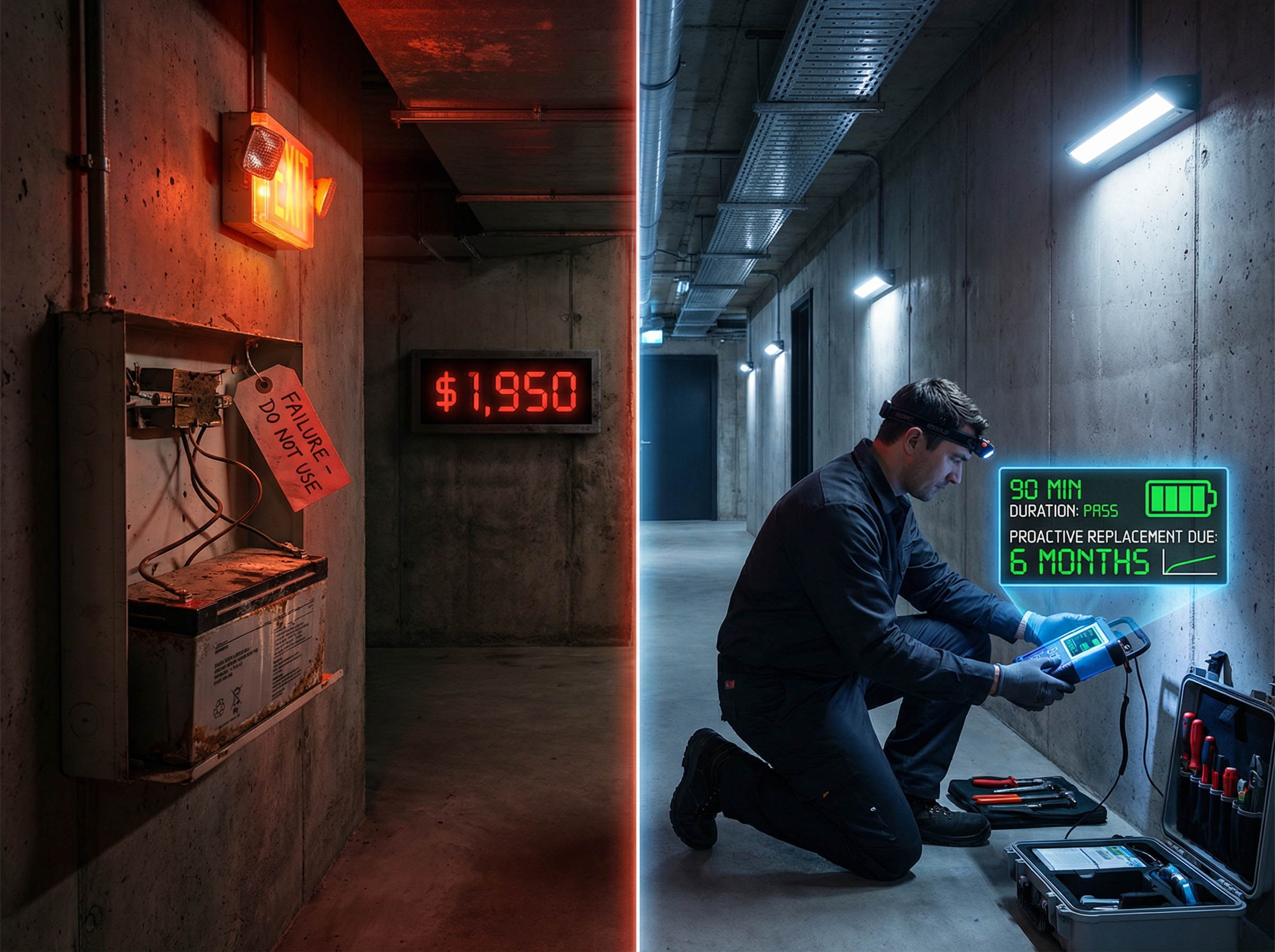
Deferred cost: $1,200 battery replacement (20 units @ $60 each)
Actual cost: $1,200 batteries + $450 re-testing + $300 emergency service = $1,950
Additional: Business disruption, compliance violation risk
Savings: -$750 (cost increased 63%)
“`
EXCUSE 3: “They’re only 5 years old”
“`
Battery type: Lead-acid (3-5 year lifespan)
Actual age: 5 years
Manufacturer spec: Replace at 4-5 years maximum
Status: END OF LIFE
Risk: 40-60% failure rate at this age
Decision: Replacement overdue
“`
EXCUSE 4: “Let’s see if they pass annual test”
“`
Annual test fee: $800 (includes site visit, testing, certification)
Battery fails: Immediate replacement needed
Additional cost: $450 return visit for re-testing
Total: $1,250 vs. $1,200 proactive replacement
Loss: Emergency correction timing, scheduling difficulty
“`
—
DIAGNOSTIC INDICATORS OF AGING BATTERIES
Warning signs requiring immediate replacement:
PHYSICAL INDICATORS:
| Observation | Meaning | Action Required |
|---|---|---|
| Battery swelling/bulging | Internal gas buildup, imminent failure | Immediate replacement |
| Corrosion on terminals | Acid leakage, connection degradation | Replacement recommended |
| Discoloration/staining | Electrolyte leakage | Immediate replacement |
| Case cracking | Structural failure | Immediate replacement |
| Excessive heat during charging | Internal resistance increased | Replacement required |
PERFORMANCE INDICATORS:
| Test Result | Interpretation | Timeline |
|---|---|---|
| 90-minute test fails at <60 minutes | Capacity severely degraded | Replace immediately |
| 90-minute test passes but dims significantly | Marginal capacity remaining | Replace within 30 days |
| Voltage drops rapidly under load | High internal resistance | Replace within 60 days |
| Extended recharge time (>48 hours) | Charging efficiency lost | Replace before next test |
| Monthly test shows declining brightness | Progressive degradation | Monitor closely, replace proactively |
—
CORRECTION PROTOCOL: PROACTIVE LIFECYCLE MANAGEMENT
48FIRE BATTERY REPLACEMENT STRATEGY:
TRACKING SYSTEM:
“`
Equipment Database:
├─ Battery installation date recorded
├─ Battery type and specifications documented
├─ Manufacturer lifespan noted
├─ Replacement due date calculated automatically
├─ Automated reminders: 6 months before due
└─ Service scheduled proactively
“`
REPLACEMENT SCHEDULE:
| Battery Type | Proactive Replacement Timeline | Conservative Approach |
|---|---|---|
| Lead-Acid | Year 4 (before degradation) | Year 3.5 (maximum reliability) |
| Nickel-Cadmium | Year 8 (before decline) | Year 7 (conservative) |
| Lithium | Year 12 (before degradation) | Year 10-11 (maximum reliability) |
Economic justification:
“`
PROACTIVE REPLACEMENT (Year 4):
Battery cost: $60
Installation: $25 (routine service visit)
Testing: $0 (included in annual maintenance)
Total: $85 per unit
Result: Passes 90-minute test, 3-5 years additional service
REACTIVE REPLACEMENT (Year 6, after failure):
Battery cost: $60
Emergency service: $125 (dedicated trip)
Initial testing: $40
Re-testing: $45
Total: $270 per unit
Result: Immediate fix only, no additional confidence
Savings lost: $185 per unit (217% cost increase)
“`
48Fire emergency lighting maintenance includes automated battery lifecycle tracking with proactive replacement notifications preventing age-related failures.
—
ERROR #2 → CHARGING CIRCUIT NEGLECT
“The Battery’s Connected, It Should Be Charging”
The invisible failure: Charging system malfunctions without obvious symptoms.
—
HOW CHARGING CIRCUITS FAIL
CHARGING SYSTEM COMPONENTS:
“`
AC POWER INPUT
↓
TRANSFORMER (Steps down voltage)
↓
RECTIFIER (Converts AC to DC)
↓
VOLTAGE REGULATOR (Maintains proper voltage)
↓
CHARGING CIRCUIT (PC board control)
↓
BATTERY (Receives charge)
“`
Failure points:
—
FAILURE MODE 1: Float Voltage Drift
PROPER CHARGING:
“`
Float voltage: 13.6-13.8V (for 12V system)
Battery receives: Maintenance charge continuously
Battery state: Fully charged, ready
System status: Emergency-ready 24/7
“`
IMPROPER CHARGING (Voltage too low):
“`
Float voltage: 12.8-13.2V (insufficient)
Battery receives: Inadequate charge current
Battery state: Chronically undercharged (85-90% capacity)
System status: Will fail before 90-minute duration
Monthly test: May still pass (low capacity requirement)
Annual test: FAILS at 60-75 minutes
“`
IMPROPER CHARGING (Voltage too high):
“`
Float voltage: 14.2-15.0V (excessive)
Battery receives: Overcharging current
Battery damage: Electrolyte loss, plate degradation, heat
Lifespan impact: Reduced from 5 years to 2-3 years
System status: Premature battery failure
“`
Why voltage drifts:
- Component aging (capacitors, resistors)
- Temperature fluctuations affecting electronics
- Power supply voltage variations
- PC board degradation
- Manufacturing tolerance drift
Detection method:
Annual professional testing with voltage measurement and PC board adjustment.
—
FAILURE MODE 2: Charging Current Loss
SYMPTOMS:
“`
Voltage appears correct (13.6-13.8V)
↓
But current flow minimal or absent
↓
Battery not receiving charge despite proper voltage
↓
Capacity depletes over time
↓
System fails during extended use
“`
Causes:
- Broken connections
- Corroded terminals
- Internal PC board trace failure
- Component failure (diodes, capacitors)
- Wiring damage
Diagnostic test:
“`
CURRENT MEASUREMENT PROCEDURE:
1. Discharge battery slightly
2. Measure charging current flow
3. Compare to specifications
4. Verify current decreases as battery charges
5. Confirm maintains float current when fully charged
EXPECTED: Initial current 0.5-2A, decreasing to 0.05-0.1A maintenance
FAILURE: No current or excessive current regardless of charge state
“`
—
FAILURE MODE 3: Power Supply Interruption
INTERMITTENT FAILURE PATTERN:
“`
Normal operation: Battery charges properly
↓
Power supply component fails intermittently
↓
Charging stops periodically (unnoticed)
↓
Battery partially discharges
↓
Charging resumes, battery recharges partially
↓
Cycle repeats, battery never fully charges
↓
System appears functional but inadequate capacity
↓
90-minute test reveals failure at 50-70 minutes
“`
Common intermittent causes:
- Loose connections
- Oxidized contacts
- Thermal cycling (expansion/contraction)
- Vibration effects
- Marginal component performance
Detection difficulty:
Visual inspection shows no issues, voltage measurements may appear normal during spot checks, only comprehensive load testing reveals capacity deficiency.
—
DIAGNOSTIC PROCEDURE FOR CHARGING ISSUES
48FIRE CHARGING CIRCUIT ASSESSMENT:
“`
STEP 1: Voltage Measurement
├─ Measure float voltage at battery terminals
├─ Compare to manufacturer specifications
├─ Document deviation if present
└─ Adjust PC board if needed
STEP 2: Current Flow Verification
├─ Discharge battery to 80% capacity
├─ Measure charging current
├─ Verify appropriate current flow
└─ Confirm current tapers as charge completes
STEP 3: Load Testing
├─ Apply electronic load simulator
├─ Monitor voltage under load
├─ Verify capacity matches rating
└─ Identify inadequate charging effects
STEP 4: PC Board Inspection
├─ Visual inspection for damage
├─ Component condition assessment
├─ Connection security verification
└─ Thermal condition evaluation
STEP 5: Adjustment and Correction
├─ Float voltage adjusted to specification
├─ Connections cleaned/tightened
├─ Damaged components replaced
└─ Verification testing performed
“`
Testing frequency preventing charging failures:
- Monthly: Basic function test (identifies complete failures)
- Annual: Comprehensive charging circuit assessment (identifies marginal performance)
- Adjustment: PC board float voltage calibration during annual service
48Fire annual emergency lighting maintenance includes comprehensive charging circuit assessment with electronic load testing, voltage/current measurement, PC board adjustment, and correction verification.
—
CORRECTION PROTOCOL: SYSTEMATIC CHARGING VERIFICATION
PREVENTION STRATEGY:
Annual maintenance checklist:
□ Float voltage measured and adjusted to specification
□ Charging current verified under load
□ Battery terminal cleaning performed
□ Connection tightness confirmed
□ PC board visual inspection completed
□ Component condition assessed
□ Load testing verifies charging effectiveness
Immediate correction triggers:
- Float voltage >0.2V outside specification
- No charging current with depleted battery
- Battery temperature excessive during charging
- Physical damage to PC board or components
- Connection corrosion or looseness
Long-term reliability:
Annual charging circuit maintenance extends battery life, prevents premature capacity loss, ensures 90-minute duration capability, maintains continuous emergency readiness.
—
ERROR #3 → ENVIRONMENTAL EXPOSURE IGNORANCE
“They’re Installed, They’ll Be Fine”
The location mistake: Placing emergency lighting in hostile environments without consideration.
—
TEMPERATURE EXTREMES IMPACT
BATTERY CHEMISTRY SENSITIVITY:
COLD TEMPERATURE EFFECTS:
| Temperature | Capacity Available | Performance Impact |
|---|---|---|
| 20°C / 68°F | 100% (optimal) | Full rated capacity |
| 10°C / 50°F | 90% capacity | Slight reduction |
| 0°C / 32°F | 80% capacity | Noticeable reduction |
| -10°C / 14°F | 60% capacity | Significant reduction |
| -20°C / -4°F | 50% capacity | Severe performance loss |
Real-world scenario:
“`
Emergency lighting installed in:
├─ Unheated stairwells (winter temperature: -5°C / 23°F)
├─ Rated capacity: 90 minutes at 20°C
├─ Actual capacity at -5°C: ~65 minutes
└─ RESULT: System non-compliant despite “passing” warm-weather tests
“`
HOT TEMPERATURE EFFECTS:
| Temperature | Battery Lifespan | Degradation Rate |
|---|---|---|
| 20°C / 68°F | 5 years (baseline) | 1× (normal) |
| 30°C / 86°F | 3 years | 1.7× faster |
| 40°C / 104°F | 2 years | 2.5× faster |
| 50°C / 122°F | <1 year | 5× faster |
Real-world scenario:
“`
Emergency lighting installed:
├─ Near rooftop in unconditioned space
├─ Summer temperature: 45°C / 113°F
├─ Expected lifespan: 5 years
├─ Actual lifespan: 18 months
└─ Premature failure, increased replacement costs
“`
—
MOISTURE AND HUMIDITY DAMAGE
CORROSION ACCELERATION:
Moisture exposure effects:
- Terminal corrosion (reduces charging efficiency)
- Connection oxidation (increases resistance)
- Internal component degradation
- Shortened electrical component life
- Housing seal failure
High-risk locations:
□ Bathrooms and locker rooms
□ Kitchen areas
□ Mechanical rooms
□ Near exterior doors (weather exposure)
□ Basement areas with humidity
□ Areas with poor ventilation
Failure progression:
“`
Month 1-6: Slight corrosion begins (unnoticed)
Month 6-12: Corrosion visible on terminals
Year 1-2: Connection resistance increases
Year 2-3: Charging efficiency reduced
Year 3: Capacity loss apparent
Year 3-4: Premature battery failure
Annual test: System fails despite battery age suggesting functionality
“`
Diagnostic indicator:
Green/white powdery substance on battery terminals or connections = active corrosion requiring immediate attention.
—
VIBRATION AND MECHANICAL STRESS
PHYSICAL DEGRADATION:
High-vibration locations:
- Near HVAC equipment
- Adjacent to mechanical rooms
- High-traffic areas with door slamming
- Areas with heavy equipment operation
- Structural vibration zones
Effects on emergency lighting:
□ Mounting loosening (unsafe, connection stress)
□ Connection vibration (intermittent contact)
□ Internal component damage
□ Accelerated wear on mechanical parts
□ Premature lamp/LED failure
□ Battery connection degradation
Failure pattern:
“`
Continuous vibration exposure
↓
Mounting screws gradually loosen
↓
Unit shifts slightly (unnoticed)
↓
Internal connections stressed
↓
Intermittent electrical contact
↓
Charging becomes unreliable
↓
Battery capacity inadequate
↓
System fails during 90-minute test
“`
—
ENVIRONMENTAL PROTECTION SOLUTIONS
48FIRE ENVIRONMENTAL ASSESSMENT:
Installation review checklist:
□ Temperature range at location documented
□ Humidity levels assessed
□ Vibration sources identified
□ Protection requirements determined
□ Appropriate housing selected
□ Enhanced maintenance schedule established
Protection strategies by environment:
| Environment | Challenge | Protection Solution |
|---|---|---|
| Extreme cold | Reduced capacity | Heated enclosure or relocated to conditioned space |
| Extreme heat | Accelerated degradation | Ventilated housing, thermal insulation, relocation |
| High humidity | Corrosion | Sealed housing (IP65+ rated), enhanced maintenance |
| High vibration | Connection failure | Vibration-dampening mounts, reinforced installation |
| Outdoor exposure | Weather damage | NEMA-rated weatherproof enclosures |
Enhanced maintenance for hostile environments:
“`
STANDARD ENVIRONMENT:
├─ Monthly testing: Standard 30-second test
├─ Annual testing: Standard comprehensive test
└─ Battery replacement: Per standard lifecycle
HOSTILE ENVIRONMENT:
├─ Monthly testing: Standard + visual inspection
├─ Quarterly inspection: Enhanced physical condition check
├─ Annual testing: Comprehensive + environmental assessment
├─ Terminal cleaning: Every 6 months (vs. annual)
└─ Battery replacement: 25-50% shorter interval
“`
48Fire emergency lighting maintenance includes environmental assessment during installation and service with protection recommendations and enhanced maintenance schedules for hostile environments.
—
ERROR PREVENTION FRAMEWORK
Systematic Emergency Lighting Maintenance Preventing Battery Failures
Comprehensive approach eliminating all three errors:
—
ERROR #1 PREVENTION: Automated Lifecycle Tracking
48FIRE BATTERY MANAGEMENT SYSTEM:
“`
EQUIPMENT DATABASE
├─ Installation date recorded
├─ Battery type/specifications documented
├─ Expected lifespan calculated
├─ Replacement window determined
└─ Automated notifications:
├─ 12 months before due: Budget planning alert
├─ 6 months before due: Procurement reminder
├─ 3 months before due: Scheduling notification
└─ Due date: Urgent replacement required
“`
Proactive replacement schedule:
- Lead-acid: Year 4 replacement (before Year 5 failure zone)
- Nickel-cadmium: Year 8 replacement (before degradation)
- Lithium: Year 12 replacement (before decline)
Result: Zero age-related failures during annual testing.
—
ERROR #2 PREVENTION: Annual Charging Circuit Maintenance
COMPREHENSIVE CHARGING ASSESSMENT:
Annual service includes:
□ Float voltage measurement and adjustment
□ Charging current verification
□ Electronic load simulator testing
□ Battery terminal cleaning
□ Connection security verification
□ PC board inspection
□ Component condition assessment
Quality assurance:
- Voltage calibrated to manufacturer specification
- Current flow verified adequate
- Capacity tested under actual load conditions
- Connections cleaned and secured
- Documentation complete
Result: Proper charging maintained, battery lifespan maximized, capacity assured.
—
ERROR #3 PREVENTION: Environmental Assessment and Protection
INSTALLATION AND MAINTENANCE PROTOCOL:
Initial installation:
□ Temperature range documented
□ Humidity assessment completed
□ Vibration sources identified
□ Protection requirements determined
□ Appropriate equipment selected
Ongoing maintenance:
□ Environmental condition monitoring
□ Enhanced inspection for hostile environments
□ Terminal cleaning frequency appropriate to conditions
□ Protection adequacy verified
□ Relocation recommended if conditions deteriorate
Result: Environmental factors managed, premature failures prevented.
—
IMPLEMENTATION ROADMAP
Building Error-Free Emergency Lighting Maintenance
48Fire systematic approach:
—
PHASE 1: System Assessment
Identify current vulnerabilities:
□ Battery age audit (identify overdue replacements)
□ Charging circuit baseline (voltage/current measurement)
□ Environmental risk assessment (hostile location identification)
□ Historical performance review (failure pattern analysis)
Deliverable: Comprehensive vulnerability report with prioritized corrections.
—
PHASE 2: Immediate Corrections
Critical error elimination:
□ Overdue batteries replaced
□ Charging circuit issues corrected
□ Environmental protection implemented
□ Testing performed to verify corrections
Timeline: 30-60 days to error-free baseline.
—
PHASE 3: Systematic Maintenance Program
Ongoing error prevention:
“`
MONTHLY:
└─ Function testing (30-second verification)
QUARTERLY (hostile environments):
└─ Enhanced inspection and terminal maintenance
ANNUAL:
└─ Comprehensive testing with:
├─ 90-minute duration verification
├─ Charging circuit assessment and adjustment
├─ Battery lifecycle evaluation
├─ Environmental condition review
└─ Professional certification
PROACTIVE REPLACEMENT:
└─ Automated tracking and timely battery replacement
“`
—
CONCLUSION
Three Battery Errors Eliminated Through Emergency Lighting Maintenance
Error #1: Deferred Replacement Beyond Lifecycle
- Problem: Batteries operated past manufacturer lifespan
- Consequence: 40-60% failure rate during 90-minute testing
- Solution: Automated lifecycle tracking, proactive Year 4 replacement (lead-acid)
- Prevention: 48Fire battery management with replacement notifications
Error #2: Charging Circuit Neglect
- Problem: Float voltage drift, current loss, intermittent failures
- Consequence: Chronically undercharged batteries, premature capacity loss
- Solution: Annual charging circuit assessment, voltage/current verification, PC board adjustment
- Prevention: 48Fire comprehensive annual maintenance with electronic load testing
Error #3: Environmental Exposure Ignorance
- Problem: Temperature extremes, moisture, vibration exposure
- Consequence: 50-80% capacity loss (cold), 2-3× faster degradation (heat), corrosion damage
- Solution: Environmental assessment, appropriate protection, enhanced maintenance schedules
- Prevention: 48Fire installation review and hostile environment protocols
Combined impact:
Error elimination reduces emergency lighting failure rates from 47% (industry average) to <5% (systematic maintenance programs).
48Fire emergency lighting maintenance services provide complete battery error prevention through automated lifecycle tracking with proactive replacement, annual charging circuit assessment with voltage/current verification and PC board adjustment, environmental risk assessment with protection implementation, and comprehensive testing ensuring continuous 90-minute emergency duration capability.
[Eliminate Battery Errors, Ensure Reliability]
—
48Fire
Emergency Lighting Maintenance Services
Battery Error Prevention • Charging Circuit Care • Environmental Protection
Contact: [/contact-us]