—
THE PROPERTY OWNER’S EXIT SIGN RESPONSIBILITY MATRIX
Exit signs = Legal obligation, not optional amenity
PROPERTY OWNER
↓
RESPONSIBLE FOR:
├─ Installation (proper type and placement)
├─ Maintenance (functional status continuously)
├─ Testing (monthly and annual verification)
├─ Documentation (compliance proof)
├─ Correction (immediate deficiency response)
└─ Liability (failure consequences)
Emergency lighting compliance encompasses:
- Federal OSHA requirements
- NFPA 101 Life Safety Code standards
- State and local fire codes
- Building code provisions
- AHJ (Authority Having Jurisdiction) enforcement
Property owner accountability: Cannot be delegated (though execution can be contracted to services like 48Fire).
This article provides comprehensive emergency lighting compliance requirements every property owner must understand regarding exit sign obligations.
—
REQUIREMENT 1 → EXIT SIGN PLACEMENT MANDATES
Where Exit Signs Legally Required
Emergency lighting compliance baseline:
Every Exit Door
NFPA 101 FUNDAMENTAL REQUIREMENT:
NFPA 101 requires that exits be marked by approved exit signs.
What qualifies as “exit”:
□ Doors leading directly outside
□ Doors leading to exit discharge (protected path to outside)
□ Stairway doors (leading to exit stairs)
□ Exit passageway doors
What doesn’t require exit sign:
- Interior office doors (not exits)
- Storage room doors (not exits)
- Restroom doors (not exits)
- Conference room doors (not exits)
Common violation:
Emergency exit doors unmarked because “everyone knows it’s an exit.”
Emergency lighting compliance standard:
ALL exits marked, regardless of how “obvious” location seems.
Directional Exit Signs at Decision Points
VISIBILITY REQUIREMENT:
NFPA 101 provision:
Exit signs must be visible from directions of approach requiring guidance.
Decision point examples:
CORRIDOR INTERSECTION:
├─ Multiple directions possible
├─ Exit not directly visible
├─ Directional sign required
└─ Arrow indicating exit direction
T-INTERSECTION:
├─ Straight-ahead wall (no exit)
├─ Exit to left or right
├─ Directional sign needed
└─ Arrow pointing to actual exit
LARGE OPEN AREA:
├─ Multiple potential paths
├─ Exit locations not obvious
├─ Strategic directional signs
└─ Guide occupants to nearest exit
Directional sign specifications:
- Arrow indicating exit direction
- Green running man symbol
- “EXIT” text (if required by local code)
- Same illumination requirements as exit signs
48Fire emergency lighting compliance assessment identifies all decision points requiring directional signage ensuring complete code satisfaction.
—
Maximum Travel Distance to Visible Sign
NFPA 101 VISIBILITY STANDARD:
NFPA 101 requires exit signs be located so that no point in a corridor exceeds 100 feet from the nearest visible exit sign.
Practical application:
Long corridor example (200 feet):
├─ Exit at one end (Exit Sign #1)
├─ 100 feet: Directional sign required (Sign #2)
├─ Another 100 feet: Exit at other end (Exit Sign #3)
└─ Result: No point >100 feet from visible sign
Open floor plan (150 × 150 feet):
├─ Exits at multiple locations
├─ Signs positioned throughout
├─ Overlapping 100-foot visibility zones
└─ Result: Complete coverage from all positions
Measurement consideration:
100 feet = straight-line visibility, not walking distance.
Emergency lighting compliance verification:
Facility walkthrough confirming sign visibility from all points.
—
REQUIREMENT 2 → EXIT SIGN SPECIFICATIONS
Technical Standards Property Owners Must Meet
Equipment requirements for emergency lighting compliance:
—
Green Running Man Symbol Standard
CURRENT CODE REQUIREMENT:
For new construction and renovations:
The green running man symbol is the required standard for exit lighting in new and renovated buildings.
Symbol specifications:
- Pictogram: Running person figure
- Color: Green on white or black background
- International standard: ISO 7010
- Universal recognition: No language barrier
Old text-only “EXIT” signs:
- Acceptable in existing buildings (grandfathered)
- Must be replaced if renovations occur
- Not compliant for new installations
- Voluntary upgrade recommended for consistency
Why green running man:
Research demonstrates pictogram recognition faster than text, especially for non-native speakers and children.
48Fire exit sign installations utilize current green running man standard ensuring emergency lighting compliance with modern code requirements.
—
Illumination Requirements
TWO ACCEPTABLE METHODS:
METHOD 1: Internally Illuminated
“`
Exit sign with internal light source:
├─ LEDs (modern standard)
├─ Incandescent bulbs (older)
├─ Fluorescent tubes (older)
└─ Connected to building power + battery backup
“`
Requirements:
- Powered by reliable light source
- Battery backup provides 90-minute minimum duration
- Automatic activation upon power failure
- Brightness adequate for visibility
—
METHOD 2: Externally Illuminated
“`
Exit sign illuminated by:
├─ External spotlight or light fixture
├─ Aimed at sign face
└─ Connected to emergency lighting system
“`
Requirements:
- Illumination source on emergency power
- 90-minute minimum duration capability
- Adequate brightness maintained
- Backup power automatic
—
METHOD 3: Photoluminescent (Passive)
“`
Non-electrical exit signs:
├─ Absorb energy from ambient light
├─ Glow in darkness
└─ No electrical connection required
“`
Requirements:
- Adequate ambient light exposure during normal conditions
- Tested for brightness standards
- Approved by AHJ
- Considered Passive Fire Protection (PFP)
Limitations:
- Directional guidance only (no ambient lighting)
- Requires regular light exposure
- Supplemental to electrical systems, rarely primary
Emergency lighting compliance preference:
Internally illuminated LED exit signs provide most reliable performance and lowest maintenance.
—
90-Minute Duration Mandate
NFPA 101 REQUIREMENT:
Emergency lighting systems must illuminate for a minimum of 90 minutes during power failures.
Why 90 minutes:
- Complete building evacuation time
- Fire department response and operations
- Search and rescue completion
- Safe building securing
Battery capacity considerations:
- New batteries: Typically exceed 90 minutes (100-120 minutes common)
- Aging batteries: Capacity decreases over time
- Testing verifies: Actual duration under load
- Replacement triggers: When capacity falls below 90 minutes
Property owner responsibility:
Ensure exit sign batteries maintain 90-minute capacity through regular testing and timely replacement.
48Fire battery lifecycle management tracks capacity ensuring emergency lighting compliance through proactive replacement before duration failures.
—
REQUIREMENT 3 → TESTING OBLIGATIONS
Monthly and Annual Verification Mandates
Emergency lighting compliance requires documented testing:
—
Monthly 30-Second Function Test
OSHA AND NFPA 101 REQUIREMENT:
The NFPA 101 Life Safety Code requires that emergency lighting and exit lighting devices be inspected monthly.
Testing procedure:
EXIT SIGN MONTHLY TEST:
├─ Activate test switch (simulates power failure)
├─ Verify sign illuminates on battery power
├─ Observe for 30 seconds minimum
├─ Confirm brightness adequate
├─ Check for flickering or dimming
├─ Return to normal power
├─ Document test in log
└─ Record any deficiencies
“`
Who performs:
- Building maintenance staff (common)
- Property management (acceptable)
- Professional service (48Fire available)
Documentation requirement:
Monthly test log maintained showing:
- Date of each test
- Inspector name
- Pass/fail status
- Deficiencies noted
- Corrective actions
Emergency lighting compliance failure:
Missing monthly tests = OSHA violation regardless of equipment functionality.
—
Annual 90-Minute Comprehensive Test
NFPA 101 REQUIREMENT:
Emergency lighting systems must be tested annually for the required duration of 90 minutes.
Professional testing includes:
ANNUAL EXIT SIGN CERTIFICATION:
├─ Complete discharge test (90 minutes)
├─ Battery load testing with electronic simulator
├─ Charging circuit verification
├─ Voltage measurement and adjustment
├─ Physical condition inspection
├─ Mounting security verification
├─ Brightness assessment throughout duration
├─ Professional certificate issuance
└─ Next test due date calculated
“`
Who performs:
Must be qualified technician or licensed contractor (48Fire certified professionals).
Testing frequency:
Maximum 12-month interval between tests (cannot skip or delay).
48Fire annual emergency lighting compliance testing provides complete certification satisfying NFPA 101 professional inspection requirements.
—
Documentation Retention
RECORDS PROPERTY OWNERS MUST MAINTAIN:
Monthly test logs:
- Minimum 12 months retention
- Permanent retention recommended
- Accessible for AHJ inspection
- Organized chronologically
Annual test certificates:
- Permanent retention recommended (best practice)
- Required for hydrostatic testing per NFPA 10 Section 8.3.3
- Minimum 3-5 years retention for compliance defense
- Professional service documentation
- Equipment inventory included
- Deficiency corrections documented
Emergency lighting compliance file:
- System design specifications
- Equipment locations and types
- Complete testing history
- Maintenance records
- Permit documentation
Why documentation critical:
- Fire marshal inspection defense
- OSHA audit compliance proof
- Insurance claim support
- Litigation protection
- Due diligence demonstration
—
REQUIREMENT 4 → MAINTENANCE RESPONSIBILITIES
Keeping Exit Signs Operational
Emergency lighting compliance extends beyond testing:
—
Immediate Deficiency Correction
NFPA 101 PROVISION:
NFPA 101 requires that defective equipment be replaced or repaired immediately.
Common exit sign deficiencies:
| Deficiency | Correction Required | Timeframe |
|---|---|---|
| Sign not illuminating | Battery replacement or unit replacement | Immediate (24-48 hours) |
| Dim illumination | Lamp/LED replacement or battery service | Within 7 days |
| Cracked housing | Housing replacement | Within 30 days |
| Loose mounting | Remounting and securing | Within 7 days |
| Missing arrow | Directional indicator replacement | Immediate |
| Faded symbol | Sign replacement | Within 30 days |
Property owner obligation:
Cannot defer corrections; deficiencies create liability exposure.
Temporary measures during repair:
- Temporary battery-powered exit signs
- Posted alternative egress directions
- Reduced occupancy if critical
- Expedited correction scheduling
48Fire emergency service provides rapid deficiency correction ensuring continuous emergency lighting compliance.
—
Battery Replacement Lifecycle
PROACTIVE REPLACEMENT STRATEGY:
Battery types and typical lifespans:
“`
LEAD-ACID (Most common in exit signs):
├─ Expected life: 3-5 years
├─ Replacement: Year 4 (proactive)
└─ Typical cost: $40-80 per unit
NICKEL-CADMIUM (Commercial grade):
├─ Expected life: 5-10 years
├─ Replacement: Year 8 (proactive)
└─ Typical cost: $80-150 per unit
LITHIUM (Premium applications):
├─ Expected life: 10-15 years
├─ Replacement: Year 12 (proactive)
└─ Typical cost: $150-250 per unit
“`
Note: Battery replacement costs vary by supplier, location, quantity purchased, and specific battery specifications. Contact 48Fire for accurate pricing based on your facility’s needs.
Replacement triggers:
- Age exceeds manufacturer specification
- Annual test shows reduced capacity
- Charging issues detected
- Physical degradation visible
Property owner planning:
Budget for battery replacement on lifecycle schedule, not reactive to failures.
—
LED Lamp Technology Advantage
MAINTENANCE REDUCTION THROUGH MODERN TECHNOLOGY:
Traditional incandescent/fluorescent:
- Lifespan: 1,000-10,000 hours
- Replacement: Every 1-3 years
- Labor: Frequent maintenance
- Energy: Higher consumption
LED technology:
- Lifespan: 50,000+ hours
- Replacement: 10-15 years
- Labor: Minimal maintenance
- Energy: 75-80% reduction
Emergency lighting compliance benefit:
LED exit signs reduce maintenance burden while improving reliability.
48Fire LED exit sign upgrades provide long-term maintenance cost reduction while ensuring continuous emergency lighting compliance.
—
REQUIREMENT 5 → LIABILITY UNDERSTANDING
Legal Consequences of Non-Compliance
Property owner exposure from exit sign failures:
—
OSHA Citations and Penalties
VIOLATION CATEGORIES:
Serious violation (most common):
- Definition: Substantial probability of serious harm
- Exit signs non-functional, inadequate, missing
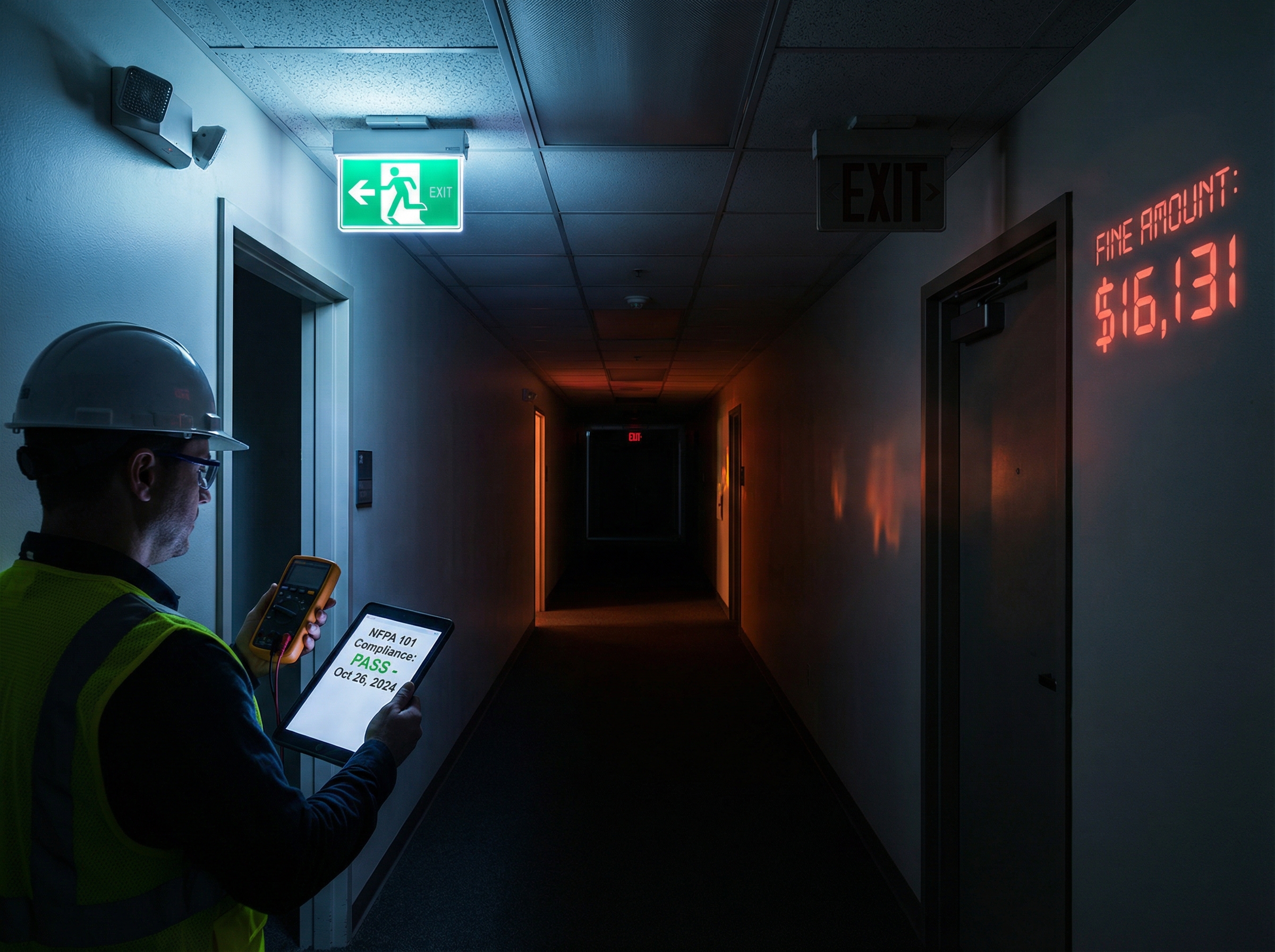
- Penalty: Up to $16,131 per violation (as of 2024)
- Multiple violations: Each deficient sign separate citation
Willful violation:
- Definition: Intentional disregard of requirements
- Known deficiencies not corrected
- Penalty: Up to $161,323 (as of 2024)
- Enhanced scrutiny: Follow-up inspections
Repeat violation:
- Definition: Same violation within 3 years
- Previous citation not preventing recurrence
- Penalty: Up to $161,323 (as of 2024)
- Compliance monitoring: Extended oversight
Property owner defense:
Complete documentation proving systematic emergency lighting compliance maintenance and testing.
—
Personal Injury Liability
NEGLIGENCE CLAIMS FRAMEWORK:
“`
INCIDENT: Power failure, exit signs non-functional, injury during evacuation
LIABILITY ANALYSIS:
├─ Duty: Property owner responsible for exit signs
├─ Breach: Signs not maintained (non-functional)
├─ Causation: Non-functional signs contributed to injury
└─ Damages: Medical costs, lost wages, pain/suffering
INVESTIGATION:
├─ Monthly test logs requested
├─ Annual test certificates examined
├─ Maintenance records reviewed
└─ Compliance status determined
OUTCOME WITH POOR RECORDS:
├─ Negligence established
├─ Liability clear
├─ Damages awarded
└─ Insurance complications
OUTCOME WITH COMPLETE RECORDS:
├─ Due diligence demonstrated
├─ Liability defense strengthened
├─ Insurance coverage maintained
└─ Settlement position improved
“`
48Fire professional emergency lighting compliance documentation provides liability protection through systematic testing records and professional certification.
—
Insurance Policy Requirements
PROPERTY INSURANCE PROVISIONS:
Common policy language:
- “Fire protection equipment maintained per applicable codes”
- “Monthly inspections documented”
- “Professional testing performed annually”
- “Deficiencies corrected promptly”
Non-compliance consequences:
- Claim denial or reduction
- Policy cancellation
- Premium increases
- Coverage limitations
Property owner protection:
Treat insurance requirements as minimum baseline, not optional.
—
REQUIREMENT 6 → SPECIAL SITUATIONS
Exit Sign Compliance for Specific Property Types
Emergency lighting compliance variations:
—
Multi-Tenant Buildings
RESPONSIBILITY ALLOCATION:
Option 1: Landlord responsibility (common)
“`
Property owner provides:
├─ All exit signs throughout building
├─ Common area coverage
├─ Tenant space coverage
├─ Complete maintenance
└─ Testing and documentation
Cost recovery: Through CAM charges
“`
Option 2: Tenant responsibility (triple-net leases)
“`
Lease requires tenant provide:
├─ Exit signs within leased space
├─ Professional maintenance
├─ Testing documentation
└─ Compliance proof to landlord
Property owner maintains:
├─ Common area exit signs
├─ Oversight of tenant compliance
└─ Coordination with AHJ
“`
Emergency lighting compliance clarity:
Lease must specify responsibilities explicitly; ambiguity creates violations.
48Fire multi-tenant coordination manages complex responsibility arrangements ensuring comprehensive emergency lighting compliance across all spaces.
—
Historical Buildings
PRESERVATION vs. CODE COMPLIANCE:
Challenge:
- Modern exit signs may conflict with historical appearance
- Green running man symbol aesthetically inconsistent
- Mounting methods may damage historical materials
Solutions:
Code-compliant options:
□ Low-profile LED signs (minimally visible)
□ Edge-lit technology (thin profile)
□ Custom colors matching interior (within code limits)
□ Strategic placement (less visible locations)
□ Photoluminescent supplemental signs
AHJ coordination:
- Variance requests for special conditions
- Alternative compliance methods
- Documented agreements
- Professional engineer involvement (complex cases)
Emergency lighting compliance priority:
Life safety requirements supersede aesthetics; creative solutions balance both.
—
Change of Occupancy
EXIT SIGN IMPLICATIONS:
When property use changes:
“`
Previous use: Office (Business occupancy)
New use: Retail (Mercantile occupancy)
Impact on exit signs:
├─ Occupant load may increase
├─ Exit quantity requirements change
├─ Travel distance limits may differ
├─ Signage requirements potentially different
└─ Inspection frequency may increase
“`
Property owner obligation:
Occupancy change triggers code compliance review; exit signs may require additions, relocations, or upgrades.
Building permit process:
- Fire marshal review required
- Exit sign adequacy assessed
- Modifications mandated if inadequate
- Certificate of occupancy dependent on compliance
48Fire change-of-occupancy services provide exit sign compliance assessment and modification coordination ensuring approval.
—
IMPLEMENTATION ROADMAP
Achieving and Maintaining Emergency Lighting Compliance
Property owner action plan:
—
Phase 1: Current Status Assessment
BASELINE COMPLIANCE EVALUATION:
“`
48FIRE ASSESSMENT INCLUDES:
├─ Complete exit sign inventory
├─ Code requirement analysis (NFPA 101, local codes)
├─ Placement verification (all required locations)
├─ Equipment specification review (standards compliant)
├─ Testing status evaluation (monthly/annual current)
├─ Documentation completeness assessment
├─ Deficiency identification
└─ Correction prioritization
“`
Deliverable: Comprehensive report with gap analysis and correction roadmap.
—
Phase 2: Immediate Compliance
CRITICAL CORRECTIONS:
“`
Priority 1 (Immediate – 24-48 hours):
├─ Non-functional exit signs
├─ Missing exit signs at required locations
├─ Serious safety hazards
Priority 2 (Short-term – 7-14 days):
├─ Inadequate directional signage
├─ Dim illumination
├─ Mounting security issues
Priority 3 (Medium-term – 30-60 days):
├─ Non-compliant signage (wrong symbol)
├─ Aesthetic improvements
├─ Voluntary upgrades
“`
—
Phase 3: Systematic Maintenance Program
ONGOING EMERGENCY LIGHTING COMPLIANCE:
“`
MONTHLY:
└─ 30-second function tests
(48Fire professional service or staff-performed)
QUARTERLY (Enhanced option):
└─ Professional verification and quality check
ANNUAL:
└─ 90-minute comprehensive testing by 48Fire
Complete certification and documentation
AS-NEEDED:
└─ Deficiency corrections
Emergency service availability
“`
—
Phase 4: Documentation Management
COMPLIANCE RECORD SYSTEM:
48Fire digital platform provides:
□ Centralized documentation storage
□ Automated testing reminders
□ Compliance status dashboards
□ Instant audit report generation
□ Historical data accessibility
□ Multi-property visibility (if applicable)
—
CONCLUSION
Property Owner Emergency Lighting Compliance Essentials
Six critical requirements:
Requirement 1: Exit Sign Placement
- Every exit door marked
- Directional signs at decision points
- 100-foot maximum distance to visible sign
- Complete coverage verification required
Requirement 2: Exit Sign Specifications
- Green running man symbol (new/renovated)
- Proper illumination method (internal, external, photoluminescent)
- 90-minute minimum battery duration
- Code-compliant equipment only
Requirement 3: Testing Obligations
- Monthly 30-second function tests (documented)
- Annual 90-minute professional certification
- Records retention (permanent recommended, minimum 3-5 years)
- Cannot skip or defer testing
Requirement 4: Maintenance Responsibilities
- Immediate deficiency correction
- Proactive battery replacement (lifecycle management)
- LED technology advantages
- Professional service coordination
Requirement 5: Liability Understanding
- OSHA citations (up to $16,131+ per violation)
- Personal injury exposure (negligence claims)
- Insurance policy requirements
- Documentation as defense
Requirement 6: Special Situations
- Multi-tenant responsibility allocation
- Historical building solutions
- Change of occupancy impacts
- AHJ coordination when needed
Property owner accountability:
Exit sign emergency lighting compliance cannot be delegated (though execution can be contracted).
48Fire emergency lighting compliance services provide complete property owner support through comprehensive assessment identifying all requirements, immediate correction of deficiencies, systematic monthly and annual testing programs, professional documentation management, liability protection through certified service, and special situation coordination—ensuring exit signs meet all regulatory obligations protecting property owners from violations, liability exposure, and insurance complications.
[Ensure Complete Exit Sign Compliance]
—
48Fire
Emergency Lighting Compliance Services
Exit Sign Requirements • Professional Testing • Complete Documentation
Contact: [/contact-us]