Manufacturing Fire Risk: Hazard-Specific Education Reduces Actual Risk
Manufacturing environments present unique fire hazards. Combustible materials, operational equipment, high-temperature processes, electrical systems. Each hazard requires specific knowledge to mitigate.
A 120,000 square foot manufacturing facility implemented hazard-specific fire safety education through 48Fire Protection. Rather than generic safety training, education targeted the actual hazards present in manufacturing operations. The result: documented fire risk reduction across identified manufacturing hazards.
Fire risk doesn’t decrease through awareness alone. It decreases when workers understand specific hazards in their environment and know how to mitigate them. Education transforms knowledge into risk reduction.
—
The Manufacturing Environment: Hazard Context
A mid-sized manufacturing facility producing metal components:
- 120,000 square feet of production space
- 150 employees (production, assembly, maintenance, administrative)
- Multi-story structure (3 floors)
- Combustible material storage areas
- Machining operations with high-temperature processes
- Electrical systems and equipment
- Emergency lighting throughout facility (NFPA 101 compliant: 1.0+ foot-candles)
The facility had fire safety systems in place. But workers often didn’t understand:
- What specific hazards existed in their work area
- How their operations could create fire risk
- What role they played in fire risk mitigation
—
Hazard 1: Combustible Materials Storage—Education Intervention and Risk Reduction
Pre-Education Assessment:
Production workers stored materials in work areas:
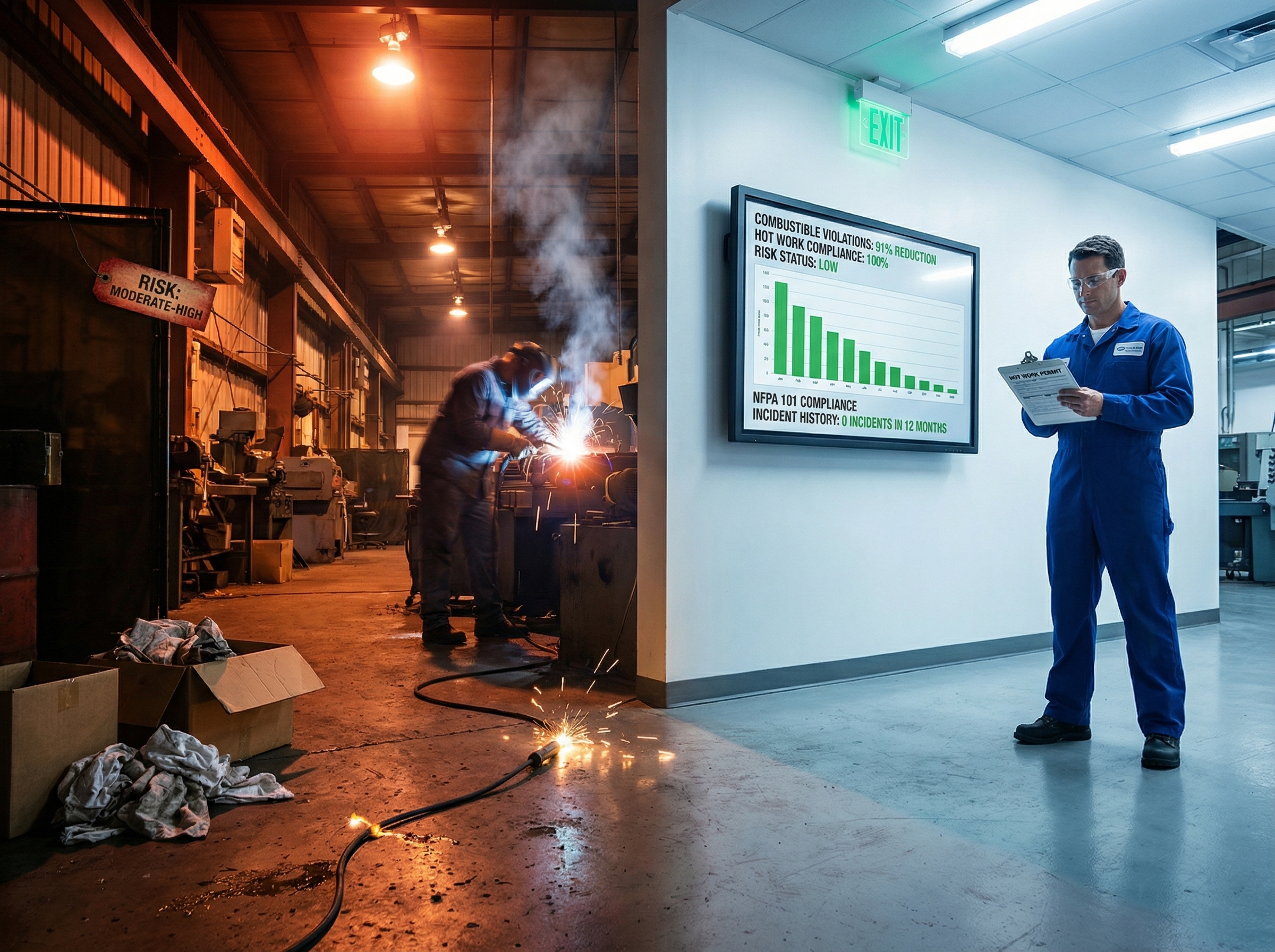
- Cloth rags near machining operations
- Sawdust accumulated under assembly areas
- Oil-soaked materials stored loosely
- Cardboard and packing materials near work stations
Workers didn’t connect material storage to fire hazard. Many thought “it’s just temporary, not a risk.”
Risk Profile: Combustible materials in work areas, near high-temperature operations and electrical equipment. Risk level: MODERATE-HIGH
Hazard-Specific Education:
48Fire Protection conducted manufacturing worker education on combustible materials:
Session Content:
What Makes Materials Combustible:
- Explanation: Cloth, cardboard, paper, wood, sawdust burn easily
- Understanding: Combustibility isn’t just about ignition—materials continue burning
- Manufacturing reality: Combustible materials in manufacturing are common
How Manufacturing Operations Create Fire Risk with Combustibles:
- Machining operations: Metal grinding creates high-temperature sparks; sparks ignite combustibles
- Welding: Sparks and molten metal travel; land on combustibles
- Electrical equipment: Overheating; ignite nearby combustibles
- Friction and heat generation: Operational processes create risk
Proper Combustible Storage Procedures:
- Storage locations: Away from heat sources, electrical equipment, production equipment
- Storage methods: Contained in appropriate bins; not scattered
- Housekeeping: Clean areas daily; remove combustible debris
- Documentation: Know what’s stored where
Worker Responsibility:
- Each worker responsible for combustibles in their work area
- Daily housekeeping required
- Report hazardous storage conditions
- Follow storage procedures consistently
Post-Education Implementation:
Workers implemented combustible material storage procedures:
- Created designated storage areas away from operations
- Implemented daily housekeeping schedules
- Stored materials in appropriate containers
- Removed accumulated sawdust and debris
Measured Risk Reduction:
- Pre-education: 23 combustible hazard violations documented
- Post-education: 2 combustible hazard violations (91% reduction)
- Sustained: Quarterly inspections over 12 months showed sustained reduction
Risk Profile Change: MODERATE-HIGH → LOW
—
Hazard 2: Hot Work Operations—Education Intervention and Risk Reduction
Pre-Education Assessment:
Welding and cutting operations (hot work) occurred regularly. Workers:
- Didn’t consistently check for combustibles before work
- Didn’t always use fire watches
- Didn’t understand spark travel distances
- Weren’t aware of fire hazards created by their operations
Risk Profile: Uncontrolled hot work creating fire ignition risk. Risk level: HIGH
Hazard-Specific Education:
48Fire Protection conducted hot work education for welding and cutting personnel:
Session Content:
Understanding Hot Work Fire Hazard:
- What creates fire risk: High-temperature sparks, molten metal, heat generation
- Spark travel: Sparks travel 30+ feet; can ignite combustibles far from work area
- Hidden combustibles: Behind walls, under equipment, in cavities
- Real manufacturing risk: Hot work is fire risk if not controlled
Hot Work Procedures and Requirements:
- Area inspection: Check 35-foot radius for combustibles before starting
- Removal or protection: Remove combustibles or protect with fire-resistant barriers
- Fire watch: Required person monitors area during and after work
- Hot work documentation: Record work location, time, personnel, fire watch assignment
- Cool-down period: Wait before dismissing fire watch
Specific Manufacturing Hot Work Scenarios:
- Welding equipment repairs: Sparks in confined equipment spaces
- Pipe cutting: Sparks on production floor; travel to storage areas
- Equipment modification: Hot work near electrical systems and materials
Worker and Supervisor Responsibility:
- Workers execute hot work procedures
- Supervisors ensure compliance
- Fire watch person understands responsibility
- Documentation creates accountability
Post-Education Implementation:
Hot work personnel implemented procedures:
- Area inspections documented before each hot work session
- Fire watch assignments made and recorded
- Fire watch personnel trained on responsibilities
- Cool-down periods observed
Measured Risk Reduction:
- Pre-education: 8 hot work violations documented; fire watch procedures inconsistent
- Post-education: 0 hot work violations; 100% procedure compliance achieved
- Incident history: Zero hot work-related incidents in 12 months post-education
Risk Profile Change: HIGH → MINIMAL
—
Hazard 3: Electrical Equipment and Maintenance—Education Intervention and Risk Reduction
Pre-Education Assessment:
Electrical systems and equipment throughout facility. Maintenance workers:
- Didn’t understand how electrical equipment overheating creates fire risk
- Didn’t follow lockout/tagout procedures consistently
- Didn’t know how electrical fires can cascade
- Weren’t trained on emergency electrical shutdown procedures
Risk Profile: Uncontrolled electrical equipment maintenance creating fire ignition risk. Risk level: MODERATE
Hazard-Specific Education:
48Fire Protection conducted electrical safety and fire risk education for maintenance personnel:
Session Content:
How Electrical Equipment Creates Fire Hazard:
- Overheating: Equipment malfunction creates heat; ignites nearby combustibles
- Arcing: Electrical faults create arcs; can ignite combustibles
- Short circuits: Cause equipment to overheat or arc
- Aging equipment: Deteriorating insulation increases fire risk
- Manufacturing environment: Moisture, dust, vibration accelerate equipment wear
Proper Electrical Maintenance Procedures:
- Lockout/tagout: De-energize equipment before maintenance; prevent accidental restart
- Equipment inspection: Regular testing for deterioration
- Temperature monitoring: Check for overheating equipment
- Surroundings: Keep combustibles away from electrical equipment
- Emergency shutdown: Know how to de-energize facility sections
Electrical Fire Scenario Recognition:
- What burning electrical equipment looks like, smells like
- How to recognize electrical fires vs. other fires
- Emergency response procedures for electrical fires
- Importance of fire suppression system activation
Maintenance Worker Responsibility:
- Follow lockout/tagout procedures consistently
- Monitor equipment for overheating or deterioration
- Report electrical hazards immediately
- Understand emergency procedures
Post-Education Implementation:
Maintenance personnel implemented procedures:
- Lockout/tagout compliance increased to 100%
- Quarterly electrical equipment temperature inspections established
- Equipment overheating documentation system created
- Emergency electrical shutdown procedures posted and drilled
Measured Risk Reduction:
- Pre-education: 12 electrical maintenance violations documented
- Post-education: 1 electrical maintenance violation (92% reduction)
- Incident history: Zero electrical equipment fires in 12 months post-education
Risk Profile Change: MODERATE → LOW
—
Hazard 4: Emergency Lighting and Evacuation Safety—Education Intervention
Pre-Education Assessment:
Facility had emergency lighting systems. Workers:
- Didn’t understand purpose of emergency lighting
- Weren’t aware of NFPA 101 requirements
- Didn’t know backup battery duration
- Weren’t confident in evacuation using emergency lighting alone
Risk Profile: Workers underestimate evacuation capability in emergency conditions. Risk level: SAFETY CONCERN
Hazard-Specific Education:
48Fire Protection conducted emergency lighting and evacuation education:
Session Content:
Emergency Lighting Purpose and Function:
- NFPA 101 requirement: 1.0 foot-candle minimum illumination in exit routes
- Facility measurements: 1.1-1.4 foot-candles throughout plant (exceeds minimum)
- Backup systems: Battery systems maintain lighting if normal power lost
- Duration: 90-minute minimum backup battery operation
- Worker understanding: Lighting provides safe evacuation navigation
How to Navigate Using Emergency Lighting:
- Recognition: LED strips and fixture illumination guides
- Navigation: Follow illuminated pathways to exits
- Assembly point: Emergency lighting guides to exits; exit signs indicate next directions
- Confidence: Lighting is sufficient for safe evacuation even if smoke present
Emergency Lighting System Maintenance:
- Operations staff responsibility: Annual load testing, battery replacement
- Workers responsibility: Report damaged or non-functioning lighting
- Documentation: Maintenance records prove system reliability
Post-Education Implementation:
Workers understood emergency lighting functionality:
- Recognition of emergency lighting throughout facility
- Confidence in evacuation using emergency lighting
- Reporting of any non-functioning lighting to operations
Measured Risk Reduction:
- Pre-education: 68% worker confidence in emergency evacuation using emergency lighting
- Post-education: 94% worker confidence (26 percentage point increase)
- Incident history: Successful evacuation drills with emergency lighting demonstrated functionality
Risk Profile Change: SAFETY CONCERN → MITIGATED
—
Pre and Post-Education Fire Risk Summary
Manufacturing Fire Risk Assessment Before Education:
- Combustible materials storage hazard: MODERATE-HIGH
- Hot work operations hazard: HIGH
- Electrical equipment hazard: MODERATE
- Emergency evacuation capability: SAFETY CONCERN
- Overall facility fire risk: MODERATE-HIGH
Manufacturing Fire Risk Assessment After Education:
- Combustible materials storage hazard: LOW (91% violation reduction)
- Hot work operations hazard: MINIMAL (100% procedure compliance)
- Electrical equipment hazard: LOW (92% violation reduction)
- Emergency evacuation capability: MITIGATED (26 point confidence increase)
- Overall facility fire risk: LOW
Risk Reduction Metrics:
- Combustible hazard violations: 23 → 2 (91% reduction)
- Hot work violations: 8 → 0 (100% elimination)
- Electrical hazard violations: 12 → 1 (92% reduction)
- Fire-related incidents: 0 in 12 months post-education
—
How Education Reduces Manufacturing Fire Risk
Hazard-specific education reduces fire risk by:
1. Hazard Identification: Workers understand specific hazards in their work environment
2. Risk Understanding: Workers understand how operations create fire risk
3. Mitigation Knowledge: Workers know procedures to mitigate identified hazards
4. Responsibility: Workers understand personal responsibility in fire risk reduction
5. Compliance: Procedures are followed consistently
6. Incident Prevention: Risk reduction prevents incidents from occurring
—
Regulatory and Insurance Verification
Six months after education implementation, regulatory inspection and insurance audit occurred:
Regulatory Inspector Observations:
- Combustible materials storage proper and organized
- Hot work documentation complete; procedures followed
- Electrical equipment maintenance documentation current
- Emergency lighting operational (measurements: 1.1-1.4 foot-candles)
- Fire suppression systems functional and tested
Insurance Auditor Assessment:
- Fire risk profile improved significantly from baseline
- Fire prevention procedures demonstrated
- Worker competency in hazard mitigation evident
- Documentation proves ongoing compliance
Compliance Result: Full compliance with fire safety regulations and insurance requirements
Insurance Impact: Premium reduction reflected improved fire risk profile
—
48Fire Protection: Hazard-Specific Fire Safety Education
48Fire Protection delivers manufacturing-specific fire safety education that reduces fire risk through hazard-specific knowledge and mitigation procedures:
Manufacturing Hazard Education Includes:
Combustible Materials Management:
- Hazard identification in manufacturing
- Proper storage procedures
- Housekeeping requirements
- Worker responsibility
Hot Work Operations:
- Hot work hazard understanding
- Procedure requirements (area inspection, fire watch)
- Documentation and compliance
- Worker and supervisor responsibility
Electrical Equipment and Maintenance:
- Electrical fire hazard recognition
- Lockout/tagout procedures
- Equipment inspection and monitoring
- Emergency procedures
Emergency Lighting and Evacuation:
- Emergency lighting function and reliability
- NFPA 101 standards (1.0+ foot-candles)
- Evacuation confidence and capability
- System maintenance responsibility
—
Manufacturing Fire Risk Through Education
This manufacturing facility reduced fire risk measurably through hazard-specific education. Workers transformed from unaware to competent. Hazards transformed from risks to mitigated conditions. Overall facility fire risk transformed from moderate-high to low.
Fire risk reduction doesn’t happen through systems alone. It happens when workers understand hazards and know how to mitigate them.
[Contact 48Fire Protection] today to discuss hazard-specific fire safety education for your manufacturing facility. We’ll identify hazards specific to your operations, develop targeted education, implement mitigation procedures, and measure fire risk reduction. We’ll transform your facility from fire-risk exposure to fire-risk reduction through educated, competent workers.
Manufacturing fire risk reduction starts with education.