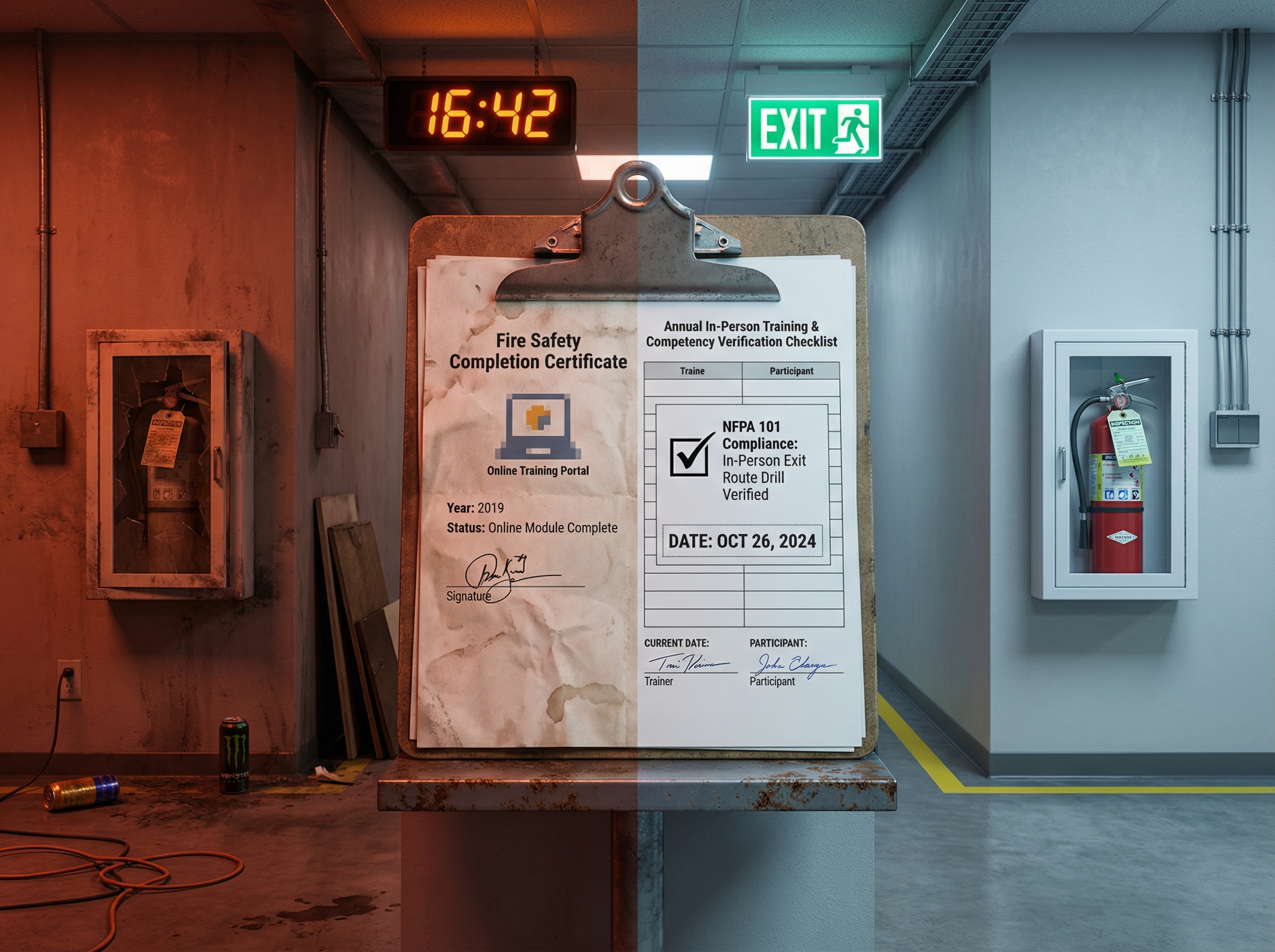
Myths persist. Organizations believe them. Training programs built on them. Teams exposed to risks these myths create. Not malicious decisions—sincere beliefs in incorrect information creating unintended consequences.
48Fire Protection encounters these myths repeatedly: facilities confident their training adequate, inspection reveals gaps. Organizations believing “we’re compliant,” reality showing otherwise. Training approaches based on assumptions contradicted by data.
Four myths appear most frequently. Four myths create measurable risk. Four corrections available.
—
MYTH #1: “Online Training Satisfies Fire Safety Requirements”
THE MYTH
“Our employees completed online fire safety course. We sent everyone link. They watched videos, passed quiz, received certificate. Training requirement satisfied. We’re compliant.”
THE REALITY
Online training provides knowledge. Fire safety requires competency.
Distinction critical: Knowledge = understanding concepts abstractly. Competency = executing procedures practically.
What online training teaches:
- Fire alarm sounds = evacuate
- Emergency lighting provides illumination
- Fire extinguishers available for small fires
- Assembly points exist outside building
What online training cannot teach:
- Where are YOUR facility’s exit routes?
- Which emergency lighting units provide YOUR evacuation illumination?
- Where are YOUR fire extinguishers located?
- Where is YOUR assembly point?
Generic online modules teach universal concepts. Fire emergencies occur in specific facilities requiring facility-specific knowledge.
Evidence from 48Fire Protection client data:
Facilities using only online training:
- Evacuation drill performance: Average 14-18 minutes
- Exit route accuracy: 62% employees reach correct exits
- Assembly point accuracy: 71% employees reach correct location
- Inspector assessment: “Generic knowledge evident, facility-specific competency lacking”
Facilities using in-person onsite training:
- Evacuation drill performance: Average 6-8 minutes
- Exit route accuracy: 96% employees reach correct exits
- Assembly point accuracy: 98% employees reach correct location
- Inspector assessment: “Facility-specific competency demonstrated”
Time difference: 6-10 minutes slower evacuation with online-only training
In fire emergency, 6-10 minutes = life-or-death difference.
THE RISKS
Risk 1: Inspection Non-Compliance
Fire inspectors increasingly questioning online-only training adequacy. Many jurisdictions require hands-on practice components. Online certificates alone insufficient documentation.
Risk 2: Emergency Response Failure
Employees evacuating based on generic “find exit” concept slower, more chaotic than employees who physically walked their facility’s exit routes during training.
Risk 3: Legal Liability
If fire emergency results in injuries and organization’s training was online-only generic module, liability exposure increases. “Adequate training” defense weakened when training lacked facility-specific preparation.
Risk 4: Insurance Implications
Insurance carriers reviewing training quality. Online-only training may not satisfy carrier requirements for premium discounts or coverage conditions.
THE CORRECTION
Effective fire safety training includes:
Component 1: Online knowledge foundation (acceptable)
Basic concepts, NFPA standards, emergency procedures theory
Component 2: In-person facility-specific practice (essential)
- Physical exit route walking
- Emergency lighting observation (NFPA 101: 1.0+ foot-candles minimum, facility measurements typically 1.1-1.4 foot-candles, 90-minute backup battery verified)
- Fire door identification
- Assembly point visit
- Evacuation drill
Hybrid approach acceptable: Online for concepts, in-person for practice. Never: Online alone.
48Fire Protection recommendation: Minimum 2-3 hours in-person onsite training annually, even if supplemented with online modules. Competency requires practice. Practice requires physical presence.
—
MYTH #2: “We Trained Everyone Five Years Ago—Still Good”
THE MYTH
“We conducted comprehensive fire safety training in 2019. All employees attended. Documentation exists. Training still valid. No need for refresher.”
THE REALITY
Fire safety knowledge decays. Competency degrades without reinforcement.
Human memory retention research:
- 6 months post-training: 70-75% retention
- 12 months post-training: 55-65% retention
- 24 months post-training: 40-50% retention
- 60 months post-training: 20-30% retention
Five years post-training: Employees retain approximately 20-30% of original training content. 70-80% knowledge lost.
Additional degradation factors:
Factor 1: Employee Turnover
Employees hired since 2019 training: Zero training received. Organizations assuming “everyone trained” often discover 30-40% current staff never received any training.
Factor 2: Facility Changes
Five years = substantial facility changes possible:
- Renovations altering exit routes
- New emergency lighting systems installed
- Fire door locations changed
- Assembly point relocated
- Building expansions creating new evacuation paths
2019 training taught 2019 facility layout. 2024 facility different.
Factor 3: Regulatory Updates
NFPA codes updated periodically. Standards evolve. Training from five years ago may not reflect current requirements. Example: Emergency lighting load testing requirements clarified in recent NFPA 101 editions. Older training may lack current testing protocol.
Evidence from 48Fire Protection assessments:
Facilities with 5+ year training gaps:
- Staff knowledge assessment: 28% average score
- Evacuation drill: 16-22 minutes, significant confusion
- Inspection pass rate: 42%
- Violation categories: Training documentation inadequate (citation noting training date 5+ years old)
Facilities with annual refresher training:
- Staff knowledge assessment: 87% average score
- Evacuation drill: 6-8 minutes, organized execution
- Inspection pass rate: 94%
- Violation categories: Training documentation current and compliant
THE RISKS
Risk 1: Regulatory Non-Compliance
NFPA 1 explicitly requires: “Training shall be provided at least annually.” Five-year gap = four years non-compliant = serious violation.
Risk 2: Insurance Certificate Denial
Insurance carrier requiring proof of current training. Five-year-old documentation insufficient. Certificate denied or coverage conditions imposed.
Risk 3: Competency Illusion
Organization believes employees trained. Reality: Employees forgot majority of training. False confidence dangerous.
Risk 4: Emergency Incident Outcome
Fire emergency occurs. Employees respond based on degraded 20-30% retention from five years ago. Outcome worse than if fresh training recently completed.
THE CORRECTION
Establish annual refresher training schedule:
Year 1: Comprehensive initial training
- 6-8 hours full curriculum
- All employees
- Complete documentation
Year 2: Annual refresher
- 2-3 hours key topics review
- Evacuation drill
- Emergency lighting update (annual load testing results shared: 90-minute backup verified, illumination measurements confirmed)
- New employee integration
- Updated documentation
Year 3, 4, 5+: Continue annual refreshers
Cost comparison:
Annual refresher: $2,000-4,000
Fire code violation for inadequate training: $1,000-3,000
Insurance premium increase from training gap: 5-15% ($3,000-12,000 annually typical)
Annual refresher investment prevents much larger expenses.
48Fire Protection recommendation: Schedule next annual refresher 11 months after previous training (not 12), creating compliance buffer. Never exceed 12-month interval.
—
MYTH #3: “Watching Videos and Reading Materials Equals Training”
THE MYTH
“We distributed fire safety videos and handouts. Employees watched videos during break. Read materials at desks. Training completed efficiently without scheduling facility-wide sessions.”
THE REALITY
Passive consumption ≠ Active training. Watching ≠ Doing.
Learning science distinction:
- Passive learning: Reading, watching, listening. Information absorbed cognitively. Retention: 10-30%
- Active learning: Doing, practicing, executing. Information absorbed cognitively AND physically. Retention: 70-90%
Fire safety requires active learning because emergencies require physical action:
- Evacuating = physical action (walking exit routes)
- Operating fire extinguisher = physical action (pull, aim, squeeze, sweep)
- Directing others = physical action (communicating under stress)
- Accountability = physical action (gathering, counting, reporting)
Video/materials teach: “In emergency, evacuate via exit routes to assembly point”
Active training teaches: [Physical experience] Walking exit route, seeing emergency lighting (1.1-1.4 foot-candles illumination), opening exit doors, reaching assembly point, experiencing assembly procedure
Evidence from comparative study (48Fire Protection, 40 facilities):
Group A – Passive materials only (20 facilities):
- Materials distributed, employees reviewed independently
- Knowledge assessment (written test): 74% average
- Evacuation drill (practical test): 12 minutes, disorganized
- Inspector observation: “Conceptual knowledge present, execution poor”
Group B – Active training sessions (20 facilities):
- Instructor-led, hands-on practice included
- Knowledge assessment (written test): 78% average (only 4 points higher)
- Evacuation drill (practical test): 7 minutes, organized (5 minutes faster, 42% time reduction)
- Inspector observation: “Practical competency demonstrated”
Critical finding: Knowledge scores nearly identical (74% vs 78%), but execution performance dramatically different (12 min vs 7 min). Videos teach concepts. Training builds competency.
THE RISKS
Risk 1: Competency Gap
Employees believe they’re trained (watched video, read materials). Organization believes employees trained. Reality: No practical competency developed.
Risk 2: Inspection Failure
Inspector conducts evacuation drill. Performance reveals training inadequacy. Violation cited: “Training documentation present, but employee competency lacking.”
Risk 3: Accountability Absence
Materials distribution lacks accountability. Did employees actually watch videos? Actually read materials? No verification. Training “completion” unverified.
Risk 4: Emergency Performance
Actual fire emergency reveals gap between watching video and executing evacuation. Employees uncertain, hesitant, slower than necessary.
THE CORRECTION
Effective training requires active participation.
Minimum requirements:
1. Instructor-led sessions (not self-paced materials)
2. Physical practice (walking routes, not watching videos of routes)
3. Hands-on demonstration (touching emergency lighting units, seeing actual fire doors, visiting actual assembly point)
4. Group drill (practicing evacuation collectively)
5. Competency verification (observing drill performance, assessing knowledge)
Videos and materials acceptable as supplements:
- Pre-training: Videos before live session (foundation building)
- Post-training: Materials as reference after hands-on training (reinforcement)
- Never: Videos/materials as sole training method
48Fire Protection approach:
- 30% content delivery (concepts, standards, procedures)
- 40% hands-on practice (walking, observing, demonstrating)
- 20% drill execution (full facility evacuation)
- 10% assessment and documentation (competency verification)
Active learning creates competency passive consumption cannot achieve.
—
MYTH #4: “Training Designated ‘Fire Wardens’ Means Everyone Is Covered”
THE MYTH
“We selected 10 employees as fire wardens. They received comprehensive training. They know evacuation procedures, accountability protocols, emergency systems. They’ll direct others during emergencies. Everyone else doesn’t need detailed training—wardens will handle it.”
THE REALITY
Fire wardens direct evacuation. They don’t execute evacuation for others.
During fire emergency:
- Fire warden directs: “Evacuate using east exit. Assembly point is parking lot. Move now.”
- Other employees must execute: Walking to east exit, navigating using emergency lighting, reaching parking lot, participating in accountability
If only wardens trained:
- Wardens know where to direct people
- People being directed don’t know routes, don’t recognize emergency lighting (NFPA 101: 1.0+ foot-candles illumination), don’t know assembly point, cannot execute directions effectively
Analogy: Fire warden = orchestra conductor. Other employees = musicians. Conductor directs performance. Musicians must know their instruments. Trained conductor + untrained musicians = poor performance.
Evidence from facilities using warden-only training:
Facility profile: 250 employees, 12 trained fire wardens (5% of workforce)
Evacuation drill results:
- Fire wardens: Positioned at exits, directing people
- Other employees: Uncertain which exit to use, hesitating at decision points, asking questions (“Which way?” “Where do we go?” “Is this the right exit?”)
- Evacuation time: 16 minutes (wardens directing, but untrained employees slowing overall evacuation)
- Issues: Wardens overwhelmed answering basic questions, employees unsure if emergency lighting reliable, assembly point confusion
Same facility, post all-employee training:
Evacuation drill results:
- Fire wardens: Still positioned at exits, but directing already-competent employees
- Other employees: Confidently walking to correct exits, using emergency lighting navigation, reaching assembly point directly
- Evacuation time: 7 minutes (9 minutes faster, 56% improvement)
- Issues: Minimal—wardens confirming evacuation, not teaching evacuation during emergency
Key insight: Fire wardens facilitate organization, they don’t replace employee knowledge.
THE RISKS
Risk 1: Regulatory Non-Compliance
NFPA codes require all employees receive training, not just designated responders. Warden-only training doesn’t satisfy regulatory requirements.
Risk 2: Warden Absence
Fire emergency occurs when some wardens off-site (meetings, vacation, sick leave). Remaining untrained employees lack knowledge to evacuate effectively.
Risk 3: Warden Overwhelm
Wardens attempting to direct 20-40 untrained employees simultaneously. Can’t provide individual guidance fast enough. Evacuation delays.
Risk 4: Collective Incompetence
Even with wardens present, untrained employees slower, more uncertain, creating collective bottlenecks, congestion, delays affecting everyone’s safety.
THE CORRECTION
Two-tier training approach:
Tier 1: All-Employee Training (Essential)
- All 100% of employees receive baseline fire safety training
- Emergency procedures, exit routes, emergency lighting (1.0+ foot-candles minimum, facility measurements, 90-minute backup), assembly point, accountability
- Duration: 2-3 hours
- Frequency: Annually
Tier 2: Fire Warden Enhanced Training (Additional)
- Designated wardens receive additional 1-2 hours beyond baseline
- Evacuation direction techniques, accountability management, emergency coordination, inspector communication
- Frequency: Annually
Result: Everyone capable of self-evacuation + wardens capable of coordination
Cost comparison:
- Training 12 wardens only: $2,400 (saving money initially)
- Training all 250 employees: $18,000 (investment required)
- Inspection violation for inadequate training: $2,000-5,000 (recurring until corrected)
- Emergency outcome improvement: Immeasurable (lives protected)
48Fire Protection data: Facilities training all employees achieve 94% inspection pass rate vs. 58% pass rate for warden-only training facilities.
—
THE PATTERN: WHY MYTHS PERSIST
Myth Characteristic 1: Sound Reasonable Initially
“Online training satisfies requirements” sounds reasonable—employees completed something, received certificates.
Myth Characteristic 2: Appear Cost-Effective
“Train wardens only” appears to save money—fewer people trained.
Myth Characteristic 3: Create False Confidence
“We trained five years ago” creates belief that training checkbox checked.
Myth Characteristic 4: Consequences Delayed
Myths don’t cause immediate obvious problems. Consequences appear later: during inspection, during insurance review, during actual emergency.
Reality: Short-term apparent savings or convenience create long-term risk and expense.
—
48FIRE PROTECTION: EFFECTIVE FIRE SAFETY TRAINING
48Fire Protection delivers effective fire safety training eliminating myths, addressing reality:
Not Online-Only: In-person onsite training at your facility, physical practice included
Not One-Time: Annual refresher training maintaining competency, updating for facility changes
Not Passive: Active learning through hands-on practice, evacuation drills, physical demonstrations
Not Warden-Only: All-employee training ensuring everyone capable, wardens receiving enhanced coordination training
Effective Training Components:
- Facility-specific exit route walking
- Emergency lighting observation and education (NFPA 101: 1.0+ foot-candles, your facility measurements typically 1.1-1.4 foot-candles, 90-minute backup battery, annual load testing)
- Fire protection systems demonstration
- Evacuation drill execution
- Competency verification
- Comprehensive documentation
Measurable Outcomes:
- 6-8 minute evacuation times (vs. 12-18 minutes with myth-based training)
- 94% inspection pass rates (vs. 58% with myth-based training)
- 85-92% employee competency scores (vs. 62-74% with myth-based training)
—
Myths create comfort through simplicity. Reality requires investment through thoroughness. Four common myths—online suffices, five-year-old training adequate, videos equal training, wardens cover everyone—put teams at risk through inadequate preparation. Correction requires rejecting convenient myths, embracing effective training reality: In-person, annual, active, all-employee. Organizations believing myths face inspection failures, insurance challenges, liability exposure, and emergency response gaps. Organizations implementing effective training achieve compliance, competency, and safety.
[Contact 48Fire Protection] to implement effective fire safety training replacing myths with reality. We’ll deliver in-person onsite training at your facility, establish annual refresher schedules maintaining competency, provide active hands-on practice creating practical skills, train all employees ensuring everyone prepared, include emergency lighting education (NFPA 101 standards, facility specifications, backup battery systems), conduct evacuation drills verifying performance, and create comprehensive documentation supporting compliance. Replace myths with effectiveness. Protect teams through reality-based training.
Myths create risk. Reality creates safety.