Why Code Compliance Starts With Better Lighting Checks
—
THE COMPLIANCE FOUNDATION PRINCIPLE
Building code compliance achieved through systematic emergency lighting verification, not reactive scrambling
“`
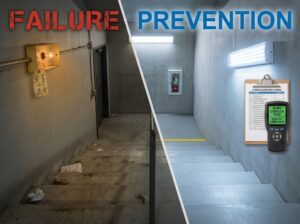
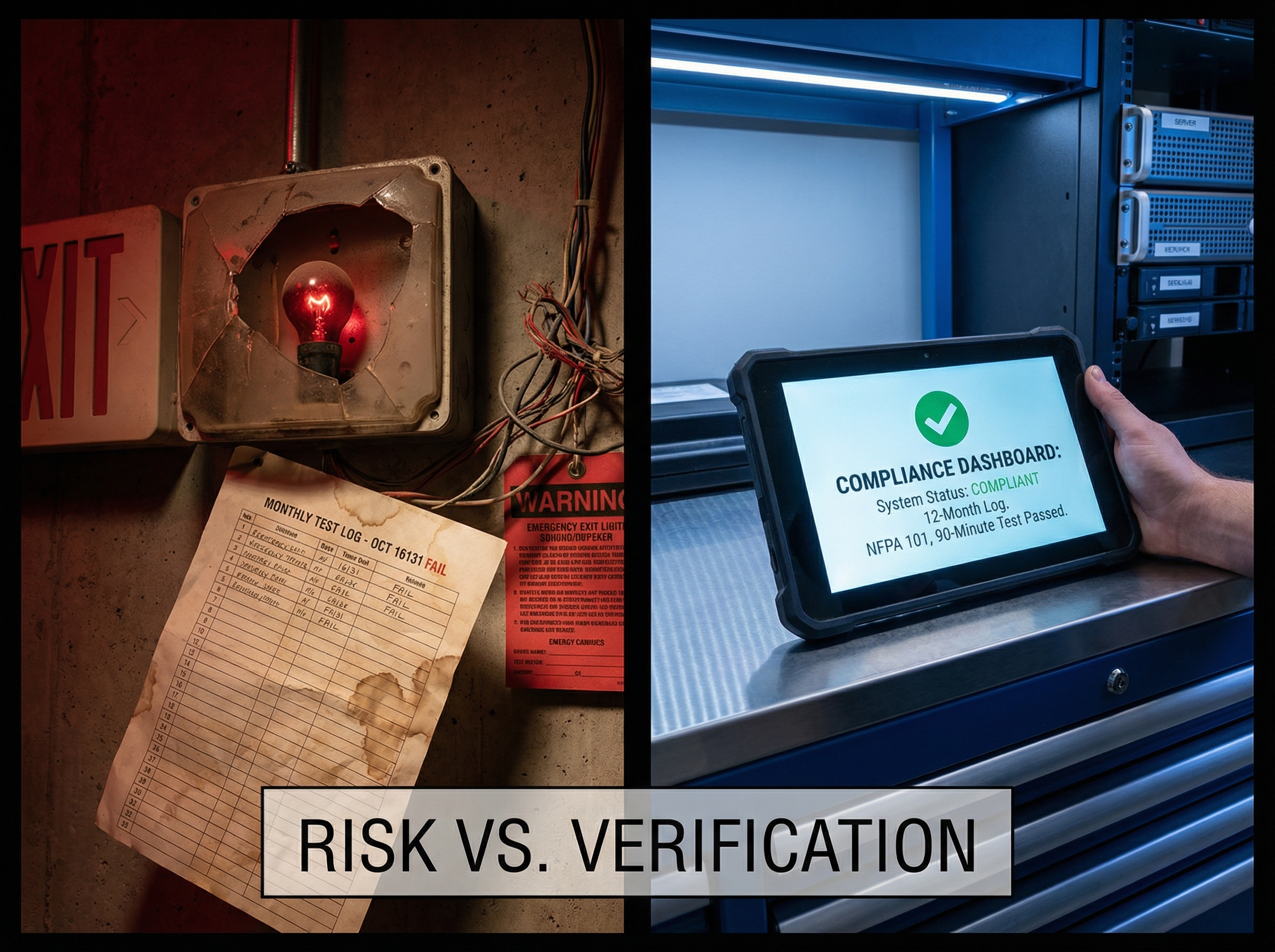
REACTIVE COMPLIANCE FAILURE PATTERN:
INADEQUATE TESTING APPROACH:
├─ Monthly testing: Inconsistent, sometimes skipped
├─ Documentation: Incomplete, difficult to retrieve
├─ Deficiency response: Delayed, corrections deferred
├─ System knowledge: Limited, status unknown
└─ Inspection preparation: Last-minute panic
INSPECTION DAY CONSEQUENCES:
├─ Fire marshal testing reveals failures (multiple units)
├─ Documentation inadequate (missing months, incomplete records)
├─ Violations cited (OSHA penalties $16,131+ per serious violation)
├─ Correction orders issued (30-60 day timeline, re-inspection required)
└─ RESULT: Non-compliance + penalties + reputation damage
“`
vs.
“`
PROACTIVE COMPLIANCE SUCCESS PATTERN:
SYSTEMATIC TESTING APPROACH:
├─ Monthly testing: Automated smart self-testing OR professional service
├─ Documentation: Complete, digital, instantly accessible
├─ Deficiency response: Immediate, corrections within 24-72 hours
├─ System knowledge: Continuous, status visible real-time
└─ Inspection preparation: Always ready, zero stress
INSPECTION DAY OUTCOME:
├─ Fire marshal verification passes (all systems functional)
├─ Documentation exemplary (complete 12-month records, professional)
├─ Zero violations (full compliance demonstrated)
├─ Commendation earned (professional maintenance recognized)
└─ RESULT: Building code compliance + professional reputation + peace of mind
“`
Building code compliance begins with systematic emergency lighting verification—the foundation preventing violations before they occur.
This article examines why comprehensive emergency lighting testing is the cornerstone of overall life safety compliance.
48Fire building code compliance services establish systematic emergency lighting verification preventing regulatory violations through proactive testing and documentation.
—
COMPLIANCE ELEMENT 1 → MONTHLY TESTING SYSTEMATIZATION
The Compliance Documentation Foundation
Monthly emergency lighting testing = First line of building code compliance defense
—
Why Monthly Testing Critical for Compliance
REGULATORY MANDATE:
“`
NFPA 101 LIFE SAFETY CODE REQUIREMENT:
“Emergency lighting shall be inspected monthly.”
COMPLIANCE INTERPRETATION:
├─ “Monthly” = Approximately 30-day intervals (12 times annually minimum)
├─ “Inspected” = Functional testing, not visual observation only
├─ “Shall” = Mandatory, not optional or suggested
└─ Non-compliance = Violation subject to citation
OSHA 29 CFR 1910.157 ALIGNMENT:
├─ References NFPA standards (adopts testing requirements)
├─ Workplace safety mandate (emergency egress protection)
├─ Enforcement authority (penalties for violations)
└─ Documentation requirement (records demonstrate compliance)
“`
Why fire marshals emphasize monthly testing:
- Demonstrates systematic maintenance culture (not reactive)
- Provides early failure detection (prevents emergency-time failures)
- Creates compliance paper trail (accountability documented)
- Indicates professional management (life safety prioritized)
—
Manual vs. Automated Testing Compliance
TWO APPROACHES TO MONTHLY VERIFICATION:
MANUAL TESTING (Traditional approach):
“`
STAFF-PERFORMED MONTHLY TESTING:
COMPLIANCE CHALLENGES:
├─ Human error: Tests sometimes forgotten (competing priorities)
├─ Documentation gaps: Handwriting illegible, months missing
├─ Quality inconsistency: Different staff, varying thoroughness
├─ Time burden: 20-40 hours annually (facility size dependent)
└─ Inspection vulnerability: Missing/incomplete records = violations
COMPLIANCE SUCCESS FACTORS (If manual chosen):
├─ Designated responsibility: Specific person accountable
├─ Backup personnel: Coverage during absence
├─ Calendar automation: Electronic reminders
├─ Checklist protocol: Systematic procedure followed
└─ Digital logs: Typed records, cloud backup
BUILDING CODE COMPLIANCE RISK: Moderate (depends on execution quality)
“`
—
SMART SELF-TESTING (Modern approach):
“`
AUTOMATED MONTHLY TESTING:
COMPLIANCE ADVANTAGES:
├─ Zero missed tests: Automatic execution, never forgotten
├─ Complete documentation: Digital records generated automatically
├─ Consistent quality: Systematic testing, no variation
├─ Time elimination: Zero staff hours (automated)
└─ Inspection confidence: Always audit-ready, complete records
COMPLIANCE ASSURANCE:
├─ Monthly requirement: Satisfied automatically (12 per year guaranteed)
├─ Documentation standard: Professional digital format
├─ Failure detection: Immediate alerts (rapid correction enabled)
├─ Historical records: Permanent cloud storage
└─ Inspection preparation: One-click report generation
BUILDING CODE COMPLIANCE RISK: Minimal (systematic automation)
“`
48Fire smart self-testing installation provides automated monthly testing ensuring building code compliance through systematic verification eliminating human error.
—
COMPLIANCE ELEMENT 2 → ANNUAL PROFESSIONAL CERTIFICATION
The Compliance Credibility Standard
Annual 90-minute testing = Professional verification building code compliance
—
Why Professional Service Essential
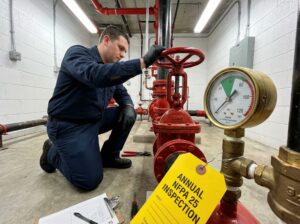
NFPA 101 ANNUAL REQUIREMENT:
“`
“Emergency lighting shall be tested annually for the
required 90-minute duration by qualified personnel.”
QUALIFIED PERSONNEL INTERPRETATION:
├─ Technical competence: Understanding electrical systems
├─ Testing equipment: Electronic load testers, voltage meters
├─ Code knowledge: NFPA 101 requirements understood
├─ Documentation capability: Professional certificates issued
└─ Liability insurance: Adequate coverage for professional services
SELF-TESTING INADEQUACY:
├─ Facility staff: Typically not “qualified” for annual testing
├─ Equipment lack: Electronic load testers not typically available
├─ Documentation: Self-certification not accepted by most AHJs
├─ Liability: Professional service providers carry insurance
└─ Fire marshal acceptance: Professional certification expected
“`
What fire marshals look for in annual certificates:
“`
COMPLIANT ANNUAL CERTIFICATION INCLUDES:
REQUIRED ELEMENTS:
☐ Professional service provider (48Fire or equivalent)
☐ Technician credentials (license number, certifications)
☐ Complete facility inventory (all units tested and listed)
☐ 90-minute duration verification (capacity confirmed)
☐ Individual unit results (pass/fail each unit documented)
☐ Deficiencies identified (specific problems noted)
☐ Corrective actions (repairs completed or scheduled)
☐ Professional signature (accountability established)
☐ Next test due date (future compliance planning)
UNACCEPTABLE ANNUAL DOCUMENTATION:
├─ Self-prepared certificates (not professional service)
├─ Missing elements (incomplete information)
├─ No credentials (unqualified personnel)
├─ Generic templates (not facility-specific)
└─ Expired certificates (>12 months old)
BUILDING CODE COMPLIANCE DETERMINATION:
Professional annual certification = Accepted
Self-certification or inadequate = Violation cited
“`
48Fire annual certification provides professional 90-minute comprehensive testing satisfying building code compliance requirements with complete documentation.
—
Annual Testing Methodology Impact
HOW TESTING QUALITY AFFECTS COMPLIANCE:
“`
INADEQUATE ANNUAL TESTING (Compliance risk):
SHORTCUTS THAT CREATE VIOLATIONS:
├─ Partial testing: Only sampling units (not comprehensive)
├─ Abbreviated duration: 30-minute test instead of 90-minute
├─ Visual-only assessment: No actual discharge testing
├─ Generic documentation: Template certificate without specifics
└─ Unresolved deficiencies: Problems noted but not corrected
FIRE MARSHAL RESPONSE:
├─ Inadequate testing = No valid certification
├─ Violations cited = Building code compliance failed
├─ Re-testing ordered = Professional comprehensive testing required
└─ Timeline pressure = 30-60 days typical correction deadline
“`
vs.
“`
COMPREHENSIVE ANNUAL TESTING (Building code compliance):
48FIRE PROFESSIONAL METHODOLOGY:
├─ Complete testing: Every single unit tested (100% coverage)
├─ Full 90-minute duration: Actual capacity verified under load
├─ Electronic load testing: Battery capacity measured precisely
├─ Charging circuit verification: Float voltage adjusted to spec
├─ Immediate corrections: Failed units repaired/replaced same visit
├─ Professional documentation: Complete certificate with all elements
└─ Follow-up service: Re-testing if corrections required additional visit
FIRE MARSHAL ACCEPTANCE:
├─ Comprehensive testing = Valid certification recognized
├─ Complete documentation = Building code compliance demonstrated
├─ Zero violations = Inspection passes smoothly
└─ Professional reputation = Facility management respected
“`
—
COMPLIANCE ELEMENT 3 → IMMEDIATE DEFICIENCY CORRECTION
The Compliance Continuity Requirement
Identifying problems = Only half the compliance equation; correction completes it
—
NFPA “Immediate” Correction Mandate
REGULATORY LANGUAGE:
“`
NFPA 101 PROVISION:
“Defective equipment shall be replaced or repaired immediately.”
COMPLIANCE INTERPRETATION:
├─ “Immediately” = Days to weeks, not months or years
├─ Not deferred until budget cycle: Correction cannot wait
├─ Not postponed for convenience: Priority over other projects
├─ Temporary measures acceptable: If permanent correction requires time
└─ Documentation essential: Correction timeline and completion recorded
FIRE MARSHAL ENFORCEMENT:
├─ Open deficiencies = Active violations (building code compliance failed)
├─ Correction timeline questioned: “When will this be fixed?”
├─ Follow-up inspections: Verify corrections completed
└─ Compliance restored: Only when deficiencies resolved
“`
—
Deficiency Response Protocol
SYSTEMATIC CORRECTION APPROACH:
“`
48FIRE DEFICIENCY MANAGEMENT:
PRIORITY-BASED RESPONSE:
CRITICAL (24-48 hours):
├─ Non-functional emergency lighting (no illumination)
├─ Multiple unit failures (system reliability compromised)
├─ Life safety hazards (falling fixtures, exposed wiring)
└─ Imminent inspections (fire marshal visit scheduled)
48Fire emergency service: Same-day or next-day response
Temporary measures: Portable battery units if permanent correction delayed
Result: Building code compliance exposure minimized
HIGH PRIORITY (3-7 days):
├─ Significantly dim units (inadequate brightness)
├─ Battery failures (won’t hold 90-minute duration)
├─ Physical damage affecting function (cracked housing, moisture)
└─ Charging circuit failures (batteries not charging properly)
48Fire priority service: Within one week scheduling
Correction execution: Permanent repairs/replacements
Result: Building code compliance restored promptly
MODERATE PRIORITY (2-4 weeks):
├─ Marginal performance (barely passing tests)
├─ Cosmetic damage (not affecting function yet)
├─ Proactive replacements (aging components)
└─ System optimization (coverage enhancements)
48Fire scheduled service: Routine maintenance cycle
Correction coordination: Efficient batch work
Result: Continuous building code compliance maintained
“`
Why immediate correction critical for compliance:
- Unresolved deficiencies = Ongoing violations (not corrected by identifying them)
- Fire marshal scrutiny = Open issues cited at inspections
- Liability exposure = Known problems create negligence claims
- Compliance culture = Prompt corrections demonstrate professional management
48Fire immediate deficiency response ensures building code compliance through rapid correction preventing violation accumulation.
—
COMPLIANCE ELEMENT 4 → COMPREHENSIVE DOCUMENTATION
The Compliance Evidence Standard
Documentation = Proof compliance exists, not just claims
—
What Constitutes Adequate Documentation
FIRE MARSHAL EXPECTATIONS:
“`
COMPLIANT EMERGENCY LIGHTING FILE:
MONTHLY TEST LOGS (12 months):
☐ Every month present (January-December, no gaps)
☐ Each test dated (specific dates, not just “monthly”)
☐ Inspector identified (name or initials, accountability)
☐ All units tested (complete facility, not sampling)
☐ Results recorded (pass/fail each unit)
☐ Deficiencies noted (specific problems identified)
☐ Corrections documented (repairs performed, dates recorded)
ANNUAL TEST CERTIFICATES (Current + historical):
☐ Current year certificate (within last 12 months)
☐ Previous years retained (3-5 years minimum, permanent recommended)
☐ Professional service provider (48Fire or equivalent)
☐ Complete inventory (all units tested)
☐ 90-minute verification (duration requirement met)
☐ Technician credentials (qualified personnel documented)
SERVICE PROVIDER CREDENTIALS:
☐ Business license (current)
☐ Liability insurance (adequate coverage)
☐ Technician certifications (if required locally)
☐ Service agreement (ongoing maintenance documented)
BUILDING CODE COMPLIANCE DETERMINATION:
Complete documentation = Compliance demonstrated
Missing/incomplete documentation = Violation cited (even if equipment functional)
“`
Documentation reality:
Fire marshals enforce compliance through documentation review MORE than physical testing. Excellent equipment but poor records = violations cited.
—
Digital vs. Paper Documentation
COMPLIANCE DOCUMENTATION FORMATS:
“`
PAPER DOCUMENTATION (Traditional):
COMPLIANCE CHALLENGES:
├─ Storage burden: Physical files, space required
├─ Organization difficulty: Chronological filing, retrieval slow
├─ Loss risk: Misfiled, damaged, discarded accidentally
├─ Inspection stress: Searching files takes time (15-20 minutes typical)
└─ Legibility issues: Handwritten logs difficult to read
ACCEPTABLE IF:
├─ Complete: All months present
├─ Legible: Readable by inspector
├─ Organized: Easy retrieval
└─ Accessible: Available during inspection
BUILDING CODE COMPLIANCE RISK: Moderate (depends on organization)
“`
vs.
“`
DIGITAL DOCUMENTATION (Modern):
COMPLIANCE ADVANTAGES:
├─ Instant retrieval: One-click report generation (30 seconds)
├─ Complete records: Cloud storage, never lost
├─ Professional presentation: Standardized format
├─ Inspection confidence: Always immediately accessible
└─ Historical access: Years of records available instantly
48FIRE DIGITAL PLATFORM:
├─ Automatic generation: Smart self-testing creates records
├─ Centralized storage: All documentation one location
├─ Remote access: Available anywhere, any device
├─ Backup security: Cloud redundancy
└─ Compliance dashboard: Status visible continuously
BUILDING CODE COMPLIANCE RISK: Minimal (systematic organization)
“`
48Fire digital documentation platform provides instant building code compliance verification through professionally organized centralized records.
—
COMPLIANCE ELEMENT 5 → PROACTIVE SYSTEM MONITORING
The Compliance Prevention Strategy
Best compliance approach = Preventing failures before they become violations
—
Real-Time Failure Detection
SMART SELF-TESTING ADVANTAGE:
“`
TRADITIONAL APPROACH (Monthly testing only):
FAILURE TIMELINE:
Day 1: Battery/unit fails
Days 2-29: Failure undetected (between monthly tests)
Day 30: Monthly test reveals failure
Day 32: Correction scheduled
Day 35: Repair performed
BUILDING CODE COMPLIANCE EXPOSURE: 35 days non-compliant
INSPECTION RISK: If fire marshal visits during 35-day window = violation
vs.
SMART SELF-TESTING APPROACH (Nightly monitoring):
FAILURE TIMELINE:
Day 1: Battery/unit fails
Day 2: Automated test detects failure (overnight test)
Day 2: Immediate alert sent (email/SMS to facilities staff)
Day 3: 48Fire service scheduled
Day 4: Correction performed
BUILDING CODE COMPLIANCE EXPOSURE: 4 days non-compliant
INSPECTION RISK: 89% reduced exposure window = much lower violation probability
IMPROVEMENT: 89% faster failure detection and correction
“`
—
Predictive Maintenance Integration
PREVENTING FAILURES BEFORE THEY OCCUR:
“`
48FIRE PROACTIVE MONITORING:
BATTERY LIFECYCLE TRACKING:
├─ Installation dates recorded (all units)
├─ Expected lifespan calculated (lead-acid 4 years, etc.)
├─ Replacement scheduling automatic (Year 4 proactive replacement)
├─ Prevents: Test-day battery failures (replaced before degradation critical)
└─ Building code compliance: Maintained continuously (no surprise failures)
CAPACITY TRENDING:
├─ Annual test data tracked (90-minute duration performance over time)
├─ Degradation identified early (capacity declining gradually)
├─ Proactive replacement triggered (before failure occurs)
├─ Prevents: Emergency service calls (planned replacement efficient)
└─ Building code compliance: Never interrupted (always functional)
PERFORMANCE ANALYTICS:
├─ Failure patterns analyzed (identify systemic issues)
├─ Environmental factors assessed (temperature, moisture impact)
├─ Optimization opportunities identified (coverage enhancement)
├─ Continuous improvement: System reliability increases over time
└─ Building code compliance: Enhanced beyond minimum (excellence culture)
“`
48Fire proactive monitoring prevents building code compliance violations through predictive maintenance addressing issues before failures occur.
—
BUILDING CODE COMPLIANCE INSPECTION READINESS
The Ultimate Compliance Test
Fire marshal inspection = Compliance verification under scrutiny
—
Pre-Inspection Preparation Checklist
48FIRE INSPECTION READINESS PROTOCOL:
“`
30 DAYS BEFORE INSPECTION:
☐ Comprehensive system testing (all units verified functional)
☐ Deficiency identification and correction (problems resolved)
☐ Documentation review (12-month completeness verified)
☐ Annual certificate current (within last 12 months)
☐ Service provider credentials updated (48Fire documentation current)
☐ Digital platform verified operational (instant retrieval ready)
7 DAYS BEFORE INSPECTION:
☐ Final system walk-through (physical condition assessed)
☐ Sample random testing (spot-check functionality)
☐ Documentation organized (laptop/folder prepared)
☐ Building contact designated (inspection coordinator identified)
☐ Access arrangements confirmed (keys, building access)
☐ Courtesy notification (if inspection date known)
INSPECTION DAY:
☐ Documentation immediately accessible (30-second retrieval)
☐ Professional presentation (organized, confident)
☐ Respectful cooperation (inspector requests accommodated)
☐ Notes documented (inspector comments recorded)
☐ Follow-up confirmed (if any minor items identified)
☐ Certificate obtained (successful building code compliance verified)
RESULT: Clean inspection, zero violations, professional commendation
“`
—
Common Inspection Violations Prevented
HOW BETTER LIGHTING CHECKS PREVENT CITATIONS:
“`
TYPICAL VIOLATIONS CITED (Without systematic testing):
1. INADEQUATE MONTHLY DOCUMENTATION (Most common):
├─ Missing months: 3-6 months no records
├─ Incomplete logs: Some units tested, others omitted
├─ No inspector identification: Accountability unclear
└─ PREVENTED BY: 48Fire automated monthly testing (complete, systematic)
2. EXPIRED ANNUAL CERTIFICATION:
├─ Certificate >12 months old: Annual test overdue
├─ Self-prepared documentation: Not professional service
├─ Incomplete information: Missing required elements
└─ PREVENTED BY: 48Fire annual professional certification (always current)
3. UNRESOLVED DEFICIENCIES:
├─ Failed units not repaired: Open problems from previous tests
├─ Corrections deferred: Budget/convenience prioritized over safety
├─ No correction timeline: When will this be fixed?
└─ PREVENTED BY: 48Fire immediate deficiency response (rapid correction)
4. NON-FUNCTIONAL EQUIPMENT:
├─ Random sampling reveals failures: Multiple units dead
├─ Battery exhaustion: No 90-minute capacity
├─ Systematic neglect: Overall system unreliable
└─ PREVENTED BY: 48Fire proactive maintenance (replacement before failure)
5. INADEQUATE DOCUMENTATION ORGANIZATION:
├─ Records difficult to retrieve: 15-20 minute search
├─ Paper files disorganized: Incomplete, scattered
├─ Inspector frustration: Inefficient inspection process
└─ PREVENTED BY: 48Fire digital platform (instant 30-second retrieval)
“`
—
CONCLUSION
Building Code Compliance Through Systematic Emergency Lighting Verification
Five compliance elements preventing violations:
Element 1: Monthly Testing Systematization
- Manual approach: Requires designated responsibility, calendar automation, digital logs
- Automated approach: Smart self-testing eliminates human error (zero missed tests)
- Compliance risk: Manual moderate, automated minimal
- 48Fire recommendation: Smart self-testing for absolute reliability
Element 2: Annual Professional Certification
- Professional service essential (facility staff typically not “qualified personnel”)
- Comprehensive 90-minute testing required (not abbreviated or partial)
- Complete documentation mandatory (all NFPA 101 certificate elements)
- 48Fire annual certification: Satisfies all building code compliance requirements
Element 3: Immediate Deficiency Correction
- NFPA mandate: “Immediately” = days to weeks, not months
- Priority-based response: Critical 24-48 hours, high 3-7 days, moderate 2-4 weeks
- Unresolved deficiencies: Ongoing violations even if identified
- 48Fire deficiency management: Rapid correction maintaining compliance continuously
Element 4: Comprehensive Documentation
- Monthly logs: 12 months complete, no gaps, all units tested
- Annual certificates: Professional, current year + historical retention
- Service provider credentials: Current license, insurance, certifications
- 48Fire digital platform: Instant retrieval (30 seconds vs. 15-20 minutes paper)
Element 5: Proactive System Monitoring
- Real-time failure detection: Smart self-testing 89% faster (4 days vs. 35 days)
- Battery lifecycle tracking: Proactive Year 4 replacement preventing failures
- Capacity trending: Performance analytics identifying degradation early
- 48Fire predictive maintenance: Prevents violations before they occur
Why compliance starts with better lighting checks:
- Foundation prevents violations (not reactive scrambling after citations)
- Documentation proves compliance (equipment + records both required)
- Systematic approach: Creates professional culture (not crisis management)
- Inspection confidence: Always ready (not last-minute preparation panic)
- Liability protection: Due diligence demonstrated (negligence defense)
Compliance transformation:
“`
FROM: Reactive, inadequate, violation-prone
TO: Proactive, systematic, compliance-confident
THROUGH: Better emergency lighting checks + comprehensive documentation
“`
48Fire building code compliance services establish systematic emergency lighting verification through smart self-testing automation eliminating missed monthly tests, professional annual 90-minute certification satisfying NFPA 101 qualified personnel requirement, immediate deficiency response ensuring rapid correction maintaining continuous compliance, digital documentation platform providing instant inspection-ready records, proactive monitoring and battery lifecycle management preventing failures before violations occur, pre-inspection preparation protocols guaranteeing readiness, and ongoing maintenance service agreements maintaining sustained building code compliance—transforming emergency lighting from potential violation source to compliance confidence foundation protecting facilities from regulatory citations, liability exposure, and professional reputation damage.
[Establish Building Code Compliance Confidence](/contact-us)
—
48Fire
Building Code Compliance Services
Systematic Testing • Professional Certification • Complete Documentation
Contact: [/contact-us](/contact-us)