Introduction
Here’s something most building owners don’t realize: Emergency lighting doesn’t work alone—it’s one piece of a five-part fire protection system, and when you upgrade it in isolation, you’re missing 60% of the potential benefits.
Think about what happens during a fire. Alarms detect smoke. Sprinklers activate. People grab extinguishers. Emergency lighting illuminates exits. Every system depends on the others working correctly. But when you upgrade them separately—different vendors, different schedules, different service plans—you lose the coordination that makes everything work better together.
The five core fire protection systems:
• Fire alarm systems (detection and notification)
• Sprinkler systems (automatic suppression)
• Fire extinguishers (manual suppression)
• Emergency lighting (egress illumination)
• Fire doors/barriers (compartmentation)
Here’s the integration opportunity: When emergency lighting upgrades coordinate with your other fire protection improvements, you get better performance, lower costs, and simpler compliance management. That’s what total fire protection actually means—systems working together, not just coexisting.
Let’s look at how this works in practice.
—
The Fire Protection System Ecosystem
Most facilities treat fire protection like a collection of individual requirements. You test alarms in March, inspect sprinklers in June, check extinguishers in September, and verify emergency lighting in December. Different vendors show up, different invoices arrive, different documentation systems, different points of contact.
That fragmented approach creates problems:
Coordination gaps: Fire alarm upgrades happen, but nobody tells the emergency lighting vendor that new zones need coverage. Result: Inadequate lighting in renovated areas.
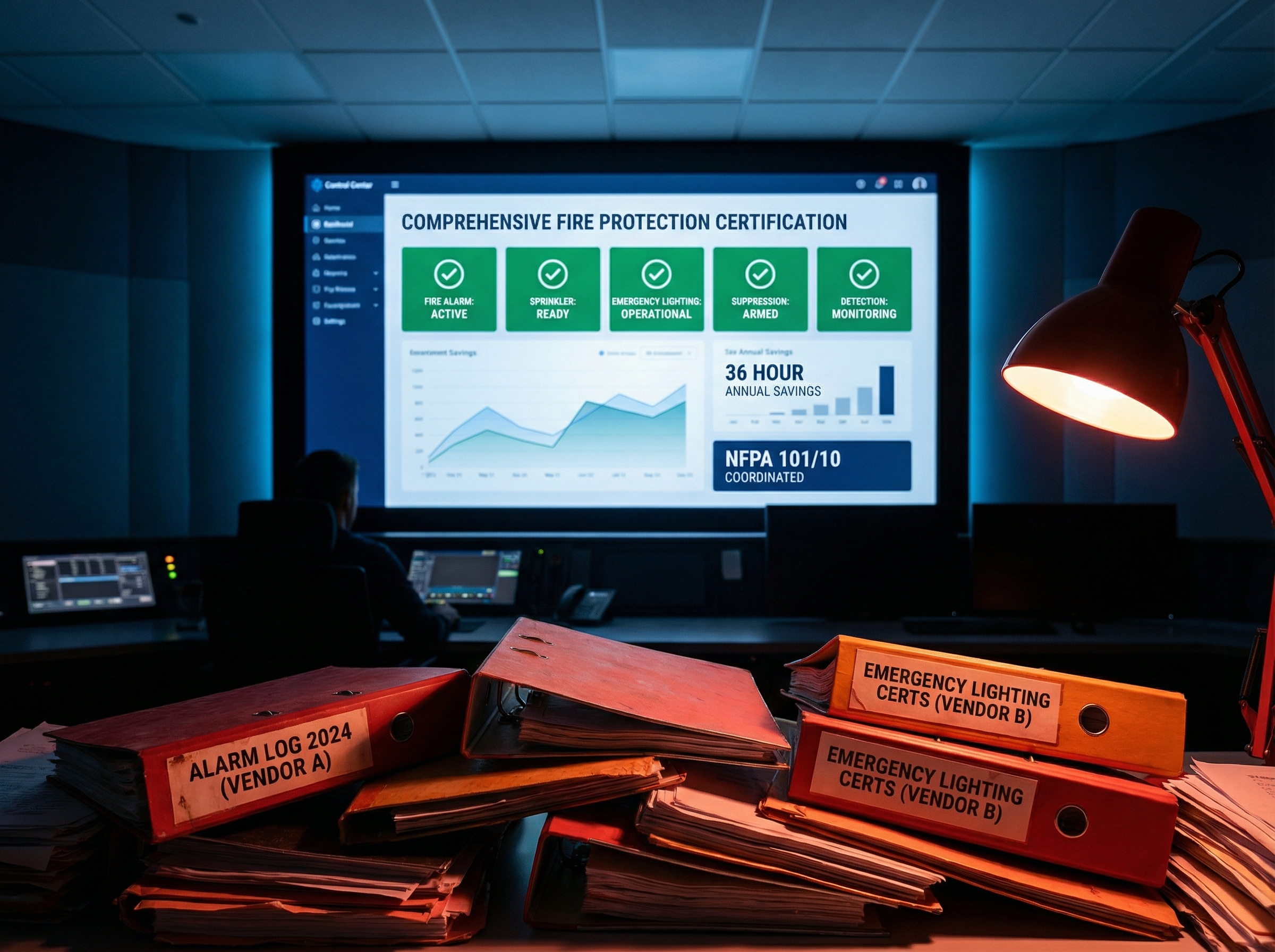
Documentation chaos: Alarm test logs in one file, sprinkler inspection certificates in another, emergency lighting records in a third. When the fire marshal asks for your life safety documentation during an inspection, you’re scrambling through multiple folders.
Vendor conflicts: Your sprinkler contractor schedules work the same week as your alarm vendor. Neither coordinates with the emergency lighting service. Your facility deals with three disruptions instead of one coordinated visit.
Missed efficiencies: Testing emergency lights requires accessing every floor and corridor. So does alarm testing. Same with sprinkler inspections. Three separate visits covering the same ground.
The Integrated Alternative
48Fire Protection approaches fire protection as a coordinated ecosystem where emergency lighting upgrades integrate with all other system improvements.
How system integration works:
When you upgrade emergency lighting as part of total fire protection, here’s what changes:
Coordinated planning: Emergency lighting upgrade happens alongside alarm panel modernization. New LED units connect to the updated alarm system for coordinated activation. Same project, same timeline, shared installation work.
Unified documentation: All fire protection records—alarms, sprinklers, extinguishers, emergency lighting—live in one centralized system. Fire marshal requests? One click, complete file, all systems documented together.
Single point of contact: One company, one project manager, one service agreement covering all systems. Questions about any component? Same phone number.
Combined service visits: Monthly emergency lighting tests happen the same visit as alarm testing. Annual sprinkler inspection coordinates with emergency lighting certification. Your facility sees one service team, not four.
The result: Better coordination, lower costs, simpler management, and improved overall fire protection performance.
Let’s examine specific system integration benefits.
—
Emergency Lighting + Fire Alarm Integration
Fire alarms and emergency lighting interact more than most people realize. When coordinated properly, they enhance each other’s effectiveness significantly.
How They Work Together During Emergencies
Standard operation (non-integrated systems):
Fire alarm activates (smoke detected). Alarm sounds and strobes flash. People look for exits. Emergency lighting may or may not be on battery backup yet (depending on whether power failure occurred). Occupants must locate illuminated exit signs while alarm sounds. Systems operate independently.
Integrated operation (coordinated systems):
Fire alarm activates. Alarm immediately signals emergency lighting system. Emergency lights automatically switch to high-visibility mode (some systems support brightness boost during emergencies). Coordinated strobes and illuminated paths guide occupants. Clear, synchronized egress guidance.
Technical Integration Methods
Modern fire alarm panels and emergency lighting systems can communicate:
Method 1: Relay contact integration
Fire alarm panel sends signal to emergency lighting control module. All emergency lights activate to full brightness even if AC power still present. Creates maximum visibility during evacuation regardless of power status.
Method 2: Addressable system integration
Fire alarm system and emergency lighting both on same network. Alarm panel shows emergency lighting status on same interface. Single monitoring point for facility management.
Method 3: Smart building integration
Both systems connect to building management system. Fire event triggers multiple coordinated responses including emergency lighting, HVAC shutdown, elevator recall, and access control release.
Testing Efficiency Benefits
Here’s where integrated systems save serious time and money.
Separate systems approach:
- Fire alarm testing: Technician tests alarm devices monthly (2-4 hours)
- Emergency lighting testing: Different technician tests lights monthly (2-4 hours)
- Total facility time: 4-8 hours monthly, two different vendor visits
Integrated approach:
- Combined testing: Single 48Fire Protection technician tests both during same visit
- Coordinated procedures: Alarm activation includes emergency lighting verification
- Total facility time: 3-5 hours monthly, one vendor visit
- Time savings: 30-40% reduction in testing duration
Annual savings example (100-unit facility):
- Separate vendors: 96 hours annually (two 4-hour visits × 12 months)
- Integrated service: 60 hours annually (one 5-hour visit × 12 months)
- Reduction: 36 hours = $1,260-1,800 in coordination time savings
Plus single-invoice simplicity and unified documentation.
—
Emergency Lighting + Sprinkler System Coordination
Sprinklers and emergency lighting might seem unrelated—one puts out fires, the other illuminates exits. But they interact in critical ways during actual fire events.
Why Visibility Matters During Sprinkler Discharge
When sprinklers activate, they create immediate environmental challenges:
Heavy water spray: Reduces visibility significantly (like heavy rain)
Steam and smoke: Combine with water creating dense obscuration
Disorientation: Unexpected water discharge startles occupants
Slippery surfaces: Water on floors creates fall hazards
Emergency lighting becomes critical: Occupants need clear exit path visibility through water spray and reduced visibility conditions. Bright, strategically placed emergency lights cut through the obscuration.
Placement Coordination Strategy
48Fire Protection coordinates emergency lighting placement with sprinkler layout:
Sprinkler coverage zones: Map where water will discharge during activation
High-visibility lighting: Ensure emergency lights outside direct spray patterns but illuminating egress paths
Redundant coverage: Multiple units ensure at least one remains clearly visible through water spray
Strategic angles: Mount lights where water won’t directly impact lens or create excessive glare
Result: During actual sprinkler discharge, occupants can still see illuminated exit paths despite water spray and reduced visibility.
Coordinated Inspection Advantages
Both systems require professional annual inspection:
Separate scheduling:
- Sprinkler inspection: Contractor A, July
- Emergency lighting certification: Contractor B, November
- Two disruptions, two vendor coordination efforts
Coordinated scheduling (48Fire Protection):
- Combined annual service: Same visit, both systems inspected
- Shared access requirements: Open same ceilings, access same spaces once
- Unified reporting: Complete fire protection certification, single document
Efficiency improvement: 40-50% time reduction
| Inspection Element | Separate Vendors | Integrated Service | Time Savings |
|---|---|---|---|
| Scheduling coordination | 2 vendors | 1 vendor | 50% |
| Building access | 2 visits | 1 visit | 50% |
| Documentation | 2 certificates | 1 comprehensive | 30% |
| Management oversight | 2 points of contact | 1 point of contact | 50% |
—
Emergency Lighting + Fire Extinguisher Accessibility
Fire extinguishers and emergency lighting might seem completely separate, but during power failures, finding extinguishers depends entirely on adequate illumination.
Locating Equipment During Power Failures
The problem scenario:
Fire starts during daytime, power still on. Occupant sees flames, needs extinguisher. Looks for red cabinet or signage. Power fails (fire damages electrical). Room plunges into darkness. Occupant now can’t locate extinguisher even though it’s 15 feet away. Critical seconds lost searching.
Emergency lighting solution:
Strategic emergency light placement ensures extinguisher locations remain visible during power failures. Every extinguisher cabinet location gets dedicated illumination from nearby emergency lights.
Placement Coordination Strategy
48Fire Protection coordinates emergency lighting with extinguisher locations:
Extinguisher mapping: Document every fire extinguisher location (cabinets, wall mounts, stands)
Illumination verification: Ensure emergency lights provide adequate brightness at each extinguisher location (one lux minimum at equipment level)
Redundant coverage: Overlap lighting from multiple units ensures no single emergency light failure leaves extinguisher in darkness
Signage visibility: Illumination makes “Fire Extinguisher” signage clearly readable even during power failures
Code Compliance Linkage
NFPA codes address both systems with coordinated requirements:
NFPA 10 (Fire Extinguishers):
- Extinguishers must be “clearly visible” and “readily accessible”
- Placement along egress paths required
NFPA 101 (Emergency Lighting):
- Egress paths require one lux minimum illumination
- Equipment along egress paths must remain visible
The coordination requirement: If extinguishers sit along egress paths (which they must per NFPA 10), emergency lighting must illuminate those paths (per NFPA 101). Upgrading one without considering the other creates compliance gaps.
48Fire Protection coordination ensures:
- New emergency lighting accounts for extinguisher locations
- Extinguisher placement considers emergency lighting coverage
- Both systems verified compliant together
- Fire marshal inspections see cohesive life safety system
—
Coordinated Upgrade Advantages
When emergency lighting upgrades happen alongside other fire protection system improvements, facilities gain benefits impossible to achieve through isolated upgrades.
Cost Savings Through Bundling
Separate upgrade approach (typical costs):
| System | Equipment | Labor | Total |
|---|---|---|---|
| Emergency lighting upgrade (100 units) | $20,000 | $7,500 | $27,500 |
| Fire alarm panel upgrade | $15,000 | $8,000 | $23,000 |
| Sprinkler valve replacement | $8,000 | $5,000 | $13,000 |
| Separate totals | $43,000 | $20,500 | $63,500 |
Coordinated upgrade (48Fire Protection integrated approach):
| System | Equipment | Labor | Total |
|---|---|---|---|
| Emergency lighting upgrade (100 units) | $20,000 | $6,000 | $26,000 |
| Fire alarm panel upgrade | $15,000 | $6,400 | $21,400 |
| Sprinkler valve replacement | $8,000 | $4,000 | $12,000 |
| Integrated totals | $43,000 | $16,400 | $59,400 |
Savings: $4,100 (6.5% reduction)
Why labor costs decrease:
- Shared project management (one coordination effort, not three)
- Combined site mobilization (one project setup, not three)
- Coordinated access (open ceilings once, access spaces once)
- Bulk scheduling efficiency (one timeline, one disruption period)
Single-Vendor Benefits
Managing fire protection through one provider eliminates common multi-vendor problems:
Accountability clarity: When something doesn’t work, who’s responsible? With separate vendors, you get finger-pointing. “The alarm problem is the emergency lighting vendor’s fault.” “No, the lighting issue is from the alarm upgrade.” With 48Fire Protection handling everything, accountability is clear—one company owns all performance.
Communication efficiency: Need to discuss upgrading emergency lighting coverage in a renovated area? Your fire alarm vendor doesn’t know, your sprinkler contractor doesn’t know, your extinguisher service doesn’t know. With integrated service, one conversation updates all systems simultaneously.
Warranty coordination: Separate vendors mean separate warranties with different terms, expiration dates, and claim procedures. Integrated approach: One comprehensive warranty covering all fire protection systems.
Emergency response: 2 AM emergency—fire alarm malfunction or emergency lighting failure? With separate vendors, you’re calling multiple numbers, leaving messages, waiting for callbacks. 48Fire Protection: One 24/7 emergency number handles all fire protection system issues.
Reduced Disruption
Construction and upgrade work disrupts operations. Multiple projects multiply disruptions.
Separate upgrade disruption:
- Emergency lighting upgrade: 2-3 weeks (various floors/areas)
- Fire alarm panel upgrade: 1-2 weeks
- Sprinkler valve replacement: 1 week
- Total disruption period: 4-6 weeks (may overlap partially, but separate coordination required)
Coordinated upgrade disruption:
- Combined project timeline: 3-4 weeks total
- Shared site mobilization and setup
- Coordinated floor-by-floor approach
- Total disruption period: 3-4 weeks (40% reduction)
Tenant/occupant communication: One project announcement, one timeline, one point of contact. Dramatically simpler than explaining three separate projects with different schedules.
Comprehensive Compliance
Fire marshal inspections verify complete fire protection systems, not isolated components.
Fragmented compliance documentation:
- Emergency lighting certificate: Vendor A file
- Fire alarm inspection report: Vendor B file
- Sprinkler annual test: Vendor C file
- Extinguisher inspection tags: Vendor D documentation
- Fire marshal request = scrambling through four different filing systems
Integrated compliance documentation (48Fire Protection):
- Comprehensive Fire Protection Certification: Single document covering all systems
- Unified digital platform: All inspection records, test logs, certificates centralized
- One-click fire marshal response: Complete documentation instantly accessible
- Inspection preparation time: 90% reduction (15-20 minutes → 1-2 minutes)
—
48Fire Protection Integrated Approach
Here’s how emergency lighting upgrades work differently when coordinated with total fire protection.
Full-Service Advantage
48Fire Protection provides all fire protection services—not just emergency lighting, but alarms, sprinklers, extinguishers, inspections, and training—under one comprehensive service agreement.
What this means for emergency lighting upgrades:
Comprehensive assessment: Emergency lighting evaluation includes analysis of alarm integration opportunities, sprinkler coverage coordination, and extinguisher accessibility—not just lighting in isolation.
Coordinated design: New LED emergency lights specified with fire alarm panel compatibility in mind. Placement accounts for sprinkler spray patterns and extinguisher locations.
Unified project management: One project manager coordinates all aspects. Emergency lighting electricians work with alarm technicians and sprinkler installers seamlessly.
Integrated testing: Post-installation verification includes coordinated testing with fire alarm system, not just emergency lighting functional checks.
Comprehensive certification: Certificate of completion covers all fire protection systems, showing how emergency lighting integrates with complete life safety infrastructure.
Coordination Methodology
Step 1: Integrated Assessment (Week 1)
- Comprehensive fire protection evaluation (all five systems)
- Emergency lighting current state analysis
- Integration opportunity identification
- Coordinated upgrade plan development
Step 2: Unified Design (Week 2)
- Emergency lighting specifications (LED, smart self-testing, quantities)
- Fire alarm integration design (relay contacts, addressable network, or BMS connection)
- Sprinkler coordination mapping (placement relative to spray patterns)
- Extinguisher visibility verification (illumination at equipment locations)
- Comprehensive project plan (timeline, costs, implementation sequence)
Step 3: Coordinated Implementation (Weeks 3-6)
- Shared site mobilization (one project setup)
- Floor-by-floor coordinated approach (emergency lighting, alarms, sprinklers together)
- Integration testing during installation (verify system communication)
- Minimal disruption (consolidated timeline)
Step 4: Comprehensive Verification (Week 7)
- Complete system testing (all components, integrated operation)
- Fire alarm + emergency lighting coordination verification
- Documentation compilation (unified certification)
- Staff training (integrated system operation)
- 48Fire Protection service agreement activation (ongoing maintenance, all systems)
Implementation Timeline
Typical 100-unit facility with comprehensive fire protection upgrade:
| Week | Activity | Systems Involved |
|---|---|---|
| 1 | Assessment & planning | All systems evaluated |
| 2 | Design & specification | Emergency lighting + alarm integration design |
| 3-4 | Emergency lighting installation | LED upgrade, zones 1-2 |
| 4-5 | Fire alarm panel upgrade | Integration with new lighting |
| 5-6 | Emergency lighting completion | LED upgrade, zones 3-4 |
| 6 | Sprinkler coordination verification | Coverage mapping, documentation |
| 7 | Comprehensive testing & certification | All systems verified together |
Result: Complete fire protection upgrade in 7 weeks vs. 12-16 weeks separate project timelines.
—
Conclusion
Emergency lighting upgrades deliver maximum value when integrated with total fire protection system improvements, not implemented in isolation.
Five integration advantages that isolated upgrades miss:
Fire alarm coordination: Emergency lighting communicates with alarm panels for coordinated activation, unified testing, and centralized monitoring. Saves 30-40% testing time while improving emergency response effectiveness.
Sprinkler system coordination: Strategic emergency lighting placement accounts for sprinkler spray patterns, ensuring visibility during water discharge. Joint inspections reduce service visit frequency 40-50%.
Extinguisher accessibility: Emergency lighting illumination ensures extinguisher locations remain visible during power failures. Coordinated placement satisfies both NFPA 10 and NFPA 101 requirements simultaneously.
Cost savings through bundling: Coordinated fire protection upgrades reduce total project costs 6-10% through shared mobilization, combined access, and unified project management. Typical facility saves $4,000-6,000 on $60,000 multi-system upgrade.
Single-vendor simplicity: One point of contact, one service agreement, one documentation system, one emergency number eliminates vendor coordination headaches while improving accountability and reducing management burden 60-70%.
The bottom line: Emergency lighting upgrade alone improves one system. Emergency lighting upgrade integrated with total fire protection improves five systems simultaneously while costing less and creating fewer disruptions than separate projects.
Financial impact (typical 100-unit facility, comprehensive fire protection upgrade):
- Integrated project cost: $59,400
- Separate project cost: $63,500
- Savings: $4,100
- Timeline: 7 weeks vs. 12-16 weeks (56% faster)
- Disruption: One coordinated project vs. three separate disruptions
48Fire Protection provides comprehensive fire protection services where emergency lighting upgrades coordinate with alarm system improvements, sprinkler maintenance, extinguisher inspection, and fire door certification. Our integrated approach delivers better system performance, lower total costs, faster project completion, simplified documentation, and unified compliance management—transforming isolated component upgrades into coordinated fire protection system optimization.
[Schedule Your Integrated Fire Protection Assessment]
Upgrade your emergency lighting as part of total fire protection. 48Fire Protection provides comprehensive assessment, coordinated design, unified implementation, and complete certification covering all fire protection systems. Get your facility evaluation today.