The Maintenance Plan That Keeps Lights Ready 24/7

The Maintenance Plan That Keeps Lights Ready 24/7

WHY DO EMERGENCY EGRESS LIGHTING SYSTEMS FAIL WHEN NEEDED MOST?

Answer: Inadequate maintenance creates invisible failures.

Emergency egress lighting appears operational until power fails. Monthly and annual testing reveals hidden problems before emergencies expose them.

The critical question: How do you maintain 24/7 readiness when testing itself creates vulnerability?

WHAT EXACTLY MUST EMERGENCY EGRESS LIGHTING ACCOMPLISH?

The 90-Minute Mandate

Required performance per NFPA 101 Life Safety Code:

“`
Power Failure Occurs

Emergency egress lighting activates AUTOMATICALLY

Provides ONE LUX minimum illumination

Along CENTER LINE of escape routes

At FLOOR LEVEL

For MINIMUM 90 MINUTES

Enabling complete building evacuation
“`

What happens in 90 minutes:

  • All occupants evacuate safely
  • Fire department responds and establishes operations
  • Emergency personnel complete search and rescue
  • Building secured

Without functional emergency egress lighting:

  • Occupants disoriented in darkness
  • Evacuation delayed or blocked
  • Panic increases injury risk
  • Rescue operations complicated

Critical understanding: Systems must work for full 90-minute duration when called upon. Testing verifies this capability.

WHO IS RESPONSIBLE FOR EMERGENCY EGRESS LIGHTING MAINTENANCE?

The Accountability Chain

PRIMARY RESPONSIBILITY:

Building manager or property owner (the “responsible person” under BS 5266)

Specific obligations:
□ Establish appropriate emergency egress lighting systems
□ Ensure monthly testing occurs
□ Coordinate annual professional inspections
□ Maintain emergency lighting file
□ Document all testing and maintenance
□ Address deficiencies promptly

DELEGATED EXECUTION:

Monthly testing: Often performed by building staff/customers

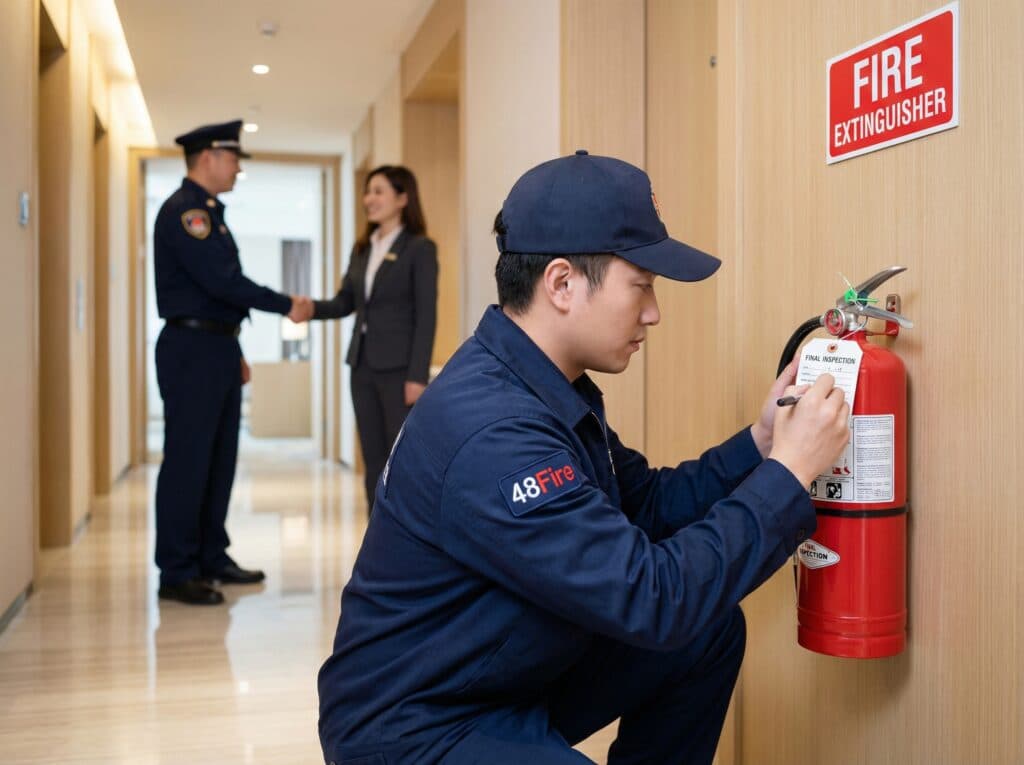
Annual testing: Must be performed by certified technicians or licensed fire suppression contractors

Professional service providers like 48Fire assume testing execution responsibility but building owner retains ultimate accountability.

HOW OFTEN MUST EMERGENCY EGRESS LIGHTING BE TESTED?

The Three-Tier Testing Framework

TIER 1: MONTHLY FUNCTION VERIFICATION

Frequency: Every 30 days

Method: 30-second push-test switch activation

Performed by: Building staff (typically)

Verification checklist:

“`
☐ Unit in designated location?
☐ Housing physically intact?
☐ Lamps illuminate when activated?
☐ Brightness appears adequate?
☐ Lamps aimed correctly?
☐ Test completes 30 seconds successfully?
☐ Results documented in log?
“`

Purpose: Confirms basic operational capability between professional inspections

NFPA 101 requirement: Monthly inspection mandatory for all emergency egress lighting devices

48Fire monthly emergency egress lighting inspection services provide professional systematic testing when building staff unavailable or additional verification desired.

TIER 2: SIX-MONTHLY PARTIAL DISCHARGE

Frequency: Every 6 months

Method: 30-minute partial discharge test

Performed by: Qualified technicians

Rationale: Balances verification frequency with system availability

Why six-monthly testing recommended:

Factor Annual-Only Testing Six-Monthly Testing
Verification frequency Once per year Twice per year
Problem detection window Up to 12 months Up to 6 months
Battery assessment Annual snapshot Semi-annual trending
Vulnerability period 24-48 hours (full discharge) 8-12 hours (partial discharge)
Building safety continuity Extended gap Reduced gap

BS 5266-1 recommendation: Six-monthly partial discharge tests (one-third of full duration) help ensure emergency egress lighting coverage maintained during hours immediately following planned maintenance.

Fire risk assessment consultants commonly recommend this enhanced frequency to mitigate vulnerability during battery recharge periods.

48Fire emergency egress lighting programs include six-monthly partial discharge testing as standard best practice.

TIER 3: ANNUAL COMPREHENSIVE TESTING

Frequency: Every 12 months

Method: Complete 90-minute discharge test

Performed by: Certified technicians/licensed contractors

Testing scope:

“`
COMPLETE SYSTEM TEST
├─ 90-minute full discharge under load
├─ Battery capacity verification
├─ Electronic load simulator testing
├─ Charging circuit functionality
├─ PC board float voltage adjustment
├─ Battery terminal cleaning
├─ Lamp/bulb inspection and testing
├─ Physical condition assessment
├─ Placement verification
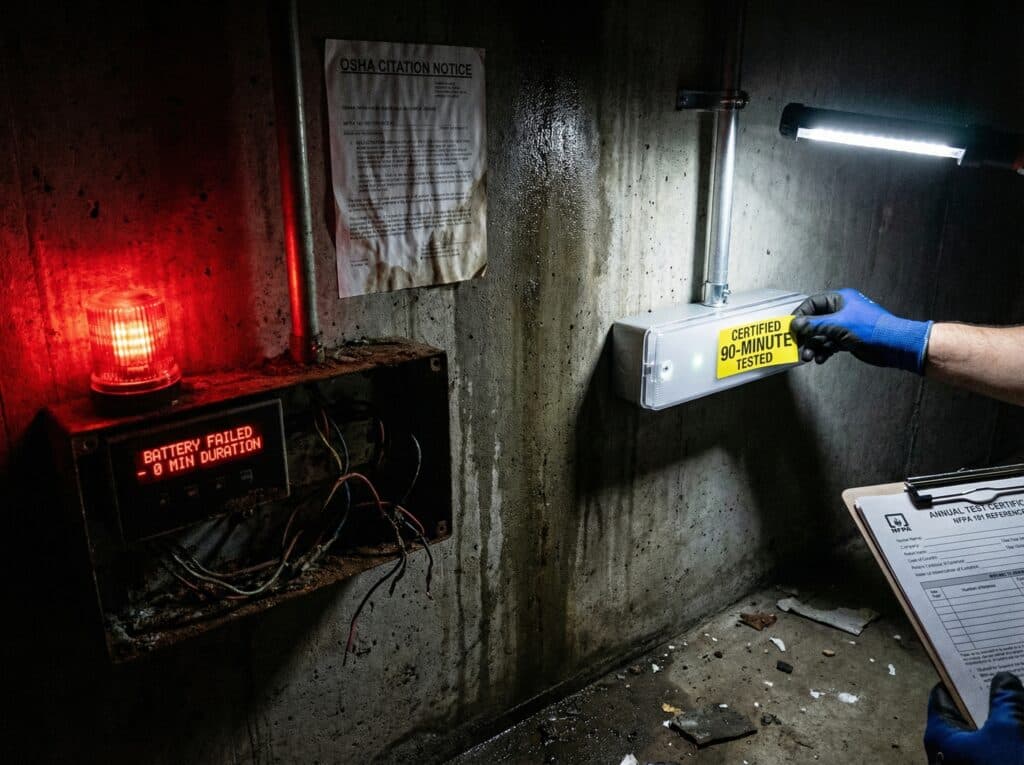
└─ Test label application
“`

NFPA 101 mandate: Annual testing of all emergency egress lighting and exit lighting devices required

Critical consideration: Full discharge renders system inoperative until recharge complete (24-48 hours typical), requiring careful scheduling during low-occupancy periods.

48Fire certified technicians perform complete annual emergency egress lighting testing satisfying all NFPA 101 professional inspection requirements with scheduling coordination to minimize building vulnerability.

WHAT HAPPENS DURING THE 90-MINUTE ANNUAL TEST?

Step-by-Step Professional Testing Protocol

PHASE 1: PRE-TEST PREPARATION

“`
Equipment Inventory Verification

System Documentation Review

Occupancy Coordination

Testing Schedule Optimization

Temporary Lighting Staging (if required)
“`

PHASE 2: COMPREHENSIVE TESTING EXECUTION

Battery Load Testing:

  • Electronic load simulator connected
  • Discharge initiated under controlled load
  • Voltage monitored throughout 90-minute period
  • Capacity degradation identified
  • Pass/fail determination documented

Illumination Verification:

  • Lamps illuminate at test start
  • Brightness monitored throughout duration
  • Dimming patterns noted
  • Final illumination level confirmed
  • One lux minimum requirement verified

Charging System Assessment:

  • Circuit operation verified
  • Voltage levels measured
  • Current flow confirmed
  • Float voltage adjusted to manufacturer specifications
  • Ensures extended battery life

Physical Inspection:

  • Housing condition examined
  • Wiring connections verified
  • Mounting security confirmed
  • Lamp/LED condition assessed
  • Corrosion or damage documented

PHASE 3: POST-TEST ACTIONS

“`
Test Results Analysis

Deficiency Identification

┌──────────────┐
│ PASS or FAIL?│
└──────────────┘
↓ ↓
PASS FAIL
↓ ↓
Certificate Repair/Replace
Applied Required
↓ ↓
Documentation Documentation
Updated + Corrective Action
↓ ↓
Recharge Retest After
Begins Correction
“`

48Fire annual testing includes complete documentation with certificates provided to building management for regulatory compliance files.

WHAT ARE THE MOST COMMON EMERGENCY EGRESS LIGHTING FAILURES?

Failure Modes Identified Through Testing

FAILURE CATEGORY 1: BATTERY DEGRADATION

Symptoms:

  • System fails before 90-minute duration
  • Voltage drops rapidly under load
  • Recharge time extended significantly
  • Physical swelling or leakage visible

Causes:

  • Age exceeds service life (3-15 years depending on type)
  • Charging circuit malfunction
  • Extreme temperature exposure
  • Insufficient maintenance

Detection method: Annual 90-minute discharge test reveals capacity loss

Resolution: Battery replacement

Prevention: Regular testing, proper environmental conditions, timely replacement per schedule

FAILURE CATEGORY 2: CHARGING CIRCUIT MALFUNCTION

Symptoms:

  • Battery doesn’t recharge after discharge
  • Float voltage incorrect
  • System fails shortly after passing previous test
  • Battery shows physical degradation

Causes:

  • Component failure (voltage regulator, capacitor)
  • Loose connections
  • Power supply issues
  • PC board degradation

Detection method: Annual testing with electronic load simulator and voltage verification

Resolution: Circuit repair or board replacement

Prevention: Annual charging circuit testing and float voltage adjustment

FAILURE CATEGORY 3: LAMP/LED FAILURE

Symptoms:

  • No illumination during test
  • Reduced brightness
  • Intermittent operation
  • Complete darkness

Causes:

  • Bulb burnout (incandescent/fluorescent)
  • LED driver failure
  • Connection issues
  • Physical damage

Detection method: Monthly 30-second tests identify most lamp failures

Resolution: Lamp/bulb replacement, LED module replacement, connection repair

Prevention: Regular testing, LED technology adoption (50,000+ hour lifespan)

FAILURE CATEGORY 4: PHYSICAL DAMAGE

Symptoms:

  • Housing cracked or broken
  • Mounting loose or detached
  • Wiring exposed
  • Moisture intrusion

Causes:

  • Impact damage
  • Environmental conditions
  • Installation quality
  • Age-related deterioration

Detection method: Monthly visual inspections

Resolution: Housing replacement, remounting, wiring repair, environmental protection

HOW DOES TESTING CREATE VULNERABILITY?

The Recharge Period Risk

THE VULNERABILITY SEQUENCE:

“`
Full 90-Minute Discharge Test Begins

Battery completely depleted

Emergency egress lighting INOPERATIVE

Recharge cycle initiates

24-48 HOURS until full capacity restored

Building vulnerable during recharge period

Power failure during this window = NO EMERGENCY LIGHTING
“`

The dilemma: Testing that verifies safety temporarily eliminates safety.

Real-world risk assessment:

Vulnerability Factor Risk Level Mitigation Options
Power failure probability during recharge Low (statistical) Schedule during stable weather periods
Occupancy during vulnerability window Variable Test during low-occupancy periods
Alternative egress lighting Usually absent Stage temporary battery lights
Building evacuation capability Reduced Restrict occupancy during recharge
Regulatory compliance vs. safety Tension exists Six-monthly partial discharge strategy

SIX-MONTHLY PARTIAL DISCHARGE SOLUTION

HOW PARTIAL DISCHARGE MITIGATES RISK:

Full Discharge (Annual):

  • Duration: 90 minutes
  • Battery capacity used: 100%
  • Recharge time: 24-48 hours
  • Vulnerability window: EXTENDED

Partial Discharge (Six-Monthly):

  • Duration: 30 minutes (one-third)
  • Battery capacity used: ~33%
  • Recharge time: 8-12 hours
  • Vulnerability window: REDUCED

Strategic advantage:

“`
ANNUAL-ONLY APPROACH:
Test → 12 months → Test → 12 months → Test
[Long verification gaps]

SIX-MONTHLY APPROACH:
Test → 6 months → Partial → 6 months → Test → 6 months → Partial
[Shorter verification gaps, reduced vulnerability]
“`

BS 5266-1 explicitly recommends six-monthly partial discharge testing to ensure buildings retain emergency egress lighting coverage during hours immediately following planned preventative maintenance.

48Fire emergency egress lighting maintenance includes six-monthly partial discharge testing as standard protocol following fire risk assessment consultant recommendations.

WHAT DOCUMENTATION IS REQUIRED?

Record-Keeping for Compliance and Liability Protection

MONTHLY TEST LOG:

“`
EMERGENCY EGRESS LIGHTING MONTHLY TEST LOG

Facility: _____________________
Month/Year: __________________

Unit ID | Location | Test Date | Inspector | Pass/Fail | Action Required
——–|———-|———–|———–|———–|—————-
EEL-01 | Stair A | 01/15/24 | JD | Pass | None
EEL-02 | Hall 2 | 01/15/24 | JD | Fail | Lamp replacement
EEL-03 | Exit 5 | 01/15/24 | JD | Pass | None
“`

Required retention: Maintain for inspection by Authority Having Jurisdiction (AHJ)

Purpose: Demonstrates consistent monthly testing compliance, provides deficiency tracking

ANNUAL TEST CERTIFICATE:

Certificate must document:
□ Test date and location
□ Technician name and certification
□ Service company (48Fire)
□ Complete inventory tested
□ 90-minute duration test results
□ Battery load test data
□ Charging circuit verification
□ Deficiencies identified
□ Corrective actions performed
□ Next test due date

Retention: Permanent (part of emergency lighting file)

Purpose: Proves professional testing compliance, supports insurance claims, demonstrates due diligence

EMERGENCY LIGHTING FILE:

Comprehensive file contents:

1. System design drawings and specifications

2. Equipment inventory with locations

3. Monthly test logs (all months)

4. Annual test certificates (all years)

5. Six-monthly partial discharge records

6. Battery replacement history

7. Repair and maintenance records

8. Compliance documentation

Responsibility: Building owner/manager

Access: Must be available for fire marshal inspections, insurance audits, regulatory reviews

48Fire digital documentation platform provides instant access to complete emergency egress lighting testing history with professional certificates and maintenance records satisfying all regulatory documentation requirements.

WHAT IF TESTING IS NEGLECTED?

Consequences of Maintenance Lapses

OPERATIONAL FAILURE SCENARIO:

“`
Maintenance neglected for 18 months

Battery degrades undetected

Power failure occurs during business hours

Emergency egress lighting fails to activate

200 occupants in darkness

Panic, falls, injuries

Delayed evacuation

Fire department response complicated
“`

Legal consequences:

  • Personal injury liability
  • OSHA citations (up to $16,131+ per serious violation)
  • Fire marshal penalties
  • Criminal negligence charges possible
  • Business license suspension risk

Financial consequences:

  • Insurance claim denial or reduction
  • Lawsuit settlements/judgments
  • Premium increases
  • Business interruption
  • Reputation damage

Regulatory consequences:

  • Correction orders with deadlines
  • Enhanced inspection frequency
  • Potential building closure
  • Compliance monitoring period

INSURANCE CLAIM COMPLICATION:

Scenario: Fire occurs, emergency egress lighting fails, injuries result during evacuation

Insurance investigation requests:

1. Monthly test logs (last 12+ months)

2. Annual test certificates

3. Maintenance records

4. Battery replacement documentation

If documentation absent or inadequate:
→ Claim denied (maintenance negligence)
→ Reduced payout (contributory negligence)
→ Policy cancellation
→ Litigation without coverage

If documentation complete:
→ Claim processed normally
→ Due diligence proven
→ Coverage maintained
→ Legal defense supported

48Fire professional maintenance documentation provides compliance defense and insurance claim support through comprehensive testing records and certification.

WHAT MAINTENANCE STRATEGIES OPTIMIZE RELIABILITY?

Best Practices for 24/7 Emergency Egress Lighting Readiness

STRATEGY 1: LED TECHNOLOGY ADOPTION

Maintenance advantages:

Component Traditional LED Maintenance Impact
Lamp lifespan 1,000-10,000 hours 50,000+ hours 5-10× longer intervals
Replacement frequency Annual/bi-annual 10+ years Dramatically reduced
Brightness degradation Sudden failure Gradual reduction Predictable performance
Energy efficiency Baseline 75-80% reduction Lower operating costs

48Fire LED emergency egress lighting upgrades reduce long-term maintenance costs while improving system reliability and performance.

STRATEGY 2: BATTERY LIFECYCLE MANAGEMENT

Proactive replacement scheduling:

“`
Battery Type Typical Lifespan Replacement Strategy
─────────────────────────────────────────────────────────────
Lead-Acid 3-5 years Replace at 4 years (proactive)
Nickel-Cadmium 5-10 years Replace at 8 years (proactive)
Lithium 10-15 years Replace at 12 years (proactive)
“`

Advantage: Proactive replacement prevents unexpected failures, eliminates emergency service calls, optimizes budget planning

48Fire battery management programs track equipment age with automated replacement notifications preventing end-of-life failures.

STRATEGY 3: SMART SELF-TESTING SYSTEMS

Automated monitoring advantages:

Traditional systems:

  • Manual monthly testing required
  • Human error potential
  • Testing sometimes missed
  • Documentation manual

Smart self-testing systems:

  • Automatic monthly self-testing
  • Continuous status monitoring
  • Immediate fault notification
  • Automatic documentation
  • Remote monitoring capability

Considerations:

  • Higher initial investment
  • Professional annual verification still required
  • Technology reliability critical

48Fire smart emergency egress lighting installations include automated testing with professional verification maintaining regulatory compliance while reducing manual testing burden.

STRATEGY 4: COORDINATED TESTING SCHEDULES

Multi-building optimization:

“`
BUILDING A: Annual test in January
BUILDING B: Annual test in April
BUILDING C: Annual test in July
BUILDING D: Annual test in October

Advantage: Distributed testing prevents concurrent vulnerability across portfolio
“`

Seasonal considerations:

  • Avoid severe weather seasons (storm risk)
  • Coordinate with low-occupancy periods
  • Schedule during extended shutdowns when possible
  • Plan for adequate recharge time before reopening

48Fire multi-property coordination optimizes testing schedules across building portfolios minimizing operational disruption and vulnerability periods.

HOW DO YOU IMPLEMENT COMPREHENSIVE MAINTENANCE?

The 48Fire Emergency Egress Lighting Maintenance Program

PHASE 1: BASELINE ASSESSMENT

Initial evaluation includes:
□ Complete system inventory and documentation
□ Operational status verification (immediate testing)
□ Compliance gap identification
□ Deficiency documentation
□ Maintenance history review
□ Corrective action recommendations

Deliverable: Comprehensive assessment report with prioritized action plan

PHASE 2: IMMEDIATE COMPLIANCE

Critical corrections:
□ Non-functional units repaired or replaced
□ Overdue testing performed immediately
□ Documentation deficiencies addressed
□ Life safety hazards eliminated
□ Minimum regulatory compliance achieved

Deliverable: Emergency egress lighting system meeting NFPA 101 minimum requirements

PHASE 3: SYSTEMATIC MAINTENANCE PROGRAM

Ongoing service schedule:

“`
MONTHLY (Months 1-12)
└─ 30-second function tests
Customer-performed or 48Fire professional service

SIX-MONTHLY (Months 6, 12)
└─ 30-minute partial discharge tests
48Fire certified technician service

ANNUAL (Month 12)
└─ 90-minute comprehensive testing
48Fire complete professional certification
“`

Automated management:

  • Testing reminders sent automatically
  • Scheduling coordinated proactively
  • Documentation generated digitally
  • Compliance status visible continuously
  • Deficiencies tracked to resolution

PHASE 4: CONTINUOUS IMPROVEMENT

Enhancement opportunities:
□ LED technology upgrades
□ Battery replacement per lifecycle schedules
□ Smart self-testing system implementation
□ Coverage expansion if inadequate
□ Photoluminescent supplementation

48Fire ongoing partnership includes technology recommendations, lifecycle management, and system optimization ensuring emergency egress lighting reliability improves continuously.

CONCLUSION

24/7 Emergency Egress Lighting Readiness Through Systematic Maintenance

Maintenance requirements ensuring continuous operational capability:

Monthly verification (30 seconds):

  • Basic function testing
  • Visual inspections
  • Deficiency identification
  • Consistent documentation
  • Typically customer-performed

Six-monthly partial discharge (30 minutes):

  • Battery performance verification
  • Enhanced testing frequency
  • Reduced vulnerability periods
  • Fire risk consultant recommendation
  • Professional service required

Annual comprehensive testing (90 minutes):

  • Full duration discharge verification
  • Battery load testing with electronic simulator
  • Charging circuit assessment and adjustment
  • Complete system certification
  • NFPA 101 mandatory requirement

Critical understanding:

  • Testing creates temporary vulnerability (recharge period)
  • Six-monthly partial discharge mitigates this risk
  • Documentation proves due diligence and supports claims
  • Neglected maintenance = life safety failure + legal liability
  • LED technology and smart systems reduce maintenance burden

48Fire emergency egress lighting maintenance services provide complete 24/7 readiness assurance through monthly inspections, six-monthly partial discharge testing recommended by fire risk consultants, annual professional certification satisfying NFPA 101 requirements, battery lifecycle management, LED upgrade options, smart system implementation, digital documentation platforms, and multi-property coordination—ensuring emergency egress lighting operational reliability when occupant safety depends on illuminated escape routes during power failures.

[Ensure Emergency Egress Lighting 24/7 Readiness](/contact-us)

48Fire
Emergency Egress Lighting Maintenance Services
NFPA 101 Compliance • 24/7 Readiness • Professional Certification

Contact: [/contact-us](/contact-us)

Related Posts

How Consistent Inspections Cut Fire Insurance Premiums

Consistent professional fire protection services reduce commercial property insurance premiums 8-22% through documented loss control programs. Facilities maintaining systematic quarterly inspections, annual certifications, and immediate deficiency correction earn superior fire protection credits. These credits average $3,400-14,800 in annual premium savings versus properties without documented loss control. Regular, professional services improve a facility’s overall risk profile, signaling to insurers a strong commitment to safety.

Read More »
Share the Post: