Inside the Fire Extinguisher Audit That Uncovered 40 Defects
—
MANUFACTURING FACILITY AUDIT
Location: Industrial park, Midwest region
Facility Size: 185,000 sq ft
Fire Extinguishers: 87 units
Operating History: 12 years
Previous Professional Service: None
Defects Found: 40
Compliance Status: 54%
—
THE INITIAL PHONE CALL
“We need our annual fire extinguisher service. Insurance is now requiring professional documentation. Should be straightforward—our team checks them monthly. Can you come out next week?”
Standard request. Happens several times weekly.
The facilities director sounded confident. Twelve years operating without incidents. Monthly inspection logs documented religiously. Equipment looked fine during his walkthroughs.
What the audit actually revealed: Eight extinguishers with dangerously low pressure. Four units completely blocked by equipment. Fourteen that had never received proper annual maintenance. Twelve with documentation that wouldn’t satisfy fire marshal scrutiny. Eighteen requiring hydrostatic testing that maintenance staff didn’t know existed.
Forty defects total. Nearly half the equipment population.
Not because anyone was careless. The maintenance supervisor was thorough, the facilities director was experienced, and the company genuinely prioritized safety.
The problem: They didn’t know the difference between checking fire extinguishers and actually maintaining them to NFPA 10 standards.
This is what that audit looked like—the methodology, the findings, the patterns that emerge when facilities finally get professional eyes on equipment they’ve been managing internally for years.
—
PRE-AUDIT DOCUMENTATION REVIEW
Professional audits start before anyone walks through your door.
Request list sent to facility:
- Current floor plans with extinguisher locations
- Equipment inventory (types, quantities, locations)
- Service history from any professional providers
- Internal inspection records
- Last insurance inspection report
What this facility provided:
✓ Floor plans: Current and accurate
✓ Equipment inventory: Excel spreadsheet listing 87 units by location
✓ Internal logs: Printed monthly checklist going back 11 months, all boxes checked
✗ Professional service records: None existed—everything done internally
✗ Manufacturing dates: Not tracked in their system
✗ Hydrostatic testing: Blank stares when asked about this
First red flag before arriving: A facility operating 12 years with zero hydrostatic testing records. Mathematically impossible that all 87 extinguishers are under their test intervals. Either equipment is seriously overdue or nobody knows testing is required.
Both turned out to be true.
—
THE ACTUAL INSPECTION PROCESS
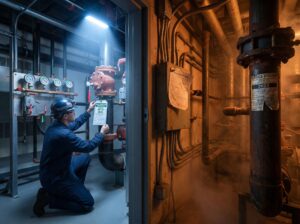
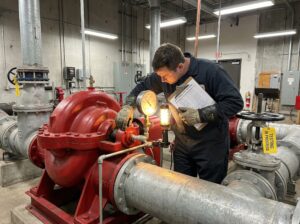
Audit day arrives. Two certified technicians. Six hours on-site.
Equipment carried in: tablets with inspection software, barcode scanners, pressure gauges, inspection mirrors, measuring tape, camera.
Starting at the main entrance. Working clockwise through the entire facility. Every single extinguisher examined—no sampling, no shortcuts.
Standard inspection sequence per unit:
1. Location verification
Confirm unit matches inventory list. Check accessibility—nothing blocking, properly mounted, visible to anyone who might need it.
2. Physical examination
Photograph the unit. Record serial number and manufacturing date (stamped on collar, often requires close examination). Inspect shell for corrosion, dents, damage. Check hose, nozzle, handle, safety pin.
3. Pressure check
Read gauge at close range with proper lighting. For CO2 units, verify weight. Document reading with photo.
4. Documentation review
Examine service tags. When was last professional maintenance? Who performed it? Does documentation meet NFPA requirements?
5. Compliance assessment
Proper type for this location’s hazards? Mounted at correct height? Signage adequate? Due for six-year examination or hydrostatic testing?
6. Digital documentation
Every finding enters the system immediately. Photos uploaded. GPS coordinates recorded. Issues flagged for immediate attention.
Takes 3-4 minutes for equipment in good shape. Takes 6-8 minutes when problems surface requiring detailed documentation.
Results by mid-afternoon:
- 87 units inspected
- 47 fully compliant (54%)
- 40 with defects requiring correction (46%)
- 12 critical safety issues
- 19 major compliance violations
- 9 minor problems
Facilities director watched the numbers accumulate on his phone through the digital platform. By unit #30, his confidence had evaporated. By unit #60, he was making calls to executive leadership.
—
CRITICAL DEFECT #1: THE PRESSURE PROBLEM
Eight extinguishers with gauges outside the green zone.
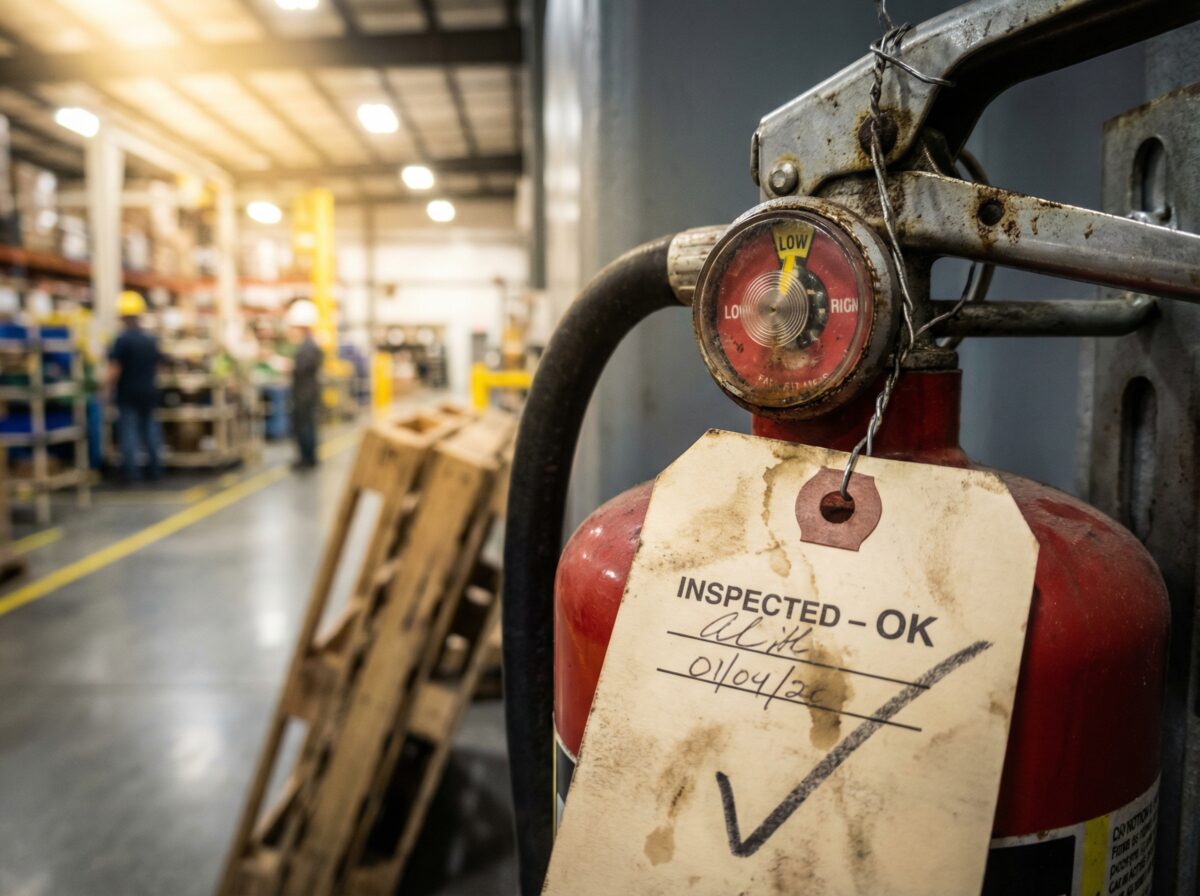
Not slightly off. Deep into yellow and red. One gauge needle buried in red zone showing approximately 80 PSI when it should read 195 PSI.
Unit #23 on the production floor:
- Type: 10 lb ABC dry chemical
- Pressure: Red zone (estimated 85 PSI vs. required 195 PSI)
- Age: 2015 manufacturing date (10 years old)
- Last documented check: Yesterday’s date on internal log marked “OK”
Pull that unit off the wall during a fire and it won’t discharge properly. Might give you three seconds of weak spray instead of the 10-12 seconds it should provide. In a growing fire, that difference matters enormously.
Unit #47 in the warehouse:
- Type: 20 lb ABC dry chemical
- Pressure: Yellow zone (estimated 140 PSI)
- Visible green corrosion on brass valve
- Manufacturing: 2018
Why this happened:
Internal inspection staff walked through monthly with clipboards. Glanced at gauges from 6-8 feet away. Gauges that showed needles near the green zone got checkmarks. Nobody examined them closely enough to see that “near green” isn’t the same as “in green.”
Additional complication: Several older units had gauge faces faded from years of exposure. The color bands that were once clearly defined green/yellow/red had weathered to similar washed-out tones. From a distance, yellow looked greenish.
NFPA 10 Section 7.2: Pressure gauge must read in the operable range. Even slightly outside requires professional service.
What happened next:
All eight units removed immediately. Temporary replacements installed from service truck. Units taken for recharge. Three showed valve corrosion during internal examination and got flagged for potential replacement. Returned within 48 hours, properly recharged and documented.
—
CRITICAL DEFECT #2: BLOCKED ACCESS
Four extinguishers partially or completely inaccessible.
Unit #62 in the maintenance shop:
New parts shelving had been installed eight months prior. Heavy steel rack, 18 inches deep, placed directly in front of the fire extinguisher. You could see the extinguisher behind the shelving if you knew where to look. Couldn’t reach it without moving a 400-pound loaded shelf.
Maintenance staff didn’t see a problem. They knew exactly where the extinguisher was. When inspecting monthly, they’d move the shelf, check the unit, note “accessible” on their form.
What they missed: NFPA requires extinguishers be “readily accessible” to anyone during emergencies. If a random employee in that room encounters fire, they need to grab protection immediately. They don’t have time to unload and move shelving. They probably don’t even know an extinguisher exists behind those parts.
Unit #71 at the loading dock:
Shipping pallets routinely stacked in front of wall-mounted extinguisher. Dock supervisor acknowledged extinguisher gets blocked “most of the time” but didn’t realize this violated code. His thinking: “We know it’s there. If we need it, we’ll move the pallets.”
The problem: Three seconds to grab an extinguisher vs. thirty seconds to move pallets and then grab an extinguisher. That gap determines whether you suppress a small fire or evacuate from a large one.
What happened:
Three units immediately cleared. Two required relocation—the blocking was structural, not temporary. New locations identified, units remounted same day. Temporary units covered the gap during remounting.
—
MAJOR DEFECT #1: NEVER HAD REAL MAINTENANCE
Fourteen extinguishers had never been professionally serviced. Ever.
The facilities director looked genuinely shocked. “We inspect them every month. I have the logs.”
The confusion: Monthly inspection vs. annual maintenance.
NFPA 10 distinguishes clearly:
Monthly inspection (Section 7.2): Quick visual check. Can be performed by trained facility staff. Check accessibility, pressure gauge, physical condition, seal intact. Takes 2-3 minutes per unit.
Annual maintenance (Section 7.3): Comprehensive examination by certified technician. Detailed internal inspection, component testing, seal replacement, pressure verification with calibrated equipment, professional documentation. Takes 15-20 minutes per unit.
Different activities. Different qualifications required. Different purposes.
Monthly inspection catches obvious problems: damaged equipment, missing units, clearly low pressure, blocked access.
Annual maintenance catches hidden problems: internal corrosion, component wear, slight pressure loss, agent degradation, seal deterioration.
This facility had been doing monthly inspections only.
Units #1-12 (original facility equipment):
- Manufacturing dates: 2013
- Professional maintenance: Never
- Age: 12 years without comprehensive service
- Monthly checks: Current, documented, thorough
Units #34 and #41 (added later):
- Manufacturing dates: 2018
- Professional maintenance: Never
- History: Ordered from supply company, installed by maintenance staff, added to monthly inspection rotation
- Professional service: Zero
Why this matters:
Annual maintenance catches problems monthly inspections can’t see:
- Internal corrosion: Shell looks fine outside. Inside, moisture contamination has created rust that weakens the vessel. Only visible when technician removes valve and inspects interior.
- Component wear: Rubber seals degrade over time. Springs weaken. O-rings harden. All invisible until you disassemble and examine.
- Agent condition: Dry chemical can clump from moisture absorption. Looks fine externally. Only discovered by weight verification and internal examination.
- Pressure accuracy: Gauge might show green zone but actual pressure could be declining. Requires calibrated testing equipment to verify.
Twelve years without this level of examination means problems definitely accumulated. You just couldn’t see them.
During annual maintenance service:
All 14 units got comprehensive examination. Three showed significant internal corrosion—rust visible inside the shell when valve was removed. Two had clumped dry chemical requiring agent replacement. One had cracked internal siphon tube.
Three units recommended for replacement. Eleven passed and returned to service with proper documentation.
—
MAJOR DEFECT #2: TAG DOCUMENTATION PROBLEMS
Twelve units with missing, illegible, or inadequate service tags.
Fire marshals don’t just look at equipment. They read tags. Tags prove service occurred. No tag = no proof = violation.
Three units missing tags entirely:
Units #19, #28, #56 had no professional service documentation attached. They had current month stickers from the internal inspection program (small circular stickers with checkmarks). But no tags showing professional annual maintenance.
Four units with illegible tags:
Unit #33 near a steam pipe—humidity and heat destroyed the paper tag within months. Still attached, but completely blank. All information faded.
Unit #67 near loading dock—weather exposure, dirt, physical wear. Tag mostly unreadable.
Five units with inadequate information:
Tags showing handwritten dates but missing critical details:
- No company name or contact
- No technician identification
- No certification numbers
- No description of service performed
Investigation revealed: Maintenance supervisor had purchased blank tags online. After monthly inspections, he’d write the date on a tag and attach it. His intention was documenting their internal program.
What he created: Tags that appeared to show professional service but actually documented nothing that would satisfy a fire marshal.
NFPA 10 Section 7.3.4 requires tags show:
- Date service performed
- Service company name and contact
- Technician name or certification number
- Type of service (inspection, maintenance, recharge, testing)
- Next service due date
Resolution:
All units received proper tags during annual maintenance. Weather-resistant laminated tags in harsh environments. Complete information meeting NFPA requirements. QR codes added linking to digital service records.
—
MAJOR DEFECT #3: WRONG EQUIPMENT FOR THE HAZARD
Three locations had inappropriate extinguisher types.
Electrical room with main distribution panel:
Current equipment: 10 lb ABC dry chemical extinguisher
Assessment: ABC works on electrical fires. But dry chemical is corrosive powder. Use it on a small electrical fire in a room full of sensitive electronics and you’ll suppress the fire while destroying $50,000 in equipment.
Better choice: CO2 or clean agent extinguisher. Suppresses fire without residue. Electrical equipment survives.
Parts cleaning station with solvent use:
Current equipment: 2.5 gallon water extinguisher
Assessment: Water on solvent fire makes things worse. Water spreads burning liquid. Water extinguishers aren’t rated for Class B (flammable liquid) fires.
Correct equipment: ABC dry chemical, foam, or CO2.
Kitchen with commercial fryer:
Current equipment: 20 lb ABC dry chemical
Assessment: ABC works on cooking fires but isn’t optimal. Modern commercial cooking equipment uses oil at very high temperatures. Class K wet chemical extinguishers are specifically designed for these fires.
How facilities make these mistakes:
Basic research says “ABC extinguishers handle most fire types.” True statement. ABC covers ordinary combustibles (A), flammable liquids (B), and electrical equipment (C).
What gets missed: “Handles” doesn’t mean “optimal for.” Specific hazards benefit from specialized equipment.
NFPA 10 Section 6.2: Select extinguishers based on specific hazards in the area being protected.
Resolution:
Three specialized units purchased and installed:
- CO2 for electrical room
- ABC dry chemical for parts cleaning (replaced water)
- Class K wet chemical for kitchen
Original equipment relocated to areas where types were appropriate.
—
THE HYDROSTATIC TESTING GAP
Mid-audit, the question got asked: “Can you show me hydrostatic testing records for your older equipment?”
Facilities director: “Hydro-what?”
The explanation:
NFPA 10 Table 8.3.1 requires periodic pressure vessel testing:
| Extinguisher Type | Test Interval |
|---|---|
| CO2 | Every 5 years |
| Water, foam | Every 5 years |
| Dry chemical (stored pressure) | Every 12 years |
| Clean agent | Every 12 years |
Process: Empty extinguisher. Fill with water. Pressurize to 1.5-3x normal operating pressure. Verify no leakage or vessel deformation. Confirms the pressure vessel is still safe to use.
This facility’s status:
- Operating 12 years
- Many original 2013 extinguishers still in service
- Zero hydrostatic testing ever performed
- Maintenance team never heard of this requirement
What the audit revealed:
- 18 units currently overdue for testing
- 12 dry chemical units manufactured 2013 (12+ years, never tested)
- 6 CO2 units with multiple missed 5-year test cycles
Additional discovery:
Three units manufactured 2008-2010. Apparently came from another company location or were purchased used. Now 15-17 years old. Never tested. Approaching end of typical service life.
Why this matters:
Pressure vessels degrade. Internal corrosion. Stress from pressure cycles. Environmental factors. An untested extinguisher might hold pressure normally until the moment someone actually uses it—then catastrophic failure occurs.
NFPA is clear: Units failing hydrostatic tests get destroyed. Cannot be repaired. Must be replaced.
Testing process initiated:
All 18 units removed for testing. Temporary replacements installed. Units transported to certified testing facility. Results:
- 14 units passed: Recharged and returned to service with proper documentation
- 4 units failed: Showed deformation under test pressure, destroyed per NFPA requirements, replaced with new equipment
Cost breakdown:
- Testing: $65/unit × 18 = $1,170
- Recharge after passing: $35/unit × 14 = $490
- Replacement for failed units: $180/unit × 4 = $720
- Total: $2,380
A program that should have been happening all along but wasn’t because nobody knew it existed.
—
WHY THIS HAPPENS
Knowledge Gap #1: Not Understanding the Standards
What facility teams typically know:
- Fire extinguishers need monthly inspection
- Equipment should be mounted and accessible
- Pressure gauges should be in green zone
What they usually don’t know:
- Monthly inspection differs from annual maintenance
- Annual maintenance requires certified technicians
- Hydrostatic testing exists at specific intervals
- Service tags need specific information
- Extinguisher types matter for specific hazards
- Mounting has exact height specifications
This facility’s director had solid general safety knowledge. He attended management seminars. Read industry publications. Talked with peers.
But nobody had ever given him chapter-and-verse on NFPA 10. The details. The technical requirements. The distinctions between different service levels.
Knowledge Gap #2: Visual Inspection Limitations
Monthly inspections catch obvious problems:
- Equipment physically damaged or missing
- Severe corrosion visible externally
- Pressure gauge deeply in red zone
- Major accessibility issues
Monthly inspections miss subtle problems:
- Slight pressure loss (yellow zone vs. green)
- Internal corrosion invisible from outside
- Component wear requiring disassembly to see
- Approaching service deadlines
- Testing requirements based on equipment age
The paradox: This facility inspected diligently every month for 12 years. Documented everything. Still had 46% defect rate.
Good monthly inspections are valuable but insufficient alone.
Knowledge Gap #3: The Assumption Everything’s Fine
Year 1: “These are brand new. We’ll get professional maintenance after they’ve been used a while.”
Year 4: “We check them every month. Everything looks good. Professional service seems like unnecessary expense.”
Year 8: “We’ve gone eight years without any problems. Our program must be working.”
Year 12: “We’ve always done it this way. Why change?”
At no point did a fire occur revealing the equipment defects. The pressure-deficient extinguishers never got used. The blocked units never became critical. The internal corrosion stayed hidden.
Every year without problems reinforced the belief that everything was fine.
The audit revealed: Problems existed anyway. They just hadn’t been discovered yet.
—
THE CORRECTION PLAN
Immediate Actions (First 48 Hours)
Critical safety issues first:
Eight pressure-deficient extinguishers removed for recharge. Temporary units installed immediately. Original units returned within 24 hours properly serviced.
Four blocked extinguishers cleared of obstructions. Two requiring relocation—units remounted same day with temporary coverage during the work.
Three wrong-type extinguishers replaced with appropriate equipment. Original units relocated to suitable areas.
Throughout this process: Zero reduction in fire protection. Temporary units maintained complete coverage.
Short-Term Corrections (Within 30 Days)
All 40 defects corrected:
✓ Annual maintenance completed on 14 overdue units
✓ Proper service tags applied to 12 units with documentation issues
✓ Six mounting height violations corrected (units remounted)
✓ Three signage problems resolved
✓ Hydrostatic testing program initiated (18 units processed)
Additional proactive work:
✓ Complete equipment inventory created with manufacturing dates, specifications, locations
✓ Testing schedule established for ongoing compliance
✓ Digital tracking system implemented
✓ All service history documented properly
Ongoing Program (Implemented)
Monthly professional inspection:
- Technician visits first Tuesday each month
- Systematic inspection of all 87 units
- Digital documentation with photos
- Issues flagged immediately
- Consistent 30-day NFPA compliance
Annual maintenance:
- Scheduled automatically 11 months after last service
- Comprehensive examination per NFPA 10
- Internal component inspection
- Seal and component replacement as needed
- Proper documentation applied
Six-year maintenance:
- System tracks equipment ages automatically
- Alerts at 5.5 years for each unit
- Complete disassembly, internal examination, recharge
- Coordinated with annual maintenance when due
Hydrostatic testing:
- Automatic tracking by equipment type and age
- Scheduling before NFPA deadlines
- Certified facility processing
- Temporary units during testing
- Complete documentation
Cost for 87-unit facility:
- Monthly inspection: $175/month = $2,100/year
- Annual maintenance: Approximately $1,900/year
- Periodic testing/replacement: ~$2,000/year average
- Total: $6,000/year
Compare to alternatives:
Single OSHA serious violation: Up to $16,131
Fire damage with inadequate equipment: Potentially $100,000-$1,000,000+
Insurance complications from poor documentation: Variable but significant
Professional service costs roughly 1% of potential fire loss.
—
WHAT THIS REVEALS
Pattern #1: Good Intentions Aren’t Enough
This facility had:
- Safety-conscious management
- Diligent maintenance staff
- Regular documented inspections
- Genuine commitment to doing things right
Still found 40 defects during first professional audit.
The gap: Not knowing what compliance actually requires.
Pattern #2: Internal Programs Have Blind Spots
Monthly inspections are NFPA-required and valuable. They catch obvious problems and maintain awareness.
But internal programs consistently miss:
- Technical requirements requiring specialized knowledge
- Problems invisible without professional equipment
- Service intervals requiring tracking systems
- Documentation standards for proving compliance
External professional assessment reveals what internal perspective cannot see.
Pattern #3: Compliance Is Technical and Specific
Not “generally maintaining equipment.”
Specific intervals: 30 days, 12 months, 6 years, 5/12 years
Specific qualifications: Certified technicians
Specific procedures: NFPA-detailed processes
Specific documentation: Exact information required
Specific equipment selection: Hazard-matched types
“Doing our best” doesn’t meet technical standards.
Pattern #4: Problems Accumulate Invisibly
Over 12 years:
- Pressure gradually decreased
- Corrosion slowly developed internally
- Documentation gaps compounded
- Testing deadlines passed unnoticed
- Inappropriate equipment remained in place
No alarm bells. No obvious failures. Just gradual drift from compliance while everything looked fine.
Professional audits make the invisible visible.
—
IF THIS SOUNDS FAMILIAR
Warning signs your facility might have similar issues:
You can’t quickly identify manufacturing dates of your oldest extinguishers
You’ve never had comprehensive professional audit by outside experts
Service tags show only your company name (internal staff documented inspections)
“Hydrostatic testing” sounds unfamiliar
Your fire extinguisher program is entirely internal—no professional service provider involved
Your confidence is based on “we check them regularly and they look fine”
These patterns consistently predict 40-50% defect rates during first professional audits.
Not because facilities are negligent. Because they don’t know what they don’t know.
—
THE AUDIT ECONOMICS
What Problems Cost When Discovered Wrong Way
Fire marshal surprise inspection finding similar issues:
Typical outcome:
- Multiple serious OSHA violations
- Citations: 3+ violations at $16,131 each = $48,000+
- Emergency correction deadline (30 days)
- Reinspection requirements and fees
- Insurance carrier notification
- Possible operational restrictions
Fire occurring with defective equipment:
Hypothetical: Fire starts. Employee grabs nearest extinguisher. Happens to be one with low pressure. Doesn’t discharge properly. Fire spreads. Damage: $250,000.
Investigation reveals no professional maintenance documentation, equipment not tested per NFPA, systematic compliance failures.
Insurance questions coverage. OSHA investigates. Liability attorneys start calling.
Total cost: Far beyond the direct fire damage.
What Prevention Costs
Professional audit: $800-1,200 for 87-unit facility
Comprehensive correction: $4,000-6,000 (all defects resolved, proper equipment installed, systems established)
Ongoing annual program: $5,000-6,500/year for complete professional service
One-time investment: ~$5,000-7,000
Ongoing cost: ~$5,500/year
Compare to violation scenario: $48,000+ minimum
Return on investment: Preventing single violation pays for 7-8 years of professional service.
Plus: Equipment actually works when needed. Insurance remains uncomplicated. Management sleeps better.
—
GETTING STARTED
Three service options available:
Option A: Verification Audit
For facilities confident in current compliance, seeking confirmation:
- Complete professional assessment by certified technicians
- Documentation review and physical inspection
- Written report identifying any gaps
- Recommendations if improvements needed
- Insurance-acceptable documentation
Timeline: 1-2 days depending on facility size
Investment: $700-1,200
[Request Verification Audit](/contact-us)
—
Option B: Comprehensive Audit + Correction
For facilities suspecting gaps, wanting complete resolution:
- Full facility assessment
- Defect identification with photographic evidence
- Prioritized correction plan
- Professional correction of all identified issues
- Ongoing compliance program establishment
Timeline: Initial audit 1-2 days, corrections within 30 days
Investment: $4,000-7,000 including all corrections
[Request Comprehensive Service](/contact-us)
—
Option C: Emergency Response
For facilities with upcoming inspections or known problems:
- Rapid assessment (24-48 hours)
- Immediate critical issue correction
- Fast-track complete compliance
- Inspector-ready documentation
Timeline: Emergency scheduling, completion within days
Investment: Custom quote based on urgency
[Request Emergency Service](/contact-us)
—
Contact Information
48Fire
Professional Fire Extinguisher Services
Nationwide Coverage • NFPA-Certified Technicians
[Schedule Your Audit](/contact-us)
—
Fire extinguisher compliance isn’t about checking boxes on a form.
It’s understanding NFPA technical requirements. Knowing what professional maintenance actually involves. Having specialized equipment and knowledge to detect problems. Documenting everything properly. Creating systematic programs preventing invisible deterioration.
Facilities operating on good intentions and internal inspections discover these realities during professional audits—or worse, during fire marshal inspections and actual emergencies.
Better to discover the gaps yourself through professional assessment when you can correct them systematically, affordably, without pressure.
The alternative is discovering them when correction becomes expensive, rushed, and complicated.
[Begin Your Professional Assessment](/contact-us)
—
FREQUENTLY ASKED QUESTIONS
How common are these compliance issues in facilities with internal programs?
Very common. Professional audits of facilities relying solely on internal inspection programs typically find 35-50% defect rates. The specific issues vary, but patterns remain consistent: overdue annual maintenance, missing hydrostatic testing, inadequate documentation, and pressure problems appear in 70-80% of first-time professional audits.
Can facility staff handle fire extinguisher maintenance themselves?
NFPA 10 Section 7.2 permits trained facility staff to perform monthly visual inspections. However, Section 7.3 requires annual maintenance by certified technicians with proper training, tools, and testing equipment. Internal staff can do visual checks but not comprehensive maintenance. Most facilities lack certified fire extinguisher technicians on staff, requiring professional service providers.
What is hydrostatic testing and when is it required?
Hydrostatic testing verifies pressure vessel integrity by pressurizing the empty extinguisher with water to levels exceeding normal operating pressure. NFPA 10 Table 8.3.1 requires testing every 5 years for CO2/water/foam types and every 12 years for dry chemical stored pressure units. Units failing testing must be destroyed and replaced—cannot be repaired.
How long does a professional audit take?
Depends on facility size and equipment quantity. Small facilities (20-30 units) require 2-3 hours. Medium facilities (80-100 units like this example) require 4-6 hours. Large facilities (200+ units) may require full day or multiple visits. Most audits complete within 1-2 business days including preliminary reporting.
What happens to fire protection while equipment gets serviced?
Professional service providers install temporary replacement units during any period equipment is removed for recharge, testing, or replacement. Critical issues receive same-day temporary coverage. Facilities never operate without required fire protection during correction processes. Temporary units meet all NFPA code requirements until permanent equipment returns.
Do insurance companies require professional audits?
Requirements vary by carrier. Some insurers specifically require annual professional service documentation. Others accept internal programs with periodic professional verification. Increasingly, carriers require certified provider documentation rather than internal-only programs. Many facilities discover professional documentation requirements when insurance policies update or during claim investigations.
How much does compliance correction typically cost?
Highly variable depending on findings. Simple corrections (proper documentation, minor adjustments, scheduled maintenance) average $3,000-5,000 for medium facilities. Extensive corrections (equipment replacement, hydrostatic testing programs, major repairs) can reach $8,000-12,000. Ongoing professional service programs cost approximately $50-80 per unit annually for complete NFPA-compliant maintenance.
Can facilities keep doing monthly inspections with professional annual service?
Yes—this is the recommended approach. Facility staff perform monthly visual inspections (checking accessibility, pressure, physical condition) while professional providers handle annual maintenance, six-year examinations, hydrostatic testing, and NFPA documentation. This combination maintains compliance cost-effectively while ensuring technical requirements are properly met.