7 Signs Your Fire Alarm System Needs an Urgent Upgrade
Fire alarm systems protect buildings for 15-25 years typically. Then they stop being protection and become liability.
The transition from “working system” to “system that needs replacement” doesn’t happen overnight. Warning signs appear months or years before complete failure. Property managers who recognize these signs early can plan proactive replacement during convenient timing rather than emergency replacement after catastrophic failure.
Some warning signs are obvious—panel won’t power on, half the devices don’t work. Others are subtle—slightly increasing trouble frequency, parts taking longer to source, technicians commenting about equipment age.
This article examines seven specific indicators that fire alarm systems have reached end of service life and need replacement rather than continued repair. These aren’t minor issues fixed with service calls. They’re fundamental problems signaling equipment exhaustion.
—
Sign 1: System Age Exceeds 15 Years
The baseline indicator: Check installation date.
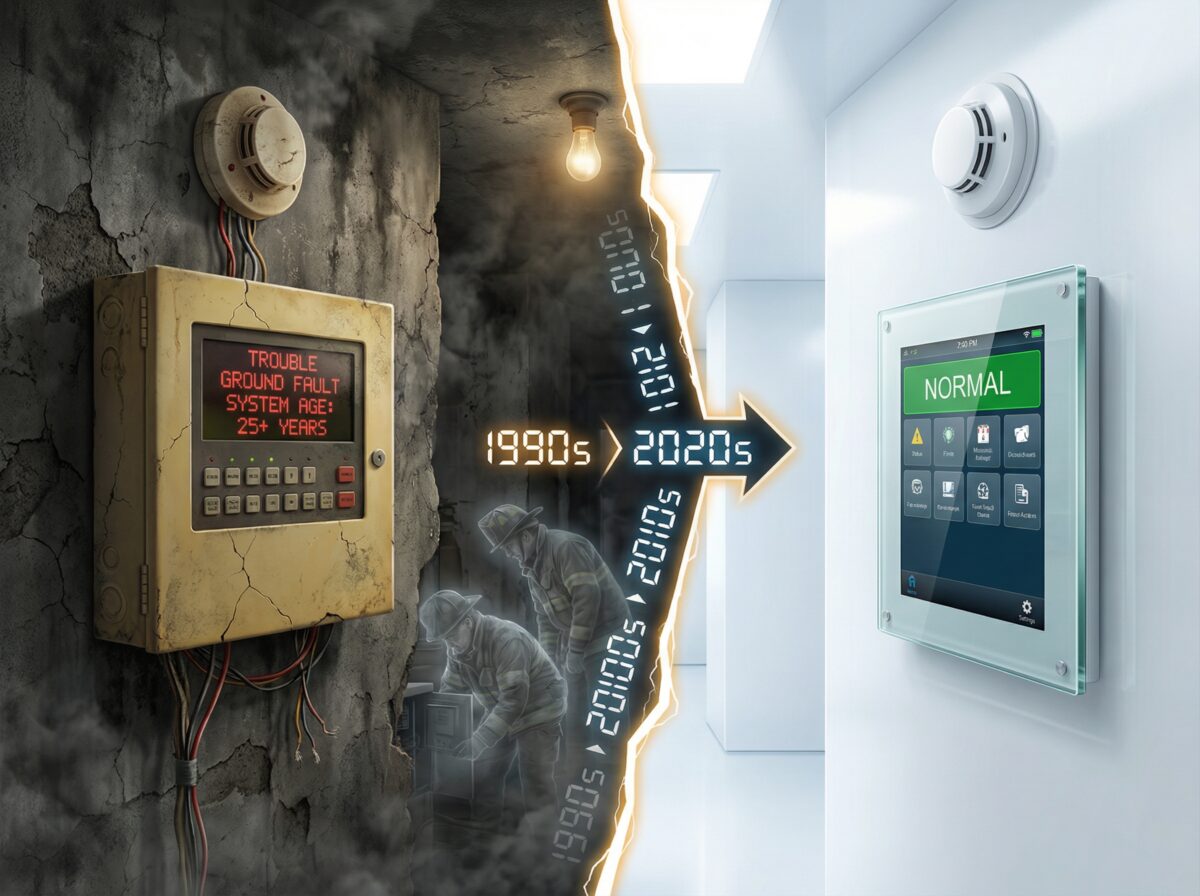
Fire alarm control panels have typical service life of 15-25 years. After 15 years, systems enter higher-failure-probability period even if currently functioning acceptably.
Why Age Matters
Electronic component degradation:
Fire alarm panels contain electronic components with finite lifespans:
- Capacitors lose capacity over time (affects power supply regulation and circuit operation)
- Solder joints develop cracks from thermal cycling (creates intermittent connection problems)
- Circuit boards experience trace corrosion and delamination (causes electrical failures)
- Relay contacts oxidize (increases resistance and creates unreliable switching)
These degradation processes occur regardless of maintenance quality. Well-maintained 20-year-old panel experiences same component aging as neglected 20-year-old panel.
Technology obsolescence:
Fire alarm technology evolves:
15+ years ago (2010 and earlier):
- Conventional systems common (limited device information)
- Basic notification (horns and strobes only)
- Phone line communication standard
- Minimal integration capabilities
- Limited diagnostic information
Current technology (2020s):
- Addressable systems standard (individual device identification and status)
- Voice evacuation capabilities
- Cellular and IP communication
- Extensive building system integration
- Advanced diagnostics and remote monitoring
Older systems lack capabilities that modern codes and building operations expect.
Manufacturer support declining:
Fire alarm manufacturers discontinue equipment models typically 10-15 years after introduction:
- Replacement parts become scarce (sourced from surplus suppliers or salvaged equipment)
- Technical support limited (manufacturer staff unfamiliar with discontinued models)
- Software updates cease (security vulnerabilities and compatibility problems)
- Documentation availability decreases (installation and service manuals harder to obtain)
How to Determine System Age
Check fire alarm panel:
Most panels have label or nameplate showing:
- Manufacturer name and model number
- Serial number
- Manufacture date or year
Panel installation typically occurs same year as manufacture for new construction, or manufacture date plus 1-2 years for renovations using warehoused equipment.
Review building records:
- Original fire alarm installation documentation
- Completion certificates from initial installation
- Previous inspection reports (often note equipment age)
- Building as-built drawings (may show installation date)
Ask current service contractor:
Fire alarm contractors familiar with equipment can estimate age based on:
- Model number and manufacturer information
- Panel design and component types
- Installation methods and wiring practices
- Comparison with industry timelines
The 15-Year Decision Point
Systems 15+ years old require evaluation:
15-20 years: Increased maintenance costs expected. Parts availability declining. Plan replacement within 3-5 years. Budget accordingly.
20-25 years: Replacement should be imminent. Parts scarce, failures increasing. High priority for replacement within 1-2 years.
25+ years: Immediate replacement recommended. System operating on borrowed time. Catastrophic failure likely. Emergency replacement costs much higher than planned replacement.
Property managers discovering their fire alarm system is 18 years old shouldn’t panic, but should start replacement planning and budget allocation. System might function adequately for 2-3 more years, but proactive planning prevents emergency situations.
Companies like 48fire provide system age assessments and replacement planning assistance, helping property managers understand remaining service life and develop realistic replacement timelines and budgets.
—
Sign 2: Chronic Trouble Conditions
The pattern indicator: Troubles becoming normal state.
Fire alarm panels generate trouble signals when equipment malfunctions. Occasional troubles normal—all equipment experiences problems. But when troubles occur weekly or trouble conditions persist for days despite service calls, system reliability has deteriorated beyond acceptable levels.
What Chronic Troubles Indicate
Trouble signal purposes:
Fire alarm troubles alert building management to:
- Device communication failures
- Power supply problems
- Ground faults
- Battery condition issues
- Environmental problems affecting equipment
Prompt trouble correction maintains system reliability. But when same troubles recur repeatedly or multiple different troubles appear constantly, underlying system degradation occurring.
Chronic trouble patterns:
Recurring device communication failures:
- Same detector shows communication trouble repeatedly
- Trouble clears after service call, returns within days or weeks
- Different devices in same area showing troubles progressively
Indicates: Wiring insulation deteriorating, connections oxidizing, or device supervision circuits degrading.
Persistent ground faults:
- Ground fault trouble appears
- Technician identifies and corrects fault location
- New ground fault appears in different location shortly after
- Pattern repeats with faults migrating through system
Indicates: Widespread wiring insulation breakdown, moisture intrusion affecting multiple circuits, or panel ground fault detection circuitry becoming overly sensitive due to component aging.
Frequent power supply troubles:
- AC power failures despite building power normal
- Battery troubles despite recent battery replacement
- Intermittent power-related troubles
- Panel rebooting unexpectedly
Indicates: Panel power supply components failing, voltage regulation circuits degrading, or internal power distribution problems.
Multiple simultaneous troubles:
- Several unrelated troubles active on panel simultaneously
- Clearing one trouble doesn’t prevent others appearing
- Trouble count increasing over time
- Panel displaying troubles more often than normal status
Indicates: Systemwide equipment degradation, panel processor problems, or environmental conditions exceeding equipment tolerance.
Cost Analysis: Repair vs. Replace
Chronic trouble scenario:
Year 1: Four service calls addressing various troubles ($1,600)
Year 2: Six service calls ($2,400)
Year 3: Eight service calls plus emergency after-hours call ($3,800)
Three-year repair cost: $7,800
System replacement cost: $15,000-25,000 (varies by building size)
After spending $7,800 on repairs over three years, building still has aging unreliable system requiring continued repairs. Replacement cost $15,000-25,000 but provides new reliable system with 15-20 year service life.
Break-even analysis:
If repair costs continue at $3,000-4,000 annually, system replacement pays for itself within 4-7 years while providing reliable operation and eliminating chronic trouble issues.
When Troubles Become Urgent
Immediate replacement warranted when:
- Communication troubles leave building unmonitored for extended periods
- Power supply troubles cause intermittent system operation
- Device troubles create coverage gaps in fire detection
- Trouble frequency exceeds one per month average
- Trouble correction costs exceed $500 monthly
At this threshold, system reliability compromised beyond acceptable level. Continued operation presents code compliance risk, insurance liability, and life safety concerns.
—
Sign 3: Replacement Parts Unavailable or Expensive
The supply chain indicator: “We’ll have to source that from surplus suppliers.”
When fire alarm technicians can’t obtain replacement parts through normal distribution channels, system obsolescence has progressed significantly.
Parts Availability Timeline
New equipment (0-5 years):
Parts readily available from manufacturer and distributors. Standard pricing. Next-day or same-week delivery typical.
Current equipment (5-10 years):
Parts available through manufacturer. Some items may require ordering (not stocked locally). Standard pricing maintained.
Aging equipment (10-15 years):
Manufacturer may discontinue some components. Distributors stock declining. Prices sometimes increase for lower-demand parts. Lead times longer.
Obsolete equipment (15+ years):
Manufacturer discontinued most parts. Must source from:
- Surplus equipment suppliers (buying old inventory)
- Salvage from decommissioned systems
- Third-party manufacturers (aftermarket parts of questionable quality)
- eBay or similar marketplaces
Pricing unpredictable. Availability uncertain. Quality concerns with salvaged or aftermarket components.
Critical Component Availability
Panel boards and processors:
Fire alarm control panel contains circuit boards managing system operation. Board failures on obsolete systems often impossible to repair:
- Original boards unavailable
- No aftermarket alternatives
- Board-level repair not economical (components themselves obsolete)
Panel board failure on 20+ year old system effectively means complete system replacement under emergency conditions.
Devices (detectors, pull stations, notification devices):
Manufacturers discontinue detector models as technology advances. Replacement detectors must match existing system communication protocol.
Obsolete system needing smoke detector replacement may find:
- Exact replacement detector unavailable
- Substitute detector from different manufacturer incompatible
- Must replace all detectors in that zone or entire system to maintain compatibility
Communication equipment:
Phone line dialers for 15+ year old systems becoming obsolete as telephone companies discontinue analog service. Cellular communicators using discontinued protocols (3G) no longer function. Replacement communicators often incompatible with obsolete panels.
Cost Impact of Parts Scarcity
Price premiums for obsolete parts:
Smoke detector for current system: $45
Same detector for obsolete system (sourced from surplus): $120-180
Circuit board for current panel: $200-400
Circuit board for obsolete panel (if findable): $800-1,500
Labor premiums for sourcing:
Technician spending hours locating obsolete parts adds labor costs:
- Researching availability across multiple suppliers
- Waiting for shipping from distant suppliers
- Testing salvaged parts before installation
- Repeat service calls if first source doesn’t work
Emergency premium:
Part failure requiring immediate replacement faces:
- Expedited shipping costs
- Premium pricing for immediate availability
- After-hours labor rates
- Possible temporary system impairment until parts arrive
The “No Longer Repairable” Threshold
System crosses into unrepairable territory when:
Critical components unavailable: Panel board failure cannot be repaired because boards don’t exist.
Cost exceeds replacement value: Sourcing and installing obsolete part costs more than replacing with new system.
Repeated failures: Replacing obsolete parts that fail again shortly after (other old components failing) makes continued repair impractical.
At this point, “repair” is no longer option. Only question is planned replacement versus emergency replacement after catastrophic failure.
Fire protection companies like 48fire track equipment obsolescence and alert property managers when systems approaching parts availability crisis, enabling planned replacement before emergency situations develop.
—
Sign 4: Incompatibility with Modern Building Systems
The integration indicator: “Your fire alarm can’t talk to the new HVAC controls.”
Modern building operations expect integrated systems sharing information and coordinating responses. Fire alarm systems 15+ years old often lack integration capabilities that current building automation, access control, and life safety systems require.
Integration Requirements Evolution
Legacy fire alarm capabilities (pre-2010):
Basic building interfaces:
- HVAC shutdown via simple relay contacts (close/open circuit)
- Elevator recall using conventional wiring
- Magnetic door holders release
- Limited or no network connectivity
Current integration expectations:
Advanced building coordination:
- BACnet or similar protocol communication with building automation
- Network-based elevator control and monitoring
- Access control integration (credential suspension during alarms)
- Mass notification coordination
- Remote monitoring and diagnostics via IP networks
- Emergency responder communication enhancement systems
Specific Integration Limitations
Building automation system (BAS) integration:
Modern BAS expects receiving detailed fire alarm information:
- Individual device status (which specific detector in alarm)
- Trouble condition details
- System health monitoring
- Historical event logs
Legacy fire alarm systems provide only basic dry contact outputs:
- “Fire alarm active” (contact closes)
- “Fire alarm clear” (contact opens)
BAS receives alarm notification but no detail about location, cause, or system status. Building operators lack information for informed decisions.
Access control integration:
Current practice during fire alarms:
- Credential readers unlock allowing free egress
- Magnetic locks release automatically
- Turnstiles unlock or free-spin
- Integration via network communication between systems
Legacy fire alarm systems:
- Simple relay outputs to unlock doors
- No communication with access control database
- Can’t selectively release only necessary doors
- No confirmation of successful door release
Emergency communication systems:
NFPA 72 and building codes increasingly require emergency communication capabilities:
- Mass notification systems
- Two-way communication systems (especially high-rise buildings)
- Emergency responder radio amplification systems
- Coordination between fire alarm and emergency communications
Legacy systems lack integration points for these modern requirements. Adding emergency communication to building with obsolete fire alarm may require complete fire alarm replacement for proper integration.
Code Compliance Impact
Renovation trigger requirements:
Building codes often require fire alarm upgrades when:
- Building undergoes major renovation (typically >50% of building value)
- Occupancy type changes
- Occupancy load increases beyond original design
Renovations trigger code compliance review. Fire marshal discovers:
- Current code requires voice evacuation (building has horn/strobe only)
- Current code requires addressable system (building has conventional)
- Current code requires specific building integrations (system incapable)
Result: Fire alarm upgrade or replacement required as renovation condition of approval.
ADA requirements:
Americans with Disabilities Act requires visible notification (strobes) in specific locations:
- Public and common use areas
- Hallways and corridors
- Restrooms
- Individual rooms in some occupancies
Legacy systems may lack adequate visible notification meeting current ADA standards. Code enforcement can require upgrades bringing systems into ADA compliance.
Future-Proofing Considerations
Building systems technology trajectory:
- Increasing network integration expectations
- Cloud-based monitoring and analytics
- Artificial intelligence and predictive maintenance
- Enhanced emergency responder information systems
Fire alarm systems installed today should support integration with technologies emerging over next 10-15 years. Legacy systems can’t be upgraded to support technologies that didn’t exist when systems designed.
Replacing obsolete systems with current addressable, network-capable systems positions buildings for future integration needs without requiring another complete replacement.
—
Sign 5: False Alarm Frequency Increasing
The reliability indicator: “The fire department was here twice last week.”
Occasional false alarms occur in all fire alarm systems. But increasing false alarm frequency—from once or twice yearly to monthly or weekly—signals system reliability deterioration.
False Alarm Cost Impact
Direct costs:
Many jurisdictions fine excessive false alarms:
- First 2-3 alarms annually: Typically no fine
- Alarms 4-6: $200-500 per alarm typical
- Alarms 7+: $500-1,000+ per alarm, escalating
Building experiencing 12 false alarms annually:
- Alarms 1-3: No fines
- Alarms 4-12: $4,500-7,500 total fines (varies by jurisdiction)
Indirect costs:
Beyond fines:
- Service calls investigating false alarm causes: $200-400 each
- Staff time responding to false alarms and fire department
- Tenant complaints and disruption
- Fire department relationship deterioration
Annual false alarm problem cost: $6,000-10,000 typical
False Alarm Causes in Aging Systems
Detector contamination and drift:
Smoke detectors accumulate dust over time. Dirty detectors become increasingly sensitive, eventually causing false alarms from normal environmental conditions:
- HVAC system startups (dust disturbance)
- Cleaning activities
- Humidity changes
- Normal building operations
NFPA 72 addresses this by requiring:
- Regular detector cleaning
- Sensitivity testing for detectors 10+ years old
- Detector replacement at 15 years maximum (earlier if sensitivity testing shows drift)
Systems with detectors 10-15+ years old experience increasing false alarm rates as detectors drift out of specification even with regular cleaning.
Electrical system deterioration:
Aging fire alarm wiring develops problems:
- Insulation cracks allowing moisture intrusion (causes intermittent shorts)
- Connections oxidize increasing resistance (creates intermittent device communication)
- Ground faults develop from insulation breakdown (causes panel instability)
These electrical problems create conditions where environmental factors (humidity, temperature, vibration) trigger false alarms intermittently and unpredictably.
Panel electronic component aging:
Fire alarm panel circuitry can develop age-related problems:
- Capacitors lose capacity (power supply becomes unstable)
- Voltage regulation degrades (circuits receive incorrect voltages)
- Signal processing components drift (false detection of alarm conditions)
These issues manifest as phantom alarms, devices appearing to activate when they haven’t, or system resets during normal operation.
The False Alarm Death Spiral
Pattern that develops:
Year 1: Two false alarms
Year 2: Four false alarms
Year 3: Seven false alarms
Year 4: Twelve false alarms
Why acceleration occurs:
Multiple aging-related problems compound:
- Detectors drifting (causing false alarms)
- Wiring degrading (causing intermittent problems)
- Panel components aging (causing instability)
- Each problem increases false alarm probability
- Combined effect multiplicative rather than additive
Eventually: System false alarms so frequently that property managers, building occupants, and fire departments lose confidence in system reliability. During actual fire, response may be delayed because everyone assumes false alarm.
When False Alarms Indicate Replacement Need
Immediate concern threshold:
- False alarms occurring monthly or more frequently
- False alarms without identifiable cause (technician can’t determine what triggered alarm)
- False alarms accompanied by other system problems (troubles, communication issues)
- False alarm frequency increasing year over year
- Building approaching or exceeding jurisdiction’s false alarm fine threshold
At this point, false alarm problem systemic rather than isolated. Individual component repairs or adjustments provide temporary relief but don’t address underlying system deterioration.
System replacement provides:
- Fresh start on false alarm count
- Modern detectors with better environmental discrimination
- New wiring without degradation issues
- Stable panel electronics
- Improved diagnostic capabilities identifying actual problems
Companies like 48fire analyze false alarm patterns helping property managers determine whether false alarms represent correctable issues or indicate system replacement warranted.
—
Sign 6: Failed or Missing Device Supervision
The blind spot indicator: “We didn’t know that detector was disconnected.”
Modern fire alarm systems continuously monitor all connected devices, generating trouble signals if devices fail or become disconnected. This “supervision” ensures system integrity. Legacy systems, especially conventional (non-addressable) systems, often lack comprehensive supervision.
What Device Supervision Provides
Continuous monitoring:
Addressable fire alarm systems poll each device regularly (every few seconds):
- Device responds with status information
- Panel logs device response
- If device doesn’t respond, panel generates trouble signal
Device-specific information:
Panel trouble display identifies:
- Exact device not responding (Device 142, Third Floor Conference Room)
- When communication lost
- Device type (smoke detector, pull station, etc.)
This specificity enables quick problem location and correction.
Contrast with unsupervised or poorly supervised systems:
Conventional systems (zone-based):
- Monitor zones (groups of devices), not individual devices
- Single disconnected device in 15-device zone may not trigger trouble
- Panel only knows “Zone 3 has problem” (not which device or what problem)
Result: Device failures can go undetected. Fire occurs near failed device—detection doesn’t occur. First indication of problem is fire department discovering smoke detector missing or disconnected during fire investigation.
Supervision Failures in Aging Systems
Degraded supervision circuitry:
Fire alarm panels use specific circuits to monitor device connectivity. As panels age:
- Supervision circuits lose sensitivity (don’t detect all disconnections)
- End-of-line resistors fail (required for proper supervision)
- Wiring problems defeat supervision capability
Symptoms:
- Technician disconnects device during testing—panel doesn’t generate trouble
- Devices discovered disconnected during inspection but panel showing normal status
- Panel trouble display vague or incorrect about device locations
Incomplete device coverage:
Some legacy systems don’t supervise all device types:
- Notification devices (horns, strobes) unsupervised—failures undetected
- Manual pull stations unsupervised—disconnections undetected
- Building interfaces unsupervised—failed door releases or HVAC shutdowns undetected
Code Requirement Evolution
NFPA 72 supervision requirements have strengthened over time.
Earlier requirements (1990s-2000s):
Basic supervision of initiating device circuits and notification appliance circuits.
Current requirements (NFPA 72-2022):
- All initiating devices individually supervised
- All notification appliances supervised
- All system wiring supervised
- System power supplies supervised
- Communication paths supervised
Legacy systems installed under earlier code editions may not meet current supervision requirements. During renovations or occupancy changes triggering code review, supervision deficiencies may require system upgrade or replacement.
Testing for Supervision Adequacy
Simple test during annual inspection:
Qualified technician should:
1. Disconnect random smoke detector
2. Verify panel generates trouble within supervision monitoring period (typically 200 seconds maximum per NFPA 72)
3. Verify trouble display identifies correct device or zone
4. Reconnect device
5. Repeat test with notification device (horn or strobe)
6. Repeat test with manual pull station
If panel doesn’t generate troubles for disconnected devices, supervision inadequate or failed.
This represents significant reliability issue. System appears functional but lacks self-monitoring capability ensuring all components operational.
When Supervision Problems Warrant Replacement
Critical threshold:
- Panel cannot identify disconnected devices
- Supervision troubles don’t indicate specific device locations
- Testing reveals multiple devices unsupervised
- System design lacks supervision for entire device categories
Inadequate supervision means building operating with unknown reliability. Failed devices might not be discovered until fires occur in areas with failed detection.
Adding proper supervision to legacy systems often impossible without complete replacement. Supervision requires specific panel capabilities and wiring methods that older systems lack.
—
Sign 7: Service Contractors Recommending Replacement
The expert opinion indicator: “We can keep repairing this, but replacement makes more sense.”
Fire alarm contractors see hundreds of systems across their service areas. When experienced contractors recommend replacement rather than continued repairs, that professional assessment carries weight.
Why Contractor Recommendations Matter
Contractors’ financial interest:
Service calls generate ongoing revenue. Contractor recommending replacement foregoes continued service call income in favor of one-time installation project.
This suggests contractor believes:
- Continued repairs not in building’s best interest
- System reliability problems beyond service call resolution
- Replacement provides better value than continued repairs
Technical assessment basis:
Contractors evaluate:
- System age and obsolescence
- Parts availability for future repairs
- Trouble frequency trends
- Technology gap between current system and modern alternatives
- Code compliance status
- Comparison with similar buildings’ replacement timelines
Experience with similar systems:
Contractor likely services dozens of buildings with similar equipment:
- Knows typical failure patterns for that equipment
- Has observed when similar systems reached end of reliable service
- Understands at what point repair costs exceed replacement value
- Can predict remaining service life with reasonable accuracy
How to Evaluate Contractor Recommendations
Questions to ask:
“What specific problems make you recommend replacement instead of repairs?”
- Contractor should cite specific issues: age, parts availability, chronic troubles, code compliance concerns
“How much longer could this system work if we continue repairs?”
- Realistic estimate helps plan replacement timing
“What would new system provide that current system doesn’t?”
- Understanding capability improvements helps justify investment
“Can we phase replacement or does it need to happen all at once?”
- Phasing may reduce budget impact
“What’s the cost difference between continued repairs and replacement over next 3-5 years?”
- Financial comparison clarifies decision
Red Flags in Contractor Recommendations
Inappropriate pressure:
Contractor should explain reasoning and provide information, not pressure immediate decisions. High-pressure sales tactics suggest contractor prioritizing their revenue over building’s needs.
Vague justifications:
“System is old” without specific problems doesn’t justify replacement. “System needs replacement because panel 18 years old, parts no longer available, experiencing monthly troubles, and using obsolete phone line communication” provides concrete justification.
Inability to provide alternatives:
Professional contractor should discuss:
- Continue current repairs (with honest assessment of viability)
- Partial upgrades (if possible)
- Complete replacement (recommended option)
- Timing options (immediate vs. planned replacement)
Contractor offering only one option without explaining alternatives may not be providing complete assessment.
Getting Second Opinions
When replacement recommended, consider:
Requesting assessment from independent contractor (not competing for installation work). Independent assessor provides unbiased evaluation without financial interest in recommendation outcome.
Consulting with fire marshal or building department. Code officials can identify specific code compliance issues requiring attention.
Reviewing with fire protection engineer. Professional engineer provides technical assessment and specification development for replacement if warranted.
Consistent recommendations across multiple sources suggest legitimate replacement need.
Fire protection companies like 48fire provide honest assessments of system condition and remaining service life, explaining specifically why replacement may or may not be warranted for individual buildings and offering various options for addressing identified deficiencies.
—
Making the Replacement Decision
When multiple warning signs present simultaneously, system replacement becomes clear recommendation.
Decision Matrix
Replace immediately if:
- System age exceeds 20 years
- Critical components unavailable
- False alarms occurring monthly or more
- Fire marshal citing code violations
- Service contractor states system unreliable
- Multiple warning signs present simultaneously
Plan replacement within 1-3 years if:
- System age 15-20 years
- Increasing trouble frequency
- Parts availability declining but not critical yet
- Integration limitations affecting operations
- Budget planning needed for major expense
Continue with current system if:
- System age under 15 years
- Trouble frequency low and stable
- Parts readily available
- No code compliance issues
- Contractor confirms adequate remaining service life
Financial Planning Considerations
Typical replacement costs:
Small buildings (under 10,000 sq ft): $15,000-35,000
Medium buildings (10,000-50,000 sq ft): $35,000-100,000
Large buildings (50,000+ sq ft): $100,000-300,000+
Costs vary significantly based on:
- Building size and complexity
- System type (conventional vs. addressable)
- Detection density (detector spacing)
- Notification requirements (horn/strobe vs. voice evacuation)
- Integration requirements
- Accessibility challenges
Budget allocation approaches:
Capital reserve funding:
Buildings with established capital reserves can allocate replacement costs over planning period (1-3 years of annual reserve contributions).
Phased replacement:
Some buildings can replace system in phases:
- Year 1: Replace panel and first floor
- Year 2: Replace second and third floors
- Year 3: Complete remaining areas
Phasing reduces annual budget impact but extends project timeline.
Financing options:
Equipment financing available through some contractors or financial institutions spreading cost over 5-7 years.
Proactive vs. Emergency Replacement
Planned replacement advantages:
- Schedule work during convenient timing (minimal operational disruption)
- Competitive bidding among contractors (better pricing)
- Coordination with other building projects (shared mobilization costs)
- Adequate time for design and permitting
- Budget planning and financial preparation
Emergency replacement disadvantages:
- System fails—building without fire protection until replacement completed
- Single contractor available for emergency work (no competitive pricing)
- Expedited installation (premium labor costs, possible overtime)
- Fire watch services required during system impairment ($150-300 per day)
- Possible occupancy restrictions until system restored
Cost difference: Emergency replacement typically 25-50% more expensive than planned replacement due to expedited scheduling, premium pricing, and fire watch requirements.
—
Fire alarm systems provide essential life safety protection for 15-25 years. Beyond that service life, systems transition from reliable protection to potential liability as age-related failures increase and obsolescence progresses.
Seven warning signs indicate when fire alarm replacement should be considered: system age exceeding 15 years, chronic trouble conditions, replacement parts unavailable or expensive, incompatibility with modern building systems, increasing false alarm frequency, failed or inadequate device supervision, and qualified contractors recommending replacement.
Property managers observing multiple warning signs simultaneously should begin replacement planning. Systems showing several indicators unlikely to provide reliable service much longer. Proactive replacement during planned project timing costs significantly less than emergency replacement after catastrophic failure.
The question isn’t whether aging systems will eventually require replacement—all equipment has finite service life. The relevant question is whether replacement happens on property manager’s schedule and budget, or happens during emergency creating operational disruption and premium costs.
Regular assessment of fire alarm system condition, age, and reliability helps property managers make informed decisions about repair versus replacement timing. Working with qualified fire protection contractors provides professional technical assessment and replacement planning assistance.
Need help evaluating whether your fire alarm system requires replacement or has adequate remaining service life? [Talk to an expert](/contact-us) at 48fire who can assess system age and condition, identify specific warning signs present in your building, provide honest recommendations about repair versus replacement options, and develop replacement plans and budgets appropriate for your facility and timeline.