3 Common Fire Extinguisher Myths That Risk Compliance
—
THE VIOLATION NOBODY SAW COMING
Distribution center. Pennsylvania. January 2024.
Operations director prepared for routine OSHA inspection. Fire extinguishers? Not a concern. The facility had 127 units. Staff checked them monthly. Equipment looked good. Pressure gauges showed green.
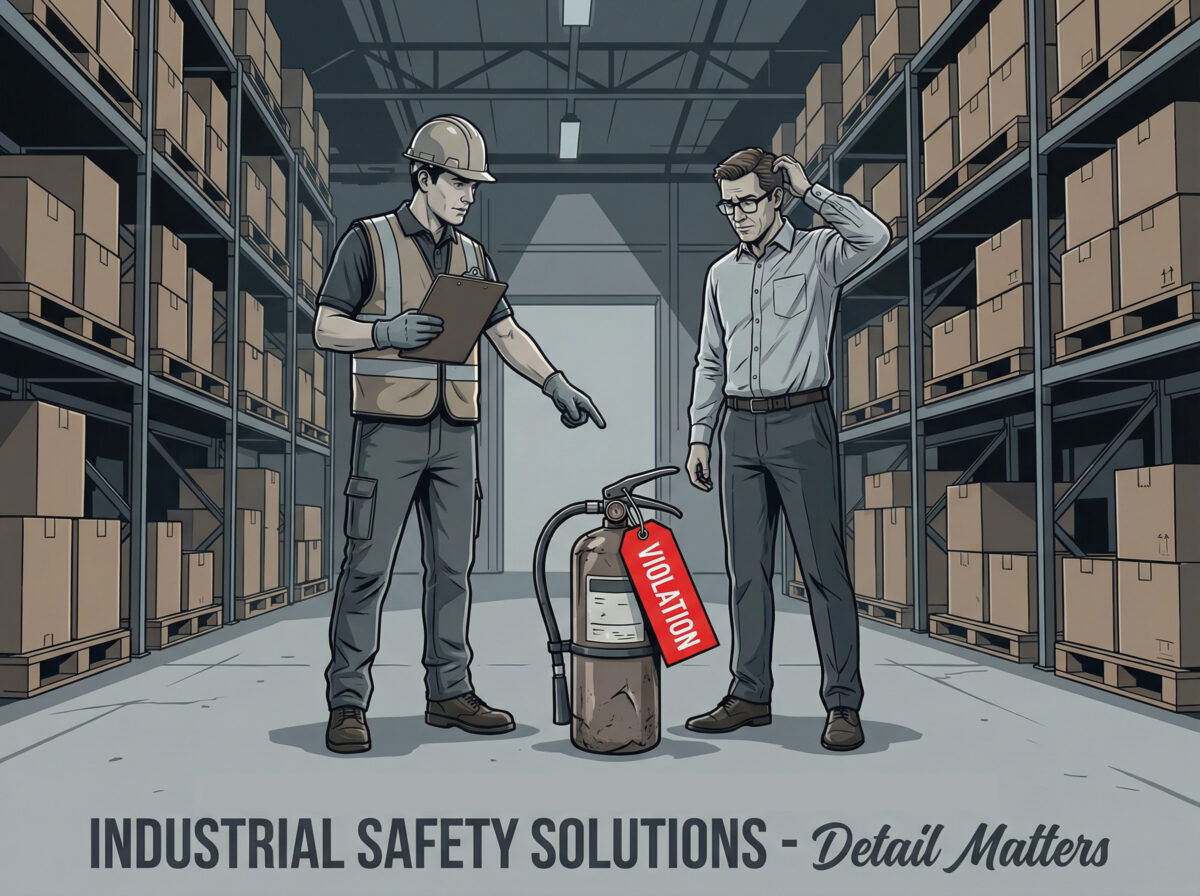
Thirty minutes into the inspection, the OSHA compliance officer pulled an extinguisher off the wall near the shipping dock.
“This service tag shows maintenance from November 2021. That’s over two years ago.”
The operations director checked his records. “We inspect these every month. Here’s our documentation.”
The officer examined the inspection logs. Complete. Detailed. Current.
“Monthly inspections are required. But they don’t replace annual maintenance. OSHA 1910.157(e)(3) requires annual maintenance by certified technicians. You’re doing inspections but skipping maintenance.”
Random check of 20 additional units revealed similar patterns. Service tags from 2020-2021. Monthly inspection logs current through last week.
Three citations issued:
- Failure to perform annual maintenance
- Inadequate service documentation
- Use of equipment beyond service intervals
Combined penalties: $48,393
Additional costs:
- Emergency service for all 127 units: $6,200
- Legal review: $4,500
- Third-party audit requirement: $3,200
- Management response time: 87 hours
Total incident cost: $62,293
The operations director’s response: “We inspect monthly like clockwork. I thought that’s what compliance meant.”
—
Auto dealership. Arizona. April 2024.
Service manager reviewing fire extinguisher inventory. Noticed several units with 2006-2009 manufacturing dates. Fifteen to eighteen years old.
“These look fine. Why replace perfectly good equipment?”
Insurance company conducting risk assessment disagreed.
“NFPA 10 Table 8.3.1 requires hydrostatic testing every 12 years for dry chemical extinguishers. These units should have been tested in 2018-2021. Without test documentation, they’re non-compliant.”
The service manager argued: “They’re in perfect condition. Gauges are green. They’ve been maintained annually.”
Insurance inspector: “Age and appearance aren’t compliance factors. Testing is mandatory. At 15-18 years without testing, these need immediate testing or replacement.”
Assessment results:
- 22 units overdue for hydrostatic testing
- All appeared visually perfect
- Emergency testing required for insurance compliance
Testing outcomes:
- 8 units passed testing and returned to service
- 14 units failed (63% failure rate)
- Failed units destroyed per NFPA requirements
Financial impact:
- Testing costs: $1,760
- Replacement units: $3,780
- Insurance compliance fee: $800
- Total: $6,340
The service manager’s reflection: “I had no idea internal vessel condition could deteriorate while everything looked fine externally.”
—
Medical office building. Georgia. July 2024.
Property management team conducted quarterly fire safety walkthroughs. Checked fire extinguishers in all 45 suites. Documented pressure gauges. Verified mounting. Everything appeared compliant.
State fire marshal inspection revealed different reality.
Extinguisher in Suite 310: Gauge showed green zone. Tag displayed 2020 service date—four years old.
“Show me your maintenance records for this unit.”
Property manager: “We check them quarterly. This gauge is green. It’s working fine.”
Fire marshal: “NFPA 10 requires annual maintenance within 12-month intervals. This tag is four years old. Gauge reading doesn’t replace professional maintenance requirement.”
Systematic examination of 30 units across building:
- 27 had service tags older than 12 months
- 19 showed tags from 2019-2021
- 11 units had no service tags visible
- All pressure gauges appeared normal
Fire marshal findings:
- Systematic annual maintenance violations
- Documentation inadequacy across property
- Correction deadline: 30 days
Correction costs:
- Emergency comprehensive service: $3,400
- Property management time: 42 hours
- Tenant communication: $600
- Fire marshal re-inspection fee: $350
- Total: $4,350
The property manager’s takeaway: “We genuinely thought quarterly visual checks with good gauge readings meant we were compliant. We were wrong.”
—
THREE BELIEFS. THREE PROBLEMS. ONE SOLUTION.
These scenarios share common threads: competent professionals, good-faith efforts, reasonable assumptions—and compliance violations costing $5,000-60,000+.
The root cause? Three persistent myths about fire extinguisher compliance that sound logical but violate NFPA 10 requirements.
MYTH #1: Regular visual checks satisfy regulatory requirements
MYTH #2: Quality equipment lasts decades with basic maintenance
MYTH #3: Functional appearance equals regulatory compliance
Each myth seems reasonable based on surface understanding. Each creates serious violations when inspectors apply actual NFPA standards.
—
MYTH #1: “REGULAR VISUAL CHECKS SATISFY REQUIREMENTS”
The Widespread Belief
What facilities think:
“We examine fire extinguishers regularly—monthly, quarterly, or during facility walkthroughs. We check pressure gauges. Verify mounting. Look for damage. Document findings. That’s fire extinguisher compliance.”
Why this belief exists:
Safety training emphasizes “inspect fire extinguishers regularly.” Facilities implement inspection schedules. Staff conduct walkthroughs. Management sees documentation and concludes compliance achieved.
NFPA 10 Section 7.2 describes “inspection” requirements. Facilities read this, establish inspection programs, and assume requirements satisfied.
The logical flow:
- Regulation requires inspections → We’re inspecting → Therefore we’re compliant
Reinforcement sources:
- Safety consultants mention “regular fire extinguisher inspections”
- Online resources focus on inspection procedures
- Facility management training covers inspection techniques
- Peer facilities describe their inspection programs
—
What Regulations Actually Mandate
NFPA 10 establishes four separate service activities—not one.
#
Activity 1: Inspection (Section 7.2)
What it is: Visual examination at approximately 30-day intervals
Who performs: Trained personnel (certification not required)
What’s checked:
- Extinguisher in designated location
- Access unobstructed, visibility clear
- Operating instructions legible and facing outward
- Pressure gauge reading within operable range
- Fullness (by weighing or hefting)
- No obvious physical damage, corrosion, or leakage
- Nozzle not clogged
- Seals and tamper indicators intact
Time required: 2-3 minutes per unit
Documentation: Date, inspector name, defects noted
Purpose: Catch obvious problems between professional service—missing equipment, blocked access, severe damage, obvious pressure loss
Critical limitation: Surface examination only. Cannot detect internal problems.
—
#
Activity 2: Maintenance (Section 7.3)
What it is: Comprehensive examination and service at intervals not exceeding 12 months
Who performs: Certified fire extinguisher technician (certification required)
NFPA 10 Section 7.3.2 specifies:
“Annual maintenance shall include a thorough examination of the following:
(1) Mechanical parts
(2) Extinguishing agent
(3) Expelling means
(4) Physical condition”
Additionally:
“All maintenance procedures shall be in accordance with the manufacturer’s service manual.”
What this involves:
- Remove and examine hose assembly
- Test pressure gauge accuracy
- Verify agent condition and quantity
- Examine valve and valve seat
- Check internal components where accessible
- Replace all seals and O-rings as specified
- Verify siphon tube condition
- Test operation mechanically
- Recharge if needed
- Apply service tag per NFPA 10 Section 7.3.4
Time required: 15-30 minutes per unit
Documentation: Service tag showing month/year, agency/person performing service
Purpose: Detect problems requiring professional expertise and equipment—component wear, seal degradation, agent condition, mechanical function
Critical difference from inspection: Internal examination, component testing, professional equipment, technical expertise
—
#
Activity 3: Internal Examination (Section 7.3.1)
What it is: Complete disassembly and internal inspection every 6 years for stored pressure extinguishers requiring 12-year hydrostatic test
Who performs: Certified technician with specialized knowledge
What’s involved:
- Complete extinguisher discharge
- Remove all agent
- Disassemble valve assembly
- Examine interior of pressure vessel for corrosion, contamination, damage
- Inspect all internal components
- Replace all seals, gaskets, O-rings
- Clean and reassemble per manufacturer specifications
- Recharge with proper agent type and quantity
- Apply service tag noting internal examination
Time required: 30-50 minutes per unit
Documentation: Service tag indicating six-year maintenance performed
Purpose: Detect internal corrosion, contamination, or deterioration invisible from exterior
Absolutely impossible through external inspection.
—
#
Activity 4: Hydrostatic Testing (Section 8)
What it is: Pressure vessel integrity testing at prescribed intervals
NFPA 10 Table 8.3.1 test intervals:
| Extinguisher Type | Test Interval |
|---|---|
| Stored pressure water, foam | 5 years |
| Carbon dioxide | 5 years |
| Wet chemical | 5 years |
| Dry chemical (stored pressure) | 12 years |
| Halogenated agent | 12 years |
| Clean agent | 12 years |
Who performs: Certified testing facility with specialized equipment
What’s involved:
- Complete discharge and agent removal
- Remove valve assembly and internal components
- Visual internal examination
- Fill vessel with water or testing fluid
- Pressurize to test pressure (typically 1.5-3x operating pressure)
- Hold pressure for specified time (typically 30-60 seconds minimum)
- Examine for leakage, deformation, or structural weakness
- If passed: Dry completely, reassemble, recharge
- If failed: Destroy per NFPA 10 Section 8.3.5 (cannot be repaired)
Time required: 45-75 minutes per unit including transport and processing
Documentation: Permanent test record showing date, testing facility, results
Purpose: Verify pressure vessel structural integrity for continued safe use
Requires specialized facility, pressure testing equipment, technical expertise—impossible for facilities to perform internally.
—
Real-World Consequences: The Inspection-Only Facility
Background:
Healthcare system, 8 clinic locations, 240 total fire extinguishers across portfolio. Corporate safety department developed comprehensive inspection program in 2019:
- Monthly inspection schedule
- Designated safety coordinator per location
- Standardized digital inspection forms
- Photographic documentation
- Quarterly corporate audits
- Management dashboard tracking completion
Program execution: Excellent. 98% inspection completion rate. Detailed documentation. Regular reporting to executive leadership. Safety director presented program as compliance best practice at regional healthcare safety conference.
2024: State health department inspection at flagship clinic
Inspector reviewed inspection documentation—impressed with thoroughness and consistency.
Then requested maintenance documentation.
“Show me when these units last received annual maintenance per NFPA 10.”
Safety coordinator checked files. Last professional maintenance: 2019, when program started.
Inspector examined equipment randomly—15 units:
Physical findings:
- Manufacturing dates 2011-2018 (6-13 years old)
- Service tags from 2019 (5 years old)
- Several units with manufacturing dates requiring hydrostatic testing (never performed)
- Multiple units over 12 years old with no testing documentation
“Your inspection program is excellent. But NFPA requires four levels of service. You’re performing inspections only. Missing annual maintenance, internal examinations, and hydrostatic testing.”
Compliance order issued:
- Immediate professional assessment all 240 units system-wide
- Emergency comprehensive maintenance for overdue units
- Hydrostatic testing program for equipment exceeding intervals
- Implementation plan for ongoing four-level service
Financial impact:
| Cost Category | Amount |
|---|---|
| Professional assessment (8 locations) | $4,800 |
| Emergency comprehensive maintenance (240 units) | $12,600 |
| Hydrostatic testing (62 units requiring testing) | $4,030 |
| Replacement units (17 failed testing) | $4,590 |
| Program implementation | $3,200 |
| Legal/consultant review | $6,500 |
| Management response time (140 hours) | $12,600 |
| Total cost | $48,320 |
Annual ongoing cost increase: $9,600 (from inspection-only to complete four-level program)
Safety director’s reflection:
“We built what we thought was a gold-standard inspection program. Invested significant resources. Created excellent documentation. And still violated compliance because we didn’t understand NFPA requires four distinct service types. Our inspection program was 25% of the requirement, not 100%.”
—
Why This Myth Persists
Terminology confusion:
Word “inspection” used broadly in safety contexts. Facilities hear “inspect fire extinguishers” and implement whatever they interpret inspection to mean—from casual glance to systematic examination.
NFPA uses “inspection” specifically for monthly visual checks. Casual users apply it to all fire extinguisher activities.
Incomplete information sources:
Many safety resources emphasize monthly inspection without explaining the three additional service levels. Facilities implement what they learn about and assume they’ve covered requirements.
Visual bias:
Monthly inspections provide visible activity—staff walking with clipboards, documentation accumulating, management seeing tangible evidence. Creates impression of comprehensive program.
Professional annual maintenance happens once yearly with external vendors—less visible, easier to overlook or defer.
Budget pressure:
Monthly inspections cost relatively little (staff time only). Annual professional maintenance, internal examinations, and testing cost real money. Facilities unconsciously emphasize low-cost visible activity over expensive professional service.
—
The Compliant Reality
Complete NFPA 10 compliance requires all four service levels operating systematically:
Monthly: Visual inspection catching obvious problems (internal staff or professional service)
Annually: Comprehensive maintenance by certified technician examining internal condition, testing components, replacing seals (professional service required)
Every 6 years: Complete internal examination for applicable types (professional service required)
Every 5/12 years: Hydrostatic testing per equipment type (certified testing facility required)
48Fire provides complete four-level programs because we understand partial compliance still means non-compliance.
Investment comparison (75-unit facility):
| Approach | Annual Cost | Compliance Status | Violation Risk |
|---|---|---|---|
| Monthly inspection only | $900-1,500 | Non-compliant | $16,131+ |
| Monthly inspection + occasional maintenance | $1,800-2,800 | Partial compliance | $8,000-16,000+ |
| Complete four-level program | $3,600-5,200 | Fully compliant | Minimal |
Net additional cost for actual compliance: $1,800-3,700 annually
vs. Single OSHA violation: $16,131
Break-even: One violation prevented every 4-9 years. Most facilities avoid multiple violations over this period through compliance.
—
MYTH #2: “QUALITY EQUIPMENT LASTS DECADES WITH BASIC MAINTENANCE”
The Reasonable Assumption
What facilities believe:
“Fire extinguishers are heavy-duty metal pressure vessels. Buy quality equipment, maintain it properly, and it should last 15-20+ years. Metal doesn’t expire. Regular maintenance keeps them functional indefinitely.”
Why this belief exists:
Durability perception:
Extinguishers are solid steel construction. Heavy. Professional appearance. No visible wear patterns like mechanical equipment develops. Looks permanent.
Lack of expiration dating:
Unlike smoke detectors or emergency lighting with clear replacement intervals, extinguishers don’t have stamped expiration dates. Creates impression of indefinite service life.
Manufacturer marketing:
“Heavy-duty construction” “Commercial grade” “Industrial quality”—language suggesting long-term durability.
Budget reality:
Replacement costs $150-400 per unit. For facilities with 50-100 extinguishers, replacement represents $7,500-40,000 expense. Strong incentive to believe maintenance extends life indefinitely.
Anecdotal evidence:
Facilities see 15-20 year old extinguishers still mounted and assume they’re functional. “It’s still here, so it must still work.”
—
What Actually Happens to Aging Equipment
#
The Testing Reality Check
NFPA 10 mandates hydrostatic testing verifying pressure vessel structural integrity.
Testing isn’t maintenance—it’s pass/fail examination.
NFPA 10 Section 8.3.5 is explicit:
“Extinguishers that fail the hydrostatic test or are found to have serious defects shall be destroyed or recycled at a scrap metal facility. Such extinguishers shall not be returned to service.”
Cannot be repaired. Must be destroyed if failed.
48Fire operates certified testing facility processing approximately 2,500 extinguishers annually.
Actual failure rate data by equipment age:
| Age at Testing | Units Tested (2024) | Failed Testing | Failure Rate |
|---|---|---|---|
| 5-7 years (first test) | 620 | 68 | 11% |
| 10-12 years (second test) | 480 | 106 | 22% |
| 15-17 years (third test) | 340 | 129 | 38% |
| 18-20 years | 180 | 94 | 52% |
| 20+ years | 85 | 67 | 79% |
Pattern clear: Failure rates increase dramatically with age.
By 15-20 years: Equipment has 40-80% chance of failing testing and requiring destruction.
Budget impact: Facilities assuming indefinite service life suddenly face wholesale replacement when testing reveals failure rates.
—
#
Real Example: The “They Look Fine” Discovery
Background:
Manufacturing facility operating since 2004. Original fire protection equipment installation included 95 extinguishers. Facility maintained equipment annually—pressure checks, visual examination, gauge replacement when needed, recharging when pressure dropped.
2024 status:
- 73 original units still in service (20 years old)
- All received regular annual service
- All appeared functional externally
- All pressure gauges showed green zones
- Facilities director confident about equipment condition
Insurance carrier required independent fire safety assessment as renewal condition.
48Fire assessment findings:
Compliance gap: 73 units manufactured 2004 had never been hydrostatic tested. NFPA requires testing at 12 years. Equipment was 8 years overdue.
Recommendation: Immediate testing required for continued service.
Facilities director response: “These units have been maintained annually for 20 years. They’re in perfect condition. This seems like unnecessary expense.”
48Fire explanation: “Annual maintenance examines external condition and mechanical function. Hydrostatic testing verifies internal pressure vessel integrity—different evaluation. NFPA mandates testing regardless of external condition. Units must pass testing or be replaced.”
Testing program executed:
73 units transported to 48Fire certified testing facility
Results:
| Outcome | Quantity | Percentage |
|---|---|---|
| Passed testing | 27 | 37% |
| Failed testing | 46 | 63% |
| Total | 73 | 100% |
Failure analysis:
46 failed units showed:
- Internal corrosion (33 units): Rust weakening vessel walls visible only when opened
- Vessel deformation under test pressure (9 units): Structural weakness causing expansion
- Valve assembly deterioration (4 units): Component degradation beyond repair threshold
Critical finding: All 46 failed units appeared perfect externally. Visual examination revealed nothing. Only hydrostatic testing detected structural problems.
Financial impact:
| Cost Item | Amount |
|---|---|
| Hydrostatic testing (73 units @ $65) | $4,745 |
| Recharge after passing (27 units @ $42) | $1,134 |
| Replacement units (46 units @ $240 avg) | $11,040 |
| Labor and logistics | $1,200 |
| Total unexpected cost | $18,119 |
Facilities director reflection:
“I genuinely believed our annual maintenance program kept equipment functional indefinitely. Twenty years old but looked perfect, worked fine during maintenance checks, showed proper pressure. Then 63% failed internal structural testing. The vessels were degrading invisibly from the inside while appearing perfect externally. I learned expensive lesson about the difference between maintaining equipment and equipment actually remaining serviceable.”
—
#
The Internal Corrosion Problem
How it develops invisibly:
Year 1-5:
Microscopic moisture penetrates seal interfaces. Temperature cycling causes condensation inside vessel. Atmospheric humidity enters during recharging. Small amounts accumulate.
Year 6-10:
Moisture contacts steel interior walls. Corrosion begins—small rust spots. External shell shows nothing. Protective exterior coating intact. Paint perfect.
Year 11-15:
Rust spreads across interior surfaces. Vessel wall thickness reduces in corroded areas. Structural integrity compromises gradually. Still looks perfect outside.
Year 16-20:
Advanced corrosion weakens vessel significantly. Under normal operating pressure, still holds. Under hydrostatic test pressure (1.5-3x normal), vessel deforms or fails—reveals structural compromise.
Why it’s invisible:
Corrosion on interior surfaces. Exterior paint and coating remain intact. No visual external indicators. Only internal examination or hydrostatic testing reveals condition.
Environmental accelerators:
- Coastal locations: Salt air penetrates seals faster, accelerates corrosion (reduces service life 25-35%)
- High humidity environments: More moisture ingress (reduces service life 15-25%)
- Chemical facilities: Aggressive atmospheres attack vessel materials (reduces service life 30-40%)
- Outdoor mounting: Weather exposure, temperature extremes (reduces service life 20-30%)
- Frequent discharge and recharge: More opportunities for contamination (reduces service life 10-15%)
48Fire sees this pattern consistently: equipment appearing perfect externally with severe internal deterioration.
—
#
Six-Year Examination Discoveries
NFPA 10 Section 7.3.1 requires six-year internal examination for stored pressure extinguishers.
What 48Fire technicians find during these examinations:
Statistical data from 650 six-year examinations performed in 2024:
| Finding | Units | Percentage | Action Required |
|---|---|---|---|
| Normal condition | 455 | 70% | Routine service, returned to service |
| Minor internal corrosion | 91 | 14% | Additional service, monitoring |
| Significant corrosion | 58 | 9% | Replacement recommended |
| Foreign material contamination | 28 | 4% | Cleaning, component replacement |
| Component wear beyond spec | 18 | 3% | Replacement required |
30% of units undergoing six-year examination require more than routine service.
9% require replacement despite appearing fine externally.
Facilities skipping six-year examinations: These problems accumulate undetected until:
- Hydrostatic testing reveals them (at higher testing cost)
- Equipment fails during actual use
- Complete failures require emergency replacement
—
Realistic Service Life Expectations
With proper maintenance including testing:
| Extinguisher Type | Typical Service Life | Primary Limiting Factor |
|---|---|---|
| Dry chemical (rechargeable) | 12-15 years | Internal corrosion, valve wear |
| Carbon dioxide | 15-20 years | Valve components, testing failures |
| Water/foam | 10-12 years | Corrosion sensitivity |
| Clean agent | 15-20 years | Component availability, testing |
| Wet chemical | 12-15 years | Agent stability, vessel corrosion |
These assume:
- Normal indoor environment
- Proper annual maintenance
- Timely six-year examinations
- Passing hydrostatic tests
- No physical damage or abuse
Harsh environment reductions:
Subtract 20-40% for coastal, outdoor, chemical, or high-humidity environments.
—
Budget Planning Reality
Facilities need lifecycle replacement planning, not indefinite maintenance assumptions.
Example: 60-unit facility, equipment installed 2010
Timeline and costs:
| Year | Equipment Age | Service Required | Typical Cost |
|---|---|---|---|
| 2010-2016 | 0-6 years | Annual maintenance only | $1,800/year |
| 2016-2017 | 6 years | Six-year examinations + annual | $4,200 |
| 2018-2021 | 7-11 years | Annual maintenance | $1,800/year |
| 2022 | 12 years | First hydrostatic testing | $7,800 |
| 2023-2027 | 13-17 years | Annual maintenance + replacements from failures | $2,400/year avg |
| 2028 | 18 years | Second hydrostatic testing | $9,200 |
| 2029-2030 | 19-20 years | High failure rates, major replacements | $12,000-15,000 |
Facilities assuming indefinite service life: Unprepared for $7,000-15,000 testing and replacement costs hitting suddenly in years 12-20.
Facilities with realistic planning: Budget $500-1,500 annually for eventual replacement, preventing budget crises.
48Fire provides equipment age tracking and replacement forecasting enabling realistic budget planning.
—
The Compliant Approach
Systematic lifecycle management:
New equipment (Years 0-5):
- Annual maintenance
- Monitor condition trends
- Begin setting aside replacement budget
First cycle (Years 6-12):
- Six-year internal examination
- First hydrostatic testing
- Replace units failing tests
- Increase replacement budget allocation
Second cycle (Years 12-18):
- Second six-year examination
- Second hydrostatic testing
- Higher failure rates expected
- Major replacement planning
End of service (Years 18+):
- Evaluate replacement vs. continued testing economics
- Consider comprehensive equipment refresh
- Most units approaching end of practical service
Investment: $40-80 per extinguisher annually covering maintenance, testing, and eventual replacement
vs. Crisis replacement: $150-400 per unit suddenly when old equipment fails testing
—
MYTH #3: “FUNCTIONAL APPEARANCE EQUALS REGULATORY COMPLIANCE”
The Logical Assumption
What facilities believe:
“Compliance is about equipment working if needed. If fire extinguisher appears functional—proper pressure, no damage, correctly mounted—we’re compliant. Visual condition indicates compliance status.”
Why this belief exists:
Visual focus in safety programs:
Monthly inspection emphasis on checking gauges, noting damage. Green gauge becomes mental shorthand for “compliant equipment.”
Functionality priority:
Facilities reason: “The point is having working fire protection. If equipment works, compliance follows naturally.”
Documentation disconnect:
Service tags seen as administrative detail vs. substantive compliance element. “We have the equipment and it works—paperwork is secondary.”
Gauge trust:
Pressure gauges provide objective measurement (so it seems). Needle in green zone feels definitive—concrete evidence of functionality.
—
What Compliance Actually Requires
Two completely separate dimensions:
#
Dimension 1: Equipment Functionality
Equipment must actually operate if used during fire.
Requires:
- Sufficient pressure for rated discharge
- Proper agent type and quantity
- Functional valve and discharge mechanism
- Structural integrity of pressure vessel
- All components operational
Note: Visual external examination provides incomplete functionality information.
—
#
Dimension 2: Documented Service Compliance
Must prove equipment has received all required NFPA service.
NFPA 10 documentation requirements:
Section 7.2.2 (Inspection):
“Manual or electronic records shall be maintained to provide evidence that the required inspections have been performed.”
Section 7.3.4 (Maintenance):
“Maintenance shall be indicated by the attachment of a service tag or label.”
Section 8.3.3 (Testing):
“Permanent records shall be maintained to provide evidence that the hydrostatic tests have been performed.”
Compliance means proving service occurred through documentation—not just having functional-appearing equipment.
—
Real Example: The Appearance Trap
Background:
Corporate office campus, 4 buildings, 140 fire extinguishers total. Facility management team conducted semi-annual fire safety walkthroughs starting 2020:
- Visual inspection all equipment
- Pressure gauge documentation
- Physical condition assessment
- Photo documentation
- Database tracking
2024 status:
- All equipment appeared excellent condition
- 137 of 140 gauges showed green zones
- 3 units flagged for professional service (low pressure)
- Equipment clean, properly mounted, undamaged
- Management confident about compliance
June 2024: Fire marshal annual inspection
Inspector initially impressed with equipment condition and organization.
Then requested service documentation.
“Show me when these units last received annual maintenance per NFPA 10 Section 7.3.”
Facilities manager explained their inspection program and produced documentation—photos, database records, gauge readings.
Inspector: “Your inspection documentation is thorough. But NFPA requires annual maintenance by certified technicians. Your inspections don’t satisfy maintenance requirements. Show me service tags and professional maintenance records.”
Random examination of service tags—20 units:
| Tag Status | Units | Notes |
|---|---|---|
| No tag visible | 6 | Equipment appeared maintained but no documentation |
| Tag from 2019-2020 | 9 | 4-5 years overdue for annual maintenance |
| Tag from external vendor | 5 | Facility has no records verifying service occurred |
“Equipment condition looks fine. Documentation proves NFPA maintenance requirements aren’t being met.”
Citation basis:
- Annual maintenance not performed per OSHA 1910.157(e)(3)
- Inadequate documentation per NFPA 10 Section 7.3.4
- Equipment beyond service intervals without verification
Correction requirements:
- Comprehensive professional maintenance all 140 units
- Proper service tag application
- Documentation system establishment
- Re-inspection verification
Costs:
| Item | Amount |
|---|---|
| Emergency comprehensive maintenance | $7,200 |
| Documentation system setup | $1,800 |
| Facilities management response time | $3,600 |
| Fire marshal re-inspection | $250 |
| Total | $12,850 |
Facilities manager takeaway:
“We documented everything visually. Every gauge reading, every equipment condition, every mounting location. Created detailed database. Thought comprehensive documentation meant compliance. Learned that visual documentation doesn’t replace service documentation. NFPA cares whether certified technicians performed maintenance, not whether equipment looks good in photos.”
—
Appearance vs. Reality: Specific Cases
Case 1: The Mechanically Stuck Gauge
48Fire monthly inspection, commercial building, September 2024.
Unit #17 hallway location:
Initial visual pass (10 feet): Gauge appears green zone
Professional examination approach:
- Walk directly to unit
- Read gauge at close range with proper lighting
- Gauge needle appears in green but at very low edge
- Tap gauge lightly—needle doesn’t move
- Apply slight finger pressure to gauge face—no response
Professional assessment: Gauge mechanically stuck. Internal mechanism failure causing needle to remain stationary despite pressure changes.
Testing: Remove unit, attempt discharge. Extremely weak discharge—actual pressure far below gauge indication.
Reality: Gauge stuck in acceptable-appearing position while actual pressure dropped significantly over months. Visual inspection from distance showed apparent compliance. Professional close examination revealed malfunction.
What would happen in fire: Employee grabs extinguisher expecting full discharge. Receives weak spray insufficient for suppression. Fire spreads while employee has false sense of using functioning equipment.
—
Case 2: The Agent Loss
48Fire annual maintenance, retail location, March 2024.
Unit examined: 10 lb dry chemical extinguisher
Visual appearance: Normal—no damage, gauge reading acceptable, properly mounted
Professional service process:
- Remove from mounting bracket
- Weigh on calibrated scale
- Specification weight: 20 lbs (10 lb vessel + 10 lb agent)
- Actual weight: 12.4 lbs
Finding: Lost 7.6 lbs—most of agent gone despite gauge showing pressure.
Investigation: Valve stem seal degraded over time. Slow leak allowed agent to escape gradually. Residual pressure kept gauge reading in acceptable range. External appearance revealed nothing.
Reality: Extinguisher appeared fully functional. Would have discharged only 2-3 seconds vs. rated 10-12 seconds. Insufficient for fire suppression despite appearing compliant.
—
Case 3: The Internal Corrosion
48Fire testing facility, hydrostatic testing batch, May 2024.
Unit received: 12-year-old dry chemical extinguisher submitted for first testing
External condition: Excellent—clean shell, no visible rust, no dents, professional appearance
Testing procedure:
- Discharge agent
- Remove valve assembly
- Internal examination: Extensive rust covering 60% of interior surfaces
- Hydrostatic test: Pressurize to test pressure
- Vessel deformation observed—fails test
NFPA requirement: Failed units must be destroyed, cannot be repaired
Reality: Perfect external appearance masked severe internal deterioration developed over 12 years. Only internal examination and pressure testing revealed structural compromise.
If testing skipped: Unit would remain in service with compromised vessel. Potential failure during discharge or catastrophic pressure vessel rupture.
—
Case 4: The Documentation Gap
48Fire assessment, professional office, August 2024.
Equipment examined: 32 extinguishers across three floors
Physical condition: All excellent—clean, undamaged, proper pressure, professional service tags visible
Service tags showed:
- Professional company name: “ABC Fire Safety Services”
- Service dates: Various 2022-2023 dates
- Technician names listed
Assessment request: “Provide service records matching these tags.”
Facility response: “We don’t have detailed records. Previous office manager handled vendor coordination. She left last year. We assumed these tags mean service was performed.”
Problem: Cannot verify:
- Service actually occurred (tags could be applied without service)
- Technician certification (listed names could be non-certified personnel)
- Service scope (annual maintenance vs. simple inspection)
- Company credentials (could be unlicensed)
OSHA/fire marshal perspective: Tags alone insufficient proof of compliance without supporting documentation from facility.
Resolution: 48Fire performed comprehensive maintenance all 32 units, establishing verified service baseline with proper documentation.
Cost: $1,760 for service that facility believed had already occurred based on tag presence.
—
What Complete Compliance Looks Like
All elements required simultaneously:
1. Verified Functionality
- Professional examination, not visual appearance
- Pressure measured with calibrated equipment
- Weight verified for agent quantity
- Internal examination per NFPA schedules
- Hydrostatic testing proving vessel integrity
- Component testing confirming operation
2. Complete NFPA Service
- Monthly inspections performed and documented
- Annual maintenance by certified technicians
- Six-year internal examinations on schedule
- Hydrostatic testing per required intervals
- All performed by qualified personnel
3. Comprehensive Documentation
- Service tags meeting NFPA 10 Section 7.3.4 requirements
- Inspection records maintained per Section 7.2.2
- Maintenance history preserved
- Testing documentation retained
- Records organized for inspector access
4. Verification Systems
- Management oversight confirming service occurs
- Third-party verification available if questioned
- Digital tracking providing accountability
- Audit-ready presentation
Visual equipment condition alone satisfies none of these requirements completely.
—
The Compliant Approach
48Fire systematic programs provide all compliance elements:
Equipment functionality verification:
- Professional examination by certified technicians
- Calibrated testing equipment for accurate measurements
- Weight verification for agent quantity
- Issue identification and immediate correction
- Equipment replacement when testing reveals failures
Complete NFPA service delivery:
- All four service levels performed: inspection, maintenance, six-year examination, testing
- Certified technicians for all activities requiring certification
- Manufacturer-specified procedures followed
- Service tags properly applied
Audit-ready documentation:
- Digital platform with complete service history
- Photographic evidence from each service visit
- Service records accessible 24/7
- Technician certification verification
- Inspection reports with findings and actions
Investment for 80-unit facility: $4,200-5,800 annually
vs. Risk of appearance-based assumptions: $16,131 OSHA violations, $5,000-15,000 correction costs, equipment failure during fires, insurance complications
—
THE AGGREGATE COST OF MYTHS
When Multiple Myths Combine
Facilities often operate on all three myths simultaneously:
Operating on Myth #1 (inspection only)
+ Operating on Myth #2 (indefinite equipment life)
+ Operating on Myth #3 (appearance equals compliance)
= Catastrophic compliance failure
Real scenario composite (based on actual 48Fire client assessments 2024):
Office building complex, 6 buildings, 180 fire extinguishers
Myth #1 in action: Monthly visual inspections only, no annual professional maintenance (5 years)
Myth #2 in action: Equipment installed 2005-2008 (16-19 years old), never tested, assumed still functional
Myth #3 in action: Management confident because gauges show green, equipment looks fine
Assessment findings:
- 0 of 180 units compliant with all NFPA requirements
- 180 units overdue for annual maintenance
- 180 units requiring immediate testing (12-year intervals exceeded)
- 127 units showing external acceptable appearance
Testing results:
- 97 units passed testing (54%)
- 83 units failed testing (46%)
Correction requirements:
- Comprehensive maintenance: 180 units
- Testing program: 180 units
- Replacement: 83 units
- Documentation system establishment
- Ongoing program implementation
Financial impact:
| Cost Category | Amount |
|---|---|
| Professional assessment | $3,600 |
| Comprehensive maintenance | $9,400 |
| Hydrostatic testing | $11,700 |
| Replacement units | $22,400 |
| Program implementation | $4,200 |
| Legal/insurance review | $5,800 |
| Management time (180 hours) | $16,200 |
| Total one-time cost | $73,300 |
| Ongoing annual program | $7,200 |
If discovered through OSHA inspection instead: Add $16,000-50,000 in penalties
Property manager reflection:
“We thought we were doing everything right. Inspected regularly. Equipment looked perfect. Gauges showed green. Then learned we’d been violating every major requirement for years. Three myths cost us $73,000 in emergency corrections. Annual compliant program would have cost $7,200 per year—we could have been compliant for 10 years for the same money we spent fixing this crisis.”
—
Insurance Carrier Responses
When insurers discover myth-based programs during audits:
Premium adjustments:
15-30% increases typical when fire safety deficiencies identified
For $50,000 annual property premium:
Premium increase: $7,500-15,000 annually until compliance demonstrated
Coverage modifications:
- Fire damage coverage limitations
- Increased deductibles for fire losses
- Exclusions for certain types of fire damage
- Required independent verification annually
Renewal conditions:
- Mandatory professional fire safety program implementation
- Third-party compliance audits
- Quarterly verification reporting
- Multi-year corrective action monitoring
—
REPLACING MYTHS WITH FACTS
Correcting misconceptions:
Myth #1 Corrected
MYTH: “Regular visual checks satisfy requirements”
FACT: NFPA 10 requires four distinct service levels—inspection, maintenance, internal examination, testing. Visual inspection is 25% of compliance, not 100%.
Action: Implement complete four-level program with professional maintenance, examinations, and testing.
—
Myth #2 Corrected
MYTH: “Quality equipment lasts decades with basic maintenance”
FACT: Typical service life 12-15 years with proper service. Hydrostatic testing failure rates increase dramatically after 15 years (40-80%). Failed units must be destroyed per NFPA 10 Section 8.3.5.
Action: Track equipment ages, budget for testing and replacement, plan lifecycle management realistically.
—
Myth #3 Corrected
MYTH: “Functional appearance equals regulatory compliance”
FACT: Compliance requires verified functionality (professional examination), complete NFPA service (all four levels), and comprehensive documentation (proving service occurred). Visual appearance provides none of these.
Action: Establish professional service with systematic documentation proving compliance, not assuming it.
—
IMPLEMENTATION ROADMAP
Phase 1: Reality Assessment (Week 1-2)
Honest evaluation of current program against NFPA requirements:
Do you perform only visual inspections? (Myth #1)
Do you have equipment 12+ years old never tested? (Myth #2)
Do you assume visual condition proves compliance? (Myth #3)
48Fire provides professional assessment comparing current practices against all NFPA 10 requirements, identifying specific violations and correction needs.
[Request Professional Assessment](/contact-us)
—
Phase 2: Emergency Corrections (Week 3-6)
Address critical compliance gaps:
- Immediate comprehensive maintenance for units overdue
- Testing program for equipment exceeding intervals
- Replacement of units failing tests
- Proper service tag application
- Documentation baseline establishment
48Fire emergency correction programs bring equipment and documentation to compliant status within 30-45 days.
[Request Emergency Correction](/contact-us)
—
Phase 3: Systematic Program (Ongoing)
Implement all four NFPA service levels:
Monthly: Professional inspection or trained internal staff with oversight
Annually: Comprehensive maintenance by certified technicians
Six-year intervals: Complete internal examination
Five/twelve-year intervals: Hydrostatic testing
48Fire provides complete ongoing programs with automated scheduling, digital tracking, and continuous compliance maintenance.
[Implement Complete Program](/contact-us)
—
Phase 4: Verification and Monitoring
Ensure sustained compliance:
- Real-time compliance dashboards
- Automated deadline tracking
- Management reporting
- Audit-ready documentation
- Periodic third-party verification
48Fire digital platform provides continuous visibility and accountability verification.
—
CONCLUSION: THE COST OF MYTHS vs. FACTS
Three myths create violations costing $16,000-75,000:
MYTH #1: Visual inspections sufficient
FACT: Four service levels required
MYTH #2: Equipment lasts decades
FACT: 12-15 year typical service life with increasing failures
MYTH #3: Appearance equals compliance
FACT: Requires verified functionality, complete service, documented proof
Operating on myths:
- $16,000-50,000 violation penalties
- $5,000-25,000 emergency corrections
- Equipment failure risks
- Insurance complications
- Liability exposure
Operating on facts:
- $3,000-6,000 annual complete compliance
- Violation prevention
- Functional fire protection
- Audit-ready documentation
ROI: 270-2,400% through violation prevention alone
48Fire helps facilities replace myths with fact-based compliance through accurate assessment, systematic service, and verified results.
Stop assuming. Start complying.
[Contact 48Fire for Facts-Based Compliance](/contact-us)
—
48Fire
Reality-Based Fire Extinguisher Compliance
NFPA-Certified • Nationwide Service
Contact: [/contact-us](/contact-us)
Proven: Replacing myths with verified compliance since 2010
—